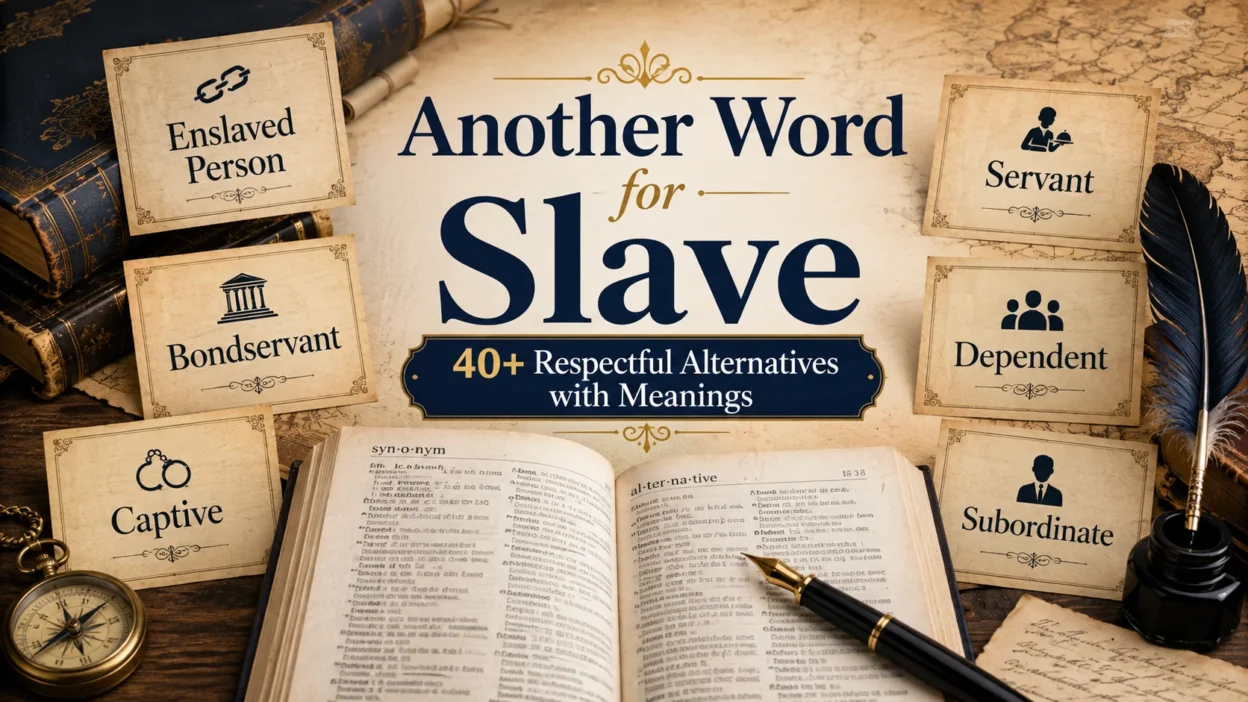
The word slave carries a strong historical and emotional meaning. In its literal sense, it refers to a person who is owned by another person and forced to work without freedom. In modern English, however, the word is also used figuratively to describe someone who is completely controlled by a habit, job, or another person.
Because slave has more than one meaning, there isn’t a single replacement that works in every situation. A word that fits a historical discussion may sound inappropriate in a business email, while a figurative replacement may not accurately describe legal or historical contexts.
This guide explains the best another word for slave alternatives, when to use them, and the subtle differences between each option. Whether you’re writing an essay, improving your vocabulary, or searching for a more appropriate expression, you’ll find context-specific alternatives with clear meanings and practical examples.
Quick Answer
Another word for slave depends on the context. In historical or legal discussions, words like enslaved person, bondservant, or captive may be appropriate. In figurative writing, alternatives such as workaholic, servant, devotee, dependent, or subordinate often communicate the intended meaning more naturally.
Word at a Glance
| Feature | Details |
|---|---|
| Word | Slave |
| Part of Speech | Noun, Verb |
| Pronunciation | /sleɪv/ |
| Primary Meaning | A person held in slavery or someone completely controlled by another person or thing |
| Common Usage | Historical, figurative, literary |
| Best Neutral Alternative | Enslaved person |
| Related Concepts | Servitude, Bondage, Captivity |
Pronunciation
| Feature | Details |
|---|---|
| IPA | /sleɪv/ |
| Phonetic | SLAYV |
| Syllables | Slave (1 syllable) |
Top Synonyms Comparison Table
| Synonym | Best Context | Formality | Tone | Example |
|---|---|---|---|---|
| Enslaved person | Historical writing | Formal | Neutral | The museum honors enslaved people who fought for freedom. |
| Bondservant | Historical or religious texts | Formal | Literary | The ancient document mentions a bondservant. |
| Captive | Prisoner or forced confinement | Neutral | Serious | The captives were released after negotiations. |
| Servant | Household or employment | Neutral | Neutral | The servant welcomed the guests. |
| Dependent | Figurative | Formal | Neutral | He’s financially dependent on his parents. |
| Subordinate | Workplace | Formal | Professional | The manager consulted every subordinate. |
| Devotee | Strong dedication | Neutral | Positive | She’s a devotee of classical music. |
| Workaholic | Figurative | Informal | Casual | He’s a workaholic who rarely takes vacations. |
| Follower | Leadership or religion | Neutral | Neutral | Many followers admired her ideas. |
| Minion | Fictional or humorous | Informal | Playful | The villain ordered his minions to attack. |
Formal Alternatives to “Slave”
| Word | Meaning | Best Use |
|---|---|---|
| Enslaved Person | Someone held in slavery | Historical and educational writing |
| Bondservant | A person bound to serve | Historical or religious discussions |
| Bondsman | Someone legally bound to another | Historical documents |
| Captive | A person held against their will | Historical, military, legal |
| Indentured Servant | A worker bound by contract | Historical writing |
Informal Alternatives
| Word | Meaning | Best Use |
|---|---|---|
| Workaholic | Someone obsessed with work | Everyday conversation |
| Devotee | Someone deeply committed | Positive descriptions |
| Follower | Someone who supports another | General writing |
| Minion | Loyal helper, often humorous | Fiction and entertainment |
| Helper | Someone who assists | Casual conversations |
Another Word for Slave with Meanings and Examples
1. Enslaved Person
Meaning
A respectful and person-first term referring to someone who has been forced into slavery. Modern historians and educators often prefer this phrase because it emphasizes the individual’s humanity rather than defining them solely by their condition.
Examples
- The documentary tells the stories of enslaved people who resisted oppression.
- Historians now frequently use the phrase enslaved person instead of slave in educational materials.
Usage Tip
Choose enslaved person in historical, educational, or academic writing where respectful and accurate language is important.
Tone: Neutral
Formality: Formal
Best Context: History, education, museums, research.
2. Bondservant
Meaning
A person legally or contractually bound to serve another, often for a specific period. The word appears frequently in historical documents and some religious translations.
Examples
- The ancient manuscript referred to him as a bondservant.
- Many historical records describe the lives of bondservants.
Usage Tip
This term is best reserved for historical or religious contexts rather than everyday conversation.
Tone: Literary
Formality: Formal
Best Context: Historical and religious writing.
3. Captive
Meaning
A person who is held against their will, often as a prisoner during conflict or by force.
Examples
- The captives were eventually reunited with their families.
- The novel follows the escape of a young captive.
Usage Tip
Use captive when describing imprisonment or forced confinement rather than slavery in general.
Tone: Serious
Formality: Neutral
Best Context: History, journalism, literature.
4. Servant
Meaning
A person employed to perform duties for another person or household. Unlike a slave, a servant is generally paid and has legal rights, so the two terms are not interchangeable.
Examples
- The servant prepared dinner for the guests.
- Victorian novels often feature household servants.
Usage Tip
Avoid using servant as a direct replacement for slave in historical contexts because the meanings are different.
Tone: Neutral
Formality: Neutral
Best Context: Historical fiction, literature, everyday English.
5. Dependent
Meaning
Someone who relies on another person for financial, emotional, or practical support.
Examples
- He remained financially dependent on his parents.
- The child is listed as a dependent on the insurance policy.
Usage Tip
Use dependent only when discussing reliance or support—not forced servitude.
Tone: Neutral
Formality: Formal
Best Context: Legal, financial, and figurative writing.
6. Subordinate
Meaning
A person who works under the authority or supervision of someone else.
Examples
- Every subordinate attended the meeting.
- Good leaders respect their subordinates.
Usage Tip
Best used in workplace or organizational contexts.
Tone: Professional
Formality: Formal
7. Devotee
Meaning
A person who is passionately dedicated to a hobby, cause, belief, or activity.
Examples
- She’s a lifelong devotee of jazz music.
- Fitness devotees gathered for the annual marathon.
Usage Tip
Works well when describing strong enthusiasm rather than control or oppression.
Tone: Positive
Formality: Neutral
8. Workaholic
Meaning
A person who is excessively devoted to work, often at the expense of personal life.
Examples
- He’s such a workaholic that he rarely takes a day off.
- Her friends encouraged the workaholic to take a vacation.
Usage Tip
Commonly used as a figurative alternative in casual conversation.
Tone: Informal
Formality: Casual
9. Follower
Meaning
A person who supports, admires, or follows the ideas, leadership, or teachings of another person.
Examples
- Thousands of followers attended the public event.
- She gained loyal followers through her inspiring work.
Usage Tip
Use follower when referring to support, belief, or leadership—not forced labor or ownership.
Tone: Neutral
Formality: Neutral
Best Context: Leadership, religion, social media, and general writing.
10. Minion
Meaning
A loyal helper or subordinate, often portrayed as carrying out another person’s orders without question.
Examples
- The movie villain ordered his minions to guard the entrance.
- His minions completed every task before sunrise.
Usage Tip
Best used in fictional, humorous, or dramatic writing rather than serious historical contexts.
Tone: Informal
Formality: Casual
Best Context: Fiction, movies, games, entertainment.
11. Attendant
Meaning
A person whose job is to assist or serve others.
Examples
- A flight attendant welcomed passengers aboard.
- The museum attendant answered visitors’ questions.
Usage Tip
Use attendant when referring to someone performing a professional service.
Tone: Neutral
Formality: Neutral
12. Aide
Meaning
Someone who helps or supports another person, especially in a professional role.
Examples
- The senator met with her senior aide.
- Every executive relied on experienced aides.
Usage Tip
Suitable for political, business, and administrative writing.
Tone: Professional
Formality: Formal
13. Assistant
Meaning
A person employed to help another person complete tasks.
Examples
- Her assistant organized the meeting schedule.
- The research assistant prepared the data.
Usage Tip
Use assistant for modern workplace situations instead of servant or slave.
Tone: Professional
Formality: Neutral
14. Worker
Meaning
A person who performs work in exchange for payment.
Examples
- Factory workers demanded better conditions.
- Every worker received safety training.
Usage Tip
Never use worker as a direct synonym for slave in historical contexts because workers are generally employed voluntarily.
15. Laborer
Meaning
A person who performs physical work, especially construction or manual labor.
Examples
- The laborers completed the bridge ahead of schedule.
- Skilled laborers are in high demand.
Usage Tip
Best used when discussing occupations involving manual work.
16. Employee
Meaning
Someone hired to work for an employer in return for wages.
Examples
- Every employee attended the annual meeting.
- The company rewarded outstanding employees.
Usage Tip
An employee has legal rights and should never be treated as a synonym for an enslaved person.
17. Prisoner
Meaning
Someone who is confined by legal authority or held captive.
Examples
- The prisoner appeared before the court.
- Several prisoners escaped during the storm.
Usage Tip
Appropriate when discussing imprisonment rather than slavery.
18. Detainee
Meaning
A person held in custody, often while awaiting legal action.
Examples
- The detainees were questioned by investigators.
- Officials released several detainees.
Usage Tip
Common in legal and news reporting.
19. Serf
Meaning
A farm worker in medieval Europe who was legally bound to the land and required to serve a landowner.
Examples
- The novel follows the life of a medieval serf.
- Many serfs worked the same land for generations.
Usage Tip
Use serf only when referring to feudal societies. It is not a general synonym for slave.
Tone: Historical
Formality: Formal
20. Bondsman
Meaning
Historically, a person bound to serve another under legal or social obligations.
Examples
- Ancient records mentioned several bondsmen.
- The historian explained the duties of a bondsman.
Usage Tip
Mostly used in historical literature.
Synonyms by Category
Formal Alternatives
| Word | Best Used For |
|---|---|
| Enslaved Person | Historical and educational writing |
| Bondservant | Religious and historical texts |
| Captive | Historical accounts |
| Dependent | Legal or financial writing |
| Subordinate | Professional workplaces |
| Aide | Government and business |
| Assistant | Professional communication |
Informal Alternatives
| Word | Best Used For |
|---|---|
| Workaholic | Casual conversation |
| Minion | Humor and fiction |
| Follower | Social media and leadership |
| Helper | Everyday English |
| Extra Hand | Informal conversation |
Business & Professional Alternatives
| Word | Why It’s Better |
|---|---|
| Employee | Modern workplace |
| Team Member | Collaborative environments |
| Assistant | Administrative support |
| Staff Member | Organizational writing |
| Subordinate | Management structure |
Historical Alternatives
| Word | Appropriate Context |
|---|---|
| Enslaved Person | Modern historical writing |
| Bondservant | Ancient history |
| Serf | Medieval Europe |
| Captive | War and imprisonment |
| Bondsman | Historical documents |
Usage Comparison
| Word | Meaning | Best Situation |
|---|---|---|
| Slave | Person forced into servitude | Historical discussions |
| Enslaved Person | Respectful historical term | Education and history |
| Servant | Paid household worker | Literature and daily English |
| Employee | Paid worker | Modern workplace |
| Subordinate | Lower-ranking worker | Business |
| Workaholic | Obsessed with work | Informal conversation |
Choose the Right Word
- Choose enslaved person when discussing history respectfully.
- Choose employee, assistant, or staff member in workplace writing.
- Choose workaholic only as a figurative expression for someone overly devoted to work.
- Choose captive when describing imprisonment or forced detention.
- Choose servant only when referring to someone employed to provide services—not as a replacement for slave.
Grammar Notes
| Form | Example |
|---|---|
| Noun | The enslaved person escaped. |
| Verb | They enslaved thousands during the conflict. |
| Adjective | Slave labor was outlawed. (Historical usage) |
Common Collocations
| Phrase | Example |
|---|---|
| Slave trade | Historians study the transatlantic slave trade. |
| Slave labor | The report condemned the use of slave labor. |
| Slave market | The novel describes a historical slave market. |
| Slave owner | Many historical records mention slave owners. |
| Slave rebellion | The rebellion changed regional history. |
| Wage slave (figurative) | He joked that he was a wage slave. |
| Slave to fashion (figurative) | She’s a slave to fashion trends. |
| Slave to technology (figurative) | Many people feel like slaves to their phones. |
Note: Expressions such as “wage slave,” “slave to fashion,” or “slave to technology” are figurative. Because the word slave has a painful historical meaning, many writers prefer alternatives like overworked, obsessed, overly dependent, or consumed by in modern writing.
Common Mistakes
❌ Using servant and slave as interchangeable words.
✅ A servant is generally employed and paid, while a slave is deprived of freedom and ownership of their own labor.
❌ Using employee as a synonym for slave.
✅ Employees work voluntarily under employment laws, making the two terms fundamentally different.
❌ Using workaholic in historical discussions.
✅ Workaholic is a figurative term and should only describe someone who voluntarily works excessively.
Writing Tips
- Consider the historical and emotional weight of the word slave before replacing it.
- In educational writing, prefer enslaved person because it emphasizes the person’s humanity.
- In workplace writing, use employee, assistant, or staff member where appropriate.
- Avoid sensational language when discussing historical slavery.
- Choose the synonym that matches the exact context rather than the dictionary definition alone.
Real-Life Example Sentences
- The museum honors the lives of enslaved people.
- Every employee deserves a respectful workplace.
- Historians continue to study the transatlantic slave trade.
- She’s become a workaholic over the past year.
- The assistant organized every document carefully.
- Their subordinate reported directly to the manager.
- The captives were released after negotiations.
- The medieval serf worked the land for his lord.
- Many followers admired the author’s philosophy.
- The research aide prepared the final report.
- A helper volunteered during the charity event.
- The attendant guided visitors through the exhibit.
- The prisoner appeared before the judge.
- The detainee spoke with legal counsel.
- Every staff member completed the training.
- The devotee traveled across the country for the festival.
- The company hired another assistant.
- The documentary highlighted stories of resistance.
- Good leaders value every team member.
- Choosing respectful language improves historical accuracy.
Related Words
The word slave is associated with several terms that describe servitude, dependence, authority, or control. While some words share similar meanings in certain contexts, they are not always interchangeable. Choosing the right word depends on whether you’re discussing history, employment, personal habits, or figurative language.
| Word | Meaning | Best Context |
|---|---|---|
| Enslaved Person | A person forced into slavery | Historical writing |
| Servant | A person employed to serve others | Household and literature |
| Bondservant | Someone bound to serve | Historical and religious texts |
| Serf | A person bound to land in medieval Europe | History |
| Captive | Someone held against their will | Military and legal writing |
| Prisoner | A person confined by law | Legal and news contexts |
| Subordinate | Someone working under authority | Business |
| Employee | Paid worker | Workplace |
| Devotee | Someone passionately dedicated | Positive figurative use |
| Workaholic | Someone obsessed with work | Informal figurative use |
Opposite Words
Although slave has no single perfect opposite, these words represent freedom, independence, or authority depending on the context.
| Opposite | Meaning |
|---|---|
| Free Person | Someone who is not enslaved |
| Independent Person | Someone who acts freely |
| Master | Historically, a person who owned enslaved people (historical context only) |
| Employer | Someone who hires workers |
| Leader | A person who directs others |
| Owner | One who possesses property or assets |
| Sovereign | Independent ruler or authority |
| Citizen | A legally free member of a society |
Confusing Words
These terms are often confused but have different meanings.
| Word | Difference |
|---|---|
| Slave | A person deprived of freedom and forced into servitude. |
| Servant | A paid worker who performs services voluntarily. |
| Employee | Someone legally employed and compensated for work. |
| Bondservant | A historically bound servant, often under contract or religious context. |
| Serf | A medieval agricultural laborer tied to land rather than owned as property. |
| Captive | A person held against their will but not necessarily enslaved. |
People Also Ask
What is another word for slave?
The best alternative depends on the context. In historical writing, enslaved person is generally preferred because it emphasizes the person’s humanity. In figurative contexts, words like workaholic, dependent, or devotee may better express the intended meaning.
Why do many historians use “enslaved person” instead of “slave”?
Many historians prefer enslaved person because it recognizes the individual as a person first rather than defining them solely by their condition. This people-first language is widely used in modern historical and educational writing.
Is servant a synonym for slave?
Not exactly. A servant generally works voluntarily and receives payment, while a slave is deprived of personal freedom and forced to work. The two words should not be used interchangeably.
What is a figurative synonym for slave?
In figurative language, words such as workaholic, devotee, obsessive, or dependent may express the idea of someone being overly controlled by work, habits, or interests.
What is another word for slave in business writing?
Business writing rarely uses the word slave. Depending on the meaning, better alternatives include employee, assistant, subordinate, team member, or staff member.
Is “bondservant” still used today?
Yes, but mostly in historical, religious, or literary contexts. It is uncommon in everyday English.
What is the opposite of slave?
Depending on the context, suitable opposites include free person, independent person, leader, or employer.
Which synonym is most respectful?
For historical discussions, enslaved person is generally considered the most respectful and accurate alternative because it avoids defining someone solely by their condition.
Frequently Asked Questions
Is “slave” always an offensive word?
No. The word is appropriate in historical, legal, and educational discussions. However, because of its historical significance, writers should use it thoughtfully and choose alternatives when discussing figurative situations.
Can I replace “slave” with “enslaved person” in every sentence?
Not always. While enslaved person is appropriate for historical contexts, figurative uses often require different alternatives, such as workaholic or dependent.
Which synonym is best for academic writing?
For history and social studies, enslaved person is widely recommended because it reflects current scholarly language.
Is “workaholic” a synonym for slave?
Only in a figurative sense. A workaholic chooses or feels compelled to work excessively, whereas slavery involves forced labor and loss of freedom.
What word should I use instead of “slave” in everyday conversation?
Choose a replacement based on your meaning. For example, use assistant, employee, helper, dependent, or workaholic where appropriate.
Can “captive” replace “slave”?
Sometimes, but only when referring to someone held against their will. A captive is not necessarily an enslaved person.
Is “serf” the same as “slave”?
No. A serf was legally tied to land in medieval Europe, while a slave was treated as property. Although both lacked full freedom, they were different legal and social systems.
Why is context important when choosing a synonym?
Because the word slave has historical, legal, and figurative meanings. Selecting the correct alternative ensures your writing is accurate, respectful, and appropriate for your audience.
Conclusion
Finding another word for slave isn’t as simple as choosing a direct synonym. The right replacement depends entirely on the context. In historical writing, enslaved person is often the most respectful and accurate choice. In workplace or everyday situations, words like employee, assistant, or subordinate may better express the intended meaning. For figurative language, alternatives such as workaholic, devotee, or dependent can communicate the idea without implying historical slavery.
Understanding these differences helps you write with greater precision and sensitivity. Rather than replacing slave automatically, consider the message you want to convey and choose the word that best fits the situation.

Vivian Mercer is an English language writer and vocabulary enthusiast who specializes in synonyms, word meanings, grammar, idioms, and language usage. She creates accurate, easy-to-understand content that helps readers improve their English skills with confidence.