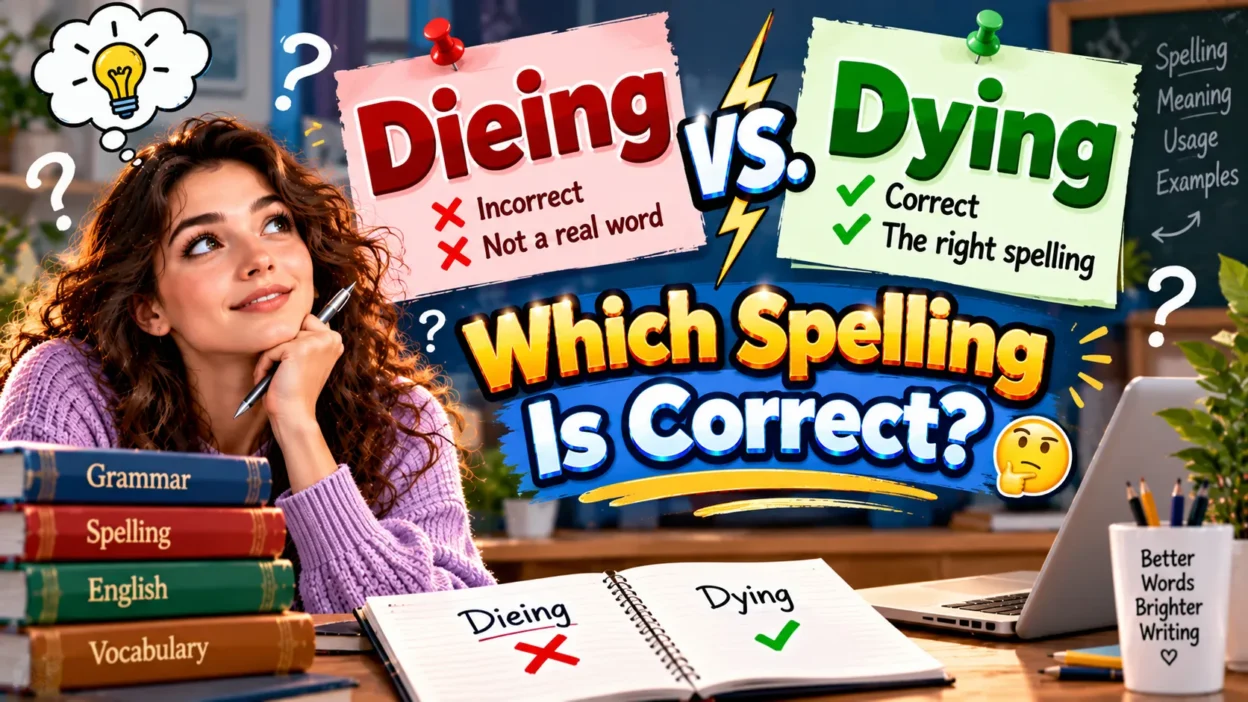
Have you ever wondered whether to write dieing vs. dying? These two words look almost identical, but only one is the correct spelling of the verb die in standard modern English. If you have ever paused while writing a sentence such as “The flowers are dying” or “He is dying,” you are not alone. This spelling confusion happens because English has several different rules for adding endings to verbs.
The correct spelling is dying, not dieing, when you mean that someone or something is approaching death, losing life, or gradually coming to an end. For example, you would write, “The plant is dying because it needs water.” The spelling dieing is uncommon and generally considered incorrect when referring to death. However, it can appear as a form of the separate verb dye, which means to color something.
In this guide, you will learn the difference between these spellings, understand the grammar rule behind them, explore practical examples, and discover easy ways to remember the correct form.
📖 Dieing vs. Dying: What Is the Difference?
The main difference between dieing and dying comes down to the original verb and its meaning. Dying is the standard present participle of die, while dieing is not the standard spelling when describing death.
When you add the ending -ing to the verb die, you remove the final -e and replace it with -ing. This produces dying. The same spelling pattern appears in words such as lie becoming lying and tie becoming tying.
Here is a quick comparison:
| Word | Meaning | Correct usage |
|---|---|---|
| Dying | Approaching death or gradually ceasing to live | The old tree is dying. |
| Dieing | Generally an incorrect spelling of dying | Avoid using it to describe death. |
| Dyeing | Coloring fabric, hair, or another material | She is dyeing her hair. |
The important distinction is that dying relates to die, whereas dyeing relates to dye. Although dieing may occasionally appear in specialized contexts or historical material, it is not the spelling you should normally use for the process of dying.
✅ Is Dieing or Dying Correct?
Dying is correct when you are talking about death, the loss of life, or something gradually coming to an end.
For example:
- Correct: The flowers are dying without enough sunlight.
- Incorrect: The flowers are dieing without enough sunlight.
- Correct: The patient was dying peacefully.
- Incorrect: The patient was dieing peacefully.
- Correct: My phone battery is dying.
- Incorrect: My phone battery is dieing.
The word dying is also used in informal expressions. Someone might say, “I’m dying of laughter,” to explain that something is extremely funny. Another person might say, “I’m dying for a cup of coffee,” to express a strong desire.
In both cases, dying is the correct spelling, even though the expression is figurative rather than literal.
If you are unsure which form to choose, remember this simple rule: when the original verb is die, the correct -ing form is always dying in standard modern English.
✍️ Why Is Dying Spelled Without the Letter E?
English spelling rules explain why die becomes dying instead of dieing. Many verbs ending in a silent e drop that letter before the ending -ing is added.
For example:
- Make → Making
- Write → Writing
- Bake → Baking
- Smile → Smiling
- Hope → Hoping
- Die → Dying
- Lie → Lying
- Tie → Tying
However, there is an important detail. When a verb ends in ie, the letters ie generally change to y before adding -ing. This is why die becomes dying, lie becomes lying, and tie becomes tying.
The transformation prevents awkward letter combinations and follows a familiar English spelling pattern.
Compare these examples:
- The plant is dying.
- She is lying on the sofa.
- He is tying his shoes.
Each word follows the same general pattern. Once you recognize it, you can avoid many common spelling mistakes.
📝 Examples of Dying in Everyday Sentences
The word dying appears in everyday conversations, books, news reports, school assignments, and informal messages. Its meaning depends on the context, but its spelling remains the same when it comes from the verb die.
Here are examples showing how to use it correctly.
Dying in the literal sense
- The farmer noticed that several crops were dying during the drought.
- The veterinarian worked hard to save the dying animal.
- Without water, the small plant started dying within a few days.
- The dying tree was removed because it had become unsafe.
- The family gathered around their elderly relative, who was dying.
- Several fish were dying because the pond lacked enough oxygen.
- The doctor explained that the disease was causing the patient’s condition to worsen.
- The flowers began dying after being left in the hot sun.
Dying in a figurative sense
- I’m dying to know what happened at the party.
- She was dying of laughter after hearing the joke.
- He said he was dying for a cold drink after the long walk.
- I’m dying to see the new movie.
- The children were dying to open their birthday presents.
- My phone battery is dying, so I need a charger.
- The old tradition is slowly dying out.
- Interest in the outdated product is dying.
These examples demonstrate that dying can describe literal death, a gradual decline, or an exaggerated feeling. Regardless of the meaning, the spelling remains unchanged.
🎨 Dying vs. Dyeing: Understanding the Difference
One of the most common reasons people search for dieing vs. dying is confusion with the word dyeing. Although these words sound similar, they have different meanings.
Dying is the -ing form of die. It refers to death, decline, or a strong figurative feeling.
Dyeing is the -ing form of dye. It means changing the color of a material, such as fabric, hair, or yarn.
Consider these examples:
- The leaves are dying because the weather is too dry.
- She is dyeing her hair a darker shade.
- The flowers are dying in the garden.
- The artist is dyeing fabric for a new project.
- The old grass is dying after weeks without rain.
- He is dyeing his cotton shirt blue.
A simple way to distinguish the words is to ask what is happening. If something is losing life, use dying. If someone is changing a color, use dyeing.
The spelling dieing should not be used as a substitute for either word in ordinary writing.
💡 Easy Tricks to Remember the Correct Spelling
Remembering the difference between dying and dieing becomes easier when you connect the spelling to familiar words and examples.
1. Remember the word “lie”
The verb lie becomes lying, not lieing. Since die follows the same general pattern, it becomes dying.
2. Think about the letter Y
When a verb ends in ie, the ie often changes to y before adding -ing.
- Die → Dying
- Lie → Lying
- Tie → Tying
3. Separate death from color
Remember that dying relates to die, while dyeing relates to dye. This distinction is especially useful when writing about clothing, crafts, or hair color.
4. Read the sentence aloud
Reading your sentence aloud can help you notice whether you mean death or a change in color. Pronunciation alone may not settle the question, but context usually will.
5. Use a simple memory sentence
Try remembering: “A plant is dying, but a shirt is dyeing.” This short sentence shows both meanings and the correct spelling of each word.
📚 Grammar Rules for Die, Dying, and Died
Understanding the different forms of die can help you write more confidently and avoid spelling errors.
| Verb form | Correct word | Example |
|---|---|---|
| Base form | Die | Plants die without enough water. |
| Third-person singular | Dies | The plant dies without sunlight. |
| Simple past | Died | The flower died last week. |
| Past participle | Died | The tree has died. |
| Present participle | Dying | The flower is dying. |
The word dying is commonly used with forms of be, including am, is, are, was, and were, to describe an ongoing process.
Examples include:
- I am dying to know the answer.
- The plant is dying.
- The flowers are dying.
- The patient was dying.
- Several trees were dying during the heatwave.
The past-tense form is different. You write died, not dyed, when referring to death. However, dyed is the past tense of dye, meaning to color something.
For example, “The plant died” describes the loss of life, while “She dyed the fabric” describes a change in color.
🚫 Common Mistakes to Avoid When Using Dying
Even confident English writers sometimes mix up words that look or sound similar. Recognizing the most common errors can help you improve spelling, grammar, and clarity.
Mistake 1: Writing “dieing” instead of “dying”
Incorrect: The leaves are dieing.
Correct: The leaves are dying.
The verb die changes to dying before the ending -ing is added.
Mistake 2: Using “dying” when you mean coloring
Incorrect: She is dying her hair red.
Correct: She is dyeing her hair red.
When the intended meaning is changing color, the correct verb is dye and its present participle is dyeing.
Mistake 3: Confusing “died” and “dyed”
Incorrect: The plant dyed last winter.
Correct: The plant died last winter.
Died is the past tense of die. Dyed is the past tense of dye.
Mistake 4: Assuming every word ending in E follows the same rule
English spelling has exceptions and different patterns. For example, see becomes seeing, not sying. It is helpful to learn common spelling patterns while checking unfamiliar words when necessary.
Mistake 5: Ignoring context
Some words have similar pronunciations but very different meanings. Always consider what your sentence is trying to communicate before choosing a spelling.
🌎 How Dying Is Used in American and British English
The spelling dying is standard in both American and British English when referring to the present participle of die. There is no regional spelling difference between the two varieties for this word.
Examples in American English:
- The plant is dying because it needs water.
- I’m dying to watch that movie.
Examples in British English:
- The plant is dying because it needs water.
- I’m dying to watch that film.
The spelling of dying remains the same. Differences such as color and colour do not apply here.
Likewise, dyeing is the standard spelling when referring to the process of coloring hair, fabric, or another material in both varieties of English.
If you are writing for an American or British audience, you can confidently use dying whenever you mean the process associated with die.
🔍 When Can Dieing Be Used?
In standard modern English, dieing is generally not accepted as the normal spelling of the verb die with an -ing ending.
You may occasionally encounter it in older texts, unusual proper names, historical material, or specialized contexts. However, these uncommon appearances do not make it the correct spelling for everyday writing.
For ordinary communication, use the following forms:
- Dying: The flowers are dying.
- Dyeing: She is dyeing the fabric.
- Died: The flowers died last week.
- Dyed: She dyed the fabric yesterday.
If you are writing an essay, article, email, social media post, or school assignment, choose dying when you mean approaching death or gradually coming to an end.
❓ Frequently Asked Questions About Dieing vs. Dying
Is dieing a real word?
Dieing occasionally appears in specialized or historical contexts, but it is generally considered a misspelling when used to mean the present participle of die. In standard modern English, the correct word is dying.
Is dying the correct spelling?
Yes. Dying is the correct present participle of die. For example, “The flowers are dying because they have not received enough water.”
Why is dying not spelled dieing?
When the verb die changes to its -ing form, the ending ie changes to y. The result is dying. The same general pattern appears in lie → lying and tie → tying.
What is the difference between dying and dyeing?
Dying refers to death or a figurative decline, while dyeing means changing the color of something. For example, a plant may be dying, while a person may be dyeing their hair.
Is it “I am dying” or “I am dieing”?
The correct phrase is “I am dying.” The word dying is used whether the statement is literal or figurative, such as “I am dying to know the answer.”
Is “dying of laughter” correct?
Yes. “Dying of laughter” is a common informal expression meaning that something is extremely funny. It is figurative rather than a literal description of death.
Is it dying or died?
Both words are correct, but they are used differently. Dying describes an ongoing process, while died describes a completed event. For example, “The plant is dying” describes a current condition, whereas “The plant died yesterday” describes something that already happened.
Is it “the battery is dying” or “the battery is dieing”?
The correct expression is “the battery is dying.” It is an informal way of saying that the battery is running out of power.
Is dying spelled the same in American and British English?
Yes. Both American and British English use dying as the present participle of die. The spelling does not change between these varieties.
What is the past tense of die?
The simple past tense of die is died. For example, “The tree died during the winter.” Do not confuse died with dyed, which is the past tense of dye.
What is the easiest way to remember dying vs. dieing?
Remember that die becomes dying, just as lie becomes lying. If the sentence describes death or a gradual decline, use dying. If it describes coloring something, use dyeing.
🎯 Conclusion: Remember the Correct Spelling
When comparing dieing vs. dying, the correct choice for standard modern English is dying whenever you are talking about death, a gradual decline, or an exaggerated feeling. The spelling follows the pattern in which the final ie changes to y before adding -ing.
Remember the difference between dying and dyeing, too. A plant is dying when it loses life, but fabric is dyeing when its color is being changed. For past-tense sentences, use died for death and dyed for coloring.
With these simple rules and examples, you can avoid a common spelling mistake and write with greater confidence. Whenever you feel unsure, remember this easy phrase: People are dying, but fabrics are dyeing.

Vivian Mercer is an English language writer and vocabulary enthusiast who specializes in synonyms, word meanings, grammar, idioms, and language usage. She creates accurate, easy-to-understand content that helps readers improve their English skills with confidence.