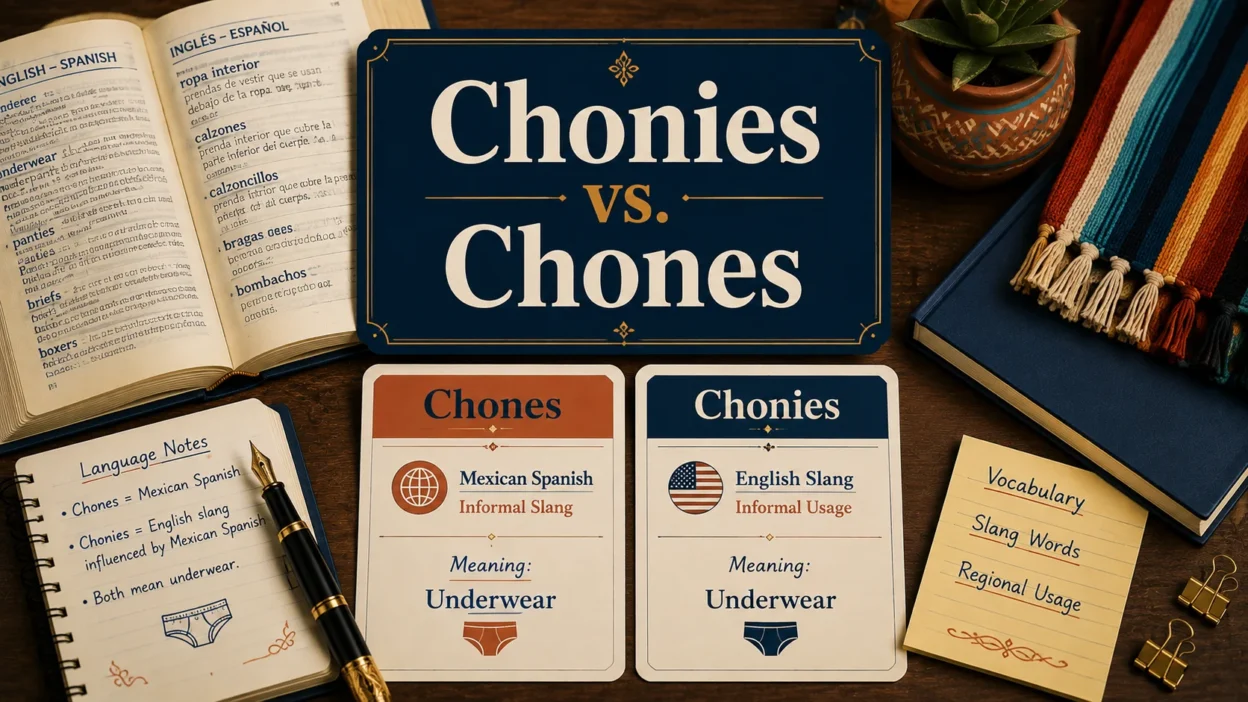
If you’ve heard someone say “chonies” or “chones,” you may have wondered whether these are two different words or simply different spellings of the same slang term. In most informal usage, both refer to underwear, particularly in Mexican and Mexican-American speech. The two forms are closely related, but chones is the Spanish form, while chonies is an English-influenced spelling and pronunciation that is also used informally in parts of the United States.
The distinction becomes especially interesting because the word is not standard formal English. It belongs to casual, regional, and cultural vocabulary, so its spelling can vary depending on where a speaker learned the term. Chones is documented as Mexican Spanish slang for underwear, while chonies is recognized as an informal English alternative borrowed from Mexican Spanish.
This guide explains chonies vs. chones, their meanings, pronunciation, origin, regional usage, spelling differences, and when each form is appropriate.
Quick Answer: Chonies vs. Chones
Chones and chonies are informal terms referring to underwear. Chones is the established Mexican Spanish form, while chonies is an English-influenced alternative commonly heard in some Mexican-American communities and parts of the U.S. Neither is appropriate for formal writing; use underwear or undergarments in standard English.
Chones vs. Chonies at a Glance
| Word | Meaning | Language/Usage | Formality |
|---|---|---|---|
| Chones | Underwear | Mexican Spanish slang | Very informal |
| Chonies | Underwear | Informal English/Mexican-American usage | Very informal |
| Underwear | Undergarments | Standard English | Neutral |
| Undergarments | Clothing worn underneath outer clothes | Standard English | Formal |
| Panties | Women’s underwear | Standard English | Informal/neutral depending on context |
| Briefs | Close-fitting underwear | Standard English | Neutral |
What Does “Chones” Mean?
Meaning of Chones
Chones is an informal Mexican Spanish term for underwear. Spanish-language references identify it as a regional word associated with Mexico, and it is commonly treated as a plural-only noun.
Depending on context, chones can refer generally to underwear rather than one particular style. English translations may include underwear, underpants, panties, briefs, or shorts.
Examples
- Mis chones están limpios. — My underwear is clean.
- Necesito comprar chones nuevos. — I need to buy new underwear.
In English-language conversations influenced by Mexican Spanish, you may also hear:
- I need to wash my chones.
- Don’t forget your chones when you pack.
Because the word is slang, these examples are casual rather than formal.
What Does “Chonies” Mean?
Meaning of Chonies
Chonies is an informal English spelling of a slang term for underwear. Wiktionary lists chonies as an informal plural-only noun meaning panties and identifies chones as an alternative form. It also traces the English word to Mexican Spanish chones.
The spelling chonies is particularly associated with Mexican-American and regional U.S. speech. Community usage reports show that it can be heard in areas such as Southern California, Arizona, Texas, and other places with strong Mexican-American cultural influence.
Examples
- I need to buy some clean chonies.
- Don’t forget to pack extra chonies.
- His chonies were showing above his pants.
These are casual examples and would not normally be appropriate in formal business or academic writing.
Are Chonies and Chones the Same?
For most casual uses, yes. Both terms refer to underwear, but they come from slightly different linguistic contexts.
Chones is the Mexican Spanish form. Chonies is an alternative form used in English, especially in some Mexican-American communities. Wiktionary specifically lists chones as an alternative form of chonies, while Spanish-language sources document chones as a Mexican regional term.
So the easiest way to remember the distinction is:
Chones = Mexican Spanish form
Chonies = English-influenced informal form
The boundary is not absolute, however. People may use either spelling depending on their family, region, language background, and personal preference.
Chonies vs. Chones: Comparison Table
| Feature | Chones | Chonies |
|---|---|---|
| Basic meaning | Underwear | Underwear |
| Origin | Mexican Spanish | Borrowed from Mexican Spanish |
| Usage | Spanish and bilingual contexts | English and bilingual contexts |
| Formal English | No | No |
| Pronunciation | Similar to Spanish pronunciation | Often anglicized |
| Regional | Especially associated with Mexico | Especially associated with parts of the U.S. |
| Meaning difference | Usually none | Usually none |
| Best formal alternative | Underwear | Underwear |
Where Did “Chones” Come From?
The word chones is generally connected with calzones, a Spanish word referring to trousers, breeches, or undergarments depending on context. Spanish-language reference material identifies chones as a shortened form of calzones.
This type of shortening is common in informal speech. Words can become shorter, more playful, or easier to use in everyday conversation. Over time, regional communities may develop their own preferred versions.
The history of the exact transformation can vary in informal sources, so it is safer to say that chones is associated with and derived from calzones rather than claiming one universally agreed step-by-step development.
How Is “Chonies” Different in English?
When chones entered English-speaking communities, especially bilingual and Mexican-American communities, its spelling could shift to reflect English pronunciation.
That is one reason you may encounter chonies instead of chones.
The English form is not a completely unrelated word. It is best understood as a borrowed slang term with an adapted spelling. Wiktionary lists the English form as borrowed from Mexican Spanish chones.
This is a good example of how languages interact. A word can move from one language into another while retaining its original cultural association but developing a slightly different spelling or pronunciation.
Pronunciation of Chones and Chonies
The two forms can sound slightly different depending on the speaker and language.
| Word | Approximate Pronunciation | Syllables |
|---|---|---|
| Chones | CHOH-nes | 2 |
| Chonies | CHOH-neez | 2 |
Wiktionary gives the General American pronunciation of chonies as approximately /ˈtʃoʊ.nis/. Spanish chones is pronounced with two syllables, approximately CHOH-nes.
The final sound is one of the easiest ways to notice the difference between the forms.
Is “Chonies” a Spanish Word?
The answer depends on which form you’re discussing.
Chones is documented as a regional Mexican Spanish word. Chonies, on the other hand, is documented as an English informal borrowing from Mexican Spanish.
That means it would be misleading to describe chonies simply as a standard Spanish word. It is better described as an informal English form derived from Mexican Spanish.
Is “Chones” a Formal Word?
No. Chones is informal and regional rather than standard formal Spanish vocabulary. It is especially associated with Mexican usage.
If you’re writing something formal in Spanish, the appropriate word can depend on the country and the exact type of underwear you’re describing. Likewise, in formal English, underwear or undergarments is much safer than either chones or chonies.
When Should You Use Chones?
Use chones when you’re intentionally using informal Mexican Spanish or discussing regional vocabulary.
It can work naturally in:
- Casual conversation
- Mexican Spanish dialogue
- Bilingual conversations
- Cultural writing
- Informal storytelling
- Discussions of regional slang
Example
My grandmother always called underwear chones.
Here, the word is being used to describe a regional speech habit.
When Should You Use Chonies?
Use chonies when you’re intentionally reflecting informal English or Mexican-American slang.
It can be appropriate in:
- Casual conversations
- Dialogue
- Informal social media
- Humor
- Regional speech
- Character writing
Example
I forgot to pack extra chonies for the trip.
This sounds intentionally casual and conversational.
When Should You Use Underwear Instead?
For most readers, underwear is the safest choice.
Use underwear in:
- Academic writing
- Business writing
- News articles
- Professional communication
- Medical writing
- Product descriptions
- Formal documents
- General-audience content
For example:
❌ The patient should bring clean chonies.
✅ The patient should bring clean underwear.
The second sentence is clearer and appropriate for a broad audience.
Common Mistakes
Mistake 1: Treating Chonies as Formal English
Chonies is informal slang, so it should not normally replace underwear in formal writing.
Mistake 2: Assuming Chones and Chonies Have Completely Different Meanings
In most contexts, they refer to the same basic thing: underwear.
Mistake 3: Calling Chonies Standard Spanish
The documented Spanish regional form is chones. Chonies is better understood as an English informal borrowing or alternative form.
Mistake 4: Using the Words Without Considering the Audience
A person familiar with Mexican-American slang may understand chonies immediately, while someone unfamiliar with the term may have no idea what it means.
Chones vs. Chonies in Different Contexts
| Context | Best Choice |
|---|---|
| Formal English | Underwear |
| Casual English | Underwear |
| Mexican Spanish | Chones |
| Mexican-American slang | Chones or Chonies |
| Academic writing | Underwear |
| Professional writing | Underwear |
| Character dialogue | Chones or Chonies, if culturally appropriate |
| Language discussion | Chones / Chonies |
Similar Words for Underwear
If your audience may not know chones or chonies, these alternatives are clearer.
| Word | Meaning | Style |
|---|---|---|
| Underwear | General term | Neutral |
| Undergarments | General formal term | Formal |
| Underpants | Underwear | Neutral |
| Panties | Women’s underwear | Common |
| Briefs | Close-fitting underwear | Neutral |
| Boxers | Loose-fitting men’s underwear | Common |
| Drawers | Informal/old-fashioned underwear term | Casual |
| Knickers | Women’s underwear | Mainly British |
| Intimates | Women’s underwear and related clothing | Retail/marketing |
People Also Ask
What is the difference between chonies and chones?
Chones is an informal Mexican Spanish term for underwear, while chonies is an English-influenced alternative form used in some Mexican-American and U.S. communities. In casual usage, they generally refer to the same thing.
What does chones mean in Spanish?
In Mexican Spanish, chones is a regional informal term for underwear. Spanish-language references identify it as a shortened form associated with calzones.
What does chonies mean in English?
Chonies is informal slang for underwear, particularly panties in some English-language usage. It is an English borrowing from Mexican Spanish chones.
Is chonies a real word?
Yes. Chonies is documented as an informal English word. It is not standard formal vocabulary, but it is recognized as a slang term for underwear and has chones as an alternative form.
Is chones Spanish slang?
Yes. Chones is documented as a regional Mexican Spanish term for underwear and is considered informal usage.
Are chones and calzones the same?
They can refer to related underwear terminology, but chones is a shortened regional form associated with calzones. The exact meaning of calzones can vary by context and region.
Can I use chonies in formal writing?
It’s better to avoid it. In formal English, use underwear or undergarments. Chonies is informal slang and may not be understood by every reader.
Is chones used in Mexico?
Yes. Chones is documented as a regional Mexican term for underwear.
Frequently Asked Questions
Are chonies and chones pronounced the same?
Not necessarily. Chones follows Spanish pronunciation more closely, while chonies has an English-influenced pronunciation. Both generally have two syllables.
Which spelling is more authentic?
If you’re referring specifically to the Mexican Spanish term, chones is the better choice because it is the documented Spanish form. Chonies is an English alternative that developed through borrowing and regional usage.
Is chonies offensive?
The word itself is generally a casual term for underwear, not inherently offensive. However, it is slang, so its appropriateness depends on the audience and setting.
Can chones refer to men’s underwear?
In informal usage, chones can be used broadly for underwear. English-language translations and references may use terms such as underwear, briefs, underpants, or panties depending on context.
Are chonies used outside Mexico?
The English form chonies is particularly associated with Mexican-American communities in parts of the United States. Its familiarity varies significantly by region. Community reports show usage in several U.S. areas, especially places with strong Mexican-American cultural connections.
Should I write chonies or chones?
Choose chones when you’re discussing the Mexican Spanish form. Choose chonies when you’re intentionally reproducing the English-influenced slang form. For general readers, underwear is the clearest choice.
What is the formal English word for chones?
The standard English term is underwear. Undergarments is another formal alternative.
Why are there two spellings?
The variation comes from language contact and regional pronunciation. Chones comes from Mexican Spanish, while chonies represents an English-influenced form of the borrowed word.
Conclusion
The difference between chonies vs. chones is mainly linguistic rather than semantic. Both forms are used to refer to underwear, but they belong to different layers of informal language. Chones is the documented regional Mexican Spanish form, while chonies is an informal English form borrowed from Mexican Spanish.
If you’re writing formal English, neither is the best choice. Underwear or undergarments will be clearer to a general audience. If you’re discussing Mexican Spanish, bilingual speech, or regional slang, however, understanding both forms can help you recognize the cultural and linguistic context behind the words.
The key takeaway is simple: chones is the Spanish form, chonies is an English-influenced slang variation, and both generally refer to underwear

Vivian Mercer is an English language writer and vocabulary enthusiast who specializes in synonyms, word meanings, grammar, idioms, and language usage. She creates accurate, easy-to-understand content that helps readers improve their English skills with confidence.