
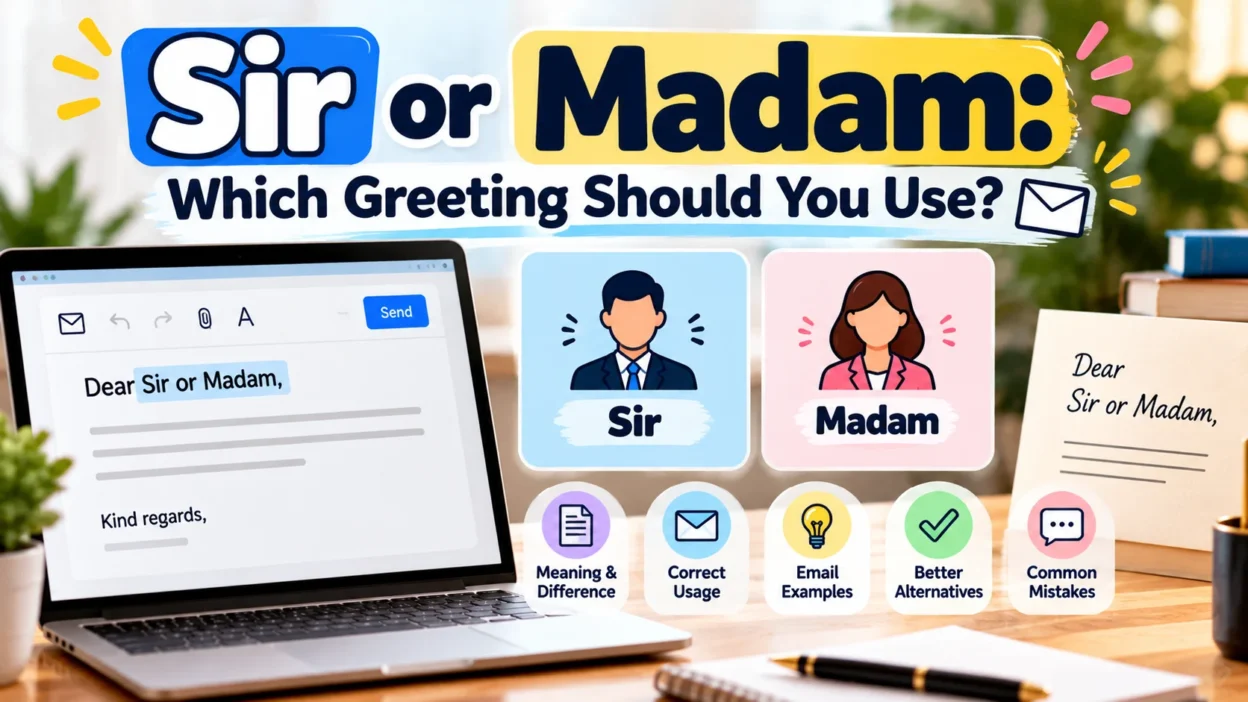
Choosing the right greeting can make a big difference when writing a professional email, business letter, job application, or formal request. You may have seen expressions such as Dear Sir, Dear Madam, and Dear Sir or Madam, but knowing when to use each one can be confusing.
The phrase sir or madam is a formal way to address someone when you do not know their name or gender. It shows politeness and respect, especially in traditional business correspondence. However, modern professional communication often offers more natural alternatives, such as Dear Hiring Manager or Hello Customer Service Team.
In this guide, you will learn the meaning of sir or madam, the difference between sir and madam, when to use each greeting, and how to choose the most appropriate opening for emails and letters.
📖 What Does Sir or Madam Mean?
Sir or Madam is a formal expression used to address a person when you do not know their name or whether they prefer to be addressed as sir or madam.
The phrase combines two traditional forms of respectful address. People commonly use it in formal letters, business correspondence, official requests, and situations where the recipient’s identity is unknown.
For example:
Dear Sir or Madam,
I am writing to inquire about the available positions at your company.
In this example, the writer does not know who will receive the letter, so the greeting remains general and respectful.
| Expression | Meaning |
|---|---|
| Sir | A respectful form of address traditionally used for a man |
| Madam | A respectful form of address traditionally used for a woman |
| Sir or Madam | A formal greeting for an unknown recipient |
| Dear Sir or Madam | A traditional opening for a formal letter or email |
Although the phrase remains correct in many situations, it can sound old-fashioned in some modern workplaces. Whenever possible, identifying the recipient by name or role often creates a more personal and direct impression.
👨 What Does Sir Mean?
Sir is a polite form of address traditionally used for a man, especially when speaking formally or showing respect.
You might use sir when addressing a customer, teacher, manager, official, or someone whose name you do not know.
Examples include:
- Excuse me, sir. Could you help me?
- Thank you for your time, sir.
- Dear Sir, I am writing regarding your advertisement.
- Yes, sir. I understand your instructions.
In British usage, Sir can also be a title for a man who has received certain honors, as in Sir David Attenborough. This title follows the person’s first name rather than functioning as an ordinary greeting.
In everyday professional English, however, people increasingly prefer a person’s name or job title when available.
👩 What Does Madam Mean?
Madam is a formal and respectful term traditionally used to address a woman. It appears in business letters, official correspondence, customer service, and some formal spoken interactions.
For example:
- Good morning, madam. How may I help you?
- Dear Madam, I am writing to request further information.
- Thank you for your assistance, madam.
The word can sound polite and professional, but it may also feel overly formal in casual conversations.
In modern correspondence, using the recipient’s name or professional title is often preferable when you know it.
For example, Dear Ms. Johnson or Dear Dr. Taylor provides a more specific greeting than Dear Madam.
⚖️ Sir vs. Madam: What’s the Difference?
The main difference between sir and madam is the person each term traditionally addresses.
Sir is generally used for a man, while madam is generally used for a woman. Both can communicate politeness and respect, but neither is a substitute for someone’s actual name when that information is available.
| Feature | Sir | Madam |
|---|---|---|
| Traditional use | Addressing a man | Addressing a woman |
| Tone | Respectful and formal | Respectful and formal |
| Spoken example | Excuse me, sir. | Excuse me, madam. |
| Letter greeting | Dear Sir | Dear Madam |
| Common modern alternative | Name or professional title | Name or professional title |
If you know the recipient’s name, a personalized greeting is usually a better choice than guessing which title to use.
✉️ When Should You Use Dear Sir or Madam?
Dear Sir or Madam is traditionally used at the beginning of a formal letter when the writer does not know who will receive it.
You might encounter this greeting when contacting an organization, submitting a formal inquiry, writing to an unfamiliar department, or sending a letter to an office that has not provided a specific contact person.
Common situations include:
- Formal business letters
- General inquiries to organizations
- Official requests
- Applications sent to an unnamed recipient
- Traditional professional correspondence
- Letters to an office with an unknown contact person
However, if you can find the recipient’s name or role, use it. For example, Dear Recruitment Manager is often more direct than Dear Sir or Madam when contacting an employer about a job.
💼 Is Dear Sir or Madam Appropriate for a Professional Email?
Yes, Dear Sir or Madam is grammatically correct and can suit a formal email when you do not know the recipient.
However, many workplaces now prefer a greeting that identifies the recipient, department, or purpose of the message.
Compare these openings:
Traditional:
Dear Sir or Madam,
I am writing to request information about your services.
Modern and specific:
Dear Customer Service Team,
I am writing to request information about your services.
Both are professional, but the second version identifies the intended audience more clearly.
If you are contacting a company, university, employer, or government office, check its website for a contact name or department before using a general greeting.
📝 How to Write Dear Sir or Madam Correctly
The standard traditional greeting is:
Dear Sir or Madam,
In American English, a colon may follow the greeting in a particularly formal business letter:
Dear Sir or Madam:
A comma is also common, especially in general correspondence and email.
The greeting usually appears on its own line before the opening paragraph.
Here is a simple example:
Dear Sir or Madam,
I am writing to inquire about the requirements for submitting an application. I would appreciate any information you can provide.
Thank you for your time and consideration.
Sincerely,
[Your Name]
The key is to maintain a consistent, respectful tone throughout the message.
🔄 What Are Better Alternatives to Sir or Madam?
Although the phrase remains acceptable, several alternatives can make your email sound more natural and targeted.
| Situation | Recommended greeting |
|---|---|
| Applying for a job | Dear Hiring Manager, |
| Contacting a university | Dear Admissions Team, |
| Asking a company a question | Dear Customer Service Team, |
| Writing to a department | Dear Human Resources Team, |
| Contacting a known person | Dear [First Name] [Last Name], |
| Writing to a professor | Dear Professor [Last Name], |
| Contacting a doctor | Dear Dr. [Last Name], |
| Sending a general informal inquiry | Hello, |
| Writing to a named group | Dear Members of the Committee, |
The best greeting is usually the one that accurately reflects the recipient and the relationship.
📧 Dear Sir or Madam vs. To Whom It May Concern
Both greetings can appear in formal correspondence, but they have slightly different traditional uses.
Dear Sir or Madam directly addresses an unknown recipient. To Whom It May Concern is a broader expression used when the writer does not know which person or department will handle the document.
For example, a general inquiry might begin with Dear Sir or Madam, while a reference letter intended for an unspecified future reader might begin with To Whom It May Concern.
| Dear Sir or Madam | To Whom It May Concern |
|---|---|
| Directly addresses an unknown recipient | Refers broadly to whoever needs the information |
| Common in traditional formal letters | Common in general-purpose formal documents |
| Often used for inquiries | Often used for reference or verification letters |
| Can sound old-fashioned | Can also sound impersonal or old-fashioned |
Neither greeting is always the best choice. If you know the recipient’s department or position, use that information to create a more relevant opening.
🌍 Sir or Madam in American and British English
Both sir and madam are understood in American and British English, although conventions and preferences can differ by workplace and situation.
Traditional formal letters in both varieties may use Dear Sir or Madam. However, modern professional communication often favors a named recipient, a department title, or a neutral greeting.
For example:
- American English: Dear Hiring Manager,
- British English: Dear Recruitment Manager,
- Either variety: Dear Customer Service Team,
These are examples rather than strict regional rules. The best choice depends on the organization, the formality of the message, and whether you know the recipient.
🚫 Common Mistakes When Using Sir or Madam
A formal greeting should be respectful, clear, and grammatically appropriate. Avoid these common errors.
1. Writing Dear Sir/Madam when the recipient is known
If you know the person’s name, use it instead of a generic greeting.
2. Using Dear Sir or Madam for a casual message
A simple Hello or Hi may sound more natural when writing to a colleague you already know.
3. Guessing the recipient’s gender
If you are uncertain, use the person’s name, professional title, or department instead of making an assumption.
4. Mixing greeting styles
Avoid combining multiple openings, such as Dear Sir or Madam, Hello, and Respected Sir in the same greeting.
5. Forgetting punctuation
A comma is a common choice after Dear Sir or Madam in a traditional email or letter.
6. Using a generic greeting when a role-specific one is available
Dear Admissions Team or Dear Hiring Manager usually communicates your purpose more directly.
💬 Examples of Sir or Madam in Real Situations
The following examples show how to choose a greeting based on the purpose of your message.
Example 1: General Business Inquiry
Dear Sir or Madam,
I am writing to inquire about the services your company provides. Could you please share details about your available packages and pricing?
Thank you for your assistance.
Sincerely,
[Your Name]
Example 2: Job Application
Dear Hiring Manager,
I am writing to express my interest in the advertised position. I believe my qualifications and experience would make me a suitable candidate.
Thank you for considering my application.
Sincerely,
[Your Name]
Example 3: University Inquiry
Dear Admissions Team,
I would like to learn more about the admission requirements for your undergraduate programs. Please let me know where I can find the application guidelines and deadlines.
Kind regards,
[Your Name]
Example 4: Formal Complaint
Dear Sir or Madam,
I am writing to raise a concern about a recent service experience. I would appreciate your assistance in reviewing the matter and explaining the next steps.
Thank you for your time.
Sincerely,
[Your Name]
These examples demonstrate that you can maintain a formal tone without always relying on the same greeting.
❓ Frequently Asked Questions About Sir or Madam
What does sir or madam mean?
Sir or madam is a formal way to address someone when you do not know their name or gender. It combines two traditional respectful forms of address.
Is Dear Sir or Madam grammatically correct?
Yes. Dear Sir or Madam is a grammatically acceptable traditional greeting for a formal letter or email addressed to an unknown recipient.
Should I write Dear Sir or Madam or Dear Madam or Sir?
Dear Sir or Madam is the more established traditional wording in English. However, a recipient’s name, title, or department is often a better choice when available.
Is Sir or Madam formal or informal?
It is formal. People generally use it in professional correspondence, official requests, and traditional business letters rather than casual conversations.
What is the difference between sir and madam?
Sir traditionally addresses a man, while madam traditionally addresses a woman. Both expressions convey respect in formal situations.
Can I use Dear Sir or Madam in an email?
Yes. It can work when you do not know who will receive the email. However, Dear Hiring Manager or Dear Customer Service Team may sound more specific and natural.
What can I use instead of Dear Sir or Madam?
Good alternatives include Dear Hiring Manager, Dear Customer Service Team, Dear Admissions Team, Dear [Name], and Hello. Choose the greeting that best matches your recipient.
Is To Whom It May Concern better than Dear Sir or Madam?
Not necessarily. Both are traditional formal greetings. To Whom It May Concern is broader, while Dear Sir or Madam directly addresses an unknown recipient. A specific name or role is often preferable to either.
Should I capitalize sir and madam?
In the greeting Dear Sir or Madam, both words are traditionally capitalized. When used as ordinary words in a sentence, capitalization depends on context and style.
Can I use sir or madam if I don’t know someone’s gender?
You can use the traditional phrase, but a neutral greeting such as Dear Customer Service Team or Hello is often a more inclusive alternative.
🌟 Final Thoughts
The phrase sir or madam is a traditional formal greeting used when you do not know the recipient’s name or gender. It remains understandable and appropriate in many official letters and professional emails, particularly when no specific contact person is available.
However, modern communication often favors direct, personalized greetings. If you know the recipient’s name, role, or department, using that information can make your message clearer and more professional.
When in doubt, choose a greeting that is respectful, accurate, and suited to the situation.

Vivian Mercer is an English language writer and vocabulary enthusiast who specializes in synonyms, word meanings, grammar, idioms, and language usage. She creates accurate, easy-to-understand content that helps readers improve their English skills with confidence.