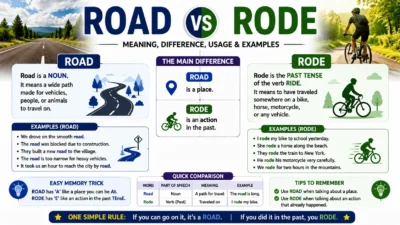

Segway and segue sound similar, but they have completely different meanings. Segue is the word you need when you mean a smooth transition from one topic, idea, section, or activity to another. Segway is a proper noun for a two-wheeled personal transportation device.
For example, a speaker might segue from one topic to another, while a person might ride a Segway through a city. Confusing these words can create an awkward spelling mistake, especially because they have similar pronunciations.
If you’re talking about a transition in writing or conversation, segue is almost certainly the correct choice.
Quick Answer: Segway or Segue?
Use segue when you mean a smooth transition from one subject, idea, activity, or part of a discussion to another.
Use Segway when you mean the brand name of a two-wheeled personal transportation device.
- Segue = transition
- Segway = personal transportation device
Examples:
- The speaker used a clever segue to introduce the next topic.
- We can segue into the next section.
- They toured the city on a Segway.
| Word | Meaning | Part of Speech | Example |
|---|---|---|---|
| Segue | A smooth transition | Noun / Verb | She made a smooth segue into the next topic. |
| Segway | A two-wheeled transportation device | Proper noun | We rented a Segway for the tour. |
What Does “Segue” Mean?
Segue refers to a smooth transition from one subject, idea, activity, or section to another.
As a noun, it means a transition.
Example:
The host made a natural segue from the interview to the audience questions.
As a verb, segue means to move smoothly from one subject or activity to another.
Example:
The presenter segued from the company’s history into its future plans.
The word often appears in writing, presentations, speeches, interviews, podcasts, and conversations.
What Does “Segway” Mean?
Segway is a brand name associated with a two-wheeled, self-balancing personal transportation device.
People can stand on the platform while the device moves forward, backward, or turns based on the rider’s movements.
Example:
The tourists explored the historic district on a Segway.
Because Segway is a brand name, it is normally capitalized.
Segway vs. Segue at a Glance
| Feature | Segue | Segway |
|---|---|---|
| Meaning | Smooth transition | Personal transportation device |
| Pronunciation | /ˈseɡ.weɪ/ | /ˈseɡ.weɪ/ |
| Part of speech | Noun and verb | Proper noun / brand name |
| Capitalization | Usually lowercase | Usually capitalized |
| Common context | Writing, speaking, presentations | Travel, transportation, tours |
| Example | A smooth segue to the next topic | Ride a Segway |
Why Do People Confuse Segway and Segue?
The biggest reason is pronunciation.
In standard English, segue is pronounced approximately SEG-way, which sounds almost exactly like Segway.
The spelling, however, comes from different origins and represents different concepts.
This creates a classic example of two words that sound alike but have different meanings and spellings.
Segue
Think:
Segue = transition
Segway
Think:
Segway = vehicle
If you’re moving from one idea to another, use segue.
If you’re talking about the transportation device, use Segway.
How to Pronounce “Segue”
Segue is pronounced:
SEG-way
IPA:
/ˈseɡ.weɪ/
It has two syllables:
seg-way
The pronunciation can make the spelling difficult because segue doesn’t look like it should sound this way to many English speakers.
How to Pronounce “Segway”
Segway is also pronounced:
SEG-way
IPA:
/ˈseɡ.weɪ/
So the two words are pronounced essentially the same.
| Word | IPA | Approximate Sound |
|---|---|---|
| Segue | /ˈseɡ.weɪ/ | SEG-way |
| Segway | /ˈseɡ.weɪ/ | SEG-way |
The key difference is therefore meaning and spelling, not pronunciation.
What Does “Segue” Mean as a Verb?
As a verb, segue means to move smoothly from one thing to another.
It commonly appears with into.
Segue Into
Segue into means to transition smoothly into another subject or activity.
Examples:
- The speaker segued into the next topic.
- The article segues into a discussion of grammar.
- The presenter segued into the final section.
- The conversation segued into a debate about education.
This is one of the most common grammatical patterns for segue.
What Does “Segue” Mean as a Noun?
As a noun, a segue refers to the transition itself.
Examples:
- That was a smooth segue into the next topic.
- The writer created a natural segue between the two sections.
- The host needed a better segue between the interviews.
- Her joke provided a perfect segue into the serious discussion.
The noun usually appears with a or the.
Segue in Writing
Writers often use segue when describing how one section or idea connects naturally to another.
For example:
The introduction discusses common grammar mistakes. The next section provides practical examples.
A writer might create a segue between those sections with a sentence that connects the general problem to specific examples.
This makes segue especially useful in:
- Blog posts
- Essays
- Reports
- Presentations
- Speeches
- Articles
- Books
- Scripts
Segue in Conversation
You can also use segue when describing a conversational transition.
Example:
We were talking about weekend plans, and somehow the conversation segued into career advice.
Here, segue emphasizes that the conversation moved naturally from one subject to another.
Segue in Presentations
Presenters often use transitions to move their audience from one section to another.
For example:
Now that we’ve discussed the problem, let’s segue into some possible solutions.
The word works particularly well when the transition feels natural rather than abrupt.
Common Mistakes With Segway and Segue
Mistake 1: Using Segway for a Topic Transition
Incorrect:
The speaker used a clever Segway to introduce the next subject.
Correct:
The speaker used a clever segue to introduce the next subject.
The sentence discusses a transition, so segue is correct.
Mistake 2: Using Segue for the Transportation Device
Incorrect:
We rented a segue for the city tour.
Correct:
We rented a Segway for the city tour.
The sentence refers to the transportation device, so Segway is correct.
Mistake 3: Writing “Segway” in Lowercase for the Brand
When referring specifically to the brand, write Segway with a capital S.
Mistake 4: Assuming They Are Different Pronunciations
Both words are pronounced approximately SEG-way.
The difference lies in their spelling and meaning.
Segue vs. Transition
Segue and transition can have similar meanings, but segue often emphasizes a smooth or natural movement between topics or activities.
| Word | Meaning | Example |
|---|---|---|
| Segue | Smooth movement between ideas | The speaker made a clever segue into the next topic. |
| Transition | Change from one state, subject, or stage to another | The transition between sections was clear. |
In many situations, you can use transition instead of segue, but segue often highlights the smoothness of the change.
Synonyms for Segue
Depending on the context, alternatives for segue include:
- Transition
- Shift
- Change
- Move
- Progression
- Connection
- Bridge
- Link
- Passage
- Continuation
For example:
The presenter made a smooth transition to the next subject.
The presenter made a smooth segue to the next subject.
Both sentences work, although segue has a more specific conversational or rhetorical flavor.
Common Collocations With Segue
These combinations frequently appear in natural English:
- Smooth segue
- Natural segue
- Perfect segue
- Clever segue
- Seamless segue
- Segue into
- Segue from
- Segue to
- Segue between topics
- Segue into a discussion
Examples
- The host made a smooth segue into the next interview.
- The article segues into a discussion of common mistakes.
- The speaker created a natural segue between the two ideas.
- The presentation segues from theory to practice.
Common Collocations With Segway
You may see Segway in contexts involving:
- Segway tour
- Segway ride
- Segway rental
- Segway vehicle
- Segway tour guide
- Ride a Segway
- Rent a Segway
- Travel by Segway
Examples:
- We booked a Segway tour.
- She learned how to ride a Segway.
- The museum offers Segway tours.
Is Segue a Verb or a Noun?
Segue can be both.
As a Verb
It means to transition smoothly.
Example:
The discussion segued into politics.
As a Noun
It means the transition itself.
Example:
The host made a smooth segue into the next topic.
This flexibility makes segue useful in both everyday and professional communication.
Is Segway a Common Noun?
Segway is primarily a brand name, so it is normally treated as a proper noun and capitalized.
However, people sometimes use the term generically in informal contexts. When you specifically mean the branded product, Segway is the appropriate form.
How to Remember Segway vs. Segue
Use this simple memory trick:
Segue = Subject Change
Both begin with Seg, but the ending helps distinguish them.
Think:
Segue → segue into another subject.
And:
Segway → way to travel.
So:
Segue = transition
Segway = transportation
This distinction works in almost every context.
20 Natural Examples With “Segue”
- The host made a smooth segue into the next topic.
- The speaker used a clever segue between the two subjects.
- We can segue into the next section.
- The conversation segued into politics.
- The presenter segued from history to modern technology.
- Her comment created a natural segue into the discussion.
- The article segues into practical examples.
- The host found a perfect segue to the next question.
- The presentation needs a smoother segue between sections.
- The discussion segued into a debate.
- The writer created a clear segue between the ideas.
- The interview segued into a conversation about education.
- That story provided a natural segue into the next subject.
- The presenter segued from the introduction to the main argument.
- The podcast uses music as a segue between topics.
- The speaker made a clever segue into the final point.
- The conversation naturally segued into family life.
- The host used humor as a segue into the serious discussion.
- The final paragraph provides a good segue into the conclusion.
- The presentation smoothly segued into the question-and-answer session.
10 Natural Examples With “Segway”
- We rented a Segway for the afternoon.
- The tourists joined a Segway tour.
- He learned how to ride a Segway.
- The city offers guided Segway tours.
- She used a Segway to explore the waterfront.
- They booked a Segway rental online.
- The guide explained how to operate the Segway.
- We saw several people riding Segways through the park.
- The hotel offers a Segway tour for guests.
- He had never ridden a Segway before.
People Also Ask
Is it segue or Segway?
Use segue when you mean a smooth transition between topics, ideas, or activities. Use Segway when you mean the two-wheeled personal transportation device.
What is the difference between segue and Segway?
Segue means a smooth transition, while Segway refers to a brand of personal transportation devices. They are pronounced essentially the same but have different meanings and spellings.
Is segue pronounced like Segway?
Yes. Segue is pronounced approximately SEG-way, the same as Segway.
What does segue mean in conversation?
In conversation, segue means to move smoothly from one topic or idea to another.
Is segue a noun or a verb?
Segue can function as both a noun and a verb. As a noun, it means a transition. As a verb, it means to transition smoothly.
What does segue into mean?
Segue into means to move smoothly from one topic, activity, or subject into another.
What is another word for segue?
Depending on the context, alternatives include transition, shift, move, bridge, link, and connection.
Why is segue spelled so strangely?
Segue comes from Italian, where it means something like “it follows.” English adopted the word as a term for a smooth transition, particularly in music and later in broader speech and writing.
Frequently Asked Questions
Can I use “segue” in an essay?
Yes. Segue works well in essays, articles, reports, presentations, and other forms of writing when you want to describe a smooth transition between ideas or sections.
Is “Segway” always capitalized?
When you mean the brand name, Segway is capitalized. In informal generic usage, capitalization can vary, but the branded form uses a capital S.
Can segue mean a transition between activities?
Yes. Segue can describe a smooth change from one activity to another, not just a change between topics.
What does “segue from” mean?
Segue from means to move smoothly away from one subject or activity toward another.
Example:
The speaker segued from the history of the company to its current strategy.
What does “segue to” mean?
Segue to means to transition smoothly to another subject, idea, or activity.
Example:
The presenter segued to the final section.
Is “segway” a misspelling of segue?
It is a misspelling when you mean a smooth transition. Segway is a separate word associated with a transportation brand.
What is the plural of segue?
The plural noun is segues.
Example:
The presentation contains several smooth segues between sections.
What is the past tense of segue?
The past tense is commonly written segued.
Example:
The conversation segued into a discussion about travel.
Conclusion
When choosing between Segway or segue, focus on the meaning rather than the pronunciation. Segue is the correct word when you mean a smooth transition between topics, ideas, activities, or sections. Segway refers to a personal transportation device associated with the Segway brand.
Although both words sound essentially the same, their spelling and meanings are completely different. If you’re writing about a presentation, conversation, article, or speech, you probably need segue. If you’re talking about riding a two-wheeled transportation device, use Segway.
The easiest rule to remember is:
Segue = transition
Segway = transportation
Once you connect each spelling with its meaning, you’ll have no trouble choosing the right word.

Vivian Mercer is an English language writer and vocabulary enthusiast who specializes in synonyms, word meanings, grammar, idioms, and language usage. She creates accurate, easy-to-understand content that helps readers improve their English skills with confidence.