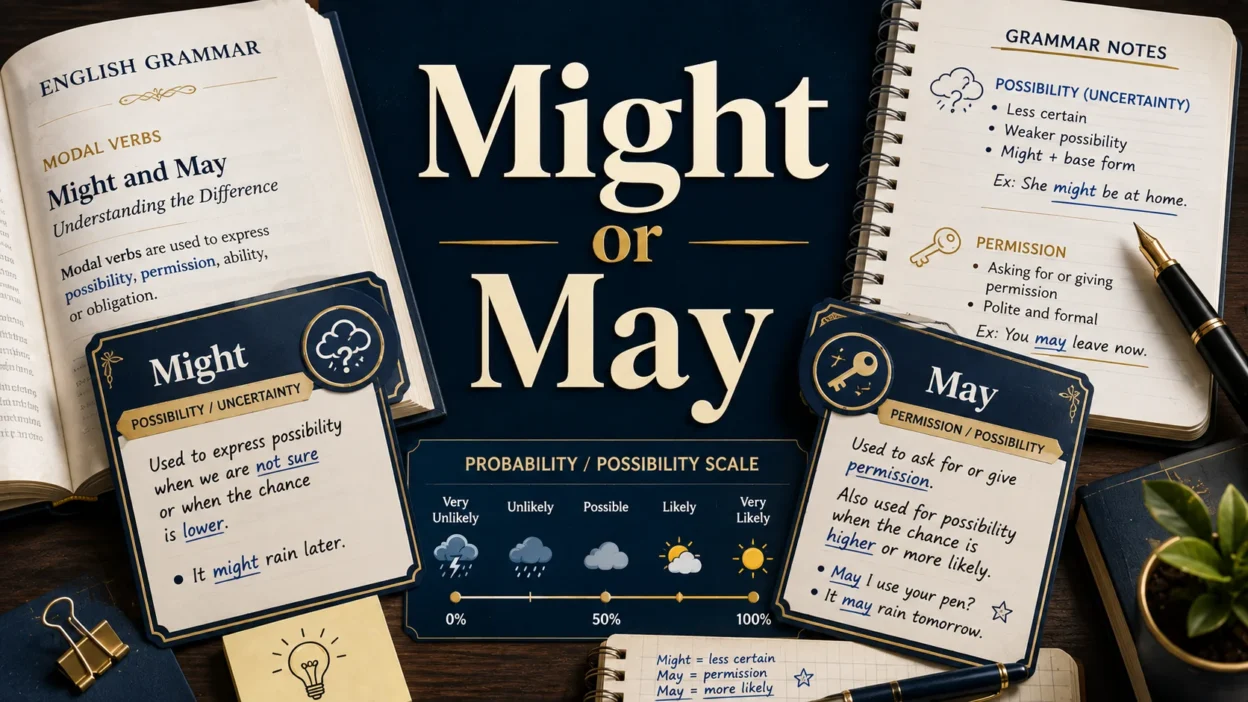
Might and may are modal verbs that often express possibility, but they do not always communicate exactly the same idea. Both can describe something that could happen, yet the choice between them can depend on certainty, context, permission, time, and tone.
For example, you can say, She may come to the party, or She might come to the party. Both sentences suggest that her arrival is possible. However, might often sounds slightly more uncertain, while may can sound more formal.
The two words also behave differently in some situations. May commonly expresses permission, as in You may leave now, while might does not normally express permission in modern standard English.
Understanding these differences will help you choose between might or may naturally in everyday conversation, academic writing, and professional English.
Might or May?
Use may and might to express possibility.
- May = something is possible
- Might = something is possible, often with greater uncertainty
- May = can also express permission
- Might = can refer to hypothetical or less certain situations
Examples:
- She may arrive later.
- She might arrive later.
- You may leave after the meeting.
- If I had more time, I might join you.
The difference between may and might is often subtle. In many possibility sentences, native speakers can use either word without changing the basic meaning.
Might vs. May at a Glance
| Feature | May | Might |
|---|---|---|
| Possibility | Yes | Yes |
| Permission | Yes | Usually no |
| Formality | Neutral/Formal | Neutral |
| Typical certainty | Possible | Often more uncertain |
| Hypothetical situations | Sometimes | Very common |
| Past possibility | May have | Might have |
| Example | She may call. | She might call. |
What Does “May” Mean?
May is a modal verb with several common uses.
The most important uses include:
- Expressing possibility
- Asking for permission
- Giving permission
- Making formal statements about possibility
May for Possibility
Use may when something has a possibility of happening.
Examples:
- It may rain tonight.
- She may visit us tomorrow.
- The company may change its policy.
- Prices may increase next year.
In these sentences, may does not guarantee that something will happen. It simply presents the event as possible.
May for Permission
May can also express permission.
Examples:
- You may leave now.
- Students may use calculators during the exam.
- You may enter the room.
- Guests may park here.
This use separates may from might.
What Does “Might” Mean?
Might is also a modal verb that commonly expresses possibility.
Examples:
- It might rain tonight.
- She might visit us tomorrow.
- The company might change its policy.
- Prices might increase next year.
Might often suggests that the speaker feels less certain about the possibility.
However, English speakers do not always make a strict distinction between the certainty levels of may and might.
May vs. Might for Possibility
This represents the most common area of confusion.
Compare:
She may come to dinner.
She might come to dinner.
Both sentences mean that her arrival is possible.
The first can sound slightly more confident or neutral.
The second can suggest greater uncertainty.
However, the difference depends heavily on context and the speaker’s intention.
Example
If you have strong evidence that she plans to attend:
She may come to dinner.
If you have little information:
She might come to dinner.
Neither sentence guarantees that she will attend.
Is May More Certain Than Might?
Traditionally, many grammar guides describe may as expressing a stronger possibility than might.
For example:
- She may come. → possible
- She might come. → possible but perhaps less likely
That distinction can help learners, but modern English does not always maintain a strict difference in probability.
Native speakers often choose may and might based on tone, context, and personal preference.
Therefore, don’t treat the difference as an exact percentage of certainty.
May or Might for Permission?
Use may for permission.
Examples:
- You may leave early.
- You may use my computer.
- You may sit here.
- Visitors may enter through this door.
Might normally does not replace may in these sentences.
Incorrect in standard modern usage:
You might leave early.
That sentence normally expresses possibility rather than permission.
For permission, use:
You may leave early.
May vs. Might in Questions
May can appear in polite questions that ask for permission.
Examples:
- May I come in?
- May I ask a question?
- May I use your phone?
- May we begin?
This construction sounds polite and somewhat formal.
Can I vs. May I?
In everyday American English, people commonly use Can I…? to ask for permission.
Example:
Can I use your laptop?
May I…? sounds more formal or polite.
Example:
May I use your laptop?
Might I…? also exists, but it sounds very formal, old-fashioned, or highly tentative in many modern contexts.
Example:
Might I ask you a question?
You may encounter it in formal speeches, literature, or very polite requests.
May vs. Might for Future Possibility
Both words can describe something that could happen in the future.
Examples:
- We may travel next month.
- We might travel next month.
- The weather may improve tomorrow.
- The weather might improve tomorrow.
The basic meaning remains similar.
Use might when you want the statement to sound more tentative.
Might for Hypothetical Situations
Might works especially well in hypothetical situations.
Examples:
- If we leave early, we might avoid traffic.
- If she studied harder, she might pass the exam.
- If I had more money, I might buy a new car.
Here, might helps communicate a possible result rather than a guaranteed outcome.
May in Formal and Academic Writing
May frequently appears in academic and professional writing because it allows writers to express possibility without making an absolute claim.
Examples:
- This approach may improve efficiency.
- The results may indicate a connection between the variables.
- The treatment may reduce symptoms.
- These findings may have broader implications.
This cautious style helps writers avoid overstating their conclusions.
Might in Formal and Academic Writing
Might can also express uncertainty in formal writing.
Examples:
- The findings might suggest a different explanation.
- This change might affect future results.
- The policy might create additional challenges.
Might can sound more tentative than may, which can be useful when evidence remains limited.
May Have vs. Might Have
Both may have and might have can describe a possible past event.
May Have
Use may have + past participle to describe a possible past situation.
Examples:
- She may have forgotten the appointment.
- He may have missed the train.
- They may have misunderstood the instructions.
Might Have
Use might have + past participle in a similar way.
Examples:
- She might have forgotten the appointment.
- He might have missed the train.
- They might have misunderstood the instructions.
Might have often sounds more tentative.
May Have vs. Might Have in Hypothetical Situations
Might have commonly appears when discussing an unreal or alternative past.
Example:
If we had left earlier, we might have caught the train.
The speaker describes a possible result that did not necessarily happen.
This pattern frequently appears with conditional sentences.
Common Mistakes With May and Might
Mistake 1: Using Might for Permission
Incorrect:
You might leave now.
If you mean permission, use:
You may leave now.
Mistake 2: Treating May and Might as Completely Different
They overlap significantly when they express possibility.
Both can work:
It may rain.
It might rain.
The difference often concerns tone and degree of uncertainty rather than a completely different meaning.
Mistake 3: Adding “To” After May or Might
Modal verbs take the base form of the main verb.
Correct:
- She may go.
- She might go.
Incorrect:
- She may to go.
- She might to go.
Mistake 4: Adding “S” to the Main Verb
After a modal verb, use the base form.
Correct:
- He may work late.
- She might visit tomorrow.
Incorrect:
- He may works late.
- She might visits tomorrow.
May and Might Grammar Rules
The basic structure is:
Subject + may/might + base verb
Examples:
- She may arrive soon.
- He might call later.
- They may visit next week.
- We might stay home.
For past possibility:
Subject + may/might have + past participle
Examples:
- She may have forgotten.
- He might have left.
- They may have misunderstood.
May vs. Might With “Be”
Both can combine with be.
Examples:
- She may be busy.
- She might be busy.
- The answer may be correct.
- The answer might be correct.
Again, might can make the statement sound more tentative.
May vs. Might With “Have”
Both can express possession or past possibility depending on the structure.
Possibility of Possession
- She may have a car.
- She might have a car.
Possible Past Action
- She may have left already.
- She might have left already.
The main verb following have determines the exact meaning.
May vs. Might: Formality and Tone
May can sound more formal in certain contexts, especially when expressing permission.
Example:
You may begin the examination.
Might often sounds more tentative.
Example:
We might need additional time.
In possibility statements, both can sound perfectly natural in professional and everyday English.
May vs. Might Examples
May
- It may rain tonight.
- She may arrive later.
- The store may close early.
- He may know the answer.
- You may enter now.
- We may need more information.
- The results may change.
- They may accept the offer.
Might
- It might rain tonight.
- She might arrive later.
- The store might close early.
- He might know the answer.
- We might need more information.
- The results might change.
- They might accept the offer.
- I might join you later.
May vs. Might in Conditional Sentences
Might often appears naturally in conditional sentences.
Examples:
- If we hurry, we might catch the bus.
- If she calls, I might answer.
- If the weather improves, we might go outside.
- If he studies tonight, he might pass the test.
May can also appear in some conditional structures:
- If you follow the instructions, you may find the process easier.
Here, may often sounds more formal or instructional.
May vs. Might in Polite Requests
May I…? is a common formal request for permission.
Examples:
- May I sit here?
- May I ask something?
- May I leave early?
Might I…? can make a request extremely tentative.
Example:
- Might I suggest another approach?
This construction sounds formal and is less common in casual American English.
May vs. Might: Quick Comparison
| Situation | Better Choice | Example |
|---|---|---|
| General possibility | May / Might | It may/might rain. |
| Greater uncertainty | Might | She might come. |
| Permission | May | You may leave. |
| Formal permission | May | May I enter? |
| Hypothetical result | Might | We might win. |
| Possible past event | May have / Might have | She may/might have left. |
| Very tentative suggestion | Might | Might I suggest an alternative? |
| Academic uncertainty | May / Might | The results may/might indicate a trend. |
People Also Ask
What is the difference between may and might?
Both may and might express possibility. Might often sounds more uncertain or tentative, while may can sound slightly more confident or formal. May also expresses permission.
Is might stronger than may?
Usually, no. Traditional grammar often treats might as expressing a weaker possibility than may, but modern English does not always maintain a strict distinction.
Is “May I?” or “Might I?” correct?
Both are grammatically correct. May I…? commonly asks for permission, while Might I…? sounds more formal and tentative.
Can may and might mean the same thing?
Yes. When they express possibility, they often have nearly the same meaning.
Which is more formal, may or might?
May often sounds more formal when it expresses permission. In possibility statements, both can appear in formal writing.
Can I use might for permission?
Generally, no. Use may for standard expressions of permission.
Should I say “It may rain” or “It might rain”?
Both are correct. It might rain can sound slightly more uncertain, while it may rain can sound more neutral.
Is “might have” past tense?
Might have + past participle can describe a possible past event or hypothetical past result.
Example:
She might have forgotten her keys.
Frequently Asked Questions
Is “may” more certain than “might”?
It can be, but not always. Traditional grammar often presents may as slightly more likely than might, but speakers frequently use them interchangeably when expressing possibility.
Can I use “may” for future events?
Yes.
Example:
We may travel next month.
Can I use “might” for future events?
Yes.
Example:
We might travel next month.
Is “may” better than “might” in academic writing?
Neither is automatically better. Choose may when you want a neutral possibility and might when you want to emphasize uncertainty or tentativeness.
Can “might” express a hypothetical situation?
Yes. This is one of its common uses.
Example:
If I had more time, I might learn another language.
What comes after may and might?
Use the base form of the verb.
Correct:
- may go
- might go
- may work
- might work
Can I say “may to”?
No. Modal verbs do not take to before the main verb.
Correct:
She may leave.
Incorrect:
She may to leave.
Can I say “might to”?
No.
Correct:
He might come later.
Incorrect:
He might to come later.
Conclusion
Choosing between might or may becomes easier when you focus on the purpose of the sentence. Both modal verbs commonly express possibility, and in many situations either one works naturally.
Use may when you want to express possibility or permission:
She may arrive later.
You may leave now.
Use might when you want to express possibility with a more tentative tone or discuss a hypothetical result:
She might arrive later.
If we leave now, we might catch the train.
The most important distinction is permission. May can grant or request permission, while might normally does not.
Remember the simple rule: may and might both express possibility, but may also expresses permission, while might often sounds more tentative.

Vivian Mercer is an English language writer and vocabulary enthusiast who specializes in synonyms, word meanings, grammar, idioms, and language usage. She creates accurate, easy-to-understand content that helps readers improve their English skills with confidence.