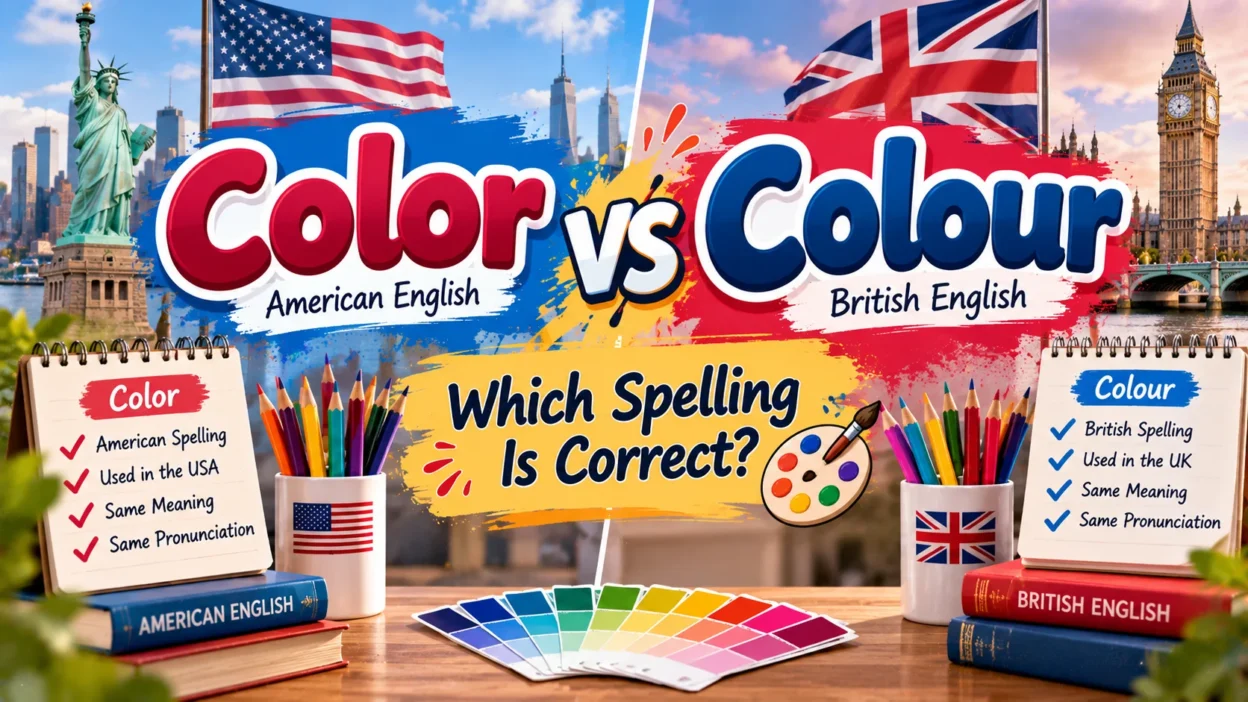
Color vs colour often confuses English learners because both spellings have the same meaning and pronunciation. The only real difference is the spelling style used in different varieties of English.
Color is the standard spelling in American English, while colour is the traditional spelling in British English and several other English-speaking countries. Neither spelling is inherently wrong; the correct choice depends on the type of English you are using.
If you write for a U.S. audience, choose color. If you follow British English, use colour.
🎨 Color vs Colour at a Glance
The easiest way to understand these two spellings is to look at where people commonly use them. American English usually removes the u, while British English keeps it.
| Word | Common English Variety | Meaning | Example |
|---|---|---|---|
| Color | American English | A visual property produced by light | What is your favorite color? |
| Colour | British English | A visual property produced by light | What is your favorite colour? |
Both words refer to the same concept. They can describe shades such as red, blue, green, yellow, black, white, purple, orange, and pink.
Quick Rule
American English → color
British English → colour
This spelling difference also appears in several related words, including colorful/colourful, coloring/colouring, and colorless/colourless.
🇺🇸 When Should You Use Color?
Use color when you are writing in American English. This spelling appears throughout U.S. schools, newspapers, websites, books, software, product descriptions, and everyday communication.
For example:
- The color of the car is bright red.
- Blue is my favorite color.
- Which color should we choose?
- The artist used several colors in the painting.
- This shirt comes in three different colors.
If your website targets readers in the United States, color should usually be your preferred spelling.
For SEO content aimed at a U.S. audience, consistency matters more than switching between the two forms. Choose American English and maintain that style throughout the article.
🇬🇧 When Should You Use Colour?
Use colour when you are following British English conventions. The spelling appears commonly in the United Kingdom and in several countries influenced by British English.
Examples include:
- What is your favourite colour?
- The colour of the wall looks beautiful.
- She chose a bright colour for the room.
- Different colours create different moods.
- The artist mixed several colours together.
British English also commonly uses favourite, while American English uses favorite. The same general spelling distinction appears with several words ending in -our.
🔤 Why Does Colour Have a U?
The extra u comes from historical British spelling conventions. English developed through influences from several languages, including French and Latin, and spelling traditions evolved differently on both sides of the Atlantic.
American English later adopted a number of simplified spellings. Writers and dictionary makers in the United States helped establish forms such as color instead of colour.
This pattern appears in several words:
| American English | British English |
|---|---|
| color | colour |
| favorite | favourite |
| honor | honour |
| behavior | behaviour |
| neighbor | neighbour |
| labor | labour |
| rumor | rumour |
| flavor | flavour |
The meanings remain the same. The spelling reflects the variety of English being used.
📝 Color vs Colour Examples
Seeing both forms in complete sentences makes the distinction easier to remember. Notice that the meaning does not change when the spelling changes.
| American English | British English |
|---|---|
| What is your favorite color? | What is your favourite colour? |
| I love the color of these flowers. | I love the colour of these flowers. |
| The wall needs a new color. | The wall needs a new colour. |
| She wore a bright color. | She wore a bright colour. |
| The artist mixed several colors. | The artist mixed several colours. |
| Which color looks better? | Which colour looks better? |
The sentence structure stays almost identical. Only the spelling changes.
🌈 Do Color and Colour Mean the Same Thing?
Yes. Color and colour have the same meaning.
Both words describe the visual characteristic of an object that people perceive through light. They can also appear in figurative expressions.
For example, someone might say that an event added color to a story in American English or added colour to a story in British English.
The spelling does not create a difference in definition.
| Feature | Color | Colour |
|---|---|---|
| Meaning | Same | Same |
| Pronunciation | Same | Same |
| American English | ✅ Standard | ❌ Less common |
| British English | ❌ Less common | ✅ Standard |
| Canadian English | Common | Common |
| Australian English | Less common | Standard |
| Plural | colors | colours |
🗣️ How Do You Pronounce Color and Colour?
Both words have essentially the same pronunciation in standard English.
They are commonly pronounced like KUHL-er, with the exact pronunciation varying slightly by accent.
The extra u in colour does not create an additional spoken syllable.
| Spelling | Pronunciation | Syllables |
|---|---|---|
| Color | KUL-er | 2 |
| Colour | KUL-er | 2 |
Therefore, you do not need to pronounce the two spellings differently.
🇨🇦 What About Canadian English?
Canadian English often uses a mixture of American and British spelling conventions. Colour is widely used, particularly in formal writing, although Canadian English also includes some American-style spellings.
For example, Canadian writing commonly uses:
- colour
- favourite
- honour
- neighbour
However, Canadian English has its own spelling conventions, so you should not assume that every Canadian word follows British or American rules exactly.
If you are writing for Canadian readers, follow a consistent Canadian style guide when formal consistency matters.
🇦🇺 What About Australian English?
Australian English generally follows British spelling traditions, so colour is the standard form.
For example:
The colour of the Australian flag is easy to recognize.
Australian English also commonly uses spellings such as favourite, honour, and neighbour.
The same principle applies: choose the spelling that matches your target audience and maintain consistency.
💻 Color vs Colour in Technology
Technology sometimes makes this distinction especially noticeable because software, programming languages, and design tools may use American English terminology even when users live in countries that normally use British English.
For example, a programming property may use color because the software or programming language follows American naming conventions.
You may encounter terms such as:
- color
- background-color
- color code
- color picker
- color palette
These technical terms usually retain their established spelling regardless of the user’s location.
This means a British English writer may use colour in ordinary prose but still write a technical term containing color when the technology requires that exact spelling.
🎨 Colorful vs Colourful
The spelling difference continues when you add suffixes.
American English uses colorful, while British English uses colourful.
| American English | British English |
|---|---|
| colorful | colourful |
| coloring | colouring |
| colorless | colourless |
| coloration | colouration |
| multicolor | multicolour |
For example:
American: The garden looks colorful in spring.
British: The garden looks colourful in spring.
Again, the meaning remains unchanged.
✍️ Color or Colour in Academic Writing?
Both forms work in academic writing as long as they match the required style.
If an American university asks you to use U.S. English, choose color. If a British institution or publication follows British English, choose colour.
The most important principle is consistency.
Avoid writing one paragraph with American spelling and another with British spelling unless you have a specific reason. Consistent spelling makes your work look polished and professional.
A Simple Writing Tip
Before starting a formal document, identify your audience.
- U.S. readers: use color.
- U.K. readers: use colour.
- Australian readers: generally use colour.
- Canadian readers: generally use colour, while recognizing Canadian-specific conventions.
- International audience: choose one standard and apply it consistently.
🔍 Color vs Colour in SEO and Websites
For websites, the best spelling depends on the audience and search intent.
If your website primarily targets people in the United States, color will usually fit your content style better. If you target the United Kingdom, colour makes more sense.
However, you should not randomly switch spellings simply to target both keywords. Search engines can understand spelling variations, but your content should still sound natural.
For example, a U.S.-focused article can use:
What Is the Meaning of Color?
A U.K.-focused article can use:
What Is the Meaning of Colour?
Choose the spelling that matches your site’s overall English style.
⚖️ Color vs Colour: Which One Is Correct?
Both are correct.
The difference comes from regional English conventions rather than meaning or grammar.
Color is correct in American English.
Colour is correct in British English and is also common in Australian and other varieties influenced by British English.
So, asking which spelling is universally correct creates the wrong impression. Both forms have a legitimate place in modern English.
🧠 Easy Trick to Remember the Difference
If you are writing for an American audience, remember:
Color = U.S. English
The American spelling drops the u.
For British English:
Colour = U.K. English
The British spelling keeps the u.
You can use the same idea with related words:
American: honor, favor, labor, color
British: honour, favour, labour, colour
Once you recognize this pattern, the spelling becomes much easier to remember.
📚 Other Words That Follow the Same Pattern
The difference between these spellings does not exist only with this particular word. Several English words show the same regional pattern.
| U.S. English | British English |
|---|---|
| color | colour |
| honor | honour |
| favor | favour |
| humor | humour |
| labor | labour |
| odor | odour |
| rumor | rumour |
| vigor | vigour |
| valor | valour |
| splendor | splendour |
There are exceptions and additional differences between American and British spelling, but the -or vs -our pattern is one of the easiest to recognize.
❓ Frequently Asked Questions
Is color or colour correct?
Both are correct. Color follows American English spelling, while colour follows British English spelling.
Is color American or British?
Color is the standard American English spelling.
Is colour British English?
Yes. Colour is the standard British English spelling.
Do color and colour sound the same?
Yes. They generally have the same pronunciation despite the different spellings.
Which spelling should I use in the USA?
Use color when writing in American English.
Which spelling should I use in the UK?
Use colour when following British English conventions.
Is colour wrong in American English?
No. American readers can understand it easily, but color is the standard U.S. spelling.
Is color wrong in British English?
No. British readers understand color, and you may encounter it in technical or international contexts. However, colour is the conventional British spelling.
Is colorful American or British?
Colorful is the American spelling. British English normally uses colourful.
Why does British English add a U?
The u reflects historical British spelling conventions, while American English adopted simplified forms such as color.
🏁 Final Verdict: Color or Colour?
The difference between color vs colour is simple: color belongs to American English, while colour represents the traditional British spelling. Both words carry exactly the same meaning and pronunciation.
If you write for a U.S. audience, choose color. If your readers use British English, choose colour. For professional writing, the most important rule is to pick one regional style and use it consistently throughout your content.

Vivian Mercer is an English language writer and vocabulary enthusiast who specializes in synonyms, word meanings, grammar, idioms, and language usage. She creates accurate, easy-to-understand content that helps readers improve their English skills with confidence.