
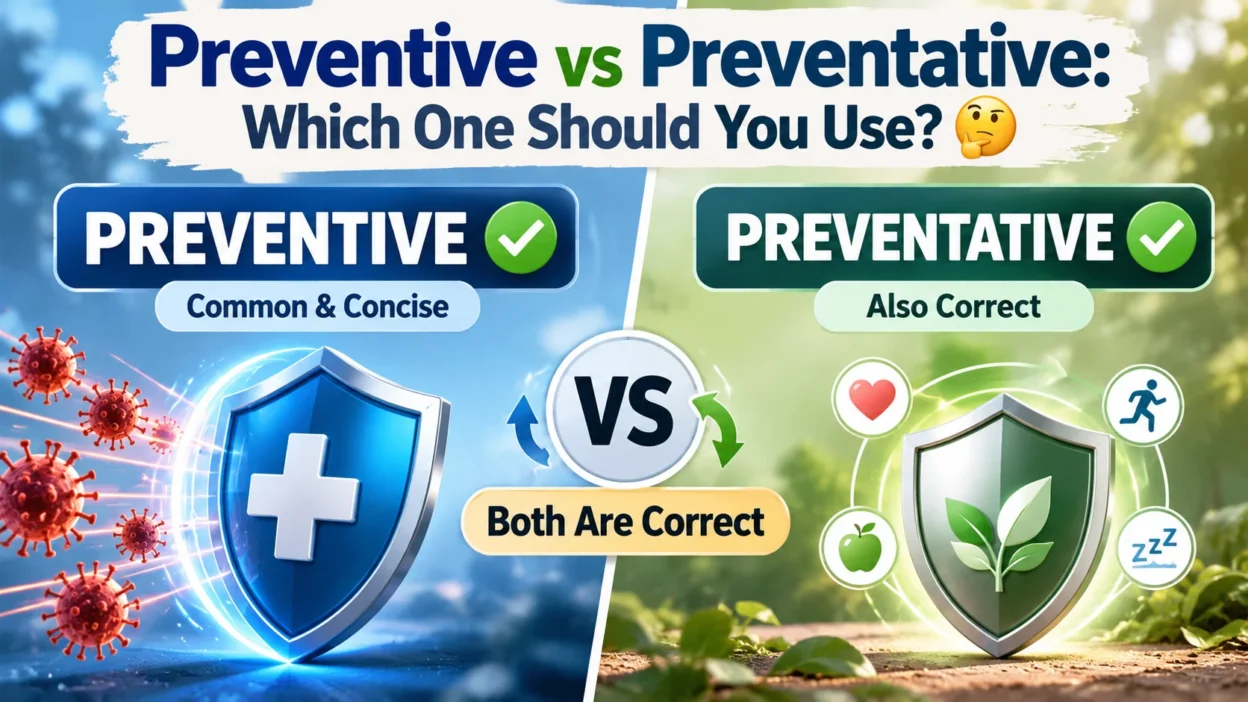
Choosing between preventive and preventative can be surprisingly confusing. Both words are established English adjectives, both relate to stopping something before it happens, and both are widely understood.
The key difference is not meaning but usage, frequency, and style. In most modern writing, particularly American English, preventive is the more concise and commonly preferred form. However, preventative is also grammatically correct and should not be treated as a spelling error.
🔍 Preventive vs Preventative at a Glance
The two words share the same basic definition: something designed to prevent a problem, condition, event, or unwanted outcome. The choice usually depends on regional preference, established terminology, and the style of the publication.
| Feature | Preventive | Preventative |
|---|---|---|
| Part of speech | Adjective | Adjective |
| Meaning | Intended to prevent something | Intended to prevent something |
| Correct spelling | Yes | Yes |
| General usage | More common | Less common |
| American English | Very common | Used, but less common |
| British English | Common | Also used |
| Style | Concise and direct | Slightly longer |
| Example | Preventive care | Preventative care |
Bottom line: If you need a general-purpose choice, preventive is usually the safest option.
📖 What Does Preventive Mean?
Preventive is an adjective describing something intended to stop a problem or event before it occurs. It is formed from the verb prevent and is widely used in medical, technical, professional, academic, and everyday English.
For example, preventive care refers to healthcare intended to reduce health risks or identify potential problems before they become more serious. Likewise, preventive maintenance involves inspecting or servicing equipment before a failure occurs.
Examples include:
- The clinic provides preventive healthcare services.
- Regular inspections are an important preventive measure.
- The company follows a preventive maintenance schedule.
- Employees received preventive safety training.
Because of its concise form and widespread use, preventive is often the preferred choice in formal and professional writing.
📝 What Does Preventative Mean?
Preventative is also a standard adjective meaning intended to prevent something from happening. It has the same fundamental meaning as preventive and can often be substituted without changing the meaning of a sentence.
For example:
- The organization introduced preventative safety measures.
- The doctor recommended preventative treatment.
- Regular maintenance can have a preventative effect.
- The program focuses on preventative strategies.
Although correct, preventative is generally less frequent than preventive. Some writers prefer it because it follows a familiar adjective pattern, while others choose preventive because it is shorter and more established in certain professional contexts.
⚖️ Are Preventive and Preventative the Same?
In most contexts, yes. There is no significant difference in their core meaning.
Both words describe an action, measure, treatment, or strategy intended to prevent something before it happens. The distinction is primarily one of usage and stylistic preference, rather than definition.
Compare these sentences:
The hospital expanded its preventive care program.
The hospital expanded its preventative care program.
Both sentences communicate the same idea. The first is simply more common in many modern contexts, particularly in American professional writing.
🇺🇸 Which Form Is Preferred in American English?
In American English, preventive is generally the more common form. It appears frequently in healthcare, government, business, engineering, education, and technical terminology.
Common expressions include:
- preventive care
- preventive medicine
- preventive treatment
- preventive measures
- preventive action
- preventive maintenance
- preventive services
- preventive strategy
For professional content aimed at a U.S. audience, preventive is usually the more natural and efficient choice.
This does not mean preventative is incorrect in American English. It simply tends to be less common.
🇬🇧 Which Form Is Used in British English?
British English uses both preventive and preventative. While preventative may appear more frequently in some British contexts, it would be inaccurate to treat it as exclusively British.
Both forms are recognized and understood across major varieties of English. Regional publications, professional organizations, and individual writers may have their own preferences.
Therefore, the distinction should not be reduced to:
Preventive = American English
Preventative = British English
The actual usage is more flexible than that.
🏥 Preventive vs Preventative in Healthcare
Healthcare is one of the most common areas where these adjectives appear. The term preventive care is particularly well established in American medical and public-health writing.
Preventive healthcare focuses on reducing health risks, identifying potential conditions early, and maintaining overall health rather than waiting until a problem becomes serious.
Examples include:
- Preventive care can help identify health risks early.
- Regular screenings are part of preventive healthcare.
- Vaccination is an important preventive measure.
- Preventive medicine emphasizes disease prevention.
You may also encounter preventative care or preventative medicine, and these forms are understandable and grammatically acceptable. However, preventive is generally the more conventional choice in professional American healthcare terminology.
🛠️ Preventive vs Preventative Maintenance
The phrase preventive maintenance is widely used in engineering, manufacturing, automotive services, technology, facilities management, and other technical fields.
Preventive maintenance involves inspecting, servicing, cleaning, repairing, or replacing equipment before a breakdown occurs. The purpose is to improve reliability, reduce unexpected failures, and extend equipment life.
For example:
The facility uses a preventive maintenance program to reduce equipment failures.
The alternative preventative maintenance is also grammatically acceptable. However, preventive maintenance is the more established technical expression and is usually preferable in professional documentation.
✍️ Which Word Is Better for Formal Writing?
For most formal writing, preventive is the stronger default choice. It is concise, widely recognized, and common across professional and academic contexts.
If you are writing an article, report, business document, academic paper, website, or technical guide, using preventive will generally give your sentence a clean and direct style.
For example:
The organization implemented preventive measures to reduce operational risks.
This is concise and professional.
That said, preventative is not inappropriate simply because it is longer. If an organization, publication, or established terminology uses preventative, maintaining that wording can be perfectly reasonable.
📚 Preventive vs Preventative in Common Phrases
Some expressions naturally appear more often with preventive because they have become established collocations in professional English.
| Common phrase | Preferred form |
|---|---|
| Healthcare | Preventive care |
| Medicine | Preventive medicine |
| Maintenance | Preventive maintenance |
| Safety | Preventive measures |
| Health | Preventive health |
| Treatment | Preventive treatment |
| Strategy | Preventive strategy |
| Action | Preventive action |
| Services | Preventive services |
The longer form can technically appear in many of these expressions, but the preventive version is generally more familiar and concise.
🧠 Why Do Both Words Exist?
The existence of both forms reflects a broader characteristic of English: words can develop alternative adjective forms over time.
Both preventive and preventative are built around the idea of prevention. The shorter form connects directly with prevent, while the longer form developed as an alternative adjective formation.
English contains many words with competing forms that remain acceptable even when one becomes more common. This is why preventative can be correct without being the preferred choice in every context.
🚫 Is “Preventative” Wrong?
No. Preventative is not wrong.
It is a legitimate English adjective with the same fundamental meaning as preventive. Calling it an incorrect spelling would be misleading.
The better distinction is:
- Preventive: more concise and generally more common.
- Preventative: correct, but less common in many contexts.
If you are editing professional content, the question should therefore be which form is more appropriate for the audience and style, rather than whether one is grammatically valid.
💡 How to Choose Between Preventive and Preventative
When you are unsure which word to use, consider three factors: audience, established terminology, and consistency.
For American English, preventive is usually the best default. It is particularly appropriate for healthcare, technical writing, business documents, and online content.
If a specific organization or publication consistently uses preventative, there is no need to change it merely because preventive is more common.
Most importantly, avoid switching between the two forms without a reason. Consistent terminology gives professional writing a more polished appearance.
📝 Preventive vs Preventative Examples
Both forms can work in the following sentences:
Preventive:
- Preventive measures reduced the risk of accidents.
- The physician discussed preventive care.
- The company introduced preventive maintenance.
- Regular exercise can support preventive health.
- The team developed a preventive strategy.
Preventative:
- Preventative measures reduced the risk of accidents.
- The physician discussed preventative care.
- The company introduced preventative maintenance.
- Regular exercise can support preventative health.
- The team developed a preventative strategy.
In each example, the basic meaning remains unchanged.
📊 Preventive vs Preventative: Quick Comparison
| Question | Preventive | Preventative |
|---|---|---|
| Is it correct? | Yes | Yes |
| Is it an adjective? | Yes | Yes |
| Does it mean “intended to prevent”? | Yes | Yes |
| Is it shorter? | Yes | No |
| Is it widely used? | Yes | Yes, but less frequently |
| Preferred in many U.S. contexts? | Yes | Less often |
| Used in British English? | Yes | Yes |
| Can the words be interchangeable? | Usually | Usually |
| Best general default? | Yes | Not usually |
❓ Frequently Asked Questions About Preventive vs Preventative
Is preventive or preventative correct?
Both preventive and preventative are correct English adjectives. They generally mean something intended to stop a problem or event before it happens.
Which is more common: preventive or preventative?
Preventive is generally more common, especially in American English and professional terminology. It is also more concise.
Is preventative grammatically correct?
Yes. Preventative is grammatically correct and is recognized as a standard English word. It is not simply an incorrect spelling of preventive.
Which is better for American English?
Preventive is generally the better choice for American English because it is widely used and appears frequently in professional expressions such as preventive care and preventive maintenance.
Is preventative British English?
Not exclusively. Both preventative and preventive are used in British English. The choice can vary according to publication, profession, and personal preference.
Should I say preventive care or preventative care?
Both are acceptable, but preventive care is generally the more common and concise expression, particularly in American English.
Is it preventive maintenance or preventative maintenance?
Both forms are possible, but preventive maintenance is the more established expression in technical and professional writing.
What is the difference between prevention and preventive?
Prevention is a noun referring to the act or practice of stopping something from happening. Preventive is an adjective describing something designed to achieve that purpose.
For example:
Prevention is important in healthcare.
Preventive care supports long-term health.
Can preventive and preventative be used interchangeably?
In most situations, yes. They have essentially the same meaning and can often be substituted without changing the intended message.
Which form should I use in formal writing?
Preventive is usually the best default because it is concise, widely recognized, and common in professional and academic writing. However, preventative remains grammatically acceptable.
🎯 Final Verdict
The choice between preventive and preventative is primarily a matter of usage and style, not correctness. Both words are legitimate adjectives meaning intended to prevent something from happening.
If you want the most concise and widely accepted option, choose preventive. It is especially common in American English and established phrases such as preventive care, preventive medicine, and preventive maintenance.
Preventative is also correct and can be used when it fits your preferred style or an established terminology. In short, you do not need to consider it a mistake—but when in doubt, preventive is the stronger general-purpose choice.

Vivian Mercer is an English language writer and vocabulary enthusiast who specializes in synonyms, word meanings, grammar, idioms, and language usage. She creates accurate, easy-to-understand content that helps readers improve their English skills with confidence.