
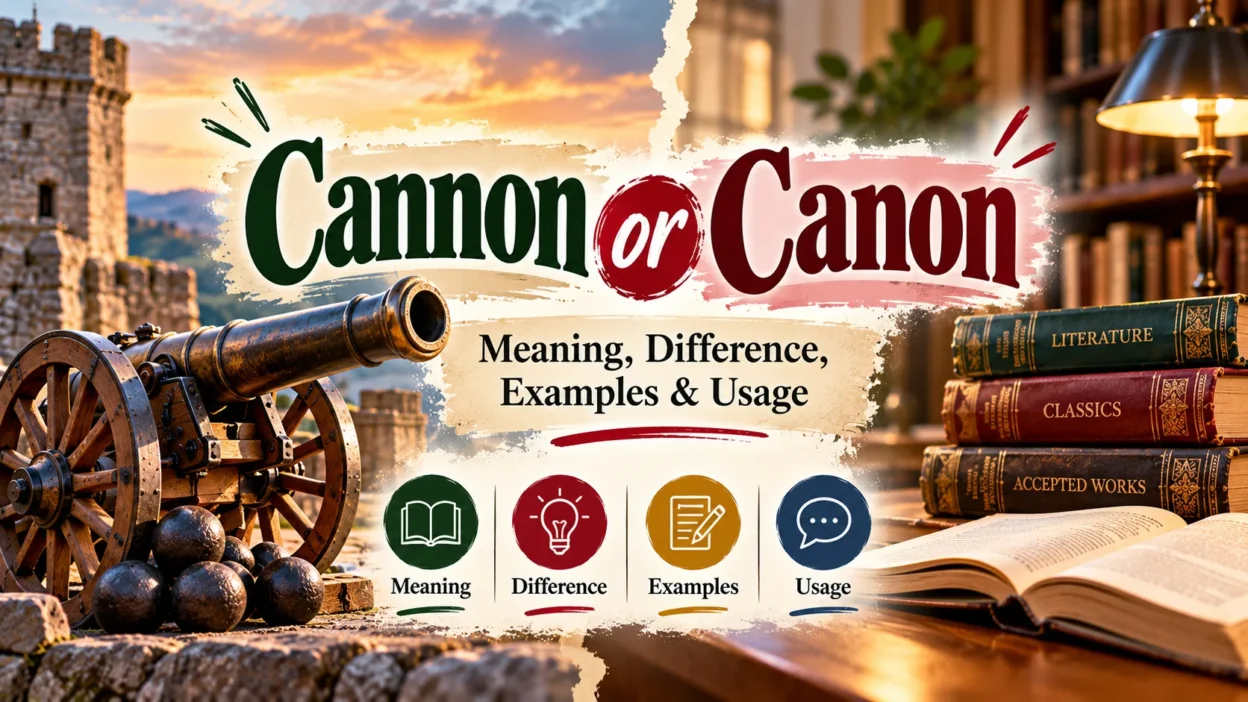
Cannon or canon? These two words look almost identical, but they have completely different meanings. The extra n in cannon changes the word from a rule, collection, or accepted body of works into a large military gun.
This spelling confusion is common because cannon and canon are pronounce the same in most varieties of English. They are therefore homophones: words that sound alike but have different spellings and meanings.
A cannon is a large gun design to fire a projectile, while a canon can refer to an accepted set of works, an established rule or principle, or an official collection of religious texts. In entertainment, canon is also frequently used for events and characters officially recognized as part of a fictional story or universe.
Understanding the difference between cannon vs. canon is important in writing because using the wrong spelling can completely change the meaning of a sentence.
📖 Cannon vs. Canon at a Glance
The easiest way to understand these words is to compare their meanings side by side. Although cannon and canon sound alike, they belong to different semantic categories and are use in very different contexts.
| Word | Meaning | Common Contexts | Example |
|---|---|---|---|
| Cannon | A large gun that fires projectiles | Military, history, weapons, ships | The cannon fired across the battlefield. |
| Canon | An accepted rule, standard, or collection of works | Literature, religion, art, entertainment | The novel is considered part of the literary canon. |
| Canon | Official story material in fiction | Movies, TV, books, games | That character is officially part of the series canon. |
| Canon | A church official or ecclesiastical rule | Religion | The cathedral has several canons. |
The important point is simple: cannon is the weapon; canon is generally a rule, standard, collection, or accepted body of material.
💥 What Does Cannon Mean?
A cannon is a large gun that is designed to fire a projectile, traditionally using explosive force. The word is strongly associated with military history, artillery, ships, forts, and warfare.
Historically, cannons were important weapons because they could launch heavy projectiles over significant distances. They appeared in different forms and sizes and were used by armies and naval forces.
Today, the word cannon can refer to large artillery pieces or other large projectile-firing guns, depending on the context.
Examples of cannon in a sentence:
- The old cannon stood outside the historic fort.
- The museum displays a cannon from the colonial period.
- The soldiers moved the cannon into position.
- A large cannon was mounted on the ship.
- Visitors could see several antique cannons in the courtyard.
When the subject involves military weapons, artillery, forts, battles, or historic ships, cannon is usually the word needed.
📚 What Does Canon Mean?
Canon has several meanings, but they all differ from the weapon-related meaning of cannon.
One common meaning is an accepted collection of works. For example, the literary canon can refer to works widely recognized as important within literature.
The word can also describe an accepted rule, standard, or principle.
In religion, canon can refer to an officially recognized collection of sacred writings. In Christian contexts, for example, the biblical canon refers to the books recognized as authoritative within a particular tradition.
So In fictional storytelling, canon refers to material that is officially recognized as part of a story’s established continuity.
Examples of canon in a sentence:
- The novel became part of the literary canon.
- Scholars continue to discuss the biblical canon.
- That episode is considered part of the show’s canon.
- The director confirmed that the character is canon.
- The artist studied the canon of classical works.
⚖️ Cannon vs. Canon: The Main Difference
The biggest difference between cannon and canon is their meaning.
Cannon refers to a large gun or artillery weapon.
Canon can refer to an accepted standard, a recognized collection of works, an authoritative collection of religious texts, or officially established material within a fictional universe.
A useful comparison is:
Cannon = weapon
Canon = accepted collection, rule, or official story
The extra n in cannon is therefore not a minor spelling detail. It changes the word completely.
🔊 Cannon and Canon Pronunciation
In most standard English pronunciation, cannon and canon sound the same or extremely similar.
They are commonly pronounced approximately like:
CAN-un
| Word | Pronunciation | Syllables |
|---|---|---|
| Cannon | CAN-un | 2 |
| Canon | CAN-un | 2 |
This is one reason the words are easy to confuse in writing. Someone may hear the word correctly but still need to determine which spelling fits the context.
The difference is primarily visible in writing rather than obvious in ordinary speech.
🧠 Easy Trick to Remember Cannon vs. Canon
A simple memory trick is to connect the extra n in cannon with its physical size.
Think:
CANNON = a big gun
The word cannon looks visually bigger because it contains the extra n.
For canon, think:
CANON = a collection, rule, or official standard
Another helpful association is:
Cannon → military
Canon → literature, religion, rules, fiction
These associations make the spelling easier to remember when writing quickly.
✍️ Cannon Examples in Everyday Writing
The word cannon commonly appears in historical writing, military descriptions, museum information, fiction, and discussions of artillery.
Here are several examples:
- The cannon was positioned near the castle wall.
- The pirate ship carried several cannons.
- The historic cannon was restored for display.
- The battle began after the cannons were fired.
- The fort once used cannons to defend the harbor.
- The documentary featured an enormous naval cannon.
- The old cannon remains a popular attraction.
- Soldiers transported the cannon across the field.
- The museum’s largest cannon dates back centuries.
- The cannon was displayed beside other military artifacts.
In each example, cannon refers to a physical weapon.
📚 Canon Examples in Everyday Writing
The word canon appears in many academic, religious, literary, artistic, and entertainment contexts.
Examples include:
- Shakespeare is often discussed as part of the literary canon.
- The church established its biblical canon through a long historical process.
- That movie is not considered part of the franchise’s official canon.
- The professor assigned several works from the Western canon.
- The character’s backstory is now considered canon.
- The director changed an element of the established canon.
- The poem has become part of the national literary canon.
- Scholars continue to debate which works belong in the canon.
- The story expands the established canon of the series.
- The author created a new work outside the traditional canon.
Here, canon has nothing to do with a gun.
🎬 What Does Canon Mean in Movies and TV?
In movies, television, books, comics, anime, and video games, canon has a particularly important meaning.
When something is canon, it means that it is officially recognized as part of the established fictional story or continuity.
For example, if a television series reveals that two characters are siblings and that information is officially accepted within the story, their relationship can be described as canon.
Fans often use expressions such as:
- Official canon
- Story canon
- Canon character
- Canon relationship
- Canon event
- Canon storyline
- Canon ending
- Canon material
This usage is especially common in fan communities.
🎮 Canon vs. Fan Theory
In fictional worlds, canon should be distinguish from theories, speculation, and fan-created material.
A canon event is officially established by the creator or rights holder within the relevant fictional continuity.
A fan theory is an interpretation or explanation created by fans. It may be convincing, but it does not automatically become canon.
Similarly, fan fiction can expand or reinterpret a fictional universe without becoming part of its official canon.
For example:
- Officially shown event = canon
- Creator-confirmed fact = canon
- Fan interpretation = fan theory
- Fan-created story = fan fiction
- Personal interpretation = headcanon
This distinction is particularly useful when discussing movies, books, comics, anime, and video games.
🧩 What Is a Headcanon?
Headcanon is an informal term use by fans for an idea they personally accept as true within a fictional universe even though it has not been officially established.
For example, a fan might imagine that a character has a particular hobby that is never mentioned in the story. That idea can become the fan’s headcanon, but it is not necessarily official canon.
This creates a useful distinction:
| Term | Meaning |
|---|---|
| Canon | Officially established story information |
| Headcanon | A fan’s personal interpretation |
| Fan theory | A fan-created explanation or prediction |
| Fan fiction | A fan-created story using existing characters or worlds |
⛪ What Does Canon Mean in Religion?
In religious contexts, canon can refer to a collection of writings officially recognized as authoritative.
The term is particularly familiar in discussions of the biblical canon. Different religious traditions have historically recognized different collections of books, which is why the term needs to be understood within the specific tradition being discussed.
The word can also refer to ecclesiastical rules or regulations.
For example:
- Scholars study the history of the biblical canon.
- Different traditions have different canonical collections.
- The discussion concerns which writings belong to the canon.
The religious meaning is therefore connected with authority, accepted texts, and established rules, not artillery.
📖 What Is the Literary Canon?
The literary canon generally refers to works that are widely recognized as important, influential, or significant within a literary tradition.
Books included in discussions of the literary canon may be studied extensively in schools and universities or regarded as influential examples of literature.
However, the literary canon is not a single fixed list accepted by everyone. Ideas about which works should receive attention can change over time.
Examples of phrases include:
- American literary canon
- Western literary canon
- English literary canon
- Classical literary canon
- Modern literary canon
🎨 Canon as a Standard or Rule
Another meaning of canon is an accepted principle, rule, or standard.
For example, someone might discuss the canon of artistic principles or established rules within a particular discipline.
This meaning is related to the broader idea of something being recognized as an accepted standard.
Examples include:
- The work follows the traditional canon of classical art.
- The composer studied the established canon of musical theory.
- The scholar challenged accepted ideas within the academic canon.
🧾 Canon as a Collection of Works
Canon can also refer to a recognized body or collection of works by an individual creator, genre, or tradition.
For example, someone might discuss:
- The complete canon of a novelist
- The musical canon of a composer
- The superhero canon
- The canon of classic films
- The canon of ancient literature
In each case, the word refers to a body of works or established material rather than a weapon.
❌ Common Cannon and Canon Mistakes
Because the words sound alike, writers sometimes accidentally substitute one for the other.
Incorrect:
That character is part of the official cannon.
Correct:
That character is part of the official canon.
The sentence concerns fictional continuity, so canon is correct.
Another example:
Incorrect:
The soldiers fired the canon.
Correct:
The soldiers fired the cannon.
The sentence refers to a weapon, so cannon is correct.
📝 Cannon vs. Canon Sentence Comparison
Seeing the two words in similar sentences makes the difference easier to understand.
| Cannon | Canon |
|---|---|
| The cannon fired across the field. | The book became part of the literary canon. |
| The ship carried a large cannon. | The character is officially part of the canon. |
| The museum displays an antique cannon. | Scholars debated the biblical canon. |
| The soldiers moved the cannon. | The episode expanded the show’s canon. |
| The castle once used a cannon. | The poem entered the literary canon. |
The context makes the correct spelling clear.
🔎 Cannon or Canon in Popular Phrases
Some phrases make the correct spelling especially easy to identify.
Use cannon with:
- Cannon fire
- Cannonball
- Cannon blast
- Cannon crew
- Naval cannon
- Military cannon
- Historic cannon
- Field cannon
- Cannon shot
- Cannon barrel
Use canon with:
- Literary canon
- Biblical canon
- Official canon
- Canon event
- Canon character
- Canon storyline
- Canon material
- Fictional canon
- Accepted canon
- Established canon
Learning these word combinations can make the distinction much faster.
🔤 Cannon, Canon, and Cannonball
Another useful spelling connection is cannonball.
A cannonball is a projectile historically fired from a cannon.
Because the word is directly related to the weapon, it uses the spelling cannon with two n’s after the o? More precisely, cannon is spelled c-a-n-n-o-n, and cannonball retains that spelling.
Examples:
- The museum displayed a cannonball.
- The cannonball was found near the old fort.
- Historians examined the cannonball as part of the archaeological discovery.
There is no standard word canonball with the meaning of a projectile fired from a cannon.
🧠 Why Are Cannon and Canon Confused?
The main reason is pronunciation.
When two words sound the same but have different meanings and spellings, writers must use context to determine which word belongs in a sentence.
English contains many other homophones that create similar problems:
- Their / there / they’re
- To / too / two
- Your / you’re
- Principal / principle
- Stationary / stationery
- Complement / compliment
- Affect / effect
Cannon and canon belong to this broader group of commonly confused English words.
📌 Cannon or Canon: Which One Should You Use?
Choosing between the two is simple once the meaning is identify.
Ask:
Am I talking about a gun or artillery?
Use cannon.
Am I talking about an accepted collection, rule, religious text collection, literary body, or official fictional story material?
Use canon.
Quick rule:
Weapon = cannon
Rule, collection, or official story = canon
🧠 Cannon or Canon Memory Trick
A memorable trick is:
CANNON has an extra N because a cannon is BIG.
Picture a large cannon with two giant N’s beside it.
For canon, think of a canon of books or a canon of stories.
Another simple memory sentence is:
The cannon fires; the canon defines.
This is not a complete explanation of every meaning of canon, but it is an easy way to separate the two words.
✨ Related Words You Should Know
Understanding related vocabulary can make the distinction even clearer.
Words related to cannon:
- Cannonball
- Artillery
- Gun
- Projectile
- Barrel
- Ammunition
- Weapon
- Fire
- Battlefield
- Naval artillery
Words related to canon:
- Canonical
- Canonize
- Canonization
- Canonically
- Literary
- Standard
- Collection
- Official
- Continuity
- Tradition
The adjective canonical is especially important. It generally means according to or forming part of an accepted canon.
For example:
The director confirmed the canonical ending.
📚 Canonical Meaning and Usage
Canonical is the adjective related to canon.
It can mean something that is accepted as authoritative, standard, or officially part of a particular canon.
Examples include:
- The canonical version of the story differs from the adaptation.
- Scholars examined the canonical texts.
- The character’s canonical history was revealed in the novel.
- The official website lists the canonical storyline.
Notice that canonical is never the spelling used for the large gun.
❓ FAQs About Cannon or Canon
Is it cannon or canon?
Both words are correct, but they have different meanings. Cannon means a large gun or artillery weapon, while canon can mean an accepted collection, rule, standard, religious text collection, or officially established fictional material.
Is cannon and canon pronounced the same?
In most English varieties, cannon and canon are pronounced the same or very similarly. This makes them homophones and explains why they are frequently confused in writing.
What is the difference between cannon and canon?
A cannon is a weapon that fires a projectile. A canon is generally an accepted collection, rule, standard, or body of officially recognized material. In fiction, canon means information officially established within a story’s continuity.
Is it canon or cannon in a movie?
Use canon when talking about the official story or continuity of a movie, television series, book, game, or fictional universe. For example, “That event is part of the official canon.”
Is it a cannonball or canonball?
The correct word for a projectile traditionally fired from a cannon is cannonball. It uses the same spelling as cannon, the weapon.
What does canon mean in literature?
In literature, canon generally refers to a recognized or influential body of literary works. The phrase literary canon is commonly use in discussions of important works and traditions.
What does canon mean in religion?
In religious contexts, canon can refer to an officially recognized collection of sacred writings or to established ecclesiastical rules, depending on the context and tradition.
What is a canon event?
A canon event is an event officially establish within a fictional story or continuity. The term is especially common among fans discussing movies, television, comics, games, and other fictional universes.
What is the easiest way to remember cannon vs. canon?
Remember cannon = gun and canon = accepted story, collection, or rule. The extra n in cannon can be associat with the large physical size of a cannon.
🎯 Final Verdict: Cannon or Canon?
The difference between cannon and canon becomes easy once the context is clear. Cannon refers to a large gun or artillery weapon, while canon has several non-weapon meanings, including an accepted body of literary works, a recognized collection of religious texts, an established rule or standard, and officially recognized material in a fictional universe.
The easiest memory trick is “cannon = gun.” If the sentence involves artillery, cannonballs, military history, or weapons, choose cannon. If it involves literature, religion, rules, movies, books, games, or fictional continuity, canon is usually the correct spelling.
Because both words sound alike, context is the key to choosing correctly. Once their meanings are separate, this common spelling confusion becomes much easier to avoid.

Vivian Mercer is an English language writer and vocabulary enthusiast who specializes in synonyms, word meanings, grammar, idioms, and language usage. She creates accurate, easy-to-understand content that helps readers improve their English skills with confidence.