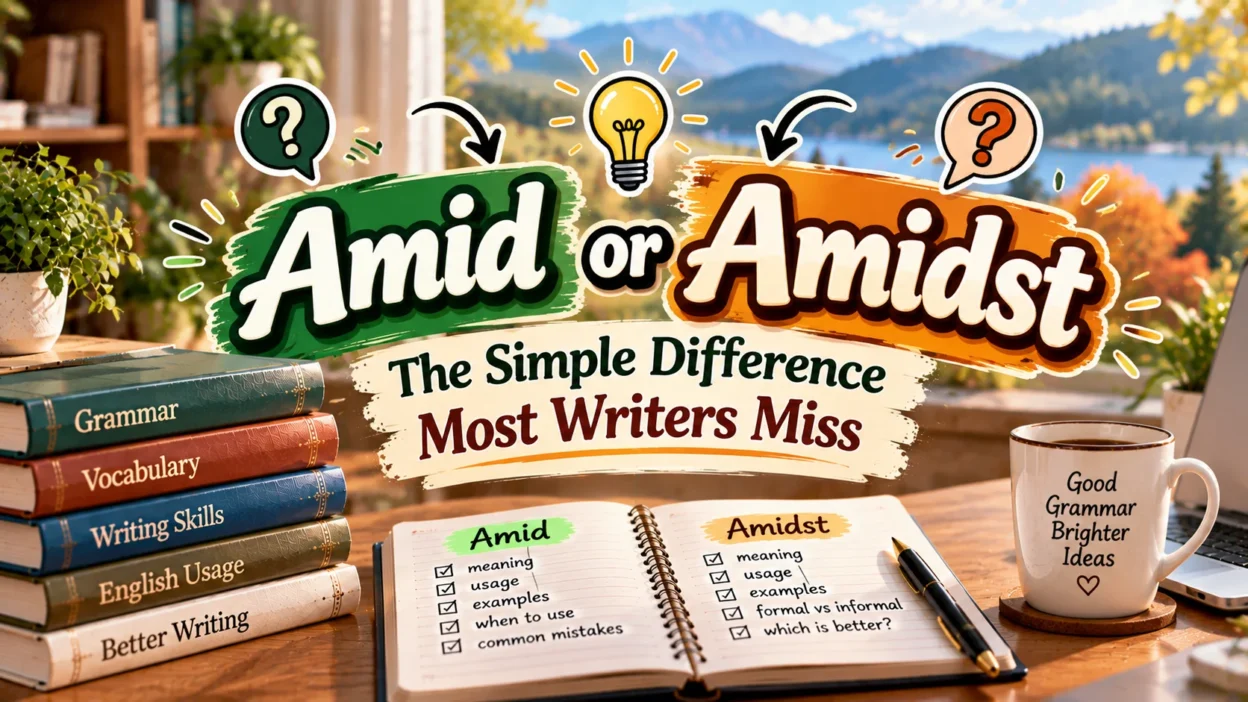
Have you ever written a sentence with amid and wondered whether amidst would sound better? Both words are correct, and both can mean “in the middle of” or “surrounded by” something. The real difference is mostly about style, tone, and usage, not meaning. Amid is more common in modern American English and everyday formal writing, while amidst can sound more literary, traditional, or slightly more British. Once you understand how these two words work, choosing the right one becomes much easier.
🔎 Amid or Amidst: Which One Is Correct?
Both amid and amidst are grammatically correct. They are prepositions used to describe something happening in the middle of, surrounded by, or during something else.
| Word | Correct? | Meaning | Common impression |
|---|---|---|---|
| Amid | ✅ Yes | In the middle of; surrounded by | Modern, concise |
| Amidst | ✅ Yes | In the middle of; surrounded by | Literary, traditional |
| Amid | 🇺🇸 Very common | Standard English | Especially common in US writing |
| Amidst | 🇬🇧 Common | Standard English | Often associated with British/literary style |
For most modern writing, amid is the simpler choice.
For example:
The team remained calm amid the confusion.
You could also write:
The team remained calm amidst the confusion.
Both sentences are correct and communicate essentially the same idea.
📖 What Does “Amid” Mean?
Amid means in the middle of something or surrounded by something. It can describe a physical setting, an emotional situation, an event, or a period of activity.
For example:
The children played amid the flowers.
Here, the children are surrounded by flowers.
It can also describe circumstances:
She remained hopeful amid difficult circumstances.
In this sentence, amid means that she remained hopeful while surrounded by or experiencing difficult circumstances.
Common synonyms include:
- among
- in the middle of
- surrounded by
- during
- in the midst of
- in the middle of a situation
Amid is short, flexible, and widely accepted in formal and everyday writing.
✨ What Does “Amidst” Mean?
Amidst has essentially the same meaning as amid. It means in the middle of, surrounded by, or during something.
For example:
The house stood amidst tall trees.
This means the house was surrounded by tall trees.
You can replace amidst with amid:
The house stood amid tall trees.
The basic meaning remains unchanged.
The main difference is the feel of the sentence. Amidst can sound somewhat more poetic, literary, old-fashioned, or expressive.
That is why you may encounter it frequently in:
- Poetry
- Literature
- Creative writing
- Descriptive prose
- Traditional writing
- Dramatic descriptions
⚖️ Amid vs Amidst: What Is the Difference?
The most important thing to remember is that there is no major difference in basic meaning.
Both words can mean:
in the middle of something
or
surrounded by something
The distinction is primarily one of style and usage.
| Feature | Amid | Amidst |
|---|---|---|
| Basic meaning | In the middle of | In the middle of |
| Part of speech | Preposition | Preposition |
| Grammar | Correct | Correct |
| Modern usage | Very common | Less common |
| American English | Very common | Used, but less common |
| British English | Common | Common |
| Tone | Neutral/formal | Literary/traditional |
| Best for concise writing | Yes | Sometimes |
| Meaning changes? | No | No |
So, if you are asking “Which word is grammatically correct?”, the answer is both.
If you are asking “Which one sounds more natural in modern writing?”, amid will often be the more straightforward choice.
🇺🇸 Is “Amid” More Common in American English?
Yes, amid is widely used in American English and is especially common in news, business, academic, and professional writing.
For example:
The company announced the change amid growing concerns.
The decision came amid increasing pressure.
She continued working amid the noise.
The community came together amid difficult circumstances.
These sentences sound natural and concise.
Because amid is shorter and direct, it often fits modern American writing particularly well.
If you are creating content for a US English audience, using amid will usually be a natural choice.
🇬🇧 Is “Amidst” British English?
Amidst is commonly associated with British English, although it is not exclusive to Britain. British writers also use amid, and American writers can certainly use amidst.
For example:
The village stood amidst beautiful countryside.
This sounds somewhat more literary or descriptive than:
The village stood amid beautiful countryside.
Both are grammatically acceptable.
It is therefore better to think of amidst as a stylistic alternative rather than simply calling it the “British version” of amid.
📝 Examples of “Amid” in Sentences
The word amid works naturally in many different contexts. It can describe physical surroundings, emotions, events, uncertainty, conflict, or change.
Everyday examples
- She smiled amid the crowd.
- The children laughed amid the noise.
- He remained calm amid the confusion.
- We found peace amid the chaos.
- The flowers bloomed amid the grass.
- The house stood amid tall trees.
- She worked amid constant interruptions.
- The family celebrated amid difficult circumstances.
- He continued walking amid the rain.
- The announcement came amid widespread discussion.
Formal examples
- The decision was announced amid growing concerns.
- The policy was introduced amid economic uncertainty.
- The company expanded amid challenging market conditions.
- The agreement was reached amid intense negotiations.
- The organization continued its work amid significant changes.
🌿 Examples of “Amidst” in Sentences
Amidst works in many of the same situations. It is particularly useful when you want a slightly more descriptive or literary tone.
- The cottage stood amidst green hills.
- She wandered amidst the trees.
- The flowers grew amidst the tall grass.
- He found peace amidst the chaos.
- The children played amidst the colorful decorations.
- A small village rested amidst the mountains.
- She remained hopeful amidst uncertainty.
- The bird disappeared amidst the branches.
- They celebrated amidst the music and laughter.
- The old building stood amidst modern skyscrapers.
In every example, amid could generally replace amidst without changing the fundamental meaning.
🧠 Easy Memory Trick for Amid and Amidst
Here is the easiest way to remember the difference:
Amid = simple and modern.
Amidst = similar meaning with a more literary feel.
Think of the extra “st” in amidst as giving the word a slightly more traditional sound.
For quick modern writing:
Choose AMID.
For a more poetic or descriptive tone:
AMIDST can work well.
This is not a strict grammar rule, but it is a useful style guide.
🚫 Common Mistakes With Amid and Amidst
Because these words have almost identical meanings, most mistakes involve usage and style, rather than basic grammar.
Mistake 1: Thinking “amidst” is wrong
Some writers believe amidst is an incorrect or outdated form.
That is not true. Amidst is a legitimate English word and is widely understood.
Mistake 2: Thinking “amid” is only American
Although amid is especially common in American English, it is not exclusively American. British writers use it as well.
Mistake 3: Thinking the words have different meanings
In most contexts, amid and amidst mean essentially the same thing.
The main difference is stylistic.
Mistake 4: Using “amidst” when a simpler word would be clearer
In concise business or informational writing, amid may be preferable because it is shorter and more direct.
For example:
The announcement came amid uncertainty.
This is usually cleaner than:
The announcement came amidst uncertainty.
Neither is grammatically wrong.
🔄 Amid vs Among: Are They the Same?
Another common question is whether amid and among mean the same thing.
They can overlap, but they are not always interchangeable.
Among usually refers to being surrounded by or included within a group of people or things.
She was standing among her friends.
Amid often emphasizes being surrounded by a situation, condition, environment, or collection of things.
She remained calm amid the confusion.
Compare these:
He sat among the students.
He worked amid the noise.
The first focuses on a group of people. The second focuses on the surrounding situation.
📚 Amid vs In the Midst Of
In the midst of is another phrase with a very similar meaning.
Compare:
- The announcement came amid the controversy.
- The announcement came amidst the controversy.
- The announcement came in the midst of the controversy.
All three communicate a similar idea.
However, in the midst of is longer and can sometimes sound more expressive.
| Expression | Style |
|---|---|
| Amid | Concise and modern |
| Amidst | Literary or traditional |
| In the midst of | More descriptive |
For concise writing, amid is often the most economical option.
🎯 When Should You Use “Amid”?
Choose amid when you want your sentence to sound:
- Clear
- Concise
- Modern
- Professional
- Neutral
- Direct
- Natural in US English
Examples:
The company grew amid economic uncertainty.
She stayed positive amid the challenges.
The announcement came amid public concern.
He remained focused amid the distractions.
These examples work particularly well in articles, reports, news writing, business content, and informational websites.
🌙 When Should You Use “Amidst”?
Choose amidst when the sentence benefits from a more:
- Literary tone
- Poetic feel
- Traditional style
- Descriptive atmosphere
- Expressive voice
For example:
A small cabin stood amidst the snow-covered mountains.
The word fits naturally into descriptive writing.
You could write:
A small cabin stood amid the snow-covered mountains.
That is also correct, but amidst gives the sentence a slightly more literary flavor.
📊 Quick Comparison: Amid, Amidst, Among, and During
These words can sometimes appear in similar sentences, but they are not always interchangeable.
| Word | Main idea | Example |
|---|---|---|
| Amid | Surrounded by/in the middle of | She stayed calm amid the chaos. |
| Amidst | Surrounded by/in the middle of | She stayed calm amidst the chaos. |
| Among | Within a group | She sat among her friends. |
| During | At a particular time | She worked during the meeting. |
A useful distinction is that during focuses on time, while amid/amidst often focus on surrounding circumstances.
✍️ Which One Should You Use in Formal Writing?
Both are acceptable, but amid is often the better default for modern formal writing because it is concise and neutral.
For example:
The proposal was introduced amid ongoing discussions.
This works well in:
- Business reports
- Academic writing
- News articles
- Professional documents
- SEO content
- Government-style writing
- Informational articles
Amidst is also grammatical, but it may add a slightly more literary tone than necessary in highly concise writing.
The key is to match the word to your audience and writing style.
🧪 Practice: Choose Amid or Amidst
Try choosing the more natural word for each sentence.
1. The village was located ___ beautiful mountains.
2. The decision was announced ___ growing concerns.
3. She remained calm ___ the confusion.
4. The flowers grew ___ tall green grass.
5. The company expanded ___ difficult economic conditions.
Answers
All of these sentences can grammatically use either amid or amidst.
For example:
The village was located amid beautiful mountains.
or:
The village was located amidst beautiful mountains.
The choice depends mainly on style.
For modern, concise writing, amid is usually the easiest choice.
❓ Frequently Asked Questions About Amid or Amidst
Is “amid” correct?
Yes. Amid is a standard English preposition meaning “in the middle of” or “surrounded by.”
Is “amidst” correct?
Yes. Amidst is also a standard English preposition with essentially the same meaning as amid.
What is the difference between amid and amidst?
The basic meaning is almost identical. Amid is generally more concise and modern, while amidst can sound more literary, traditional, or expressive.
Is amid more common in American English?
Yes. Amid is widely used in American English and is especially common in modern formal and informational writing.
Is amidst British English?
Amidst is commonly used in British English, but it is not exclusively British. British writers also use amid, and American writers can use amidst.
Can I use amid and amidst interchangeably?
In many sentences, yes. Both can describe something happening in the middle of or surrounded by something.
Which is better for a US audience?
For a US audience, amid is usually the more natural and concise choice.
Does amidst sound old-fashioned?
It can sometimes have a more traditional or literary feel, especially compared with the shorter amid. However, it is still a normal English word.
Are amid and among the same?
Not always. Among usually emphasizes being within a group, while amid often emphasizes being surrounded by a situation, condition, or environment.
Is “amidst” more formal than “amid”?
Not necessarily. Amidst can sound more literary, but that does not automatically make it more formal. In many professional contexts, amid is preferred because of its concise style.
🏁 Final Thoughts on Amid or Amidst
When choosing between amid and amidst, you usually do not need to worry about being grammatically wrong. Both words are correct, and both generally mean “in the middle of” or “surrounded by.”
The real difference is style and frequency. Amid is shorter, concise, and especially common in modern American English. Amidst has the same basic meaning but can give writing a more literary, traditional, or descriptive tone.
A simple rule to remember is:
Use “amid” for a clean, modern, concise style.
Use “amidst” when you want a slightly more literary or expressive feel.
For a US-focused website or blog, amid is usually the safest default. But if amidst fits the voice of your sentence, there is nothing grammatically wrong with using it.

Vivian Mercer is an English language writer and vocabulary enthusiast who specializes in synonyms, word meanings, grammar, idioms, and language usage. She creates accurate, easy-to-understand content that helps readers improve their English skills with confidence.