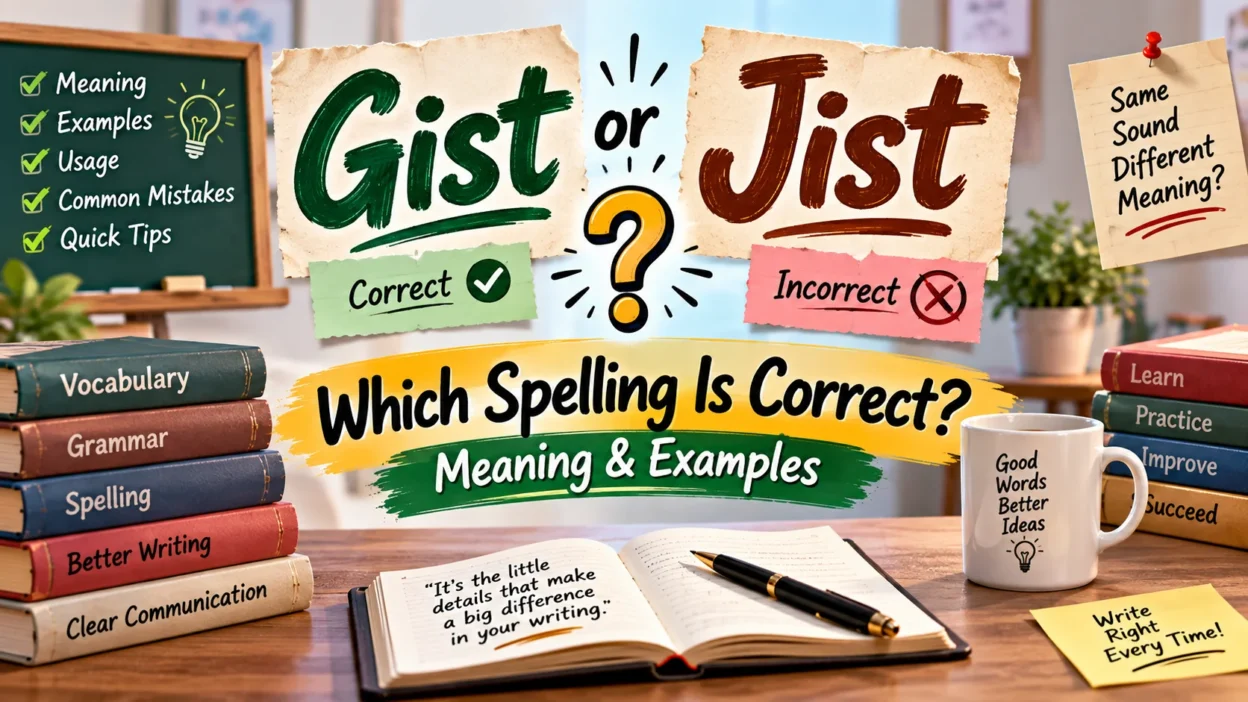
Gist or Jist is a common spelling question in English, especially because the word gist is pronounced with a soft j sound. If you have ever wondered whether to write gist or jist, the correct spelling is gist. The spelling jist is incorrect in standard English.
The word gist means the main point, central idea, essential meaning, or general substance of something. You might use it when summarizing a conversation, article, speech, story, email, or explanation. For example, if you do not remember every detail of a conversation but understand its main idea, you can say that you understood the gist.
In this guide, we will explain gist vs. jist, the correct spelling, meaning, pronunciation, origin, examples, common mistakes, synonyms, and how to remember the correct form. We will also look at common phrases such as the gist of it, get the gist, and give me the gist so you can use the word naturally and confidently.
✅ Gist or Jist: Which Is Correct?
The correct spelling is gist.
Jist is a misspelling and should not be used in standard written English.
| Spelling | Correct? | Meaning |
|---|---|---|
| Gist | ✅ Yes | Main point or essential idea |
| Jist | ❌ No | Incorrect spelling of gist |
The confusion happens because gist is pronounced with a soft j sound at the beginning. Even though the first letter is g, it sounds like the beginning of words such as gesture and giant.
Correct:
- I understand the gist of the article.
- Can you give me the gist of the meeting?
- She quickly got the gist of the story.
Incorrect:
- I understand the jist of the article.
- Can you give me the jist of the meeting?
When writing, always use gist.
📖 What Does Gist Mean?
Gist means the main point, general meaning, or essential idea of something.
You use the word when you want to talk about the overall meaning without discussing every individual detail.
For example:
I did not read the entire report, but I understood the gist.
This means you understood the main idea even though you did not study every detail.
Another example is:
Can you give me the gist of the conversation?
This means the speaker wants a short explanation of the main points of the conversation.
The word can apply to many things:
- The gist of an article
- The gist of a conversation
- The gist of a story
- The gist of a speech
- The gist of an email
- The gist of a report
- The gist of a message
- The gist of an argument
- The gist of a meeting
- The gist of an explanation
🗣️ How Do You Pronounce Gist?
Gist is pronounced approximately like jist.
Its pronunciation is:
/dʒɪst/
The first sound is the soft j sound, even though the word begins with the letter g.
Similar beginning sounds
- Gist
- Giant
- Gesture
- General
- Genius
This pronunciation is one reason people sometimes mistakenly spell the word as jist.
Remember that pronunciation does not always tell you the spelling. In this case, the word sounds like it begins with j, but its correct spelling begins with g.
🧠 Why Do People Spell Gist as Jist?
The most common reason is pronunciation.
When people hear gist, they hear a sound similar to jist. Since English contains many words beginning with the letter j and the /dʒ/ sound, it is easy to assume that gist should be spelled with a j.
However, English spelling does not always directly match pronunciation.
For example:
- Gist sounds like jist.
- Giant begins with a similar soft g sound.
- Gesture begins with a similar soft g sound.
- Gym begins with a similar soft g sound.
So, even though the pronunciation may suggest a j, the standard spelling is gist.
✨ What Is the Meaning of the Gist?
The meaning of gist is the main idea or essential point of something.
Consider this example:
The manager explained the entire project for an hour, but the gist was that we needed to finish it by Friday.
You do not need to repeat everything the manager said. The important idea was the deadline.
Here are some related meanings:
| Meaning | Explanation |
|---|---|
| Main point | The most important idea |
| Central idea | The idea at the center of a discussion |
| Essential meaning | The part that communicates the basic meaning |
| General idea | A broad understanding without every detail |
| Substance | The important content of something |
| Summary | A shortened representation of the main information |
💬 What Does Get the Gist Mean?
Get the gist means to understand the main idea or general meaning of something.
For example:
- I did not understand every word, but I got the gist.
- After reading the report, she got the gist of the proposal.
- He explained it quickly, but I got the gist.
This expression is extremely common in everyday English.
You do not have to understand every detail to get the gist. You simply need to understand what something is mainly about.
Example
Imagine someone explains a complicated movie plot in two minutes.
You might say:
I did not catch all the details, but I got the gist.
That means you understood the basic story.
📝 What Does The Gist of It Mean?
The gist of it means the main or essential point of something.
For example:
I do not remember every detail, but the gist of it was that the company is moving.
The phrase is useful when summarizing a longer explanation.
More examples:
- The gist of it is that we need more time.
- The gist of it was that she wanted to leave early.
- I missed part of the conversation, but I understood the gist of it.
- What is the gist of it?
- Let me explain the gist of it in a few sentences.
📚 Gist Examples in Sentences
Here are some natural examples showing how gist is used.
- I understood the gist of the story.
- Can you explain the gist of the article?
- She gave me the gist of the meeting.
- I only read the first few pages, but I got the gist.
- He explained the gist of the problem.
- The teacher asked us to identify the gist of the passage.
- I did not catch every word, but I understood the gist.
- What is the gist of this message?
- She quickly understood the gist of his explanation.
- The gist of the report was easy to understand.
- Can you give me the gist before I read the whole document?
- I know the details are complicated, but I understand the gist.
- The gist of the conversation was about the upcoming changes.
- He summarized the gist of the presentation.
- We discussed the details, but the gist remained simple.
📊 Gist vs. Jist
The difference is straightforward.
| Feature | Gist | Jist |
|---|---|---|
| Standard English spelling | ✅ Yes | ❌ No |
| Meaning | Main point or idea | No standard meaning as a spelling of gist |
| Pronunciation | /dʒɪst/ | Often intended to represent gist |
| Use in formal writing | Correct | Incorrect |
| Use in essays | Correct | Incorrect |
| Use in professional emails | Correct | Incorrect |
If you are writing an essay, article, email, report, or school assignment, use gist.
🔎 Is Jist a Word?
Jist is not the standard spelling of the English word meaning main point or essential idea.
People may write jist when they mean gist, but this is generally considered a spelling error.
If you see someone write:
I got the jist of it.
They almost certainly mean:
I got the gist of it.
The correct version is gist.
🎓 Gist in Academic Writing
Gist is a useful word in academic contexts, especially when discussing reading comprehension, summaries, articles, passages, and general understanding.
Examples include:
- Students should identify the gist of the passage.
- The exercise asks readers to understand the gist of the article.
- Reading quickly can help students understand the gist before examining details.
- The researcher summarized the gist of the findings.
- The introduction provides the gist of the argument.
However, in very formal academic writing, alternatives such as central argument, main idea, principal point, or overall meaning may sometimes be more precise.
📧 Gist in Emails and Messages
Gist is also common in workplace communication.
For example:
Can you give me the gist of the meeting?
This asks someone to provide the important points without explaining every detail.
Other examples include:
- Can you give me the gist of the email?
- I read the report and understand the gist.
- Please send me the gist of the discussion.
- I missed the meeting, so could you give me the gist?
- I understand the gist, but I need to review the details.
The word is especially useful when someone wants a quick summary.
🧩 Synonyms for Gist
Several words can replace gist depending on the context.
| Synonym | Meaning |
|---|---|
| Main idea | The central thought |
| Main point | The most important point |
| Essence | The essential nature or meaning |
| Substance | The important content |
| Summary | A shortened version |
| Outline | A general description of important points |
| Core | The central part |
| Crux | The most important or difficult point |
| Heart | The central meaning |
| Thrust | The main purpose or direction |
| Kernel | A central or essential idea |
| Import | The meaning or significance |
| Point | The central idea |
Example
I understood the gist of the article.
Possible alternatives:
- I understood the main idea of the article.
- I understood the main point of the article.
- I understood the essence of the article.
- I understood the general meaning of the article.
⚖️ Gist vs. Summary
Gist and summary are closely related, but they are not exactly the same.
Gist refers to the essential idea or main point.
Summary usually refers to a shortened account of the main information.
| Word | Meaning |
|---|---|
| Gist | The essential idea |
| Summary | A shortened version of information |
For example:
I got the gist of the movie.
This means you understood what the movie was generally about.
I wrote a summary of the movie.
This means you created a condensed account of its main events or ideas.
🔥 Gist vs. Main Idea
Gist and main idea are often interchangeable, especially in reading comprehension.
Gist usually focuses on a general understanding.
Main idea often identifies the central point more specifically.
For example:
What is the gist of this article?
asks for a general understanding.
What is the main idea of this paragraph?
asks for the central point of that specific paragraph.
Both expressions are useful, but they may be preferred in different contexts.
📖 Gist vs. Essence
The words gist and essence are also similar.
Gist usually refers to the main idea or general meaning of information.
Essence can refer to the fundamental nature or most important quality of something.
| Word | Example |
|---|---|
| Gist | I understood the gist of the conversation. |
| Essence | The essence of the argument is freedom. |
The word essence can sound more formal or philosophical, while gist is common in everyday English.
💡 How to Remember Gist Spelling
A simple way to remember the correct spelling is:
Gist = G
Think of:
Gist = General idea
Both begin with G.
You can also remember that the word has a soft G, like:
- giant
- gym
- gesture
- genius
- gist
Although gist sounds like it starts with j, it is spelled with G.
Memory trick:
GIST = General Idea, Simple Thought
This is not the formal definition, but it can help you remember the spelling.
🚫 Common Mistakes With Gist
The most common mistake is writing jist instead of gist.
Incorrect:
- I understand the jist.
- What is the jist of the story?
- Give me the jist of the meeting.
Correct:
- I understand the gist.
- What is the gist of the story?
- Give me the gist of the meeting.
Another mistake is assuming that gist means a complete summary. It usually refers to the main idea or essential point, not every detail.
🗣️ Common Phrases With Gist
Here are some natural expressions using gist:
- Get the gist
- Understand the gist
- Know the gist
- Catch the gist
- Grasp the gist
- Explain the gist
- Give me the gist
- The gist of it
- The gist of the story
- The gist of the conversation
- The gist of the article
- The gist of the argument
- The gist of the message
- The gist of the report
- The gist of the discussion
Examples
I got the gist.
Can you give me the gist?
She understood the gist of the conversation.
The gist of it is that we need to leave early.
🌟 Is Gist Formal or Informal?
Gist can be used in both everyday and formal English.
It is natural in conversation:
I did not understand everything, but I got the gist.
It can also appear in professional or academic contexts:
The students were asked to identify the gist of the passage.
However, in highly formal writing, phrases such as central argument, principal point, or overall meaning may sometimes be more specific.
❓ Frequently Asked Questions About Gist or Jist
Is it gist or jist?
The correct spelling is gist. Jist is a common misspelling. Although gist is pronounced with a soft j sound, it is spelled with the letter g.
What does gist mean?
Gist means the main point, central idea, essential meaning, or general substance of something. If you understand the gist, you understand what something is mainly about without necessarily knowing every detail.
Is jist a correct word?
Jist is not the standard spelling of the English word meaning main point or essential idea. The correct spelling is gist.
How do you pronounce gist?
Gist is pronounced /dʒɪst/, approximately like the word jist sounds. The spelling uses a soft g even though the pronunciation begins with a j-like sound.
What does get the gist mean?
Get the gist means to understand the main idea or general meaning of something. For example, I did not understand every detail, but I got the gist.
What does the gist of it mean?
The gist of it means the main or essential point of something. For example, The gist of it was that the meeting had been canceled means the main information was that the meeting was canceled.
What is another word for gist?
Common synonyms for gist include main idea, main point, essence, summary, substance, core, crux, heart, and general meaning.
Why is gist spelled with G instead of J?
Gist uses a soft g sound. English has many words in which the letter g produces a j-like sound, including giant, gesture, genius, and gym. Gist follows the same spelling pattern.
🌟 Final Thoughts
If you have been wondering gist or jist, the answer is simple: gist is correct. The spelling jist is a common mistake caused by the pronunciation of the word.
Gist means the main point, essential idea, or general meaning of something. It is useful when talking about conversations, articles, stories, meetings, emails, reports, speeches, and explanations.
Remember the simple trick: Gist = General Idea. Even though it sounds like it begins with J, always spell it with G.
So when you want to say that you understood the main idea, write:
I got the gist. ✅
Not:
I got the jist. ❌

Vivian Mercer is an English language writer and vocabulary enthusiast who specializes in synonyms, word meanings, grammar, idioms, and language usage. She creates accurate, easy-to-understand content that helps readers improve their English skills with confidence.