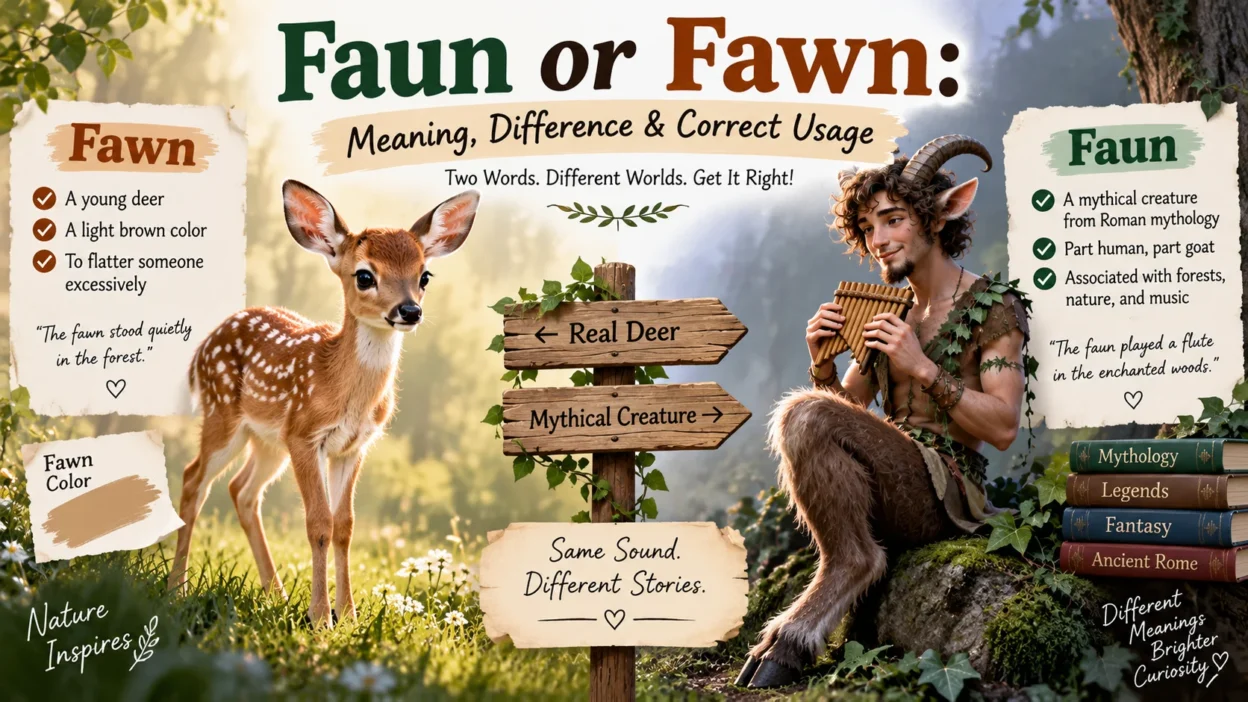
Faun or fawn are two English words that look and sound similar, but they have completely different meanings. A fawn is a young deer, while a faun is a mythical creature from ancient Roman mythology, usually depicted as part human and part goat. Because the spelling differs by only one letter, these words are easy to confuse in writing. Understanding the difference between faun and fawn can help you choose the correct word when discussing wildlife, mythology, literature, or fantasy characters.
🦌 Fawn Meaning: What Does Fawn Mean?
The word fawn most commonly refers to a young deer, especially a baby deer. It can also describe a light yellowish-brown color and, as a verb, means to behave in an overly flattering or submissive way toward someone.
Here are the main meanings of fawn:
- A young deer
- A baby deer
- The light brown color associated with a young deer
- A yellowish-brown shade
- To flatter someone excessively
- To behave submissively
- To seek approval through excessive praise
Examples:
- We saw a fawn hiding beneath the trees.
- The baby deer had beautiful white spots.
- She wore a fawn-colored coat.
- He tends to fawn over wealthy clients.
When people use fawn in everyday English, they are most often referring to a young deer.
🌿 Faun Meaning: What Does Faun Mean?
A faun is a mythical creature from ancient Roman mythology. Fauns are traditionally portrayed as beings with a human-like upper body and goat-like features, including goat legs, ears, or horns. They are associated with forests, nature, music, and wild places.
The word is especially common in mythology, fantasy literature, art, and fictional storytelling.
Examples of faun:
- The story featured a mysterious faun living in the forest.
- The artist painted a faun playing a flute.
- The fantasy novel introduced a wise old faun.
- The character looked like a creature from Roman mythology.
Because of their connection with forests and nature, fauns often appear in fantasy stories alongside magical creatures, woodland spirits, elves, and other mythical beings.
⚖️ Faun vs. Fawn: What’s the Difference?
The easiest way to remember the difference is simple: fawn is an animal, while faun is a mythical creature.
| Word | Meaning | Example |
|---|---|---|
| Fawn | A young deer | We spotted a fawn in the woods. |
| Faun | A mythical human-goat creature | The faun lived deep in the forest. |
| Fawn | A light brown color | She chose a fawn-colored dress. |
| Fawn | To flatter excessively | He continued to fawn over his boss. |
So, if you are talking about a baby deer, use fawn. If you are describing a mythological creature, use faun.
🦌 What Is a Fawn?
A fawn is a young deer, particularly one that has not yet reached adulthood. Baby deer are often recognized by their spotted coats, which help them blend into their surroundings.
The word is commonly associated with wildlife, forests, nature, and deer behavior.
Common phrases with fawn
- Baby fawn
- Young fawn
- Spotted fawn
- Deer fawn
- Newborn fawn
- Fawn in the forest
- Fawn habitat
- Fawn season
- Fawn tracks
- Fawn coat
Example:
“The mother deer stayed close while her fawn rested in the grass.”
🐐 What Is a Faun?
A faun is a mythological creature associated with ancient Roman mythology. Traditional artistic representations often show a creature with human and goat-like characteristics.
Fauns are frequently connected with:
- Forests
- Nature
- Music
- Dancing
- Wilderness
- Fertility
- Rural life
- Ancient mythology
- Fantasy
- Magical forests
In modern fiction, fauns may be portrayed differently from their classical descriptions. Authors and artists often give them unique personalities, abilities, clothing, or appearances.
Example:
“The young faun played music beneath an ancient tree.”
📚 Faun or Fawn in a Sentence
Seeing both words in sentences makes the spelling difference much easier to remember.
Fawn examples
- A tiny fawn followed its mother through the meadow.
- We photographed a spotted fawn near the woodland trail.
- The fawn quickly disappeared into the bushes.
- The forest ranger found an injured fawn.
- Her jacket was a soft fawn color.
Faun examples
- The faun guarded the entrance to the enchanted forest.
- A mysterious faun appeared in the fantasy story.
- The ancient painting showed a faun playing music.
- The children encountered a friendly faun in the magical woods.
- The fantasy character had the legs and horns of a faun.
🎨 Fawn as a Color
Besides referring to a young deer, fawn can describe a soft yellowish-brown, tan, or light brown color. The exact shade can vary depending on the context.
You may see fawn used to describe:
- Clothing
- Furniture
- Paint
- Leather
- Animal coats
- Interior design
- Shoes
- Bags
- Decorative fabrics
Examples
- She bought a fawn-colored handbag.
- The room featured a warm fawn sofa.
- He wore a fawn jacket with dark trousers.
- The puppy had a beautiful fawn-colored coat.
This meaning has nothing to do with the mythical faun.
💬 Fawn as a Verb
There is another meaning of fawn that is unrelated to deer. As a verb, to fawn means to flatter someone excessively, usually because you want their approval, favor, or attention.
The phrase fawn over is especially common.
Examples
- He constantly fawns over his manager.
- The assistant seemed to fawn over the celebrity.
- She disliked people who fawned over powerful individuals.
- He began fawning over his new boss.
In this context, fawn is a verb, not a noun.
🔤 Why Are Faun and Fawn Confusing?
The confusion between faun and fawn mainly comes from their similar spelling and pronunciation. Both words contain the same basic sounds, but their meanings come from completely different sources.
Fawn is associated with:
- Deer
- Wildlife
- Nature
- Young animals
- Brown or tan colors
- Excessive flattery
Faun is associated with:
- Mythology
- Ancient Rome
- Fantasy
- Forest creatures
- Goat-like beings
- Magical stories
A simple spelling difference changes the entire meaning.
🧠 Easy Trick to Remember Faun vs. Fawn
Try this memory trick:
Fawn = Forest animal 🦌
The W in fawn can remind you of wildlife.
Faun = Fantasy creature 🐐
The U in faun can remind you of the unusual, mythical nature of the creature.
Another easy trick is:
Fawn has W for wildlife.
If you’re talking about a young deer, choose fawn.
If you’re talking about a mythical creature, choose faun.
✍️ Faun or Fawn: Which Spelling Is Correct?
Both faun and fawn are correct English words. The correct choice depends entirely on what you mean.
Use fawn when you mean:
- A young deer
- A baby deer
- A light brown color
- Excessive flattery
Use faun when you mean:
- A mythical creature
- A creature from Roman mythology
- A human-goat-like fantasy character
Therefore, neither spelling is simply “more correct.” They are different words with different meanings.
🌲 Faun and Fawn in Literature and Fantasy
Both words can appear in stories involving forests and nature, which can make the distinction even more confusing. A fawn is a real young deer, while a faun belongs to mythology and fantasy.
For example:
“A fawn wandered through the forest while a faun watched from behind an ancient oak.”
This sentence uses both words correctly. The fawn is the young deer, while the faun is the mythical creature.
Fantasy writers may use both creatures in the same fictional setting, especially in stories involving enchanted forests, magical kingdoms, woodland characters, and mythical beings.
🌳 Faun vs. Fawn: Quick Comparison
| Feature | Fawn | Faun |
|---|---|---|
| Type | Animal / word with multiple meanings | Mythical creature |
| Main meaning | Young deer | Human-goat-like creature |
| Origin | English | Roman mythology |
| Related to | Deer and wildlife | Forests and mythology |
| Real creature? | Yes | No, traditionally mythical |
| Color meaning? | Yes | No |
| Verb meaning? | Yes | No |
| Common in fantasy? | Sometimes | Very common |
| Example | A fawn crossed the road. | A faun played a flute. |
📝 Common Mistakes With Faun and Fawn
Because the words are so similar, writers sometimes accidentally use one in place of the other.
Incorrect:
- “We saw a faun beside the road.”
(If you mean a real baby deer.)
Correct:
- “We saw a fawn beside the road.”
Incorrect:
- “The mythical fawn had goat legs.”
(If you mean the fantasy creature.)
Correct:
- “The mythical faun had goat legs.”
The context usually makes the intended meaning clear, but choosing the correct spelling makes your writing more precise.
🔎 Faun or Fawn: Synonyms and Related Words
Understanding related vocabulary can make the difference easier to remember.
Words related to fawn
- Deer
- Fawn
- Calf
- Young deer
- Baby deer
- Doe
- Buck
- Wildlife
- Spotted deer
- Woodland animal
Words related to faun
- Mythical creature
- Forest spirit
- Woodland creature
- Satyr
- Nature spirit
- Mythological being
- Fantasy creature
- Magical creature
- Ancient creature
- Woodland guardian
Note: A faun and a satyr are related concepts in classical mythology, but they are not always treated as exactly the same figure. Their characteristics and cultural origins can differ depending on the source.
❓ Frequently Asked Questions About Faun or Fawn
Is it faun or fawn for a baby deer?
The correct word is fawn. A fawn is a young deer, often recognizable by its spotted coat.
What does faun mean?
A faun is a mythical creature associated with ancient Roman mythology. It is traditionally depicted with human and goat-like characteristics.
What does fawn mean?
Fawn primarily means a young deer. It can also describe a light brown color or mean to flatter someone excessively when used as a verb.
Are faun and fawn pronounced the same?
In many varieties of English, faun and fawn are pronounced the same or very similarly. Their meanings and spellings are different.
Is a faun a real animal?
No. A faun is traditionally a mythical creature from ancient Roman mythology. Modern fantasy stories may use fauns as fictional characters.
Is a fawn a baby deer?
Yes. A fawn is a young deer.
What is the difference between a faun and a satyr?
Both are associated with classical mythology and are often depicted with human and goat-like features, but they come from different mythological traditions and can have different characteristics. Modern fantasy sometimes uses the terms more loosely.
What color is fawn?
Fawn generally refers to a light yellowish-brown, tan, or soft brown shade. The exact color can vary depending on the context.
What does “fawn over someone” mean?
To fawn over someone means to praise or flatter them excessively, often because you want their approval or favor.
How can I remember faun vs. fawn?
Remember “Fawn = wildlife.” A fawn is a young deer. Faun refers to the mythical creature.
🎯 Final Answer: Faun or Fawn?
The difference between faun and fawn is easy once you connect each word with its meaning. Fawn refers primarily to a young deer, but it can also describe a light brown color or mean to flatter someone excessively. Faun, on the other hand, refers to a mythical creature associated with ancient Roman mythology and is often depicted with human and goat-like features.
So, if you’re writing about a baby deer, use fawn. If you’re describing a mythical forest creature, use faun.

Vivian Mercer is an English language writer and vocabulary enthusiast who specializes in synonyms, word meanings, grammar, idioms, and language usage. She creates accurate, easy-to-understand content that helps readers improve their English skills with confidence.