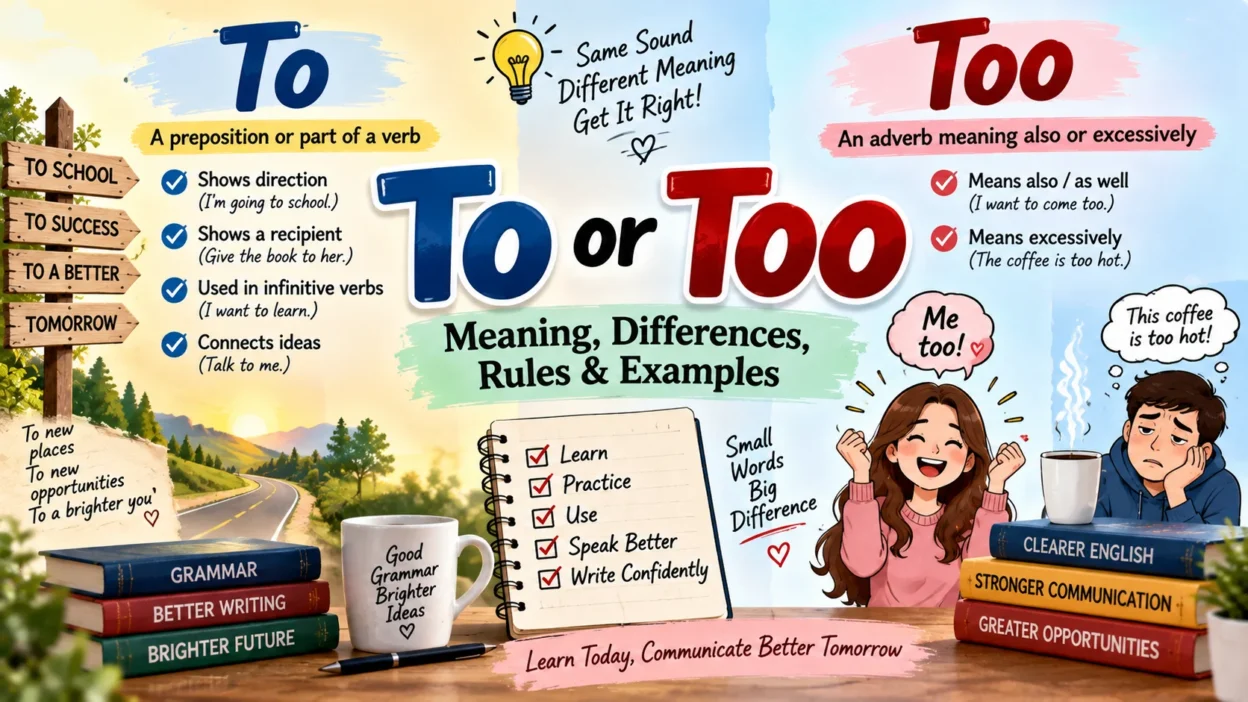
The words to and too are among the most commonly confused words in English. They sound alike in many sentences, but they have completely different meanings and grammatical functions. Using the wrong form can make an otherwise correct sentence look careless or confusing.
The easiest way to understand the difference is to remember that to usually works as a preposition or part of an infinitive verb, while too is generally used as an adverb meaning also, excessively, or more than necessary.
For example, in I want to go to school, the first word shows direction and the second part introduces the verb. In I want to go too, the final word means also.
Learning a few simple rules can make this common grammar problem much easier to avoid.
📚 What Does To Mean?
To has several important grammatical functions in English. It is most commonly used as a preposition or as part of an infinitive verb.
As a preposition, it can indicate movement, direction, a recipient, a relationship, or a destination.
Examples:
- She walked to the store.
- We traveled to Chicago.
- Give the letter to Maria.
- He spoke to his teacher.
- I am going to work.
In these examples, the word connects one part of the sentence to another and often shows where something is going or who receives something.
It can also appear before the base form of a verb.
Examples:
- I want to sleep.
- She needs to study.
- They decided to leave.
- We hope to win.
- He likes to read.
Here, to is part of an infinitive.
➕ What Does Too Mean?
Too is an adverb with two major meanings.
The first meaning is also or as well.
Examples:
- I want to come too.
- She likes coffee too.
- We watched the movie too.
- He is coming with us too.
The second meaning is excessively or more than is desirable.
Examples:
- The coffee is too hot.
- This bag is too heavy.
- The music is too loud.
- It is too late to call.
- The box is too large for the shelf.
A useful clue is that too often expresses an additional idea or an excessive degree.
⚖️ To vs. Too: The Main Difference
The simplest distinction is:
To commonly shows direction, connection, or forms an infinitive.
Too generally means also or excessively.
| Word | Main Function | Meaning | Example |
|---|---|---|---|
| To | Preposition / infinitive marker | Direction, relationship, or verb form | I went to school. |
| Too | Adverb | Also or excessively | I went too. |
| Too | Adverb | More than necessary | It is too cold. |
If you can replace the word with also, you probably need too.
If the word introduces a verb or shows direction, you probably need to.
🧭 When to Use To for Direction
One of the most common uses of to is showing movement toward a destination or person.
Examples:
- We drove to the airport.
- She went to the office.
- He walked to the park.
- They moved to Texas.
- I am going to the gym.
- Send the package to my house.
The word indicates where someone or something is moving.
Compare these:
- She went to school.
- She went too school.
The first sentence is correct because school is the destination. The second sentence does not make grammatical sense.
👤 To Show a Recipient
To can also identify the person who receives something.
Examples:
- Give the book to James.
- Send an email to your manager.
- I gave the keys to Sarah.
- She explained the problem to me.
- He handed the documents to his assistant.
In each sentence, the word connects an action with its recipient.
This use is particularly common with verbs such as:
- Give
- Send
- Show
- Tell
- Explain
- Offer
- Lend
- Bring
- Hand
- Write
🔤 To Before a Verb
Another important use occurs when to comes before the base form of a verb.
This structure is known as an infinitive.
Common pattern:
to + base verb
Examples:
- to eat
- to sleep
- to work
- to learn
- to write
- to travel
- to understand
- to improve
Sentence examples:
- I want to learn English.
- She plans to travel abroad.
- We need to finish the project.
- He decided to stay home.
- They hope to win the competition.
Here, to does not mean direction. It is part of the verb construction.
➕ When to Use Too for Also
Use too when you mean also, as well, or in addition.
Examples:
- I like pizza too.
- She wants to come too.
- He speaks Spanish too.
- We enjoyed the concert too.
- They are attending the event too.
A simple test is to substitute also.
If the sentence still makes sense, too is probably correct.
Example:
I like chocolate too.
Replace the word:
I like chocolate also.
The meaning remains clear, so too is correct.
🔥 When Too Means Excessively
The second major use of too describes something that goes beyond a desirable, suitable, or manageable level.
Examples:
- The soup is too salty.
- The room is too cold.
- The test was too difficult.
- The car is too expensive.
- The bag is too heavy.
- The shirt is too small.
In these sentences, too means more than is appropriate or necessary.
This meaning is often followed by an adjective or adverb.
Common patterns:
too + adjective
- too expensive
- too difficult
- too loud
- too small
- too fast
too + adverb
- too quickly
- too slowly
- too loudly
- too carefully
⏰ Too Much vs. Too Many
Another important grammar point is the difference between too much and too many.
Use too much with uncountable nouns.
Examples:
- too much water
- too much sugar
- too much time
- too much money
- too much information
Use too many with countable plural nouns.
Examples:
- too many books
- too many people
- too many questions
- too many mistakes
- too many emails
Compare:
- There is too much noise.
- There are too many people.
This distinction is useful because it connects the word too with quantity as well as degree.
🧠 An Easy Trick to Remember the Difference
There are several simple ways to remember which word you need.
Trick 1: Replace Too With Also
If also works, use too.
Example:
I want coffee too.
I want coffee also.
Both make sense.
Trick 2: Look for Excess
If the meaning is more than necessary, use too.
Example:
The coffee is too hot.
The coffee is more hot than it should be.
Trick 3: Look for Direction
If the word shows movement toward a place or person, use to.
Example:
She went to school.
Trick 4: Look Before a Verb
If the word comes before a base verb in an infinitive construction, use to.
Example:
I want to sleep.
These four tests solve many everyday spelling and grammar mistakes.
❌ Common Mistakes With To and Too
Because the two words sound similar, they are frequently confused in writing.
Incorrect:
- I want too go home.
- She went too the store.
- I like it to.
- It is to expensive.
- He is coming to.
- I am too tired to walk to work.
Correct:
- I want to go home.
- She went to the store.
- I like it too.
- It is too expensive.
- He is coming too.
- I am too tired to walk to work.
The last sentence demonstrates that both forms can appear in the same sentence while serving different grammatical roles.
✍️ To and Too in the Same Sentence
Sometimes both words are needed in one sentence.
Examples:
- I want to go too.
- She needs to leave too.
- He is going to the party too.
- We need to talk to her too.
- They decided to stay too.
Look closely at this sentence:
I want to go to the beach too.
The first to is part of the infinitive to go.
The second to shows the destination.
The final too means also.
This is a useful example because it shows why the words cannot simply be treated as interchangeable spellings.
📝 Common Expressions With To
Many everyday expressions naturally use to.
Examples:
- listen to
- talk to
- speak to
- belong to
- according to
- next to
- close to
- similar to
- important to
- related to
Sentence examples:
- Please listen to me.
- I need to talk to you.
- This book belongs to Sarah.
- According to the report, sales increased.
- The house is next to the school.
These expressions should generally be learned as common word combinations.
🌟 Common Expressions With Too
Too frequently appears in expressions involving degree or addition.
Meaning also:
- me too
- you too
- I do too
- she does too
- they are coming too
Meaning excessively:
- too much
- too many
- too long
- too short
- too late
- too early
- too expensive
- too difficult
- too easy
- too far
Examples:
- Me too!
- The dress is too expensive.
- We have too many boxes.
- You are too early.
- The movie was too long.
🗣️ To and Too in Everyday Speech
In spoken English, the difference may be difficult to hear because the two words can sound similar.
That is why context is especially important when writing.
For example:
I want to go too.
The final word expresses addition.
But:
I want to go to the store.
The first word connects the verb with the destination.
When listening, focus on the meaning of the complete sentence rather than trying to identify the word from sound alone.
💼 To and Too in Professional Writing
Correct usage becomes especially important in professional emails, reports, applications, academic assignments, and business communication.
A small spelling mistake can distract the reader even when the intended meaning is obvious.
Examples:
Incorrect:
- I would like too discuss the proposal.
- The deadline is to short.
- I would like to attend too.
Correct:
- I would like to discuss the proposal.
- The deadline is too short.
- I would like to attend too.
Proofreading for these small errors can make professional writing appear more polished.
📖 To, Too, and Two
There is another word that sounds similar: two.
The three words have completely different functions.
To
Used for direction, relationships, and infinitives.
- I went to school.
- I want to learn.
Too
Means also or excessively.
- I want to come too.
- It is too cold.
Two
Represents the number 2.
- I have two brothers.
- She bought two tickets.
Quick comparison:
- I have two books.
- I want to read them.
- You can read them too.
This sentence is an excellent way to remember all three forms.
🔍 Quick Grammar Test
Choose the correct word in each sentence.
- I want ___ learn Spanish.
- She went ___ the market.
- I want some coffee ___.
- The coffee is ___ hot.
- He has ___ brothers.
- We are going ___ the beach.
- She wants ___ come with us.
- There are ___ many people here.
- I would like ___ join you ___.
- They bought ___ tickets.
Answers
- to
- to
- too
- too
- two
- to
- to
- too
- to, too
- two
If you understand why each answer works, you have mastered the basic distinction.
🚨 How to Avoid the Mistake
The best way to avoid confusion is not to memorize hundreds of examples. Instead, identify what role the word plays in the sentence.
Ask yourself:
Does it show direction?
Use to.
Does it come before a base verb?
Use to.
Does it mean also?
Use too.
Does it mean excessively?
Use too.
Does it represent the number 2?
Use two.
This quick mental check can prevent most errors.
📌 Quick Reference Guide
| If you mean… | Use |
|---|---|
| Direction | to |
| Destination | to |
| Recipient | to |
| Infinitive verb | to |
| Also | too |
| As well | too |
| Excessively | too |
| More than necessary | too |
| Number 2 | two |
Keeping this table in mind makes the distinction much easier.
❓ Frequently Asked Questions
What is the main difference between to and too?
To is commonly used for direction, relationships, and infinitive verbs. Too generally means also or excessively.
How can I remember when to use too?
Try replacing it with also. If the sentence still makes sense, too is likely correct. If it describes something as excessive, too is also the correct choice.
Is to an adverb?
Usually, to functions as a preposition or as an infinitive marker. Its exact grammatical role depends on the sentence.
Is too an adverb?
Yes. Too commonly functions as an adverb, expressing addition or an excessive degree.
What is an example of to and too together?
A simple example is: I want to come too.
The first word introduces the infinitive verb, while the second means also.
What is the difference between too and two?
Too means also or excessively. Two represents the number 2.
Why do to and too cause so many mistakes?
They are pronounced similarly in many varieties of English, so writers sometimes rely on sound rather than grammatical meaning.
Is too always placed at the end of a sentence?
No. When it means also, it often appears at the end, but it can appear in other positions for emphasis. When it means excessively, it normally appears before an adjective, adverb, or quantity expression.
Can both words appear in one sentence?
Yes. For example, a sentence may contain to as part of an infinitive and too to mean also.
Is to too difficult to learn?
No. Once you identify whether the word expresses direction, introduces a verb, means also, or expresses excess, the distinction becomes much easier.
🎯 Final Thoughts
The difference between to and too is simple once you focus on their grammatical roles rather than their pronunciation.
Use to for direction, destinations, recipients, relationships, and infinitive verbs. Use too when you mean also or when something is excessive or more than necessary. And remember two when you are referring to the number 2.
A useful final check is to ask what the sentence is trying to say. If the meaning involves movement or an infinitive, to is usually the right choice. If the meaning is also or excessively, choose too.
With regular reading and a little proofreading, this common English grammar confusion becomes much easier to avoid.

Vivian Mercer is an English language writer and vocabulary enthusiast who specializes in synonyms, word meanings, grammar, idioms, and language usage. She creates accurate, easy-to-understand content that helps readers improve their English skills with confidence.