
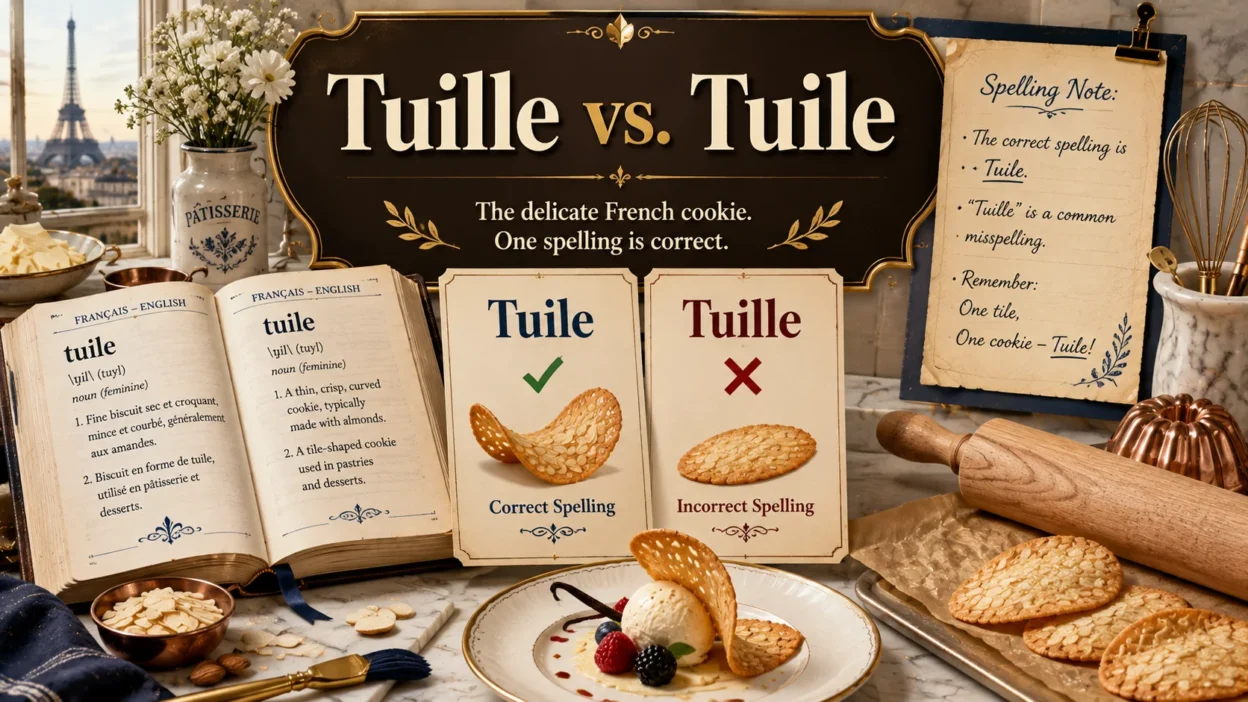
If you’re writing about the delicate French pastry called a tuile, you may wonder whether the correct spelling is tuille or tuile. The answer is straightforward: tuile is the standard spelling. Tuille is generally a misspelling when you mean the pastry.
A tuile is a thin, crisp French biscuit that pastry chefs often use as a dessert garnish. Chefs may shape the biscuit while it remains warm, creating elegant curves that resemble traditional roof tiles. The French word tuile means “tile,” which explains the pastry’s name.
You may see tuille in recipes, menus, food blogs, or social media posts, but standard culinary writing uses tuile. If you want your recipe or article to look professional and accurate, choose tuile.
Quick Answer: Tuille or Tuile?
Tuile is the correct spelling for the French pastry.
Tuille is generally an incorrect spelling when you mean this thin, crisp biscuit.
- ✅ Tuile — correct
- ❌ Tuille — incorrect for the pastry
| Word | Correct? | Meaning |
|---|---|---|
| Tuile | ✅ Yes | A thin, crisp French biscuit |
| Tuille | ❌ No | Usually a misspelling of tuile |
What Does “Tuile” Mean?
Tuile refers to a thin, crisp French biscuit or cookie. Pastry chefs often bake it until it becomes delicate and crunchy, then shape it while it remains warm.
The word has another meaning in French. Tuile literally means “tile.” The pastry takes its name from the curved shape that can resemble a traditional roof tile.
For example:
The chef placed an almond tuile beside the ice cream.
A chocolate tuile added a crisp texture to the mousse.
What Does “Tuille” Mean?
When you see tuille in a recipe or pastry article, the writer usually means tuile.
Standard culinary English does not use tuille as the spelling for this French pastry.
For example:
❌ The chef decorated the cake with an almond tuille.
✅ The chef decorated the cake with an almond tuile.
The difference comes down to one extra letter. Write:
T-U-I-L-E
not:
T-U-I-L-L-E
Tuile vs. Tuille at a Glance
| Feature | Tuile | Tuille |
|---|---|---|
| Standard pastry spelling | ✅ Yes | ❌ No |
| Culinary meaning | Thin, crisp biscuit | Usually a misspelling |
| French term | Yes | No |
| Common in pastry recipes | Yes | Incorrect |
| Spelling | T-U-I-L-E | T-U-I-L-L-E |
| Best choice for writing | Tuile | Avoid |
Why Is “Tuile” the Correct Spelling?
The spelling tuile comes directly from French. In French, tuile means tile, especially a roof tile.
Traditional tuiles can take a curved shape that resembles a roof tile. Pastry chefs bake the thin batter and shape it before it cools completely. Once the pastry cools, it becomes crisp and holds its shape.
This gives the word a simple connection:
Tuile = tile → curved pastry → tuile cookie
The spelling stays tuile with only one l.
How Do You Pronounce “Tuile”?
French speakers pronounce tuile approximately as /tɥil/.
For English speakers, a rough pronunciation sounds like “tweel,” although the French pronunciation includes a sound that English does not have exactly.
| Feature | Tuile |
|---|---|
| French IPA | /tɥil/ |
| Approximate English pronunciation | “tweel” |
| Syllables | 1 |
| Language | French |
Don’t pronounce tuile like the English word tile. Although the words share a connection in meaning, their pronunciations differ.
What Is a Tuile Cookie?
A tuile cookie is a very thin and crisp baked biscuit. Pastry chefs often serve it with creamy or soft desserts because its crunch creates a pleasant contrast.
You may find tuiles alongside:
- Ice cream
- Sorbet
- Chocolate mousse
- Panna cotta
- Custard
- Cakes
- Fruit desserts
- Pastry creams
A chef might place a curved almond tuile vertically into a dessert to add height and texture to the presentation.
Why Do Pastry Chefs Shape Tuiles?
Pastry chefs shape tuiles while they are still warm because the baked biscuits remain flexible for a short time.
A chef can place a warm tuile over a rolling pin or another mold. As the biscuit cools, it becomes crisp and keeps its new shape.
This technique allows chefs to create:
- Curves
- Arches
- Tubes
- Waves
- Cups
- Decorative curls
For example:
The pastry chef shaped the warm tuile around a rolling pin.
Once the tuile cools, the chef can use it as a decorative element on the plate.
What Is an Almond Tuile?
An almond tuile is one of the most familiar types of tuile. It combines the delicate crunch of the biscuit with the nutty flavor of almonds.
Recipes often use sliced or slivered almonds. The almonds toast as the tuile bakes, creating additional flavor and texture.
You can serve an almond tuile with:
The chef served vanilla ice cream with a crisp almond tuile.
Almond tuiles work especially well with desserts that contain smooth or creamy textures.
Popular Types of Tuiles
Pastry chefs can create many variations of the classic tuile.
Almond Tuile
Almond tuiles provide a crisp texture and lightly toasted nutty flavor. They make excellent garnishes for ice cream, mousse, and custard.
Chocolate Tuile
Chocolate tuiles add a rich cocoa flavor and pair naturally with chocolate mousse, vanilla ice cream, and fruit desserts.
Sesame Tuile
Sesame seeds give the tuile a toasted, nutty flavor. Chefs can use sesame tuiles with both sweet and savory dishes.
Citrus Tuile
Lemon or orange zest can add a fresh citrus note to a sweet tuile.
Savory Tuile
Chefs can also prepare savory tuiles. These versions can add a crisp element to salads, soups, appetizers, and plated savory dishes.
Is a Tuile the Same as a Wafer?
Not exactly.
A wafer describes a broad category of thin, crisp baked foods. A tuile describes a particular French-style biscuit with its own traditional preparation and shaping technique.
| Tuile | Wafer |
|---|---|
| Specific French pastry term | Broad food category |
| Often curved | Often flat |
| Commonly shaped while warm | Shape varies |
| Frequently used as a garnish | Can be eaten alone |
| Strong French culinary association | Used across many cuisines |
A tuile can have a wafer-like texture, but you shouldn’t automatically call every wafer a tuile.
Tuile vs. Other Crisp Dessert Garnishes
Many desserts use crisp components, but each one has its own characteristics.
| Dessert Component | Main Characteristic |
|---|---|
| Tuile | Thin, crisp French biscuit |
| Wafer | Thin, crisp baked food |
| Meringue | Whipped egg-white and sugar preparation |
| Biscotti | Italian twice-baked cookie |
| Brandy snap | Thin, crisp caramelized biscuit |
| Praline | Caramelized sugar and nut confection |
These ingredients can all add crunch, but they don’t mean the same thing.
Is “Tuile” a French Word?
Yes. Tuile is a French word.
In everyday French, it means tile. French also uses the word for the culinary biscuit.
The pastry gets its name from the traditional curved shape that resembles a roof tile.
This makes the culinary meaning easier to understand:
Tuile = tile
The pastry’s shape connects the literal French word with the culinary term.
Is “Tuille” Ever Correct?
If you mean the French pastry, use tuile.
You may encounter tuille elsewhere as a name, surname, or spelling in an unrelated context. However, that doesn’t make it the correct spelling for the pastry.
For recipes, menus, food blogs, and culinary articles, write:
tuile
Common Spelling Mistakes
Mistake 1: Adding a Second “L”
❌ Chocolate tuille
✅ Chocolate tuile
The standard spelling uses one l.
Mistake 2: Writing “Tuille Cookie”
❌ Almond tuille cookie
✅ Almond tuile cookie
Mistake 3: Pronouncing It Like “Tile”
The French pronunciation differs from the English word tile.
Mistake 4: Treating Every Crisp Garnish as a Tuile
A crisp garnish isn’t automatically a tuile. The term describes a particular type of thin biscuit or pastry.
How to Use “Tuile” in a Sentence
Here are natural examples:
- The chef served the mousse with an almond tuile.
- She made several crisp tuiles for the dessert.
- The pastry chef shaped the warm tuile into a curve.
- The chocolate tuile added a satisfying crunch.
- We served the panna cotta with a delicate tuile.
- The almond tuile complemented the vanilla ice cream.
- The chef placed a sesame tuile on top of the soup.
- The recipe explains how to shape each tuile.
- The citrus tuile added brightness to the dessert.
- The pastry chef used the tuile as a decorative garnish.
What Is the Plural of Tuile?
The plural form is tuiles.
For example:
The chef prepared several almond tuiles.
The dessert came with two chocolate tuiles.
Adding -s creates the plural in English culinary writing.
Tuile vs. Tuiles
Don’t confuse tuile and tuiles.
- Tuile = one pastry
- Tuiles = more than one pastry
Examples:
I made one almond tuile.
I made six almond tuiles.
Neither form needs the extra l found in tuille.
How to Remember the Correct Spelling
The easiest trick is simple:
Tuile has one L.
Write the word slowly:
T-U-I-L-E
You can also connect the word to its French meaning:
Tuile = tile
The pastry gets its name from the curved shape that resembles a roof tile.
Whenever you’re tempted to add another l, remember:
Tuile ✓
Tuille ✗
People Also Ask
Is it tuille or tuile?
Tuile is the correct spelling when you mean the French pastry. Tuille is generally a misspelling in this context.
What is a tuile in baking?
A tuile is a thin, crisp French biscuit that chefs often use as a dessert garnish. They can shape the biscuit while it remains warm.
What does tuile mean in French?
Tuile means “tile” in French. The pastry takes its name from its traditional curved shape, which resembles a roof tile.
How do you pronounce tuile?
French speakers pronounce tuile approximately /tɥil/. English speakers often approximate it as “tweel.”
Is a tuile a cookie?
Yes. English culinary references commonly describe a tuile as a thin, crisp biscuit or cookie.
What is an almond tuile?
An almond tuile is a thin, crisp biscuit that contains almonds and often serves as a garnish for desserts.
Why is it called a tuile?
The French word tuile means “tile.” The pastry gets its name from the curved shape that resembles a traditional roof tile.
Can tuiles be savory?
Yes. Chefs can prepare savory tuiles and use them to add crunch and visual interest to soups, salads, appetizers, and other dishes.
Frequently Asked Questions
Is “tuille” a different pastry?
No, not when you’re referring to the classic French biscuit. In that context, tuille is generally a misspelling of tuile.
What is the plural of tuile?
The plural is tuiles.
The chef prepared several almond tuiles.
Are tuiles always curved?
No. Although chefs traditionally shape tuiles into curves, they can create different shapes depending on the recipe and presentation.
Why do chefs shape tuiles while they’re warm?
Warm tuiles remain flexible. Chefs can shape them before they cool and become crisp.
What ingredients go into a tuile?
Recipes vary, but sweet tuiles often contain butter, sugar, flour, egg whites, and almonds. Chefs can adapt the recipe with chocolate, citrus, sesame, spices, or other ingredients.
Can you make chocolate tuiles?
Yes. Chocolate tuiles provide a crisp cocoa-flavored element for desserts.
Is a tuile the same as a French wafer?
Not exactly. A tuile is a specific French-style crisp biscuit, while wafer describes a broader category of thin baked foods.
Should I use “tuile” or “tuille” in a recipe?
Use tuile. It is the standard spelling for the French pastry.
Conclusion
When choosing between tuille vs. tuile, use tuile for the classic French pastry. A tuile is a thin, crisp biscuit that chefs often shape while warm and use as a decorative or textural element in desserts.
The word comes from the French tuile, meaning “tile.” The name makes sense because chefs traditionally shape the pastry into a curve that resembles a roof tile.
The spelling is easy to remember: tuile has one L.
So when you write a recipe, restaurant menu, food blog, or culinary guide, choose tuile instead of tuille.
Tuile ✓ — Correct
Tuille ✗ — Incorrect for the pastry

Vivian Mercer is an English language writer and vocabulary enthusiast who specializes in synonyms, word meanings, grammar, idioms, and language usage. She creates accurate, easy-to-understand content that helps readers improve their English skills with confidence.