
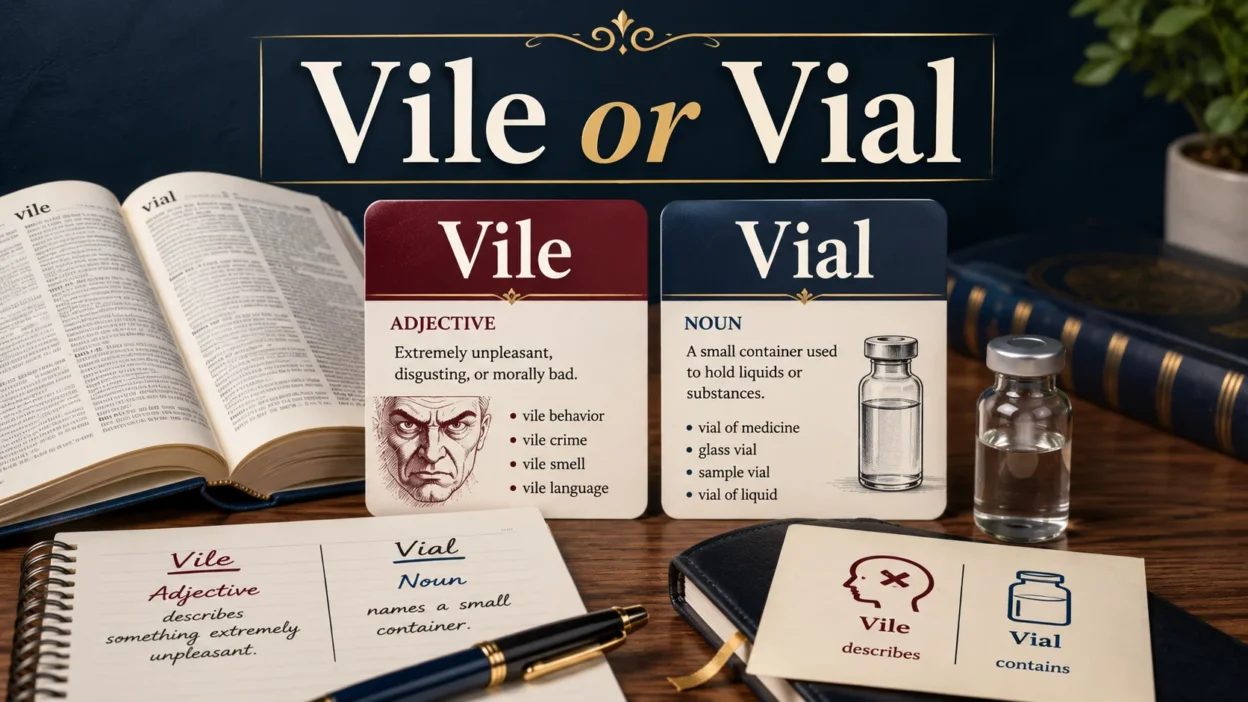
Vile and vial are easy to confuse because they look and sound quite similar. However, they belong to different parts of speech and describe completely different things.
Vile is an adjective used for something extremely unpleasant, disgusting, cruel, or morally wrong. Vial is a noun that refers to a small container, usually used for medicine, chemicals, liquids, or laboratory samples.
For example, you might say, The criminal committed a vile act, but The medicine came in a small vial. Changing one letter changes the meaning completely.
If you often confuse these two words while writing, this guide will help you understand vile vs vial, see how each word works in real sentences, and learn an easy way to remember the difference.
Vile vs Vial: The Difference in One Look
| Word | Meaning | Word Type | Simple Example |
|---|---|---|---|
| Vile | Extremely unpleasant, disgusting, or morally bad | Adjective | It was a vile act. |
| Vial | A small container for liquids or substances | Noun | She opened a vial of medicine. |
The easiest rule
Vile describes. Vial contains.
If you are describing something terrible or disgusting, choose vile.
If you are talking about a small container, choose vial.
What Does Vile Mean?
Vile means extremely unpleasant, disgusting, offensive, or morally wrong.
It is an adjective, so it normally describes a noun.
You can use vile for things such as:
- Behavior
- Actions
- Crimes
- Language
- Smells
- Treatment
- Comments
- Attitudes
Examples
- The man was punished for his vile behavior.
- The room had a vile smell.
- Everyone condemned the vile act.
- The article contained vile language.
- She was shocked by his vile comments.
In each sentence, vile tells us something negative about another noun.
What Does Vial Mean?
A vial is a small container, usually used to store a liquid or other substance.
Vials are especially common in:
- Medicine
- Pharmacies
- Hospitals
- Laboratories
- Scientific research
- Chemical storage
Examples
- The nurse opened a vial of medicine.
- The scientist placed the sample inside a vial.
- Keep the vial in a cool place.
- The laboratory stored the substance in a glass vial.
Unlike vile, vial names an actual object.
Vile vs Vial in Real Sentences
Sometimes seeing the two words side by side makes the difference much clearer.
| Example | Correct Word | Reason |
|---|---|---|
| The smell was extremely ___. | Vile | Describes the smell |
| The nurse opened a ___ of medicine. | Vial | Names a container |
| His actions were ___. | Vile | Describes actions |
| The scientist labeled the ___. | Vial | Refers to a container |
| They condemned the ___ treatment. | Vile | Describes treatment |
| The sample was placed in a ___. | Vial | Refers to a small container |
Vile as an Adjective
One of the easiest ways to recognize vile is to look at the word that follows it.
You can say:
- vile crime
- vile act
- vile behavior
- vile smell
- vile language
- vile treatment
- vile comment
You cannot normally use vile as the name of a container.
For example:
Correct: The criminal committed a vile crime.
Incorrect: The medicine was stored in a vile.
The second sentence needs vial.
Vial as a Noun
Because vial is a noun, it can appear after words such as:
- a
- the
- this
- that
- small
- glass
- sealed
- medical
Examples:
- a vial
- a glass vial
- a small vial
- the vial
- a sealed vial
- a medical vial
You can also use vial with of:
- a vial of medicine
- a vial of blood
- a vial of liquid
- a vial of chemicals
- a vial of perfume
How Are Vile and Vial Pronounced?
The pronunciation can make these words confusing because they can sound very similar in some varieties of English.
Vile generally has one syllable and rhymes with words such as mile and file.
Vial is commonly pronounced with one or two syllables depending on accent and speaking style.
Because pronunciation varies, don’t rely only on how the words sound. Look at their meaning and spelling.
Vile vs Vial: Synonyms
Knowing their synonyms can also help you separate them.
| Word | Useful Synonyms |
|---|---|
| Vile | Disgusting, horrible, nasty, wicked, evil, repulsive, offensive |
| Vial | Container, bottle, ampoule, small bottle |
The synonyms aren’t always exact replacements, so context still matters.
For example, disgusting can replace vile in some sentences:
It was a vile smell.
It was a disgusting smell.
But you cannot replace vial with disgusting because the two words have completely different meanings.
Common Expressions With Vile
Here are some natural phrases you may see in English:
Vile Behavior
This describes behavior that is extremely bad, cruel, or offensive.
The organization condemned his vile behavior.
Vile Crime
This describes a particularly horrible or morally offensive crime.
The police investigated the vile crime.
Vile Smell
This describes an extremely unpleasant odor.
A vile smell came from the kitchen.
Vile Language
This refers to offensive or extremely unpleasant language.
The website was criticized for its vile language.
Common Expressions With Vial
Vial frequently appears in medical and scientific language.
Vial of Medicine
The pharmacist gave him a vial of medicine.
Glass Vial
The liquid was stored in a glass vial.
Sample Vial
The technician placed the sample in a sample vial.
Sealed Vial
The laboratory kept the substance inside a sealed vial.
Vile vs Vial: Common Mistakes
1. Writing Vial When You Mean Vile
Incorrect:
His actions were vial.
Correct:
His actions were vile.
Why? Because the sentence needs an adjective describing his actions.
2. Writing Vile When You Mean Vial
Incorrect:
The doctor opened a vile of medicine.
Correct:
The doctor opened a vial of medicine.
Why? Because the sentence needs a noun referring to the container.
3. Assuming They Have the Same Meaning
They don’t.
Although they look similar, their meanings are unrelated:
Vile → unpleasant or morally bad
Vial → small container
A Simple Memory Trick
Here’s an easy way to remember the difference:
Vile = Very Bad
Think:
VILE = Very unpleasant
Examples:
- vile behavior
- vile crime
- vile smell
Vial = Vessel
Think:
VIAL = a small vessel/container
Examples:
- vial of medicine
- vial of liquid
- glass vial
This simple association can help you remember which spelling to use.
Which One Should You Use?
Before choosing between vile and vial, ask yourself one question:
Am I describing something bad, or am I naming a container?
If you’re describing something horrible, disgusting, offensive, or immoral → VILE
If you’re naming a small container → VIAL
| If You Mean… | Use |
|---|---|
| Extremely unpleasant | Vile |
| Morally bad | Vile |
| Disgusting | Vile |
| Cruel or offensive | Vile |
| Small container | Vial |
| Medicine container | Vial |
| Laboratory container | Vial |
| Small liquid container | Vial |
Practice: Vile or Vial?
Try filling in the blanks before looking at the answers.
- The doctor opened a ___ of medication.
- His behavior was absolutely ___.
- The laboratory stored the sample in a ___.
- They described the crime as ___.
- The medicine came in a small glass ___.
- The garbage produced a ___ odor.
Answers
- vial
- vile
- vial
- vile
- vial
- vile
If you remember vile describes and vial contains, these questions become much easier.
People Also Ask
What is the difference between vile and vial?
Vile is an adjective meaning extremely unpleasant, disgusting, or morally bad. Vial is a noun meaning a small container used to hold medicine, liquids, chemicals, or samples.
Is vile an adjective?
Yes. Vile is an adjective used to describe something extremely unpleasant, offensive, disgusting, or morally wrong.
Is vial a noun?
Yes. Vial is a noun that refers to a small container.
Is “vile behavior” correct?
Yes. Vile behavior is correct because vile describes the behavior.
Is “vial of medicine” correct?
Yes. A vial of medicine is a small container holding medicine.
What is an easy way to remember vile and vial?
Remember: Vile describes something bad, while a vial holds something.
Are vile and vial homophones?
They can sound very similar, but pronunciation varies by accent. They are spelled differently and have completely different meanings.
Frequently Asked Questions
Can I use vile and vial interchangeably?
No. They have different meanings and different grammatical roles. Vile is an adjective, while vial is a noun.
What is the opposite of vile?
Depending on the context, opposites of vile can include good, pleasant, kind, decent, admirable, or respectable.
What is another word for vial?
Depending on its use, a vial can be described as a small container, bottle, ampoule, or small vessel.
Can vile describe a person?
Yes. Vile can describe someone whose behavior or character is extremely unpleasant, cruel, or morally bad.
Can vial refer to medicine?
Yes. Vial is frequently used for small containers of medicine, vaccines, chemicals, and other liquids.
Which is correct: vile smell or vial smell?
Vile smell is correct because vile describes an unpleasant smell.
Which is correct: vial of medicine or vile of medicine?
Vial of medicine is correct because a vial is a container.
Final Verdict: Vile or Vial?
The distinction is straightforward once you connect each word with its function:
Vile is an adjective meaning extremely unpleasant, disgusting, offensive, or morally bad.
Vial is a noun meaning a small container for medicine, liquids, chemicals, or samples.
So remember:
Vile describes. Vial contains.
That one rule will help you choose the correct spelling in most situations.
Quick Reference
| Word | Remember It As | Example |
|---|---|---|
| Vile | Something very bad | A vile act |
| Vial | A small container | A vial of medicine |

Vivian Mercer is an English language writer and vocabulary enthusiast who specializes in synonyms, word meanings, grammar, idioms, and language usage. She creates accurate, easy-to-understand content that helps readers improve their English skills with confidence.