Good vs. well is a common English grammar question because both words can describe how something happens or how someone performs.
The confusion usually comes from sentences such as I feel good and I feel well.
Although the two words sometimes overlap, they usually serve different grammatical roles.
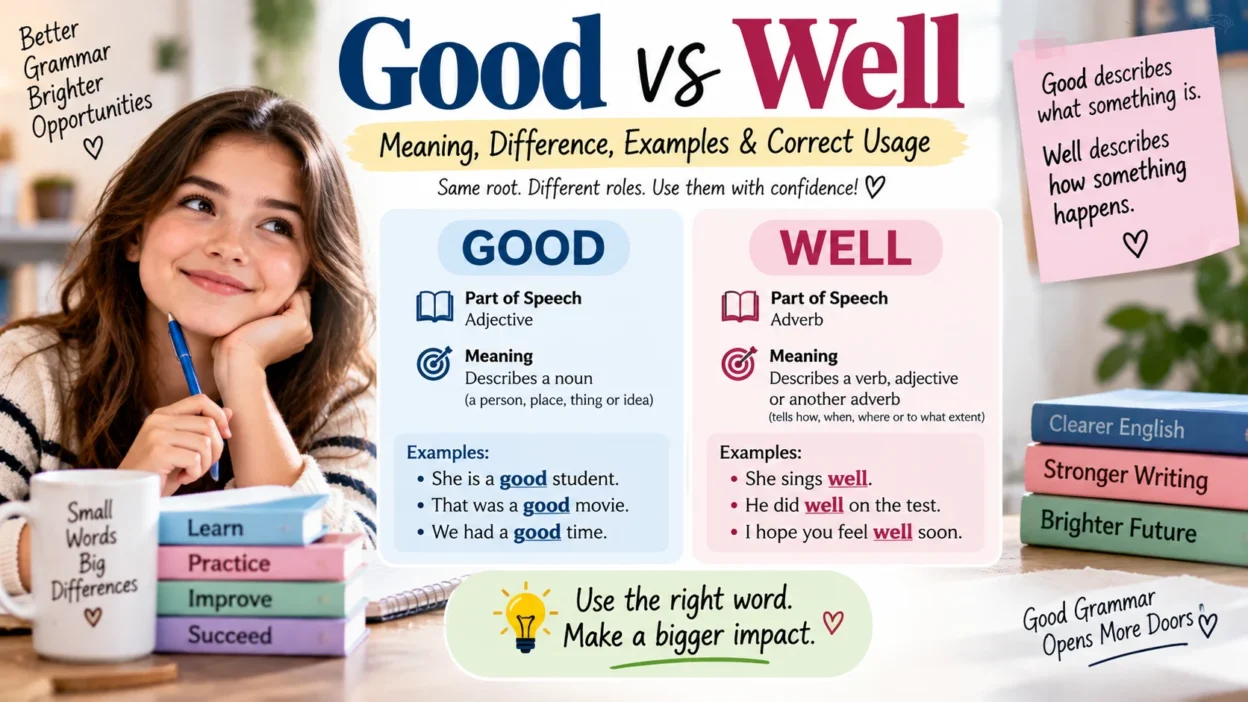
Good is primarily an adjective. It describes a person, place, thing, idea, action, or condition.
Well is primarily an adverb. It describes how someone performs an action.
For example:
She is a good singer.
Here, good describes the singer.
She sings well.
Here, well describes how she sings.
Understanding this basic difference makes it much easier to choose between the two words.
Good vs. Well: Quick Answer
Good is usually an adjective that describes a noun or pronoun.
Well is usually an adverb that describes a verb and explains how an action happens.
| Word | Main Function | What It Describes | Example |
|---|---|---|---|
| Good | Adjective | A person, thing, or condition | She is a good student. |
| Well | Adverb | An action | She studies well. |
| Well | Adjective in some contexts | Health or condition | I am well. |
The simplest rule is:
Good = describes what something is like.
Well = describes how something happens.
What Does Good Mean?
Good is an adjective that describes quality, character, condition, or value.
It can describe people, objects, ideas, experiences, food, performances, and many other things.
Examples With Good
- She is a good teacher.
- That was a good movie.
- He is a good friend.
- We had a good day.
- This restaurant serves good food.
- You made a good decision.
- The book has a good ending.
In each sentence, good describes a noun or pronoun.
Good Can Describe People
When good describes a person, it can refer to ability, character, behavior, or quality.
For example:
Maria is a good student.
Here, good describes Maria’s performance or qualities as a student.
Another example:
He is a good friend.
Here, good describes his behavior and character as a friend.
What Does Well Mean?
Well usually works as an adverb.
It tells us how someone performs an action.
For example:
She sings well.
The word well describes how she sings.
Examples With Well
- He runs well.
- She writes well.
- They work well together.
- You explained the topic well.
- The machine works well.
- She speaks English well.
- He performed well in the competition.
In these examples, well modifies a verb.
Good vs. Well: The Main Difference
The easiest way to understand the difference is to look at what the word modifies.
Good usually modifies a noun.
Well usually modifies a verb.
Compare these sentences:
She is a good dancer.
Here, good describes the dancer.
She dances well.
Here, well describes the action of dancing.
Another example:
He is a good writer.
He writes well.
The first sentence describes the person.
The second sentence describes the person’s performance.
Good vs. Well Examples
| Good | Well |
|---|---|
| She is a good singer. | She sings well. |
| He is a good driver. | He drives well. |
| They are good workers. | They work well. |
| She is a good speaker. | She speaks well. |
| He is a good cook. | He cooks well. |
| She is a good dancer. | She dances well. |
| He is a good writer. | He writes well. |
This pattern provides a simple way to remember the difference.
Good describes the person or thing.
Well describes the action or performance.
When Should You Use Good?
Use good when you need an adjective.
It commonly appears before nouns or after linking verbs.
Before a Noun
- a good book
- a good student
- a good idea
- a good restaurant
- a good decision
- a good opportunity
Examples:
That is a good idea.
She bought a good laptop.
After a Linking Verb
Good can also follow linking verbs such as be, seem, look, feel, smell, taste, and sound.
Examples:
- The food tastes good.
- You look good.
- That sounds good.
- The idea seems good.
- I feel good.
Here, good describes the subject or its condition rather than describing an action.
When Should You Use Well?
Use well when you need an adverb to describe an action.
Examples:
- She sings well.
- He writes well.
- They communicate well.
- You explained it well.
- The computer works well.
- She performed well.
In each example, well answers the question:
How?
For example:
How does she sing?
She sings well.
How does he write?
He writes well.
This simple question can help you identify the correct word.
Good vs. Well With Linking Verbs
This area causes many mistakes.
Consider:
She looks good.
Here, good describes her appearance.
She looks well.
This can have a different meaning. In traditional usage, well can describe someone’s health.
For example:
She looks well after her recovery.
Here, well means healthy.
The same distinction appears with feel.
I Feel Good
I feel good usually describes an emotional or physical state.
It can mean that you feel happy, positive, comfortable, or fine.
I Feel Well
I feel well usually emphasizes health.
For example:
I feel well after getting some rest.
This means you feel healthy.
In everyday American English, people commonly say I feel good when discussing how they feel generally.
Is I Feel Good Correct?
Yes.
I feel good is grammatically correct.
The verb feel can function as a linking verb.
In this construction, good acts as an adjective that describes the subject.
For example:
I feel good today.
The sentence describes your state or condition.
Similarly:
- I feel happy.
- I feel tired.
- I feel nervous.
- I feel good.
All of these use adjectives after the linking verb feel.
Is I Feel Well Correct?
Yes.
I feel well is also correct.
In this sentence, well emphasizes physical health.
For example:
I feel well today.
This can mean that you feel healthy.
The choice depends on what you want to communicate.
I feel good often focuses on your general feelings or state.
I feel well often focuses on your health.
Good vs. Well After Taste, Smell, Look, and Sound
Several verbs can function as linking verbs.
These include:
- Look
- Feel
- Taste
- Smell
- Sound
- Seem
- Appear
- Become
When these verbs connect the subject to a description, an adjective usually follows.
Taste
The soup tastes good.
Here, good describes the soup.
Smell
The flowers smell good.
Here, good describes the flowers’ smell.
Look
You look good today.
Here, good describes your appearance.
Sound
That sounds good.
Here, good describes the idea or suggestion.
Using well after these verbs can change the meaning or make the sentence less natural.
Good vs. Well in Questions
The correct word depends on what you want to describe.
How Are You?
A natural answer is:
I am good.
In casual American English, people often use this expression to mean they are fine.
You can also say:
I am well.
This answer traditionally emphasizes health.
How Did You Do?
A natural answer is:
I did well.
Here, you are describing your performance.
For example:
How did you do on the test?
I did well.
You would not normally say:
I did good.
in formal standard English when you mean that you performed successfully.
Good vs. Well in Performance
When describing performance, well usually works as the adverb.
Examples:
- She performed well.
- He played well.
- The team worked well.
- They communicated well.
- She handled the situation well.
- He answered the questions well.
However, good can describe the person or thing performing the action.
Compare:
She is a good player.
She plays well.
The first describes her ability or quality.
The second describes her performance.
Good vs. Well in Writing
The same rule applies to writing.
He is a good writer.
Here, good describes the person.
He writes well.
Here, well describes his writing ability or performance.
Another example:
She is a good editor.
She edits documents well.
Both sentences can communicate a positive idea, but they focus on different things.
Good vs. Well in Formal Writing
Formal writing requires careful word choice.
Use good as an adjective:
- a good result
- a good method
- a good example
- a good explanation
- a good solution
Use well as an adverb:
- performed well
- worked well
- explained well
- functioned well
- responded well
For example:
The new system works well.
This sentence describes how the system functions.
The new system is good.
This sentence gives a broad judgment about the system.
Common Mistakes With Good and Well ❌
Mistake 1: She Sings Good
In standard formal English, this sentence should use the adverb.
Correct:
She sings well.
The word well describes the action of singing.
Mistake 2: He Did Good on the Test
When describing performance, standard English normally uses well.
Correct:
He did well on the test.
Mistake 3: The Food Tastes Well
When you describe the taste of food, use the adjective good.
Correct:
The food tastes good.
Here, taste acts as a linking verb.
Mistake 4: She Looks Well Today
If you mean that she has an attractive or pleasing appearance, use good.
Correct:
She looks good today.
If you mean that she appears healthy, well can work.
She looks well after her illness.
The meaning determines the word.
Good vs. Well: Common Expressions
Some expressions frequently use good.
Common Expressions With Good
- Good idea
- Good job
- Good news
- Good luck
- Good time
- Good choice
- Good friend
- Good person
- Good example
- Good result
Examples:
That is a good idea.
You made a good choice.
Other expressions commonly use well.
Common Expressions With Well
- Work well
- Speak well
- Write well
- Perform well
- Sleep well
- Behave well
- Communicate well
- Understand well
- Function well
- Respond well
Examples:
The new system works well.
She communicates well with her team.
Good vs. Well: A Simple Test
When you are unsure, ask yourself what you are describing.
Are You Describing a Person or Thing?
Use good.
She is a good teacher.
Are You Describing an Action?
Use well.
She teaches well.
Another useful test involves the question How?
If the word answers How did someone do something?, you will usually need well.
For example:
How did he perform?
He performed well.
If the word describes a person, object, idea, or condition, you will often need good.
Good vs. Well Comparison Table
| Situation | Correct Word | Example |
|---|---|---|
| Describing a person | Good | She is a good teacher. |
| Describing a thing | Good | That is a good book. |
| Describing an action | Well | She teaches well. |
| Describing performance | Well | He performed well. |
| Describing health | Well | I am well. |
| Describing feelings | Good | I feel good. |
| After taste | Good | The food tastes good. |
| After smell | Good | The flowers smell good. |
| After sound | Good | That sounds good. |
| After look for appearance | Good | You look good. |
Good vs. Well Practice
Choose good or well in each sentence.
- She is a ______ student.
- He speaks English ______.
- The food tastes ______.
- They worked ______ together.
- That is a ______ idea.
- She performed ______ in the competition.
- I feel ______ today.
- He is a ______ writer.
Answers
- good
- well
- good
- well
- good
- well
- good
- good
These examples cover the most common uses.
Frequently Asked Questions
Is good an adjective or an adverb?
Good is primarily an adjective. It describes a noun or pronoun.
Example:
She is a good student.
Is well an adjective or an adverb?
Well is primarily an adverb. It describes how an action happens.
Example:
She studies well.
However, well can also function as an adjective when it refers to health.
Example:
I am well.
Is it correct to say I feel good?
Yes. I feel good is grammatically correct and very common in everyday English.
Is I feel well also correct?
Yes. I feel well is correct and often emphasizes physical health.
Should I say I did good or I did well?
Use I did well when you mean that you performed successfully.
Should I say the food tastes good or well?
Use The food tastes good.
Here, good describes the food’s taste.
Should I say she sings good or she sings well?
In standard English, say She sings well.
The word well describes how she sings.
Can good and well mean the same thing?
They can sometimes communicate a similar positive idea, but their grammatical functions usually differ.
Good generally describes a person, thing, or condition.
Well generally describes an action or performance.
Final Takeaway
The difference between good vs. well becomes much easier when you identify what each word describes.
Use good primarily as an adjective to describe a person, thing, idea, quality, or condition.
Use well primarily as an adverb to describe how someone performs an action.
Compare:
She is a good singer.
She sings well.
The first sentence describes the person.
The second sentence describes the action.
Remember one simple rule:
Good describes what something is like.
Well describes how something happens.
There are a few special cases, especially with feel, look, taste, smell, and sound. In those situations, consider whether you are describing a general condition, appearance, or health.
Once you recognize the role of the word in the sentence, choosing between good and well becomes much more natural.

Vivian Mercer is an English language writer and vocabulary enthusiast who specializes in synonyms, word meanings, grammar, idioms, and language usage. She creates accurate, easy-to-understand content that helps readers improve their English skills with confidence.