Integrity is one of the most respected qualities a person can have. It reflects honesty, strong moral principles, reliability, and the courage to do what is right even when nobody is watching. However, using the same word repeatedly can make your writing sound predictable. Learning different synonyms for integrity helps you describe someone’s character, professional ethics, trustworthiness, and commitment to doing the right thing with greater precision.
Whether you’re writing a professional recommendation, preparing a resume, describing a trustworthy leader, or discussing personal values, choosing the right alternative can make your message more meaningful. Words such as honesty, uprightness, sincerity, morality, and probity express different aspects of integrity, but they are not always interchangeable. Some emphasize truthfulness, while others highlight ethical behavior, consistency, or strong principles.
This comprehensive guide explores more than 150 related words and expressions, explains their meanings, and shows how to use them naturally. You’ll also discover professional alternatives, academic vocabulary, descriptive phrases, sentence examples, and tips for choosing the best word for your situation.
🌟 What Does Integrity Mean?
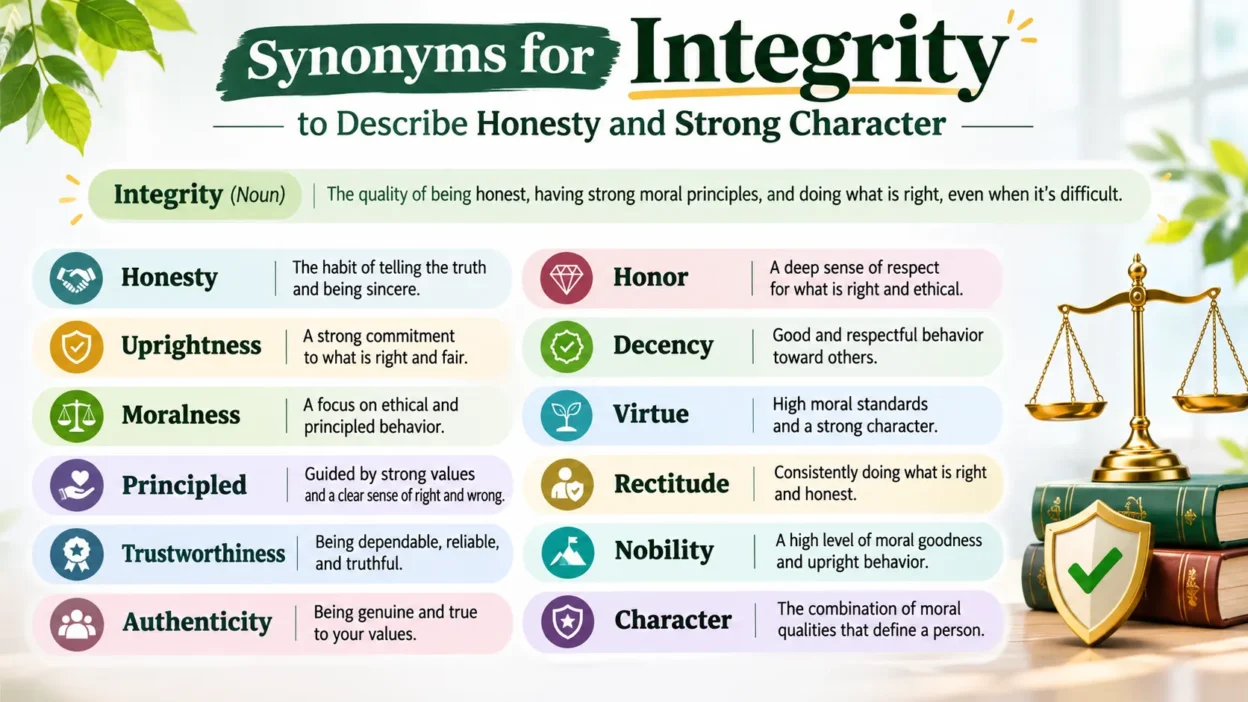
Integrity is the quality of being honest, ethical, and consistent in your principles and actions. A person with integrity follows strong moral values, takes responsibility for mistakes, keeps promises, and treats others fairly. Their behavior remains consistent even when doing the right thing becomes difficult or inconvenient.
Integrity is more than simply telling the truth. It also involves accountability, fairness, respect, dependability, and the willingness to stand by your values. For example, an employee who admits to making a costly mistake instead of blaming a colleague demonstrates integrity.
The word is commonly used in personal relationships, workplaces, leadership discussions, education, and business ethics.
Examples of integrity in sentences:
- Her integrity earned the respect of everyone on the team.
- A successful leader should demonstrate honesty and integrity.
- The company built its reputation through years of ethical conduct.
- He showed integrity by admitting his mistake.
- Parents can teach children the importance of strong moral principles.
- The organization values employees who act with fairness and accountability.
📚 Best Synonyms for Integrity
Several words can express the qualities associated with integrity. However, each alternative carries a slightly different meaning. Some focus on honesty, others describe moral strength, and a few emphasize consistency between beliefs and actions.
Here are some of the most useful alternatives:
| Synonym | Meaning |
|---|---|
| Honesty | Being truthful and avoiding deception |
| Uprightness | Following strong moral principles |
| Probity | Having high standards of honesty and morality |
| Rectitude | Correctness in moral behavior |
| Sincerity | Expressing genuine thoughts and feelings |
| Trustworthiness | Being worthy of another person’s trust |
| Honor | Demonstrating strong moral standards |
| Morality | Following principles of right and wrong |
| Ethicality | Conforming to accepted ethical principles |
| Righteousness | Acting according to moral or religious principles |
| Virtue | A positive moral quality |
| Fairness | Treating people impartially and justly |
| Accountability | Accepting responsibility for actions |
| Reliability | Being dependable and consistent |
| Authenticity | Being genuine and true to oneself |
| Conscientiousness | Taking duties and responsibilities seriously |
| Principle | A fundamental belief guiding behavior |
| Decency | Showing acceptable moral behavior |
| Honorability | Having qualities deserving respect |
| Transparency | Being open and clear about actions and decisions |
These alternatives are useful in different situations. For example, honesty works well when discussing truthfulness, while accountability is more appropriate when describing someone who accepts responsibility for their decisions.
💎 One-Word Synonyms for Integrity
Sometimes a single word communicates an idea more effectively than a lengthy explanation. The following vocabulary offers useful alternatives for describing ethical behavior, strong character, and moral responsibility.
Honesty and Truthfulness
These words emphasize telling the truth, avoiding deception, and communicating openly. They are particularly useful when discussing personal relationships, workplace behavior, and trustworthy communication.
- Truthfulness: The habit of speaking and acting honestly.
- Candor: Open and direct communication without hiding important facts.
- Frankness: Expressing opinions clearly and honestly.
- Veracity: The quality of being truthful or accurate.
- Sincerity: Genuine thoughts, feelings, and intentions.
- Guilelessness: A lack of deception or dishonest intentions.
- Forthrightness: Being direct, open, and honest.
- Authenticity: Being genuine rather than pretending to be someone else.
- Openness: Willingness to communicate honestly and transparently.
- Straightforwardness: Communicating without unnecessary deception or complications.
- Genuineness: The quality of being real and sincere.
- Truthfulness: Consistency with facts and reality.
- Trustability: The quality of being considered trustworthy.
- Plainspokenness: Speaking honestly and directly.
- Transparency: Making information and intentions clear.
Moral Character and Ethical Behavior
These alternatives focus on a person’s moral standards, principles, and commitment to doing what is right. They are especially useful in discussions about leadership, personal values, and ethical decision-making.
- Rectitude: Strong moral correctness.
- Probity: Strict honesty and integrity in conduct.
- Uprightness: Following high moral standards.
- Righteousness: Acting according to moral principles.
- Virtue: A desirable quality of moral character.
- Morality: Understanding and following principles of right and wrong.
- Ethicality: The condition of being ethically sound.
- Honor: Respectable behavior based on moral principles.
- Decency: Behavior that demonstrates acceptable moral standards.
- Principledness: Consistency in following personal or ethical principles.
- Honorability: The quality of deserving respect because of good character.
- Goodness: The quality of being morally good.
- Respectability: Behavior that earns social or moral respect.
- Nobility: Excellence of character and moral purpose.
- Virtuousness: The quality of possessing strong moral values.
Reliability and Trustworthiness
Integrity often involves keeping commitments and behaving consistently. These alternatives are useful when describing dependable employees, responsible leaders, loyal friends, and trustworthy business partners.
- Dependability: The quality of being reliable.
- Reliability: Consistency in performing duties or keeping promises.
- Trustworthiness: The ability to deserve another person’s trust.
- Faithfulness: Remaining loyal to commitments or principles.
- Steadfastness: Remaining firm in beliefs and decisions.
- Consistency: Maintaining similar standards of behavior over time.
- Loyalty: Showing commitment to a person, group, or cause.
- Responsibility: Being accountable for duties and actions.
- Conscientiousness: Taking responsibilities seriously and carefully.
- Diligence: Showing careful and persistent effort.
- Commitment: Dedication to a principle, promise, or responsibility.
- Reliance: The condition of being trusted or depended upon.
- Stability: Remaining dependable and steady.
- Fidelity: Faithfulness to obligations, promises, or principles.
- Perseverance: Continuing to follow a goal despite difficulties.
Fairness and Accountability
These words describe the willingness to treat others justly, accept consequences, and make responsible decisions. They are especially valuable in workplace policies, management discussions, and organizational ethics.
- Fairness: Treating people without unjust favoritism.
- Impartiality: Making decisions without personal bias.
- Justice: Treating people according to what is fair and right.
- Equity: Fairness that considers different needs and circumstances.
- Accountability: Accepting responsibility for actions and outcomes.
- Answerability: Being required to explain or justify decisions.
- Responsibility: Taking ownership of duties and behavior.
- Objectivity: Judging situations without personal bias.
- Evenhandedness: Treating people fairly and consistently.
- Honorable conduct: Behavior guided by ethical standards.
- Ethical responsibility: The duty to make morally appropriate decisions.
- Good faith: Acting honestly and without deceptive intentions.
- Justice-mindedness: A commitment to fair treatment.
- Decorum: Appropriate and respectful behavior.
- Trust: Confidence in another person’s honesty and reliability.
🏢 Professional Synonyms for Integrity
In professional writing, the best alternative depends on the quality you want to highlight. A resume might emphasize reliability and accountability, while a leadership evaluation may focus on ethical conduct, transparency, and fairness.
The following words are especially useful in workplace communication, performance reviews, business reports, and professional recommendations.
| Professional synonym | Best use |
|---|---|
| Ethical conduct | Following workplace and professional standards |
| Accountability | Taking responsibility for decisions |
| Transparency | Communicating decisions openly |
| Trustworthiness | Building confidence among colleagues |
| Dependability | Consistently completing responsibilities |
| Professionalism | Maintaining appropriate workplace behavior |
| Honesty | Communicating truthfully |
| Fairness | Making unbiased decisions |
| Reliability | Delivering consistent results |
| Responsibility | Taking ownership of assigned duties |
| Conscientiousness | Handling work carefully and responsibly |
| Ethical leadership | Guiding others through moral principles |
| Credibility | Being believable and deserving confidence |
| Authenticity | Demonstrating genuine behavior |
| Compliance | Following applicable rules and standards |
Examples in professional sentences:
- Her accountability makes her a valuable member of the management team.
- The organization expects transparency in all financial decisions.
- His ethical conduct strengthened the company’s reputation.
- Dependability is one of the most important qualities in this position.
- The manager demonstrated fairness when resolving the disagreement.
- Her professionalism earned the confidence of senior leadership.
- The candidate has a strong reputation for responsible decision-making.
🎓 Academic and Formal Words Related to Integrity
Academic writing often requires precise vocabulary rather than repeatedly using general terms. Certain alternatives are especially appropriate for essays about morality, philosophy, social responsibility, organizational behavior, and ethical leadership.
Here are useful formal words and their meanings.
| Word | Meaning |
|---|---|
| Probity | Strict moral honesty |
| Rectitude | Moral correctness |
| Veracity | Truthfulness or accuracy |
| Virtuousness | Possessing strong moral qualities |
| Uprightness | Following ethical principles |
| Moral soundness | Having acceptable moral standards |
| Ethical consistency | Applying ethical principles consistently |
| Conscientiousness | Careful attention to responsibilities |
| Impartiality | Freedom from unfair bias |
| Moral responsibility | Accountability for ethical choices |
| Authenticity | Genuineness in behavior |
| Fidelity | Faithfulness to obligations |
| Principle-centeredness | Making decisions according to core principles |
| Trustworthiness | Deserving confidence |
| Righteousness | Acting according to moral standards |
Examples in academic writing:
- Probity is essential for maintaining public confidence in institutions.
- Ethical consistency strengthens the credibility of a research project.
- Moral responsibility influences how individuals make difficult decisions.
- Transparency and impartiality are important elements of responsible governance.
- Conscientiousness can improve the quality of professional research.
❤️ Synonyms for Personal Integrity and Strong Character
Personal integrity describes the values that guide someone’s behavior in everyday life. It becomes visible through small decisions, such as keeping promises, admitting mistakes, respecting boundaries, and treating people fairly.
The following words help describe people who demonstrate strong character.
- Honor: A commitment to respectable and ethical behavior.
- Sincerity: Genuine intentions and honest communication.
- Authenticity: Being true to your identity and beliefs.
- Decency: Treating others with basic respect.
- Loyalty: Remaining committed to people and values.
- Faithfulness: Keeping promises and honoring commitments.
- Humility: Recognizing personal limitations without arrogance.
- Courage: Doing what is right despite fear or pressure.
- Self-discipline: Controlling behavior to follow personal standards.
- Accountability: Accepting the consequences of personal decisions.
- Kindness: Treating others with consideration and compassion.
- Respectfulness: Showing regard for other people.
- Steadfastness: Remaining firm in important beliefs.
- Principled behavior: Acting according to personal moral standards.
- Maturity: Demonstrating responsible judgment and behavior.
Example sentences:
- Her sincerity makes people feel comfortable trusting her.
- His courage allowed him to speak up against unfair treatment.
- Personal accountability is an important part of strong character.
- She demonstrated loyalty by supporting her friends during difficult times.
- Authenticity helps people build meaningful relationships.
📝 Synonyms for Integrity on a Resume
When writing a resume, avoid relying on general statements such as “I have great integrity.” Instead, choose vocabulary that demonstrates how your ethical qualities influence your professional behavior.
A strong resume connects personal qualities with actual responsibilities and accomplishments.
| Resume-friendly word | Example phrase |
|---|---|
| Trustworthy | Recognized as a trustworthy team member |
| Accountable | Maintained accountability for project outcomes |
| Ethical | Followed ethical business practices |
| Dependable | Demonstrated dependable performance |
| Transparent | Promoted transparent communication |
| Conscientious | Applied conscientious attention to detail |
| Reliable | Maintained reliable work standards |
| Responsible | Accepted responsibility for important decisions |
| Professional | Demonstrated professional conduct |
| Fair | Applied fair and consistent decision-making |
| Principled | Maintained principled leadership standards |
| Honest | Communicated honestly with clients and colleagues |
Resume examples:
Instead of writing:
“I am a person with integrity.”
Try these stronger alternatives:
- Demonstrated consistent accountability and ethical judgment when handling confidential information.
- Maintained transparent communication with clients, colleagues, and management.
- Built professional relationships through honesty, reliability, and responsible decision-making.
- Followed organizational policies while maintaining high standards of fairness and professionalism.
- Earned management’s confidence through dependable performance and conscientious work habits.
These examples are more effective because they connect ethical qualities with workplace behavior.
👔 Synonyms for Integrity in Leadership
Integrity is an essential quality in leadership because employees and stakeholders need to trust the people making important decisions. A leader demonstrates strong character by communicating honestly, accepting responsibility, applying rules fairly, and maintaining consistent standards.
Different leadership situations call for different vocabulary.
- Ethical leadership: Guiding people according to moral principles.
- Accountability: Accepting responsibility for decisions and outcomes.
- Transparency: Explaining decisions and sharing relevant information.
- Fairness: Treating team members impartially.
- Trustworthiness: Earning confidence through reliable conduct.
- Consistency: Applying the same standards across situations.
- Credibility: Establishing confidence through honest actions.
- Responsibility: Taking ownership of leadership duties.
- Impartiality: Avoiding favoritism when making decisions.
- Moral courage: Standing up for ethical principles despite pressure.
Example sentences:
- Ethical leadership creates a culture of trust and responsibility.
- A credible manager accepts criticism instead of avoiding accountability.
- Transparency helps employees understand important organizational decisions.
- Fairness encourages a respectful and supportive workplace.
- Consistency allows leaders to establish clear expectations.
🌱 Positive Words That Describe a Person With Integrity
Some words do not directly replace integrity but describe the qualities associated with an honest and principled person. These alternatives can make descriptions more personal, expressive, and specific.
| Descriptive word | What it communicates |
|---|---|
| Honorable | Deserving respect because of moral behavior |
| Genuine | Honest and authentic |
| Principled | Guided by strong beliefs |
| Trustworthy | Worthy of confidence |
| Ethical | Following moral standards |
| Reliable | Consistently dependable |
| Fair-minded | Willing to consider different perspectives fairly |
| Conscientious | Careful and responsible |
| Sincere | Genuine in thoughts and intentions |
| Dependable | Able to be trusted with responsibilities |
| Upright | Morally honest |
| Accountable | Willing to accept responsibility |
| Respectable | Deserving approval and respect |
| Virtuous | Possessing good moral qualities |
| Faithful | Loyal to commitments and principles |
| Transparent | Open and honest |
| Decent | Respectful and morally acceptable |
| Courageous | Willing to defend what is right |
| Authentic | True to personal values |
| Steadfast | Firm in principles and commitments |
🔗 Phrases and Expressions Related to Integrity
Sometimes a phrase communicates the meaning more naturally than a single synonym. These expressions are particularly useful in essays, professional documents, speeches, and personal descriptions.
| Expression | Meaning |
|---|---|
| Strong moral character | Having deeply established ethical values |
| High ethical standards | Following demanding moral expectations |
| Unwavering honesty | Remaining truthful in difficult situations |
| Moral uprightness | Consistently behaving ethically |
| Ethical responsibility | Taking ownership of moral duties |
| A strong sense of right and wrong | Understanding ethical behavior |
| Commitment to honesty | Dedication to telling the truth |
| Personal accountability | Taking responsibility for one’s actions |
| Consistency in values | Applying beliefs across different situations |
| Professional ethics | Moral standards within a profession |
| Honest intentions | Genuine and truthful motives |
| A reputation for trustworthiness | Being known as someone dependable |
| Respect for principles | Following established beliefs |
| Commitment to fairness | Treating people justly |
| Ethical decision-making | Choosing actions based on moral standards |
| Moral courage | Defending ethical beliefs despite challenges |
| Truthful communication | Sharing accurate information |
| Responsible conduct | Acting with care and accountability |
| Character strength | Demonstrating strong personal values |
| Commitment to doing what is right | Choosing ethical actions consistently |
✨ How to Use Integrity Synonyms in Different Sentences
Choosing the right alternative requires understanding the message behind your sentence. A word that works in a business report may sound unnatural in a personal conversation.
Here are practical rewrites showing how different alternatives change the emphasis.
| Original sentence | Alternative sentence |
|---|---|
| She is known for her integrity. | She is known for her honesty and uprightness. |
| The manager demonstrated integrity. | The manager demonstrated ethical leadership. |
| Integrity matters in business. | Ethical conduct matters in business. |
| His integrity earned my trust. | His trustworthiness earned my confidence. |
| The organization values integrity. | The organization values accountability and transparency. |
| She acted with integrity. | She acted according to her moral principles. |
| Integrity is important in leadership. | Ethical responsibility is important in leadership. |
| He has strong personal integrity. | He has strong moral character. |
| The employee showed integrity. | The employee demonstrated honesty and responsibility. |
| Integrity builds relationships. | Trustworthiness helps build lasting relationships. |
Notice that some alternatives change the emphasis slightly. For example, trustworthiness highlights whether someone deserves confidence, while transparency emphasizes openness in communication.
🚫 Words That Are Related to Integrity but Are Not Exact Synonyms
Not every positive character trait means the same thing as integrity. Some words describe qualities that support ethical behavior without replacing the original concept.
Understanding these differences helps you avoid awkward or inaccurate wording.
| Related word | Why it is not an exact synonym |
|---|---|
| Kindness | Describes caring behavior rather than overall moral consistency |
| Intelligence | Refers to mental ability, not ethical conduct |
| Confidence | Describes belief in oneself or something |
| Discipline | Refers to controlling behavior and following rules |
| Loyalty | Focuses on commitment to a person, group, or cause |
| Respect | Describes regard for others |
| Courage | Describes bravery in difficult situations |
| Generosity | Describes willingness to give or help |
| Patience | Describes the ability to tolerate delays or difficulties |
| Humility | Describes modesty and freedom from arrogance |
| Competence | Refers to the ability to perform a task successfully |
| Charisma | Describes the ability to attract or influence people |
For example, a person can be intelligent and confident without necessarily demonstrating integrity. Similarly, loyalty does not always mean ethical behavior because someone may remain loyal to a person who acts dishonestly.
💡 Tips for Choosing the Best Alternative
The most effective word depends on what you want your reader to understand. Instead of selecting a synonym simply because it sounds impressive, consider the specific quality you’re describing.
Use these guidelines:
- For honesty: Choose truthfulness, sincerity, candor, or veracity.
- For moral behavior: Choose uprightness, probity, rectitude, or virtue.
- For workplace reliability: Choose dependability, accountability, or conscientiousness.
- For leadership: Choose ethical conduct, transparency, fairness, or credibility.
- For personal character: Choose honor, authenticity, faithfulness, or principled behavior.
- For academic writing: Choose probity, rectitude, impartiality, or moral responsibility.
- For professional resumes: Choose trustworthy, accountable, ethical, or dependable.
- For business communication: Choose transparency, ethical conduct, or professional responsibility.
Always consider the sentence structure, audience, and intended meaning. A sophisticated word is not automatically a better choice if it makes your writing harder to understand.
❓ Frequently Asked Questions
What is the best synonym for integrity?
Honesty, uprightness, probity, rectitude, and trustworthiness are among the closest alternatives. The best choice depends on the intended meaning. Honesty emphasizes truthfulness, while probity and rectitude focus more strongly on moral correctness.
What is another word for integrity in a professional setting?
Accountability, ethical conduct, transparency, dependability, and professionalism are useful professional alternatives. They describe responsible workplace behavior and ethical decision-making.
What is a more sophisticated word for integrity?
Probity and rectitude are two formal alternatives. Probity refers to strict honesty and moral conduct, while rectitude describes correctness in moral behavior.
What is a simple word for integrity?
Honesty is one of the simplest and most familiar alternatives. Other accessible words include fairness, trustworthiness, sincerity, and responsibility.
What is the opposite of integrity?
Common opposites include dishonesty, corruption, deceit, fraudulence, hypocrisy, and immorality. These words describe different forms of unethical behavior or a lack of moral principles.
How do you describe someone with integrity?
You can describe such a person as honest, trustworthy, principled, sincere, dependable, fair-minded, ethical, or upright. These adjectives highlight different aspects of strong character.
What is another way to say someone has strong moral values?
You can say that someone has strong principles, excellent moral character, ethical standards, personal uprightness, or a commitment to doing what is right.
What is integrity in the workplace?
Workplace integrity means acting honestly, accepting responsibility, respecting colleagues, following ethical standards, and making fair decisions. It also involves keeping commitments and handling confidential information responsibly.
Is integrity the same as honesty?
No. Honesty is an important part of integrity, but the two words are not identical. Honesty focuses on truthfulness, whereas integrity also includes consistency, accountability, fairness, and following moral principles.
Can authenticity be used as a synonym for integrity?
Authenticity is related to integrity because both involve being genuine and consistent with personal values. However, authenticity emphasizes being true to oneself, while integrity covers a broader range of ethical qualities.
What are three qualities associated with integrity?
Honesty, accountability, and fairness are three important qualities associated with integrity. Trustworthiness, consistency, and ethical responsibility are also closely connected.
🎯 Conclusion
Finding the right alternative for integrity can make your writing more precise, professional, and engaging. Words such as honesty, probity, rectitude, sincerity, uprightness, and trustworthiness describe different aspects of strong moral character. Meanwhile, accountability, transparency, fairness, and ethical conduct are particularly useful in workplace and leadership discussions.
Remember that these alternatives are related but not always interchangeable. Choose honesty when discussing truthfulness, probity when emphasizing strict moral standards, and accountability when describing responsibility for actions. By understanding these differences, you can communicate ideas about ethics, character, and trust with greater confidence.

Vivian Mercer is an English language writer and vocabulary enthusiast who specializes in synonyms, word meanings, grammar, idioms, and language usage. She creates accurate, easy-to-understand content that helps readers improve their English skills with confidence.