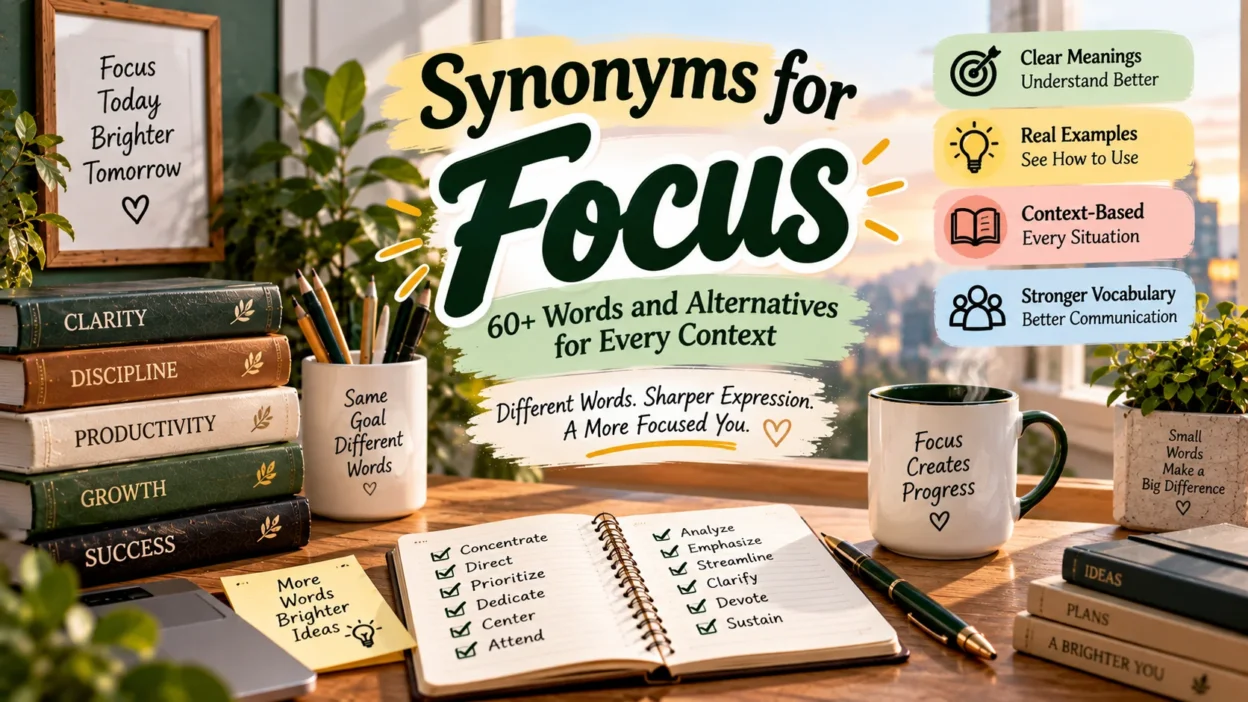
The word focus can describe attention, concentration, priorities, goals, or the main subject of something.
That wide range of meanings makes it easy to repeat focus too often in writing.
Fortunately, English offers many alternatives.
You can concentrate on a difficult task, prioritize an important responsibility, emphasize a key point, or highlight useful information.
In professional writing, words such as target, address, direct, and devote can make your meaning more precise.
In casual English, expressions such as pay attention, keep your eye on, and zero in on sound more natural.
The best synonym depends on the exact meaning you want to express.
60 Synonyms for Focus at a Glance
| # | Synonym | Main Meaning | Best Context |
|---|---|---|---|
| 1 | Concentrate | Give full attention | Study, work |
| 2 | Attend | Give attention | Formal writing |
| 3 | Emphasize | Give special importance | Writing, speech |
| 4 | Highlight | Draw attention to | Writing, presentations |
| 5 | Prioritize | Give greater importance | Work, planning |
| 6 | Center on | Have as the main subject | Discussions |
| 7 | Concentrate on | Direct attention toward | Tasks |
| 8 | Pay attention | Notice carefully | Everyday English |
| 9 | Attend to | Deal with carefully | Work, responsibilities |
| 10 | Target | Direct toward a goal | Marketing, strategy |
| 11 | Direct | Aim attention or effort | Professional contexts |
| 12 | Devote | Give time or effort | Goals, projects |
| 13 | Address | Deal with an issue | Problems, reports |
| 14 | Stress | Emphasize importance | Formal writing |
| 15 | Consider | Give thought to | Decisions |
| 16 | Examine | Look at carefully | Research |
| 17 | Study | Examine closely | Academic contexts |
| 18 | Observe | Watch carefully | Research |
| 19 | Inspect | Examine closely | Objects, systems |
| 20 | Contemplate | Think deeply about | Formal writing |
| 21 | Ponder | Think carefully | Reflective writing |
| 22 | Mind | Pay attention to | Everyday English |
| 23 | Notice | Become aware of | General use |
| 24 | Watch | Look carefully | Everyday situations |
| 25 | Monitor | Observe continuously | Work, technology |
| 26 | Track | Follow progress | Business, data |
| 27 | Follow | Keep attention on | Instructions, discussions |
| 28 | Pursue | Work toward | Goals |
| 29 | Aim | Direct toward an objective | Goals |
| 30 | Orient | Direct toward something | Formal contexts |
| 31 | Fixate | Focus excessively | Negative contexts |
| 32 | Zero in on | Focus closely | Informal English |
| 33 | Home in on | Focus precisely | Problems, details |
| 34 | Key in on | Give special attention | Informal |
| 35 | Single out | Select for attention | People, issues |
| 36 | Zoom in on | Examine closely | Details, visuals |
| 37 | Immerse | Become deeply involved | Learning |
| 38 | Engage | Become actively involved | Work, activities |
| 39 | Apply oneself | Give serious effort | Study, work |
| 40 | Commit | Give dedication | Goals, projects |
| 41 | Dedicate | Give time or effort | Long-term goals |
| 42 | Invest | Put time or resources into | Business, personal growth |
| 43 | Channel | Direct energy toward | Effort, emotions |
| 44 | Allocate | Assign resources or attention | Business |
| 45 | Aim at | Direct toward | Objectives |
| 46 | Gear toward | Design for a purpose | Strategy |
| 47 | Tailor to | Adapt for a target | Content, services |
| 48 | Highlight | Make noticeable | Information |
| 49 | Underline | Emphasize | Writing |
| 50 | Reinforce | Strengthen an idea | Communication |
| 51 | Feature | Give prominence to | Media, websites |
| 52 | Spotlight | Give special attention | Media |
| 53 | Foreground | Put in a prominent position | Formal writing |
| 54 | Base on | Make central to | Plans, decisions |
| 55 | Revolve around | Have as the central subject | Ideas, stories |
| 56 | Concern | Relate mainly to | Formal writing |
| 57 | Address | Give attention to | Issues |
| 58 | Deal with | Give attention to a matter | Everyday English |
| 59 | Zero in | Focus closely | Informal |
| 60 | Keep an eye on | Watch carefully | Everyday English |
1. Concentrate
Concentrate is one of the closest synonyms for focus when you mean giving your full mental attention to something.
Example:
I need to concentrate on my work.
It works especially well for studying, reading, writing, and problem-solving.
2. Attend
Attend can mean to give attention to something, especially in formal English.
Example:
The report attends to several important concerns.
This use sounds more formal than simply saying focus on.
3. Emphasize
Use emphasize when you want to give special importance to an idea or point.
Example:
The speaker emphasized the importance of teamwork.
It works particularly well in essays, presentations, reports, and speeches.
4. Highlight
Highlight means to draw attention to something important.
Example:
The report highlights several major problems.
It works well when discussing information, statistics, achievements, or key points.
5. Prioritize
Prioritize means to treat something as more important than other things.
Example:
We need to prioritize customer satisfaction.
This word works especially well in business and productivity contexts.
6. Center On
Use center on when something serves as the main subject or concern.
Example:
The discussion centered on climate change.
You can also use center around, although center on often provides a more direct construction.
7. Concentrate On
Concentrate on directly expresses directed attention.
Example:
She concentrated on completing the assignment.
It works naturally in both everyday and formal English.
8. Pay Attention
Pay attention is a common conversational alternative to focus.
Example:
Please pay attention to the instructions.
It sounds natural in classrooms, workplaces, and everyday conversations.
9. Attend To
Attend to means to give attention to something that needs action or care.
Example:
The manager needs to attend to several urgent matters.
It often appears in professional or formal contexts.
10. Target
Target means to direct an action, product, message, or effort toward a particular person or goal.
Example:
The campaign targets young customers.
Marketing professionals use this word frequently.
11. Direct
Direct means to aim attention, energy, effort, or resources toward something.
Example:
The company directed its resources toward research.
It works well when you want to emphasize purposeful action.
12. Devote
Devote means to give time, energy, attention, or resources to something.
Example:
She devoted her time to learning Spanish.
It often suggests sustained effort.
13. Address
Address means to deal with or give attention to an issue.
Example:
The company needs to address customer complaints.
This word works particularly well in professional and academic writing.
14. Stress
Stress means to emphasize something strongly.
Example:
The teacher stressed the importance of regular practice.
It can replace focus when the original sentence means emphasize.
15. Consider
Consider means to think carefully about something before making a decision.
Example:
The committee considered several possible solutions.
It works well when focus involves thoughtful evaluation.
16. Examine
Examine means to inspect or study something carefully.
Example:
Researchers examined the effects of the new policy.
It works especially well in academic and analytical writing.
17. Study
Study means to examine something carefully in order to understand it.
Example:
Scientists studied the behavior of the animals.
It can replace focus when you mean detailed investigation.
18. Observe
Observe means to watch or examine something carefully.
Example:
Researchers observed changes in the participants’ behavior.
This word works particularly well in scientific contexts.
19. Inspect
Inspect means to examine something closely, often to find problems.
Example:
The technician inspected the equipment.
Use it when careful physical examination matters.
20. Contemplate
Contemplate means to think deeply about something.
Example:
She contemplated the possible consequences of her decision.
It sounds more formal and thoughtful than focus.
21. Ponder
Ponder means to think carefully and deeply about something.
Example:
He spent the evening pondering the question.
It works well in reflective or literary writing.
22. Mind
Mind can mean to pay attention to or take care of something.
Example:
Mind the details when completing the form.
This use is common in instructions and everyday English.
23. Notice
Notice means to become aware of something.
Example:
She noticed a small error in the report.
It works when focus means becoming aware rather than maintaining concentration.
24. Watch
Watch means to look at something carefully, usually for a period of time.
Example:
Watch the road while you drive.
It works naturally in everyday conversations.
25. Monitor
Monitor means to watch something continuously or regularly.
Example:
The team monitors website traffic every day.
It works well for systems, progress, health, data, and performance.
26. Track
Track means to follow the development or movement of something.
Example:
The company tracks its monthly sales.
It works particularly well with progress, numbers, trends, and performance.
27. Follow
Follow can mean to pay close attention to something or continue watching it.
Example:
Please follow the instructions carefully.
It can also describe keeping up with a discussion or development.
28. Pursue
Pursue means to actively work toward a goal.
Example:
She pursued her goal of becoming a writer.
It emphasizes continued effort rather than simple attention.
29. Aim
Aim means to direct an action or effort toward a particular objective.
Example:
The program aims to improve literacy.
Use it when focus involves a clear goal.
30. Orient
Orient means to direct something toward a particular purpose, position, or goal.
Example:
The training is oriented toward practical skills.
It has a formal and professional tone.
31. Fixate
Fixate means to focus on something excessively or for too long.
Example:
Don’t fixate on a single mistake.
Unlike neutral words such as concentrate, fixate often has a negative meaning.
32. Zero In On
Zero in on means to focus closely on a particular person, problem, or detail.
Example:
The investigators zeroed in on the main cause.
It works well in informal and journalistic writing.
33. Home In On
Home in on means to move attention or effort toward a specific target.
Example:
The team quickly homed in on the source of the problem.
It works well when someone narrows their attention.
34. Key In On
Key in on means to focus attention on a particular point.
Example:
The presentation keyed in on customer needs.
This expression sounds more conversational than emphasize.
35. Single Out
Single out means to select one person or thing for particular attention.
Example:
The teacher singled out three important examples.
It does not simply mean focus; it implies selection.
36. Zoom In On
Zoom in on means to examine something closely.
Example:
Let’s zoom in on the final section of the report.
It works especially well in casual discussions and visual contexts.
37. Immerse
Immerse means to become deeply involved in an activity, subject, or experience.
Example:
She immersed herself in the study of history.
It suggests deep involvement rather than ordinary concentration.
38. Engage
Engage means to become actively involved with something.
Example:
Students should engage with the material.
It works well in education, communication, and professional settings.
39. Apply Oneself
Apply oneself means to make a serious and sustained effort.
Example:
He applied himself to his studies.
It emphasizes dedication and effort.
40. Commit
Commit means to dedicate yourself seriously to a goal, task, or course of action.
Example:
She committed herself to improving her writing.
It suggests strong dedication.
41. Dedicate
Dedicate means to give significant time, effort, or attention to something.
Example:
He dedicated years to scientific research.
It works well for long-term efforts.
42. Invest
Invest can describe putting time, energy, money, or attention into something.
Example:
The company invested more resources in employee training.
It often appears in business and personal-development contexts.
43. Channel
Channel means to direct energy, attention, or effort toward a particular purpose.
Example:
She channeled her energy into creative work.
It creates a sense of purposeful direction.
44. Allocate
Allocate means to assign resources, time, or attention to something.
Example:
The manager allocated more resources to the project.
It works especially well in business and planning.
45. Aim At
Aim at means to direct an effort toward a specific objective.
Example:
The campaign aims at increasing brand awareness.
It emphasizes the intended target.
46. Gear Toward
Gear toward means to design or organize something for a particular purpose or audience.
Example:
The course is geared toward beginners.
It works especially well for programs, products, courses, and services.
47. Tailor To
Tailor to means to adapt something for a particular person, group, or purpose.
Example:
The company tailored its services to small businesses.
It works well when focus involves customization.
48. Underline
Underline means to emphasize an important point.
Example:
The results underline the need for further research.
It works well in formal and academic writing.
49. Reinforce
Reinforce means to strengthen an idea, message, behavior, or impression.
Example:
The examples reinforced the main argument.
Use it when focus involves strengthening rather than simply directing attention.
50. Feature
Feature means to give something a prominent place or position.
Example:
The website features customer success stories.
It works especially well for websites, magazines, advertisements, and media.
51. Spotlight
Spotlight means to give special attention or publicity to something.
Example:
The article spotlights local businesses.
It sounds vivid and works particularly well in journalism and marketing.
52. Foreground
Foreground means to place something in a prominent or important position.
Example:
The novel foregrounds the experiences of ordinary people.
This word suits academic, literary, and analytical writing.
53. Base On
Base on means to make something depend on a particular idea, fact, or principle.
Example:
The company based its decision on customer feedback.
It can express focus when a decision centers strongly on particular information.
54. Revolve Around
Revolve around means to have something as the central subject or concern.
Example:
The discussion revolved around workplace safety.
It works well when describing conversations, stories, plans, or relationships.
55. Concern
Concern can mean to relate to or involve a particular subject.
Example:
The report concerns environmental challenges.
It often sounds formal and works well in academic or professional writing.
56. Deal With
Deal with means to handle or give attention to a subject, issue, or problem.
Example:
The article deals with common grammar mistakes.
It sounds natural in everyday and professional English.
57. Zero In
Zero in means to focus closely on something specific.
Example:
The researchers zeroed in on the most important variable.
It suggests narrowing attention to a particular target.
58. Keep an Eye On
Keep an eye on means to watch or monitor something carefully.
Example:
Please keep an eye on the children.
This expression sounds casual and conversational.
59. Spotlight
Spotlight can also work as a strong alternative when you want to make a person, issue, or achievement especially noticeable.
Example:
The event spotlighted emerging artists.
It works particularly well when attention comes from public presentation.
60. Highlight
Highlight remains one of the most versatile alternatives to focus.
Example:
The presentation highlighted the most important findings.
It works in academic, professional, marketing, and everyday writing.
Synonyms for Focus in Different Contexts
The best synonym changes according to the situation.
| Context | Strong Choices |
|---|---|
| Studying | Concentrate, study, attend |
| Work | Concentrate, prioritize, attend to |
| Business | Prioritize, target, address, allocate |
| Marketing | Target, tailor to, gear toward |
| Research | Examine, study, observe, investigate |
| Writing | Emphasize, highlight, underline |
| Goals | Pursue, aim, commit, dedicate |
| Problems | Address, examine, deal with |
| Monitoring | Watch, track, monitor, keep an eye on |
| Deep involvement | Immerse, engage, commit |
| Casual conversation | Pay attention, watch, zero in on |
| Formal writing | Emphasize, foreground, address, examine |
Synonyms for Focus When You Mean Concentration
If focus means mental concentration, these choices work particularly well:
- Concentrate
- Pay attention
- Attend
- Attend to
- Immerse
- Engage
- Apply oneself
- Zero in on
- Home in on
- Keep an eye on
Example:
I need to focus on my homework.
You could write:
I need to concentrate on my homework.
Or:
I need to pay attention to my homework.
Concentrate usually provides the closest replacement.
Synonyms for Focus When You Mean Emphasize
When focus means giving importance to an idea, use:
- Emphasize
- Highlight
- Stress
- Underline
- Spotlight
- Foreground
- Reinforce
- Feature
Example:
The article focuses on the importance of sleep.
You could write:
The article emphasizes the importance of sleep.
This version makes the intended meaning clearer.
Synonyms for Focus When You Mean Prioritize
When you want to show that something receives greater importance than other things, use:
- Prioritize
- Devote
- Dedicate
- Commit
- Allocate
- Direct
- Channel
- Invest
Example:
The company is focusing on customer service.
A more precise version could be:
The company is prioritizing customer service.
The new sentence suggests that customer service has moved higher on the company’s list of priorities.
Synonyms for Focus When You Mean the Main Subject
If focus refers to the central topic, use:
- Center on
- Revolve around
- Concern
- Address
- Feature
- Spotlight
- Foreground
- Deal with
Example:
The documentary focuses on ocean pollution.
You could write:
The documentary centers on ocean pollution.
Both sentences identify the main subject.
Stronger Alternatives to Focus
If you want your writing to sound more precise, replace the general word focus with a word that explains the exact action.
Instead of:
The report focuses on the problem.
Try:
The report examines the problem.
Instead of:
The campaign focuses on young adults.
Try:
The campaign targets young adults.
Instead of:
The speech focuses on the importance of education.
Try:
The speech emphasizes the importance of education.
Instead of:
She focuses on her studies.
Try:
She concentrates on her studies.
Specific verbs often communicate more information than the general word focus.
Focus Synonyms: Which Word Should You Choose?
- Use concentrate when attention requires mental effort.
- Use emphasize when you want to stress importance.
- Use prioritize when you place something above other tasks.
- Use highlight when you draw attention to information.
- Use target when you direct an effort toward a specific audience or goal.
- Use address when you deal with an issue.
- Use examine when you study something carefully.
- Use monitor when you watch something continuously.
- Use pursue when you actively work toward a goal.
- Use immerse when you become deeply involved.
- Use fixate when the attention becomes excessive or unhealthy.
This approach helps you choose a synonym based on meaning rather than simply swapping words.
Common Mistakes When Using Synonyms for Focus
Not every synonym works in every sentence.
For example, prioritize cannot replace focus when you simply mean paying attention.
I prioritized the instructions changes the meaning.
I paid attention to the instructions keeps the original idea.
Likewise, fixate carries a negative sense.
You should not use it when you simply want to describe healthy concentration.
Context matters more than finding a word that looks similar in a thesaurus.
Frequently Asked Questions
What is the best synonym for focus?
Concentrate is one of the closest synonyms when focus means giving your attention to something. Other strong choices include emphasize, prioritize, highlight, address, and target, depending on the context.
What is a professional synonym for focus?
Professional alternatives include prioritize, emphasize, address, examine, target, direct, and allocate.
What is a synonym for focus in writing?
Use emphasize, highlight, stress, underline, foreground, or spotlight when focus means giving special attention to an idea.
What is a synonym for focus on a goal?
Good choices include pursue, aim for, work toward, commit to, dedicate oneself to, and target.
What is a synonym for focus on a problem?
Use address, examine, investigate, deal with, tackle, or zero in on, depending on the sentence.
What is a synonym for focus in business?
Useful choices include prioritize, target, address, allocate, direct, and strategize around.
What is a synonym for focus in academic writing?
Examine, emphasize, investigate, analyze, center on, and foreground work well in academic contexts.
What is a strong synonym for focus?
The strongest choice depends on the intended meaning. Concentrate works for attention, emphasize for importance, prioritize for importance among tasks, and target for a specific audience or objective.
Conclusion
There are many useful synonyms for focus, but each one brings a slightly different meaning.
When you mean mental attention, choose concentrate or pay attention.
When you mean importance, emphasize, highlight, or stress can work better.
For priorities, prioritize, devote, dedicate, and allocate provide more specific meanings.
When you describe a central topic, consider center on, revolve around, address, or feature.
For goals and directed effort, pursue, target, aim, commit, and channel can make your writing more precise.
The key is not to replace focus automatically.
Instead, identify what you actually mean and choose the word that expresses that idea most accurately.
That small change can make your writing sound clearer, more natural, and more professional.

Vivian Mercer is an English language writer and vocabulary enthusiast who specializes in synonyms, word meanings, grammar, idioms, and language usage. She creates accurate, easy-to-understand content that helps readers improve their English skills with confidence.