
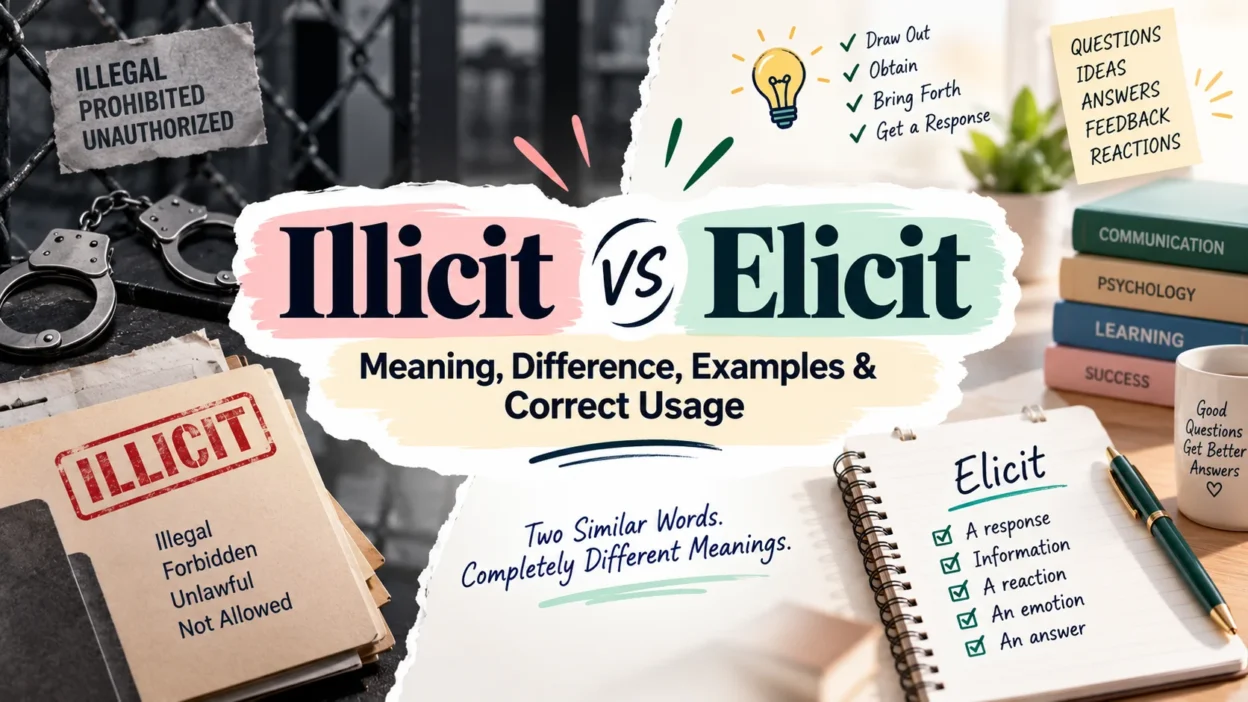
Illicit vs. elicit are two English words that sound very similar, but they have completely different meanings.
This similarity often causes confusion in writing and conversation.
Illicit describes something illegal, forbidden, or not officially permitted.
Elicit means to draw out a response, reaction, answer, information, or emotion from someone.
For example, an illicit activity breaks a law or rule.
On the other hand, a question can elicit a response from a student.
The words also belong to different parts of speech and usually appear in very different sentence patterns.
Understanding the difference can help you avoid common spelling and vocabulary mistakes.
Illicit vs. Elicit: Quick Answer
Illicit means illegal, prohibited, or unauthorized.
Elicit means to obtain or draw out something, especially a response, information, reaction, or emotion.
The easiest way to remember them is:
Illicit = illegal or forbidden
Elicit = draw out or bring forth
| Word | Meaning | Part of Speech | Example |
|---|---|---|---|
| Illicit | Illegal or forbidden | Adjective | The police investigated an illicit operation. |
| Elicit | Draw out a response or reaction | Verb | The question elicited a strong response. |
What Does Illicit Mean?
Illicit means illegal, forbidden, or not allowed by law or an established rule.
It describes actions, goods, activities, relationships, or behavior that authorities or accepted rules prohibit.
For example:
The authorities discovered an illicit business operation.
The word tells us that the activity violates a law or official rule.
Examples of Illicit
- The police uncovered an illicit operation.
- The company was accused of engaging in illicit activities.
- Authorities seized illicit goods.
- The investigation focused on illicit financial transactions.
- The organization tried to stop illicit trade.
- He was involved in an illicit scheme.
In each example, illicit describes something prohibited or unauthorized.
What Does Elicit Mean?
Elicit is a verb that means to draw out or bring forth something.
You can elicit:
- A response
- An answer
- Information
- A reaction
- An emotion
- A comment
- A memory
- An explanation
- A laugh
For example:
The teacher asked a question to elicit an answer from the students.
The question encouraged the students to provide an answer.
Examples of Elicit
- The question elicited a thoughtful response.
- Her story elicited laughter from the audience.
- The interviewer tried to elicit more information.
- The announcement elicited mixed reactions.
- The teacher asked several questions to elicit discussion.
- His comments elicited an emotional response.
Here, elicit describes the act of drawing something out.
The Main Difference Between Illicit and Elicit
The difference becomes simple when you focus on their meanings.
Illicit describes something that is not allowed.
Elicit describes the action of drawing something out.
Compare these sentences:
The authorities investigated an illicit business.
The business violated laws or regulations.
The journalist tried to elicit information from the witness.
The journalist tried to get information from the witness.
The two words may sound similar, but their meanings have no direct connection.
Illicit vs. Elicit: Side-by-Side Comparison
| Feature | Illicit | Elicit |
|---|---|---|
| Meaning | Illegal or forbidden | Draw out or obtain |
| Part of speech | Adjective | Verb |
| Main idea | Something prohibited | Getting a response or reaction |
| Common subjects | Activities, goods, trade, behavior | Questions, actions, comments |
| Common objects | Activity, trade, goods, behavior | Response, answer, information |
| Example | Illicit trade can harm communities. | The question elicited an answer. |
| Related word | Illegal | Evoke / draw out |
Easy Examples to Understand the Difference
Here are some simple examples:
Illicit
The company was involved in illicit trade.
The trade was illegal or prohibited.
Elicit
The interview elicited useful information.
The interview brought useful information out.
Illicit
Officials seized illicit products.
The products were not legally permitted.
Elicit
The teacher’s question elicited several answers.
The question encouraged students to provide answers.
These examples show how differently the words function.
Illicit in Different Contexts
The adjective illicit appears in several formal contexts.
Illicit Trade
Illicit trade refers to trade that violates laws or regulations.
Example:
The government introduced new measures to combat illicit trade.
Illicit Activities
This phrase refers broadly to activities that violate laws or rules.
Example:
The investigation uncovered several illicit activities.
Illicit Goods
Illicit goods are goods that people cannot legally produce, possess, sell, or distribute in a particular context.
Example:
Customs officials intercepted a shipment of illicit goods.
Illicit Payments
An illicit payment involves money transferred in a prohibited or unlawful way.
Example:
The investigation examined allegations of illicit payments.
Elicit in Different Contexts
The verb elicit commonly appears when someone intentionally draws something out.
Elicit a Response
Example:
The campaign was designed to elicit a positive response.
Elicit Information
Example:
The interviewer used open-ended questions to elicit information.
Elicit an Answer
Example:
The teacher asked another question to elicit the correct answer.
Elicit an Emotion
Example:
The film elicited strong emotions from viewers.
Elicit a Reaction
Example:
The announcement elicited a mixed reaction from employees.
These combinations appear frequently in academic, professional, journalistic, and everyday writing.
Elicit vs. Evoke
Elicit and evoke can overlap, especially when discussing emotions or reactions.
However, they emphasize different ideas.
Elicit means to draw something out.
Evoke means to bring a feeling, image, memory, or reaction to mind.
Compare:
The question elicited an answer.
The question caused someone to provide an answer.
The photograph evoked childhood memories.
The photograph brought those memories to mind.
A useful rule is:
Elicit = get something from someone
Evoke = bring something to mind
Illicit vs. Illegal
Illicit and illegal also have similar meanings, but they do not always work in exactly the same way.
Illegal directly means against the law.
Illicit means forbidden, unlawful, or unauthorized and often sounds more formal.
For example:
The police arrested him for illegal activity.
You could also say:
The police investigated illicit activity.
In many contexts, the two words overlap.
However, illicit can sometimes describe something forbidden by rules or accepted standards even when the situation does not involve a specific criminal law.
Common Phrases With Illicit
Learning common word combinations can make the word easier to remember.
Some common phrases include:
- Illicit activity
- Illicit trade
- Illicit goods
- Illicit business
- Illicit operation
- Illicit market
- Illicit transaction
- Illicit payment
- Illicit relationship
- Illicit behavior
- Illicit scheme
- Illicit dealings
Example Sentences
- Authorities investigated the illicit operation.
- The report discussed illicit financial activity.
- Officials worked to prevent illicit trade.
- The company denied involvement in illicit transactions.
Common Phrases With Elicit
Elicit commonly appears with words describing information, reactions, and emotions.
Some common combinations include:
- Elicit a response
- Elicit an answer
- Elicit information
- Elicit a reaction
- Elicit emotions
- Elicit comments
- Elicit feedback
- Elicit laughter
- Elicit sympathy
- Elicit discussion
- Elicit a memory
- Elicit an explanation
Example Sentences
- The survey elicited useful feedback.
- Her speech elicited applause.
- The question elicited an interesting response.
- The interviewer tried to elicit more details.
- The story elicited strong emotions.
Common Mistakes With Illicit and Elicit ❌
Mistake 1: Using Elicit When You Mean Illegal
Incorrect:
The company was involved in elicit activities.
Correct:
The company was involved in illicit activities.
The adjective illicit describes prohibited activity.
Mistake 2: Using Illicit Instead of Elicit
Incorrect:
The interviewer tried to illicit information.
Correct:
The interviewer tried to elicit information.
Here, elicit means to draw information out.
Mistake 3: Confusing the Spelling
The spelling difference is small.
Illicit contains ill-.
Elicit begins with e-.
Remember:
Illicit → illegal
Elicit → extract a response
This connection can help you remember the correct spelling.
How to Remember Illicit vs. Elicit 🧠
Try these memory tricks.
Illicit = Illegal
Both words begin with a strong connection to something unlawful.
Think:
ILLICIT → ILLEGAL
When you see illicit, think about something forbidden.
Elicit = Extract
Think:
ELICIT → EXTRACT
When you elicit something, you draw it out.
For example:
The question elicited an answer.
The question extracted or brought out the answer.
Another quick trick:
Illicit breaks rules.
Elicit brings something out.
Illicit vs Elicit in Academic Writing
Both words can appear in formal and academic writing.
Illicit often appears in discussions involving law, economics, politics, crime, regulation, and social issues.
For example:
Researchers examined the effects of illicit markets on local economies.
Elicit commonly appears in research methodology, psychology, education, interviews, and communication.
For example:
The researchers used open-ended questions to elicit detailed responses.
Using the correct word makes academic writing much more precise.
Illicit vs. Elicit in Professional Writing
Professional communication also uses both words.
You might see illicit in reports involving compliance, regulations, financial misconduct, or unauthorized activity.
For example:
The audit identified several potentially illicit transactions.
You might see elicit in communication, research, customer service, interviews, and surveys.
For example:
The survey was designed to elicit customer feedback.
The context usually makes the correct word easy to identify.
Grammar: How to Use Illicit Correctly
Illicit functions as an adjective.
It normally modifies a noun.
Common structures include:
illicit + noun
Examples:
- illicit activity
- illicit trade
- illicit goods
- illicit transaction
- illicit behavior
You would not normally use illicit as the verb meaning get or obtain.
Grammar: How to Use Elicit Correctly
Elicit functions as a verb.
A person, question, event, or action can elicit something.
Common structures include:
subject + elicit + object
Examples:
- The question elicited a response.
- Her speech elicited applause.
- The survey elicited useful feedback.
- The interview elicited important information.
The object usually represents the response, information, emotion, or reaction that someone draws out.
Illicit vs. Elicit: Quick Practice
Choose the correct word in each sentence.
- The investigation uncovered ______ financial activity.
- The teacher asked a question to ______ a response.
- Authorities seized ______ goods.
- The interview ______ useful information.
- The report examined ______ trade.
- The announcement ______ a strong reaction.
Answers
- Illicit
- Elicit
- Illicit
- Elicited
- Illicit
- Elicited
The pattern becomes clear when you identify the role of the word.
If it describes something forbidden, choose illicit.
If it describes drawing out a response or reaction, choose elicit.
Frequently Asked Questions
What is the difference between illicit and elicit?
Illicit means illegal, forbidden, or unauthorized. Elicit means to draw out or obtain a response, reaction, emotion, answer, or information.
Is illicit an adjective?
Yes. Illicit is an adjective.
For example:
The authorities investigated illicit activity.
Is elicit a verb?
Yes. Elicit is a verb.
For example:
The question elicited a detailed response.
Is illicit the same as illegal?
They often have similar meanings. However, illicit can also describe something forbidden or unauthorized in a broader sense, while illegal directly refers to something against the law.
Is elicit the same as evoke?
Not always. Elicit means to draw something out, while evoke often means to bring a feeling, memory, image, or reaction to mind.
How can I remember the spelling of illicit?
Connect illicit with illegal. Both relate to something unlawful or forbidden.
How can I remember elicit?
Think of elicit as extract. To elicit something means to draw it out.
What is an example of illicit?
The authorities investigated an illicit trade network.
Here, illicit means illegal or prohibited.
What is an example of elicit?
The interviewer asked questions to elicit more information.
Here, elicit means to draw information out.
Final Takeaway
The difference between illicit vs. elicit becomes easy once you focus on their functions.
Illicit is an adjective that describes something illegal, forbidden, or unauthorized.
Elicit is a verb that means to draw out a response, answer, emotion, reaction, or information.
Remember the simplest connection:
Illicit = illegal or forbidden.
Elicit = draw out or obtain.
If you are describing prohibited activity, choose illicit.
If someone or something brings out a response or reaction, choose elicit.
These two words sound similar, but their meanings and grammatical roles differ completely.

Vivian Mercer is an English language writer and vocabulary enthusiast who specializes in synonyms, word meanings, grammar, idioms, and language usage. She creates accurate, easy-to-understand content that helps readers improve their English skills with confidence.