At first glance, feasible vs. possible may seem like a simple word-choice question. Both words describe something that can happen or be done.
However, they do not carry exactly the same meaning.
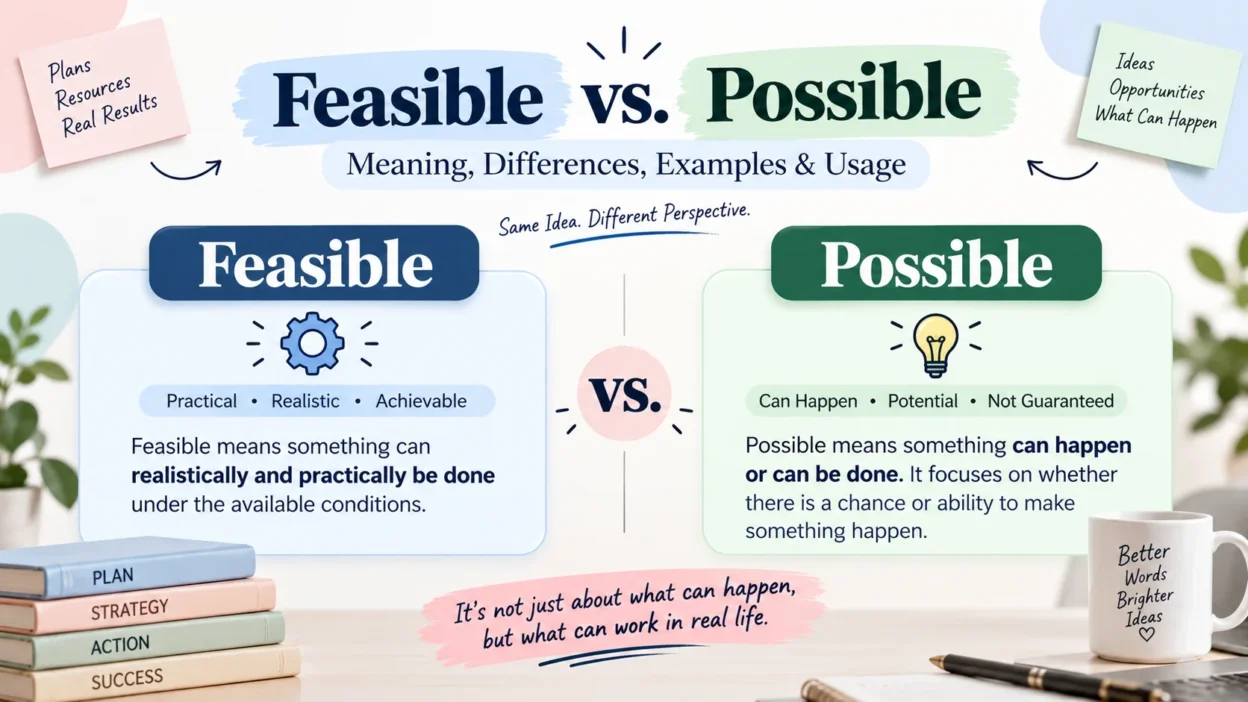
Possible describes something that can happen or can be done. It focuses on whether there is a chance or ability to make something happen.
Feasible goes a step further. It describes something that can realistically and practically work under the available circumstances.
For example, it may be possible to finish a large project in one week. But if you do not have enough employees, money, or resources, the plan may not be feasible.
This small difference matters in business, education, project management, technology, engineering, and everyday communication.
Once you understand what each word emphasizes, choosing between them becomes much easier.
Feasible vs. Possible: Quick Answer
Possible means that something can happen or can be done.
Feasible means that something can realistically and practically be done.
In simple terms:
Possible = Can it happen?
Feasible = Can it realistically work?
| Word | Meaning | Main Idea |
|---|---|---|
| Possible | Something can happen or be done | Potential |
| Feasible | Something can realistically be done | Practicality |
| Impossible | Something cannot happen or be done | No possibility |
| Infeasible | Something cannot realistically work | Not practical |
What Does Possible Mean?
Possible means capable of happening, existing, or being done.
The word focuses on possibility rather than practical limitations.
If something has a chance of happening, you can describe it as possible.
Examples of Possible
- It is possible to finish the work today.
- Is it possible to change the appointment?
- Several solutions are possible.
- It is possible that the weather will improve.
- We should consider every possible outcome.
The word possible works in many situations.
You can use it when discussing events, plans, results, explanations, opportunities, and future situations.
Possible Does Not Mean Likely
One important point can prevent confusion.
Possible does not necessarily mean something will probably happen.
For example:
It is possible that the team will win.
This sentence only says that the team has a chance of winning.
It does not tell us that the team will probably win.
That distinction makes possible broader than words such as probable or likely.
What Does Feasible Mean?
Feasible means practical, realistic, and achievable under particular conditions.
When you describe a plan as feasible, you usually consider real-world factors.
These factors can include:
- Time
- Money
- Staff
- Equipment
- Technology
- Skills
- Materials
- Location
- Rules
- Available resources
For example:
The manager approved the feasible plan after reviewing the budget.
Here, feasible suggests that the plan can actually work within the company’s circumstances.
Examples of Feasible
- The team developed a feasible solution.
- We need a feasible plan for the next phase.
- The project is technically feasible.
- The company needs a financially feasible option.
- The engineer confirmed that the design is feasible.
The word often appears when people evaluate plans, solutions, projects, or strategies.
The Main Difference Between Feasible and Possible
The biggest difference comes down to potential versus practicality.
Possible asks whether something can happen.
Feasible asks whether something can realistically happen under the circumstances.
Consider this example:
Imagine that someone wants to build a house in seven days.
Modern technology may make the project possible in certain circumstances.
But if the person has a small budget, limited workers, and no construction materials, the plan may not be feasible.
So:
Possible: It can happen.
Feasible: It can realistically work.
That is the easiest distinction to remember.
Can Something Be Possible but Not Feasible?
Yes.
This happens frequently in real-life situations.
Something may work in theory but fail when you consider practical limitations.
For example:
It is possible to travel around the world in a few days.
With the right aircraft, money, and schedule, the journey could happen.
But for someone with a limited budget and little free time, that trip may not be feasible.
Here is another example:
It is possible to complete the project in five days.
However, the company may only have two employees available.
The project remains possible in general.
But the five-day deadline may not be feasible for that particular team.
Can Something Be Feasible but Not Possible?
No.
If something is genuinely feasible, it must first be possible.
Feasibility exists within the range of possibility.
Think of the relationship this way:
Possible is the larger category.
Feasible describes a realistic option within that category.
For example, building a particular machine may be technically possible.
After engineers examine the cost, materials, technology, and production process, they may decide that the machine is feasible.
But an impossible project cannot become feasible simply because someone wants to build it.
Feasible vs Possible Examples
Examples make the difference much easier to understand.
| Situation | Possible | Feasible |
|---|---|---|
| Finish a small assignment today | Yes | Yes |
| Build a skyscraper overnight | Maybe in theory | No |
| Launch a business with enough funding | Yes | Yes |
| Complete a major project with no budget | Perhaps | No |
| Travel somewhere by plane | Yes | Depends on cost and circumstances |
| Build a new product | Yes | Depends on resources |
| Learn a new skill | Yes | Usually yes with enough time |
| Finish a year-long project in one day | Theoretically limited | Usually not feasible |
The examples show why possible and feasible cannot always replace each other.
Feasible vs Possible in Business
Business writing often uses both terms.
However, each word serves a different purpose.
Possible in Business
Use possible when you discuss opportunities, potential outcomes, or things that could happen.
Examples:
- We are exploring possible markets.
- Several outcomes are possible.
- The company is considering possible expansion.
- Is it possible to reduce production costs?
Here, the focus remains on potential.
Feasible in Business
Use feasible when you evaluate whether a business idea or plan can realistically work.
Examples:
- We need to determine whether the proposal is feasible.
- The company developed a feasible growth strategy.
- The expansion may not be financially feasible.
- The team presented a feasible business model.
Business professionals often consider costs, employees, resources, demand, and time before calling something feasible.
Feasible vs Possible in Project Management
Project management provides a perfect example of the difference.
Suppose a manager wants to complete a project in 10 days.
The project may be possible if the team has the required skills and technology.
But the manager must also consider:
- Team size
- Budget
- Deadlines
- Workload
- Materials
- Dependencies
- Client requirements
If those factors support the deadline, the plan becomes feasible.
For example:
Completing the project in 10 days is possible.
This only describes the potential.
Completing the project in 10 days is feasible with our current team and budget.
This sentence makes a practical judgment.
Feasible vs Possible in Academic Writing
Students and researchers often use these words when discussing research ideas and methods.
Use possible when you discuss something that may happen or may be true.
Examples:
- Several explanations are possible.
- Another interpretation is possible.
- Researchers considered possible causes.
- A different outcome is possible.
Use feasible when you discuss whether researchers can realistically conduct a study or use a particular method.
Examples:
- The researchers developed a feasible research method.
- The experiment is feasible within the available budget.
- The proposed study may not be feasible within six months.
- Researchers evaluated whether the approach was feasible.
In academic writing, feasible often signals a practical evaluation.
Feasible vs Possible in Technology
Technology creates many situations where the distinction matters.
A technological solution can be technically possible without being commercially feasible.
For example:
Creating an advanced AI system may be technically possible.
But producing that system at a reasonable cost may not be feasible.
Similarly, a company may have the technology to build a product.
However, high manufacturing costs could make the project financially infeasible.
Common Questions in Technology
Teams may ask:
- Is the technology possible?
- Can the system perform this task?
- Is the design feasible?
- Can we build it with current resources?
- Is the solution financially feasible?
- Can we maintain the system long term?
These questions show how possibility and feasibility work together.
Feasible vs Possible in Engineering
Engineers frequently distinguish between technical possibility and practical feasibility.
A design may work according to theory.
Engineers then examine whether they can build it safely and affordably.
For example:
The design is technically possible.
This means the technology can support the design.
The design is technically feasible.
This suggests that engineers believe they can realistically build and operate it.
Engineers may evaluate:
- Materials
- Safety
- Manufacturing
- Energy use
- Cost
- Structural requirements
- Maintenance
- Available technology
That is why feasible often appears in engineering and technical discussions.
Feasible vs. Possible in Everyday English
Possible appears much more often in everyday conversation.
For example:
- Is it possible to meet tomorrow?
- Is it possible to change the date?
- Is it possible to finish this tonight?
- Is it possible to get there by bus?
These sentences sound natural because they ask whether something can happen.
Feasible sounds more formal.
You might use it when discussing a plan:
Is this plan feasible?
That question asks whether the plan can realistically work.
In casual conversation, people often use words such as practical, realistic, or doable instead of feasible.
Synonyms for Possible
Several words can replace possible, depending on the context.
Common Alternatives
- Achievable
- Attainable
- Doable
- Conceivable
- Plausible
- Potential
- Probable
- Likely
- Realizable
- Viable
However, these words do not always mean exactly the same thing.
For example, likely suggests a strong chance.
Possible only indicates that something can happen.
Similarly, plausible suggests that something seems reasonable or believable.
Synonyms for Feasible
You can replace feasible with several alternatives when the context allows.
Common Alternatives
- Practical
- Realistic
- Workable
- Viable
- Achievable
- Attainable
- Doable
- Manageable
- Reasonable
- Sustainable
For example:
The plan is feasible.
You could say:
The plan is practical.
Or:
The plan is workable.
However, feasible often sounds more precise in professional or technical writing.
Feasible vs Practical
Feasible and practical have similar meanings.
However, they emphasize slightly different ideas.
Feasible focuses on whether something can realistically be achieved.
Practical often focuses on whether something works well in real life.
Compare these sentences:
The project is financially feasible.
This focuses on whether the budget can support the project.
The solution is practical.
This focuses on whether the solution works well in real-world use.
Both words can describe realistic ideas, but their emphasis differs.
Feasible vs Viable
Viable and feasible also overlap.
Feasible usually means something can realistically be done.
Viable often means something can succeed, survive, or continue successfully.
For example:
The construction plan is feasible.
This means the team can realistically carry it out.
The business model is viable.
This means the business model has a realistic chance of succeeding.
A business idea can therefore be feasible without becoming commercially viable.
Feasible vs Realistic
Realistic means something fits actual circumstances and avoids unreasonable expectations.
Feasible specifically emphasizes practical achievement.
For example:
A 10% increase in sales is a realistic goal.
This describes a reasonable expectation.
The sales strategy is feasible.
This suggests that the company can actually put the strategy into action.
The two words often work well together.
For example:
We need a realistic and feasible plan.
Common Collocations With Possible
Learning common combinations can make your English sound more natural.
Some common phrases include:
- Possible solution
- Possible outcome
- Possible explanation
- Possible cause
- Possible reason
- Possible answer
- Possible result
- Possible opportunity
- Possible problem
- Possible risk
- Possible change
- Possible future
Examples
- We need to find a possible solution.
- Several explanations are possible.
- The team considered every possible outcome.
- There may be a possible reason for the delay.
Common Collocations With Feasible
Feasible frequently appears with words related to plans, projects, and resources.
Common combinations include:
- Feasible solution
- Feasible plan
- Feasible option
- Feasible approach
- Feasible alternative
- Feasible strategy
- Feasible project
- Technically feasible
- Financially feasible
- Economically feasible
- Practically feasible
Examples
- The team proposed a feasible solution.
- We need a more feasible approach.
- The project is technically feasible.
- The plan is not financially feasible.
- Management approved the feasible alternative.
Common Mistakes to Avoid ❌
Mistake 1: Using Feasible as a Direct Replacement for Possible
You cannot always replace possible with feasible.
For example:
Is it possible that she will arrive late?
This sounds natural.
The sentence discusses whether an event may happen.
Is it feasible that she will arrive late?
This sounds unnatural because the sentence does not involve a practical plan.
Mistake 2: Thinking Possible Means Practical
Possible only tells you that something can happen.
It does not guarantee practicality.
A plan can be possible but expensive, difficult, or unrealistic.
Mistake 3: Thinking Feasible Means Easy
Something can be feasible and still require significant effort.
For example:
The project is feasible, but it will require six months of work.
The project can realistically happen.
That does not mean the project will be easy.
Mistake 4: Confusing Possible With Probable
Possible does not mean likely.
Possible: There is a chance.
Probable: There is a strong chance.
That difference matters when you want to express the level of certainty accurately.
How to Choose the Right Word
When you are unsure which word to use, ask yourself what you want to communicate.
Choose Possible When:
- You discuss whether something can happen.
- You describe potential events.
- You discuss possible outcomes.
- You consider explanations.
- You talk about opportunities.
- You express uncertainty.
Choose Feasible When:
- You evaluate a plan.
- You discuss practical limitations.
- You consider costs.
- You evaluate resources.
- You discuss deadlines.
- You assess technical requirements.
- You decide whether an idea can realistically work.
A simple question can help:
Can it happen? → Possible
Can it realistically work? → Feasible
A Simple Memory Trick 🧠
Remember these two questions:
Possible: Can it happen?
Feasible: Can it work in real life?
Think of possible as the first test.
If something passes that test, you can then ask whether it is feasible.
For example:
A company wants to launch a product.
First:
Is launching the product possible?
If yes, the company can examine:
Is launching the product feasible with our current budget, staff, technology, and deadline?
This simple approach makes the difference easy to remember.
Feasible vs Possible: Final Comparison
| Feature | Possible | Feasible |
|---|---|---|
| Basic meaning | Can happen or be done | Can realistically be done |
| Main focus | Possibility | Practicality |
| Considers resources | Not necessarily | Usually |
| Considers cost | Not necessarily | Often |
| Considers time | Not necessarily | Often |
| Common in casual English | Yes | Less common |
| Common in business | Yes | Yes |
| Common in technical writing | Yes | Very common |
| Common with plans | Yes | Yes |
| Can describe an event | Yes | Usually less natural |
| Can describe a practical solution | Yes | Yes |
Frequently Asked Questions
Is feasible the same as possible?
No. Possible means something can happen or be done, while feasible means something can realistically and practically be achieved.
What is the easiest way to remember feasible vs. possible?
Remember this:
Possible = It can happen.
Feasible = It can realistically work.
Can something be possible but not feasible?
Yes. A project may be technically possible but impractical because of its cost, deadline, resources, or other limitations.
Is feasible more formal than possible?
Yes, in most contexts. Feasible appears frequently in business, engineering, academic writing, project management, and technical discussions.
What is the opposite of feasible?
Common opposites include infeasible, impractical, unworkable, and unrealistic.
What is the opposite of possible?
The direct opposite of possible is impossible.
Can doable replace feasible?
Sometimes. Doable means something can be done and sounds more casual. Feasible sounds more formal and often suggests an evaluation of practical conditions.
Which word should I use in a business proposal?
Use feasible when you want to show that a plan can realistically work with the available resources, budget, and time.
Conclusion
The difference between feasible vs. possible becomes clear once you focus on what each word emphasizes.
Possible describes something that can happen or can be done. It focuses on potential.
Feasible describes something that can realistically and practically be achieved. It often considers factors such as money, time, resources, technology, and skills.
A project can be possible without being feasible.
For example, a company might have the technology to create a product, but high production costs could make the project financially infeasible.
When you simply want to say that something can happen, choose possible.
When you want to discuss whether a plan can realistically work, feasible usually provides the more precise choice.
The easiest rule to remember is simple: possible asks whether something can happen, while feasible asks whether it can realistically work.

Vivian Mercer is an English language writer and vocabulary enthusiast who specializes in synonyms, word meanings, grammar, idioms, and language usage. She creates accurate, easy-to-understand content that helps readers improve their English skills with confidence.