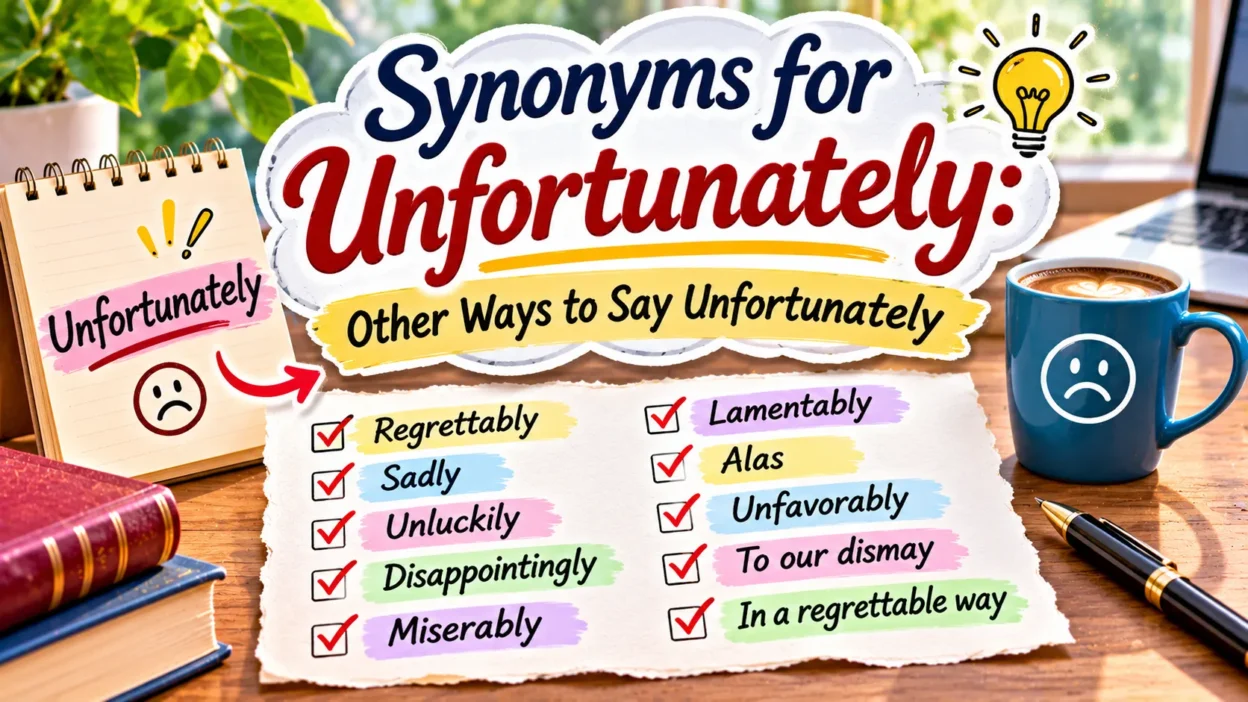
Synonyms for unfortunately help you express disappointment, regret, or an undesirable situation without repeating the same word. Whether you are writing a professional email, preparing an academic assignment, sending a personal message, or improving your everyday vocabulary, choosing the right alternative can make your sentences sound more natural and engaging. Words and phrases such as regrettably, sadly, unhappily, disappointingly, and to my dismay can communicate similar ideas in different situations.
However, not every synonym for unfortunately works in every sentence. Regrettably sounds formal and professional, sadly expresses emotional disappointment, and to my dismay emphasizes a personal reaction to an unpleasant event. Some alternatives also communicate bad luck or an unexpected problem rather than direct regret. This guide explores useful synonyms for unfortunately, their meanings, example sentences, formal alternatives, casual expressions, and phrases you can use in everyday and professional writing.
📖 What Does Unfortunately Mean?
Unfortunately is an adverb used to introduce information about an unpleasant, disappointing, or undesirable situation. It tells readers that something has happened that is not ideal or that the speaker wishes had happened differently.
People commonly use unfortunately in conversations, emails, news reports, academic writing, and everyday communication. It often appears at the beginning of a sentence to prepare the reader for disappointing information.
Examples:
- Unfortunately, the event has been canceled because of bad weather.
- I wanted to attend the meeting, but unfortunately, I had another commitment.
- Unfortunately, we cannot accept your application at this time.
- The team worked hard, but unfortunately, it did not win the competition.
- Unfortunately, the store was closed when we arrived.
Simple meaning: Unfortunately means something happened in an undesirable way or that the situation is disappointing.
🌟 Best Synonyms for Unfortunately
The best synonyms for unfortunately include words that express regret, disappointment, sadness, or an unfavorable outcome. The following alternatives can help you make your writing more varied and precise.
- Regrettably
- Sadly
- Unhappily
- Disappointingly
- Unfortunately enough
- Inauspiciously
- Sadly enough
- To my dismay
- To our disappointment
- Much to my regret
- Alas
- By bad luck
- As luck would have it
- In an unfortunate turn of events
- To everyone’s disappointment
- Tragically
- Distressingly
- Frustratingly
- Dishearteningly
- To our regret
- Sadly to say
- Much to our dismay
- Against our wishes
- In a disappointing turn
- To my disappointment
- With regret
- Regretfully
- To our dismay
- In a regrettable situation
- As it happens
Example: Instead of saying, “Unfortunately, I cannot attend the meeting,” you could write, “Regrettably, I cannot attend the meeting.”
😔 Synonyms for Unfortunately That Mean Sadly
Some alternatives emphasize sadness or emotional disappointment rather than simply describing an unfavorable situation. These words are especially useful in personal messages, storytelling, reflective writing, and conversations about difficult experiences.
- Sadly: In a way that expresses sadness or disappointment.
- Unhappily: In an unhappy or undesirable manner.
- Disappointingly: In a way that fails to meet expectations.
- Tragically: In a deeply sad or disastrous way.
- Dishearteningly: In a way that reduces hope or confidence.
- Distressingly: In a way that causes worry or emotional discomfort.
- Sorrowfully: With sadness or sorrow.
- Regretfully: With a feeling of regret.
- Painfully: In a way that causes emotional or physical pain.
- Mournfully: In a way that expresses deep sadness.
Example sentences:
- Sadly, the concert was canceled at the last minute.
- Disappointingly, our team did not qualify for the final round.
- Tragically, the accident changed many lives.
- It was dishearteningly clear that the project would not finish on time.
- Regretfully, I must decline your invitation.
Writing tip: Use tragically only for genuinely serious or devastating situations. For ordinary disappointment, sadly or disappointingly usually sounds more appropriate.
💼 Formal Synonyms for Unfortunately
In professional communication, formal alternatives can make disappointing news sound more polished and respectful. These expressions are useful in business emails, official letters, workplace announcements, academic writing, and customer service responses.
| Formal alternative | Meaning | Example sentence |
|---|---|---|
| Regrettably | With regret | Regrettably, the position has been filled. |
| Unfortunately | In an undesirable situation | Unfortunately, the deadline has passed. |
| With regret | Expressing sorrow or disappointment | With regret, we must cancel the appointment. |
| It is regrettable that | It is disappointing that | It is regrettable that the proposal was rejected. |
| To our disappointment | Causing disappointment | To our disappointment, the shipment arrived late. |
| Much to our regret | Something we wish were different | Much to our regret, we cannot extend the offer. |
| Disappointingly | Below expectations | Disappointingly, the results were lower than expected. |
| In an unfortunate development | In an undesirable new situation | In an unfortunate development, the launch was delayed. |
| We regret to inform you | Introducing disappointing information | We regret to inform you that your request was declined. |
| Due to unforeseen circumstances | Because of unexpected events | Due to unforeseen circumstances, the event has been postponed. |
| As circumstances would have it | Because of how events developed | As circumstances would have it, the meeting was rescheduled. |
| To our dismay | Causing concern or disappointment | To our dismay, the application was unsuccessful. |
Example: Instead of writing, “Unfortunately, your payment was not received,” a business email could say, “Regrettably, we have not yet received your payment.”
🗣️ Casual Ways to Say Unfortunately
Everyday conversations often sound more natural when you use simple expressions instead of formal vocabulary. These casual alternatives work well in text messages, friendly conversations, social media posts, and informal emails.
- Sadly
- Bad news
- The problem is
- The trouble is
- I’m afraid
- It’s a shame
- What a pity
- Sadly enough
- As it turns out
- Not so luckily
- Things didn’t work out
- It didn’t go as planned
- I wish it were different
- That’s too bad
- It just wasn’t meant to be
- I hate to say it
- The downside is
- To make matters worse
- It didn’t happen as expected
- We weren’t that lucky
Example sentences:
- Sadly, I won’t be able to join you tonight.
- I’m afraid the restaurant is already closed.
- It’s a shame that we missed the last train.
- As it turns out, the tickets are sold out.
- The problem is that we don’t have enough time.
- Things didn’t work out the way we expected.
✍️ Synonyms for Unfortunately in Professional Emails
When communicating disappointing news at work, you should sound clear, polite, and respectful. Instead of repeating unfortunately throughout an email, choose an expression that matches the message and your relationship with the recipient.
Here are useful alternatives with ready-to-use examples:
Regrettably
Regrettably, we are unable to approve your request at this time.
We regret to inform you
We regret to inform you that your application was not successful.
With regret
With regret, I must inform you that the scheduled meeting has been canceled.
Due to unforeseen circumstances
Due to unforeseen circumstances, we need to postpone the product launch.
I am afraid
I am afraid we will not be able to meet the original deadline.
To our disappointment
To our disappointment, the supplier could not deliver the order as promised.
It is unfortunate that
It is unfortunate that we could not reach an agreement during the discussion.
I sincerely regret
I sincerely regret that we cannot offer you the position at this time.
A more professional approach: Avoid making disappointing news sound unnecessarily dramatic. Choose direct language, explain the situation briefly, and offer a practical next step whenever possible.
📚 Academic and Formal Writing Alternatives for Unfortunately
Academic writing often benefits from precise and objective language. Instead of using unfortunately repeatedly, you can select alternatives that describe an unfavorable result, limitation, or unexpected outcome without adding unnecessary emotion.
- Regrettably
- Disappointingly
- In an unfavorable outcome
- Contrary to expectations
- Despite these efforts
- In spite of this
- Nevertheless
- However
- Nonetheless
- Despite this limitation
- An unexpected result was
- The outcome was less favorable
- The results were not as anticipated
- The findings were limited by
- This presented a challenge
Example sentences:
- Regrettably, the available data did not support the original hypothesis.
- Contrary to expectations, the experiment produced inconsistent results.
- Despite these efforts, the research team could not identify a clear pattern.
- The findings were less favorable than initially anticipated.
- However, the study was limited by a relatively small sample size.
- Nevertheless, the researchers continued to investigate the issue.
- Disappointingly, the second trial did not produce the expected improvement.
- The outcome was unfavorable because several variables remained uncontrolled.
Important distinction: Words such as however, nevertheless, and nonetheless introduce contrast. They are not exact synonyms for unfortunately because they do not necessarily express regret or disappointment.
💔 Synonyms for Unfortunately When Expressing Disappointment
Sometimes you want to communicate that an event did not happen as expected. These alternatives are useful when discussing missed opportunities, unsuccessful plans, rejected applications, or unexpected setbacks.
- Disappointingly
- Regrettably
- Sadly
- To my disappointment
- To my dismay
- Much to our regret
- Against expectations
- Contrary to our hopes
- In an unfortunate turn of events
- As luck would have it
- To everyone’s frustration
- Much to our surprise
- Against our wishes
- In a disappointing outcome
- Not as expected
Example sentences:
- Disappointingly, the concert tickets sold out before we could buy them.
- To my dismay, I missed the final opportunity to apply.
- Much to our regret, the school trip had to be canceled.
- Contrary to our hopes, the project did not receive approval.
- In an unfortunate turn of events, the flight was delayed.
🍀 Synonyms for Unfortunately That Describe Bad Luck
Some situations are disappointing because of unexpected events or bad luck. These expressions highlight the role of chance rather than the speaker’s personal regret.
| Expression | Meaning | Example |
|---|---|---|
| By bad luck | Because of an unlucky event | By bad luck, we missed the train. |
| As luck would have it | Because of how chance affected events | As luck would have it, the shop was closed. |
| Unluckily | In an unlucky way | Unluckily, it started raining before the match. |
| Against the odds | In a way that goes against expectations | The team succeeded against the odds. |
| Through no fault of our own | Not because of our mistake | Through no fault of our own, the delivery was delayed. |
| By an unfortunate coincidence | Because of an unexpected coincidence | By an unfortunate coincidence, both meetings were scheduled together. |
| In a stroke of bad luck | Because of a sudden unlucky event | In a stroke of bad luck, the car broke down. |
| Through unfortunate circumstances | Because of undesirable events | Through unfortunate circumstances, we had to leave early. |
Example: “Unfortunately, we missed the train” could become “By bad luck, we missed the train.”
🔄 Unfortunately vs. Regrettably vs. Sadly vs. Disappointingly
These four words are common alternatives, but each one communicates a slightly different feeling. Understanding their differences can help you choose the most natural expression.
| Word | Main meaning | Best use |
|---|---|---|
| Unfortunately | An undesirable or unfavorable situation | General disappointing news |
| Regrettably | Something that causes regret | Formal and professional writing |
| Sadly | Something that causes sadness | Personal and emotional situations |
| Disappointingly | Something that fails to meet expectations | Results, plans, and outcomes |
Compare these examples:
- Unfortunately: Unfortunately, the meeting has been canceled.
- Regrettably: Regrettably, we cannot offer you the position.
- Sadly: Sadly, my favorite restaurant is closing.
- Disappointingly: Disappointingly, the results were lower than expected.
Although these words sometimes fit the same sentence, they are not always interchangeable. Choose the word that reflects the tone and meaning you intend.
🧠 Other Ways to Start a Sentence Instead of Unfortunately
If you frequently begin sentences with unfortunately, changing your sentence structure can improve your writing. You do not always need another adverb; sometimes a different opening sounds clearer and more natural.
Here are some alternatives:
- The difficulty is that…
- The main problem is…
- It is disappointing that…
- We regret that…
- I am sorry to say that…
- The situation is not ideal because…
- Despite our efforts…
- Although we hoped otherwise…
- As circumstances developed…
- The outcome was not what we expected…
- We were unable to…
- The plans had to change because…
- There is one challenge…
- The unfortunate reality is that…
- It was not possible to…
Before: Unfortunately, we cannot complete the project today.
After: We regret that we cannot complete the project today.
Before: Unfortunately, the weather ruined our plans.
After: The weather did not cooperate, so we had to change our plans.
Before: Unfortunately, I missed your call.
After: I’m sorry I missed your call.
🚫 Opposite Words of Unfortunately
Antonyms can help you understand the meaning of unfortunately by showing the opposite idea. These words and expressions describe favorable circumstances, positive outcomes, or good luck.
- Fortunately
- Thankfully
- Luckily
- Happily
- Fortunately enough
- Thankfully enough
- Favorably
- Successfully
- Positively
- Thankfully, things worked out
- As luck would have it
- To our delight
- Much to our pleasure
- Luckily for us
- In our favor
Example sentences:
- Fortunately, everyone arrived safely.
- Thankfully, the weather improved before the event.
- Luckily, we found another available hotel.
- To our delight, the application was approved.
- The situation turned out favorably for the entire team.
📝 Example Sentences Using Synonyms for Unfortunately
The following sentences demonstrate how different alternatives work in everyday communication, professional writing, and personal conversations.
- Regrettably: Regrettably, we cannot extend the registration deadline.
- Sadly: Sadly, the old building will be demolished next month.
- Disappointingly: Disappointingly, the team lost its final match.
- Unhappily: Unhappily, the two friends ended their partnership.
- To my dismay: To my dismay, I discovered that my wallet was missing.
- To our disappointment: To our disappointment, the event was postponed.
- Tragically: Tragically, the storm destroyed several homes.
- I’m afraid: I’m afraid we have run out of available seats.
- With regret: With regret, I must withdraw my application.
- As it turns out: As it turns out, the store does not open on Sundays.
- By bad luck: By bad luck, we arrived just after the doors closed.
- Dishearteningly: Dishearteningly, the project made very little progress.
- To my regret: To my regret, I did not attend the farewell party.
- In an unfortunate turn of events: In an unfortunate turn of events, the flight was diverted.
- Much to our dismay: Much to our dismay, the tickets were unavailable.
- I hate to say it: I hate to say it, but the plan is not working.
- It is a shame: It is a shame that we could not meet earlier.
- To everyone’s disappointment: To everyone’s disappointment, the celebration was canceled.
- Due to unforeseen circumstances: Due to unforeseen circumstances, the office will remain closed.
- Contrary to expectations: Contrary to expectations, the new system performed poorly.
❓ Frequently Asked Questions About Synonyms for Unfortunately
These common questions explain how to use alternatives to unfortunately in different types of writing and conversations.
What is the best synonym for unfortunately?
Regrettably is one of the closest synonyms for unfortunately, especially in formal writing. Other useful alternatives include sadly, disappointingly, unhappily, and to my dismay.
What is a simple word for unfortunately?
The simplest alternatives are sadly, unluckily, and regrettably. In casual conversation, you can also say “I’m afraid” or “it’s a shame.”
What is a formal way to say unfortunately?
Regrettably, with regret, and “we regret to inform you” are suitable formal expressions. They work well in business emails, official announcements, and professional letters.
What is another way to say unfortunately in an email?
You can use “regrettably,” “I am afraid,” “we regret to inform you,” or “due to unforeseen circumstances.” Choose the expression that best fits the message and your relationship with the recipient.
Is regrettably the same as unfortunately?
Regrettably and unfortunately have very similar meanings, but regrettably places more emphasis on regret. Unfortunately generally introduces an undesirable situation, while regrettably often communicates that the speaker wishes the situation were different.
Can I use sadly instead of unfortunately?
Yes, you can use sadly in many situations. However, sadly often carries a stronger emotional tone, while unfortunately can describe a disappointing or inconvenient situation without necessarily expressing deep sadness.
What is the opposite of unfortunately?
The most common opposite is fortunately. Other alternatives include luckily, thankfully, happily, and favorably.
How do you say unfortunately in a professional way?
Use expressions such as “regrettably,” “we regret to inform you,” or “due to unforeseen circumstances.” For example, “Regrettably, we are unable to approve your request.”
Is alas a synonym for unfortunately?
Yes. Alas is an interjection used to express sadness, regret, or disappointment. It is generally more literary or dramatic than unfortunately and may sound unnatural in ordinary business communication.
What can I use instead of unfortunately in academic writing?
Depending on the sentence, you can use regrettably, disappointingly, contrary to expectations, or “the results were less favorable than anticipated.” Words such as however and nevertheless can introduce contrast, but they do not directly express regret.
🌈 Conclusion
Synonyms for unfortunately give you more flexibility when expressing regret, sadness, disappointment, or an unfavorable situation. Words such as regrettably, sadly, disappointingly, and unhappily are useful alternatives, while phrases like “to my dismay,” “due to unforeseen circumstances,” and “we regret to inform you” work well in more specific situations.
The best choice depends on your audience and the message you want to communicate. Use regrettably for formal writing, sadly for emotional situations, and disappointingly when something fails to meet expectations. By choosing precise alternatives and varying your sentence openings, you can make your writing clearer, more natural, and more engaging.

Vivian Mercer is an English language writer and vocabulary enthusiast who specializes in synonyms, word meanings, grammar, idioms, and language usage. She creates accurate, easy-to-understand content that helps readers improve their English skills with confidence.