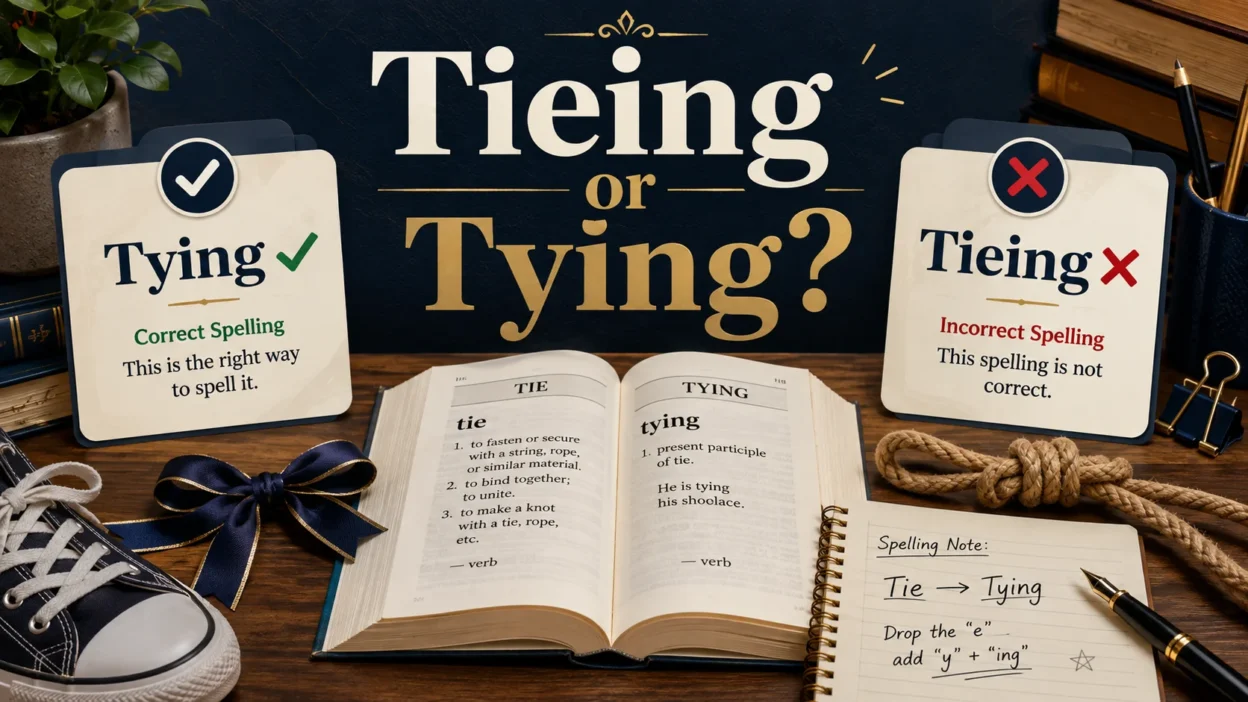
If you are unsure whether tieing or tying is correct, the answer is simple: tying is the correct spelling. Tieing is a common misspelling and is not the standard form used in modern English.
The confusion comes from the verb tie. When adding -ing to many English verbs, we simply keep the base word and add the ending. However, verbs ending in a silent e often follow a special spelling rule: the final e is dropped before -ing is added. That gives us tie → tying, not tieing.
The word tying can mean fastening, connecting, binding, or securing something with a string, rope, ribbon, or similar material. It can also be used figuratively, such as tying two ideas together or tying a business decision to a particular condition.
This guide explains why tying is correct, why tieing is wrong, how the spelling rule works, and how to use tying naturally in everyday English.
Quick Answer: Tieing or Tying?
Tying is the correct spelling.
Tieing is generally considered incorrect in standard modern English.
The correct formation is:
tie → tying
The final -e is removed before adding -ing, but the spelling also changes from ie to y.
| Form | Correct? | Example |
|---|---|---|
| Tying | ✅ Correct | She is tying her shoes. |
| Tieing | ❌ Incorrect | She is tieing her shoes. |
What Does “Tying” Mean?
Tying is the present participle and gerund form of the verb tie.
The verb tie means to fasten, attach, secure, or connect something using a knot, string, rope, ribbon, or another method.
Examples
- He is tying his shoes.
- She is tying a ribbon around the box.
- They are tying the boat to the dock.
- I spent ten minutes tying the package.
- She is tying her hair back.
The word can also have a figurative meaning:
The report is tying the two events together.
Here, tying means connecting or associating the ideas.
What Does “Tieing” Mean?
Tieing is not the standard spelling of the present participle of tie.
If you see tieing in a sentence, it is almost certainly a spelling mistake.
❌ She is tieing her shoes.
✅ She is tying her shoes.
❌ He was tieing the rope.
✅ He was tying the rope.
The correct spelling is always tying when you mean the -ing form of tie.
Why Is It “Tying” Instead of “Tieing”?
This is where English spelling can become confusing.
The base verb is:
tie
When you form the -ing version, English does not simply add -ing to create tieing. Instead, the spelling changes:
tie → tying
The ie changes to y before -ing.
This spelling pattern also appears in other words ending in -ie.
Similar Examples
| Base Word | -ing Form |
|---|---|
| Die | Dying |
| Lie | Lying |
| Tie | Tying |
So:
- die → dying
- lie → lying
- tie → tying
Not:
- dieing ❌
- lieing ❌
- tieing ❌
The “IE → Y” Spelling Rule
When a verb ends in -ie, the ie generally changes to y before adding -ing.
The formula is:
-ie + -ing → -y + -ing
For example:
tie → tying
lie → lying
die → dying
This rule is particularly useful because simply adding -ing would produce spellings that aren’t standard English.
Tieing vs. Tying at a Glance
| Feature | Tieing | Tying |
|---|---|---|
| Standard spelling | ❌ No | ✅ Yes |
| Base verb | Tie | Tie |
| Correct -ing form | No | Yes |
| Meaning | — | Fastening or connecting |
| Example | ❌ He is tieing it. | ✅ He is tying it. |
Pronunciation of Tying
Tying is pronounced with one syllable.
| Feature | Tying |
|---|---|
| IPA | /ˈtaɪɪŋ/ |
| Approximate pronunciation | TYE-ing |
| Syllables | 2 |
| Base verb | Tie |
| -ing form | Tying |
Although the spelling contains y, the word still begins with the same sound as tie.
As a Verb Tying
- Tying can describe many physical actions.
Tying Shoes
- The child is tying his shoes.
Tying a Knot
He is tying a knot in the rope.
Tying a Package
She is tying the package with string.
Tying Something to Another Object
They are tying the boat to the dock.
Tying Hair
She is tying her hair into a ponytail.
Tying in Figurative Language
The word tying doesn’t always refer to physical objects.
It can also mean connecting, associating, or linking ideas, events, people, or conditions.
Examples
- The evidence is tying him to the case.
- The study is tying poor sleep to lower concentration.
- The company is tying bonuses to performance.
- The author is tying the ending to an earlier event.
- The two stories are tying together in unexpected ways.
In these examples, nothing is literally being tied with a rope or string.
Tying vs. Tied vs. Tie
These forms are related but have different grammatical functions.
| Word | Form | Example |
|---|---|---|
| Tie | Base verb | I need to tie my shoes. |
| Ties | Present tense | She ties her shoes quickly. |
| Tied | Past tense/past participle | He tied the rope. |
| Tying | Present participle/gerund | She is tying the rope. |
Examples
Present:
I tie my shoes every morning.
Past:
I tied my shoes before leaving.
Continuous:
I am tying my shoes now.
Common Mistakes
Mistake 1: Writing “Tieing”
❌ She is tieing her shoes.
✅ She is tying her shoes.
The correct -ing form changes ie to y.
Mistake 2: Writing “Tyeing”
❌ He is tyeing the rope.
✅ He is tying the rope.
The spelling tyeing is also incorrect.
Mistake 3: Writing “Tying” as “Ting”
❌ She is ting her shoes.
✅ She is tying her shoes.
The word retains the y after the spelling change.
Mistake 4: Confusing Tying With Trying
These words sound different and have completely different meanings.
- Tying = fastening or connecting
- Trying = attempting something
Examples:
She is tying her shoes.
She is trying to fix her shoes.
Tying vs. Trying
Because the words look similar, they can sometimes be confused.
| Word | Meaning | Example |
|---|---|---|
| Tying | Fastening or connecting | He is tying the rope. |
| Trying | Attempting | He is trying to lift the box. |
A simple memory trick is:
Tie → Tying
Try → Trying
The two verbs have different spelling patterns.
Why People Write “Tieing”
The spelling tieing is understandable because English learners may assume that the normal rule is simply:
tie + ing = tieing
However, English spelling changes certain words ending in -ie before -ing is added.
The same thing happens with:
lie → lying
die → dying
tie → tying
Once you learn this pattern, tying becomes much easier to remember.
20 Natural Examples With Tying
- She is tying her shoes.
- He is tying a knot in the rope.
- I am tying a ribbon around the gift.
- They are tying the boat to the dock.
- She spent several minutes tying her hair.
- He is tying the package with string.
- The children are learning how to tie knots.
- I watched her tying the balloons together.
- The farmer is tying the plants to wooden stakes.
- He hurt his hand while tying the rope.
- The evidence is tying the two events together.
- The report is tying the problem to poor planning.
- She is tying the curtains back.
- He was tying his shoelaces when the phone rang.
- We are tying the decorations to the railing.
- The coach is tying the team’s success to better preparation.
- She learned a new method for tying a bow.
- The story is tying several characters together.
- He is tying the boxes securely.
- The company is tying bonuses to employee performance.
How to Remember “Tying”
The easiest memory trick is to group tie with lie and die:
- tie → tying
- lie → lying
- die → dying
All three change ie to y before -ing.
You can remember the rule as:
IE becomes Y before ING.
So don’t write:
tieing ❌
Write:
tying ✅
Practice Exercise
Choose the correct word.
- She is ______ her shoes.
- A. tieing
- B. tying
- He was ______ the rope to the post.
- A. tieing
- B. tying
- I am ______ a ribbon around the box.
- A. tieing
- B. tying
- They are ______ the boat securely.
- A. tieing
- B. tying
- She spent the morning ______ her hair back.
- A. tieing
- B. tying
Answers
- B — tying
- B — tying
- B — tying
- B — tying
- B — tying
People Also Ask
Is it tying or tieing?
Tying is the correct spelling. Tieing is a common misspelling. The verb tie changes from ie to y before the -ing ending: tie → tying.
Why is tieing incorrect?
English spelling changes the final ie to y when many verbs ending in -ie take the -ing ending. Therefore, tie + ing becomes tying, not tieing.
How do you spell the -ing form of tie?
The correct spelling is tying.
She is tying her shoes.
Is tying one word?
Yes. Tying is one word and is the standard present participle and gerund form of tie.
Is tieing ever correct?
In standard modern English, tieing is not the accepted spelling of the -ing form of tie. Use tying instead.
What is the spelling rule for tie?
When tie takes -ing, the ie changes to y:
tie → tying
The same pattern occurs with lie → lying and die → dying.
Is tying pronounced like “tie-ing”?
Yes. Tying is generally pronounced approximately “TIE-ing.” It has two syllables.
What is the past tense of tie?
The past tense is tied.
She tied her shoes.
The -ing form is tying.
What is the difference between tying and tied?
Tying describes an ongoing action, while tied is the past tense or past participle.
She is tying her shoes.
She tied her shoes.
Frequently Asked Questions
Is “I am tieing my shoes” correct?
No. The correct sentence is:
I am tying my shoes.
Is “tying” a verb?
Yes. Tying is the present participle and gerund form of the verb tie.
Why does tie become tying?
The spelling changes ie to y before the -ing ending. This gives us tying.
Are dying and lying spelled the same way?
They follow the same basic ie → y pattern:
- die → dying
- lie → lying
- tie → tying
Is “tying” two syllables?
Yes. It is generally pronounced TIE-ing, with two syllables.
What is the noun form of tying?
Tying can itself function as a gerund, which means it can act like a noun.
Tying knots takes practice.
Can tying be used figuratively?
Yes. It can mean connecting or associating ideas, events, people, or conditions.
The evidence is tying the two cases together.
What is the easiest way to remember tying?
Remember:
IE → Y + ING
So:
TIE → TYING
Conclusion
The correct spelling is tying, not tieing. Tying is the present participle and gerund form of tie, and it can describe fastening something with a knot, connecting objects, or linking ideas figuratively.
The main spelling rule to remember is that verbs ending in -ie generally change ie to y before -ing is added. That’s why we write tie → tying, just as we write lie → lying and die → dying.
If you ever find yourself wondering whether to write tieing or tying, remember the simple pattern: IE becomes Y before ING. Once you know this rule, tying is easy to spell correctly every time.

Vivian Mercer is an English language writer and vocabulary enthusiast who specializes in synonyms, word meanings, grammar, idioms, and language usage. She creates accurate, easy-to-understand content that helps readers improve their English skills with confidence.