
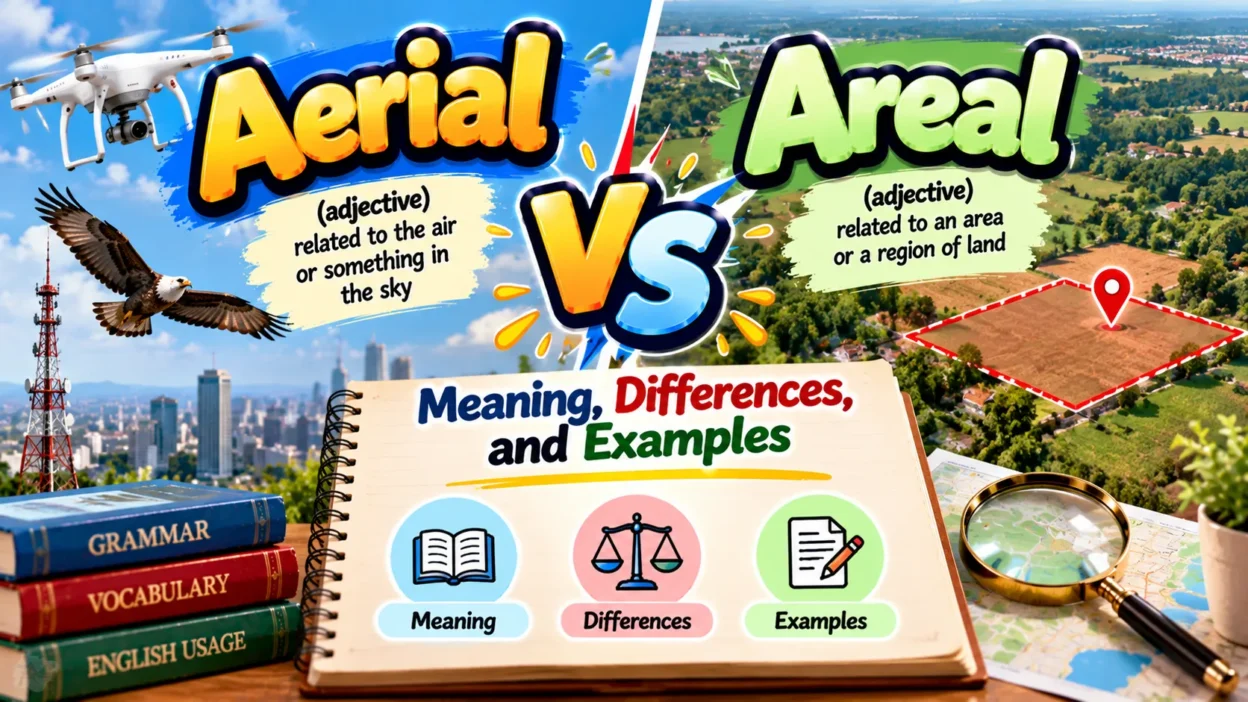
English contains many words that look or sound similar but have completely different meanings. Aerial vs areal is one such comparison that can confuse writers, students, and anyone trying to choose the correct word. Both terms are spelled similarly, but they are used in different contexts.
The word aerial usually relates to the air, something above the ground, or a view from a high position. In contrast, areal relates to an area, region, or the distribution of something across a particular space.
Understanding this distinction will help you use both words correctly in academic writing, geography, science, photography, and everyday communication. This guide explains their meanings, differences, pronunciation, examples, and common mistakes so you can choose the right term with confidence.
📘 What Does Aerial Mean?
The word aerial is an adjective that generally describes something connected with the air, the atmosphere, or a position above the ground. It can also be used as a noun, depending on the context.
For example, an aerial photograph shows a location from above. An aerial view of a city may reveal its streets, buildings, parks, and surrounding landscape from a plane, drone, or another elevated position.
The word also appears in sports and entertainment. An aerial move in gymnastics or acrobatics involves movement through the air. In British English, aerial can also mean an antenna used to receive radio or television signals.
Examples of Aerial in Sentences
- The photographer captured an aerial view of the coastline.
- A drone provided aerial images of the construction site.
- The pilot performed an impressive aerial maneuver during the demonstration.
- The news team used aerial footage to show the extent of the flooding.
- We installed a television aerial to improve signal reception.
- The dancers performed an impressive aerial trick during the show.
In each example, the word relates to the air, an elevated viewpoint, movement through the air, or an antenna.
🗺️ What Does Areal Mean?
The word areal is an adjective related to an area or region. It describes something associated with a particular geographical space, the extent of a surface, or the distribution of a feature across an area.
This term is more common in technical, scientific, geographical, and academic writing than in everyday conversation.
For example, an areal distribution map may show where a particular plant species grows across a region. An areal measurement may describe the size or extent of a surface.
The word is especially useful when discussing geography, ecology, geology, linguistics, and spatial analysis.
Examples of Areal in Sentences
- Researchers studied the areal distribution of the plant species.
- The report examined areal differences in rainfall across the region.
- Scientists created an areal map showing the spread of the habitat.
- The study compared the areal extent of wetlands before and after restoration.
- Linguists investigated areal features shared by neighboring languages.
- The ecologist analyzed the areal pattern of vegetation in the reserve.
In these sentences, the term relates to an area, spatial extent, or the distribution of something across a region.
⚖️ Aerial vs Areal: Key Differences
Although these words look almost identical, their meanings are different. The easiest way to remember the distinction is to connect aerial with air and areal with area.
| Feature | Aerial | Areal |
|---|---|---|
| Main meaning | Related to air or an elevated position | Related to an area or region |
| Part of speech | Adjective and noun | Primarily an adjective |
| Common contexts | Photography, aviation, sports, antennas | Geography, ecology, science, linguistics |
| Common phrases | Aerial view, aerial photography, aerial stunt | Areal distribution, areal extent, areal variation |
| Everyday usage | Relatively common | More specialized |
| Memory clue | Think of air | Think of area |
The correct choice depends on what you want to describe. If something is viewed from above or moves through the air, aerial is generally appropriate. If you are discussing the extent or distribution of something across a region, areal is usually the better choice.
🔤 Aerial vs Areal: Pronunciation Differences
Both words contain similar letters, but their pronunciations differ.
Aerial: Commonly pronounced AIR-ee-uhl or AIR-ee-ul, depending on the speaker and accent.
Areal: Commonly pronounced AIR-ee-uhl or AIR-ee-ul in some dictionaries and accents, though pronunciation can vary by region and technical context.
Because the pronunciations can overlap, listening alone may not always help you identify which word someone means. Pay attention to the context and spelling.
For example, a sentence about drone photography would normally use aerial, while a sentence about the geographic distribution of a species would likely use areal.
📷 When Should You Use Aerial?
Use aerial when describing something related to the air, an elevated viewpoint, or movement above the ground.
Here are some common situations where this word fits naturally.
Aerial Photography
Aerial photography involves taking photographs from an elevated position, often using drones, aircraft, or helicopters.
Example: The company used aerial photography to document the new highway.
Aerial Views
An aerial view shows a place from above, revealing details that may be difficult to see from ground level.
Example: The aerial view revealed the full layout of the botanical garden.
Aerial Sports and Acrobatics
The term can describe movements performed in the air, including certain gymnastics, dance, and acrobatic techniques.
Example: The gymnast completed an aerial move with impressive control.
Aerial Antennas
In British English, an aerial can refer to an antenna used to receive television or radio signals.
Example: The technician adjusted the aerial to improve reception.
These examples share a connection with air, height, airborne movement, or signal-receiving equipment.
🌍 When Should You Use Areal?
Use areal when the subject concerns an area, geographical region, surface extent, or the distribution of something across space.
The word is particularly useful in technical writing.
Areal Distribution
Areal distribution describes how something is spread across a particular geographical area.
Example: The researchers mapped the areal distribution of the wildflower.
Areal Extent
Areal extent refers to the amount of surface area covered by something.
Example: The satellite data revealed a reduction in the areal extent of the ice sheet.
Areal Variation
Areal variation describes differences between locations or regions.
Example: The study examined areal variation in soil moisture across the agricultural landscape.
Areal Linguistics
In linguistics, areal features are characteristics shared by languages in a particular geographical region, often because of long-term contact between their speakers.
Example: The linguist studied areal similarities among neighboring languages.
In each case, the focus is on geographical space or the distribution and extent of a feature rather than the air above the ground.
📝 Common Mistakes When Choosing Between the Two
Writers sometimes confuse these terms because they share many letters. However, replacing one with the other can change the meaning of a sentence.
Mistake 1: Using areal for a photograph taken from above
Incorrect: The company produced an areal photograph of the city.
Correct: The company produced an aerial photograph of the city.
The correct word is aerial because the photograph was taken from an elevated position.
Mistake 2: Using aerial for regional distribution
Incorrect: The report studied the aerial distribution of the species across the forest.
Better: The report studied the areal distribution of the species across the forest.
The second sentence is appropriate when the intended meaning is the species’ distribution across a geographical area.
Mistake 3: Assuming the words are interchangeable
Incorrect: Aerial and areal have the same meaning.
Correct: Aerial and areal have different meanings despite their similar spelling.
Always consider the subject of your sentence before selecting a word.
Mistake 4: Choosing based only on pronunciation
Because their pronunciations may sound similar, spelling and context are important. If the subject concerns a drone, aircraft, or airborne movement, aerial is usually the right choice. If it concerns geographical extent or spatial distribution, areal is generally appropriate.
🧠 Easy Ways to Remember the Difference
A simple memory trick can help you distinguish the terms without repeatedly checking a dictionary.
- Aerial = Air: Think of aircraft, drones, flying, and views from above.
- Areal = Area: Think of regions, land coverage, maps, and spatial distribution.
You can also remember the words through familiar phrases. Aerial photography captures images from above, while areal distribution describes how something is spread across a region.
When writing a sentence, ask yourself one question: Am I describing the air or an area? That quick check will usually point you toward the correct term.
✏️ Practice Quiz: Choose the Correct Word
Test your understanding by selecting the word that best completes each sentence.
- The drone captured an impressive ______ view of the mountain range.
- Scientists examined the ______ distribution of the plant across the island.
- The gymnast performed a difficult ______ maneuver.
- Researchers measured the ______ extent of the wetland.
- The television technician replaced the damaged ______.
- The study investigated ______ differences in rainfall between regions.
Answers:
- Aerial
- Areal
- Aerial
- Areal
- Aerial
- Areal
If you answered all six correctly, you understand the main distinction. Remember that the surrounding sentence determines which term makes sense.
❓ Frequently Asked Questions
What is the main difference between aerial and areal?
Aerial relates to air, elevated viewpoints, or airborne movement. Areal relates to an area, region, or the distribution of something across geographical space.
Is aerial a real word?
Yes. Aerial is a standard English word used as an adjective and noun. It appears in phrases such as aerial photography, aerial view, aerial stunt, and television aerial.
Is areal a real word?
Yes. Areal is a standard English adjective, particularly common in technical and academic contexts. It is used in phrases such as areal distribution, areal extent, and areal variation.
Is aerial photography or areal photography correct?
Aerial photography is the standard expression for photographs taken from above the ground, usually from aircraft, drones, or other elevated platforms.
What does areal distribution mean?
Areal distribution describes how a feature, organism, language characteristic, or other phenomenon is spread across a geographical area.
Are aerial and areal pronounced the same way?
Their pronunciations can overlap in some accents, although variation exists. Since they have different meanings, spelling and context are often the most reliable ways to distinguish them.
Which word is used in geography?
Both terms can appear in geographical writing, but they serve different purposes. Aerial often describes images or observations taken from above, while areal describes spatial extent, regional distribution, or patterns across an area.
Can areal be used in everyday conversation?
It can be, but it is less common than aerial in everyday English. The term is most often found in scientific, geographical, and other specialized discussions.
✅ Conclusion
The difference between these two terms becomes simple once you understand their central meanings. Aerial describes something connected with the air, height, or airborne movement, while areal refers to an area, region, or spatial distribution.
Use aerial photography when discussing pictures taken from above and areal distribution when describing how something is spread across a region. These examples demonstrate why the words cannot be used interchangeably.
Whenever you are unsure, remember the simple distinction: aerial means air-related, while areal means area-related. Keeping this rule in mind will help you write more accurately and confidently.

Vivian Mercer is an English language writer and vocabulary enthusiast who specializes in synonyms, word meanings, grammar, idioms, and language usage. She creates accurate, easy-to-understand content that helps readers improve their English skills with confidence.