
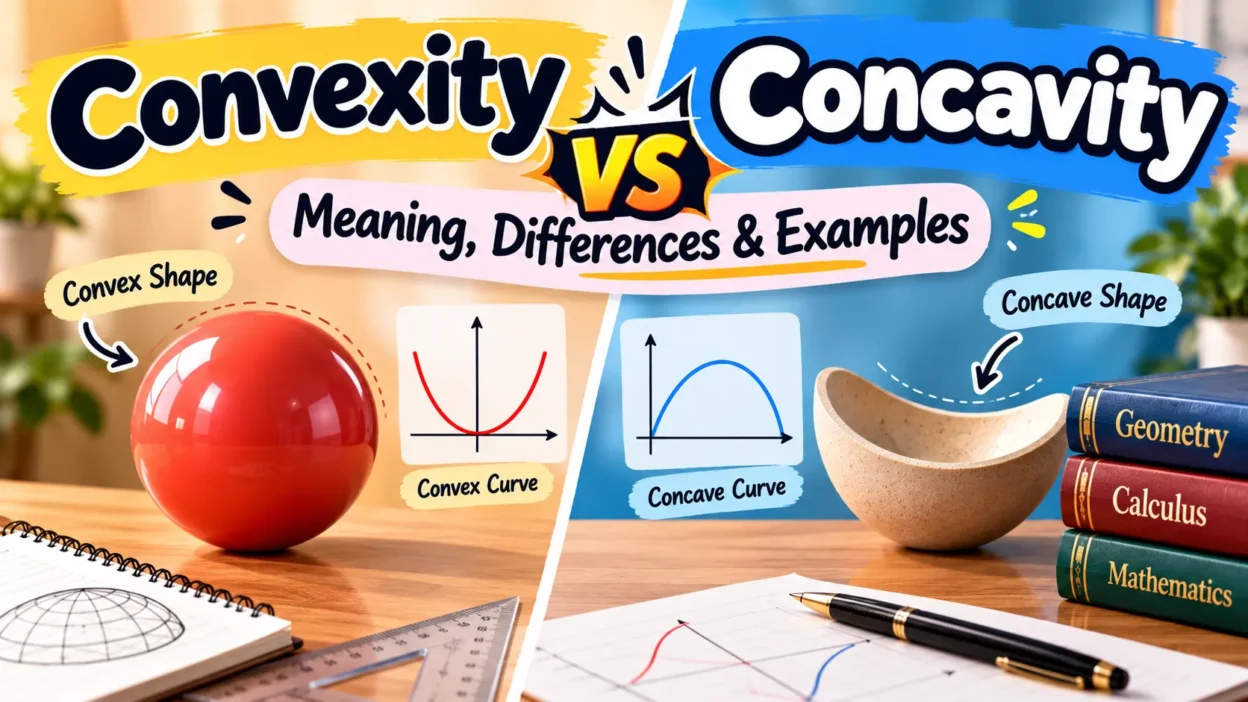
Convexity and concavity are important mathematical concepts used in geometry, calculus, economics, and optimization. Although these terms sound similar, they describe different properties of curves, functions, and shapes. Understanding the difference between convexity and concavity makes it easier to analyze graphs, solve mathematical problems, and recognize how functions behave.
In simple terms, convexity describes a shape that curves outward like a bowl, while concavity describes a shape that curves downward like an upside-down bowl. In mathematics, however, the exact meaning depends on whether you’re discussing a function, a geometric shape, or a curve.
This guide explains convexity vs concavity with definitions, visual descriptions, equations, real-world examples, and practical tips for identifying each property.
🔎 Convexity vs Concavity: Quick Difference
Convexity and concavity describe how a function or shape bends. In calculus, the second derivative is often used to determine whether a twice-differentiable function is convex or concave over an interval.
| Feature | Convexity | Concavity |
|---|---|---|
| Basic idea | Curves upward | Curves downward |
| Common visual | Bowl opening upward | Bowl opening downward |
| Second derivative test | (f”(x)\geq 0) | (f”(x)\leq 0) |
| Chord behavior | Lies above or on the graph | Lies below or on the graph |
| Example | (f(x)=x^2) | (f(x)=-x^2) |
| Typical shape | U-shaped | Inverted U-shaped |
For a twice-differentiable function, a nonnegative second derivative throughout an interval indicates convexity, while a nonpositive second derivative indicates concavity. These tests are sufficient and necessary under the stated smoothness conditions.
📘 What Is Convexity in Mathematics?
Convexity describes a function or shape with a particular outward-bending property. For a convex function, the straight line segment joining any two points on its graph lies on or above the graph itself.
For a twice-differentiable function, convexity on an interval is guaranteed when its second derivative is nonnegative throughout that interval.
For example, consider:
[
f(x)=x^2
]
Its first derivative is (f'(x)=2x), and its second derivative is (f”(x)=2). Since the second derivative is positive everywhere, the function is strictly convex over the real numbers.
Convexity appears in geometry, optimization, economics, and machine learning. Convex functions are especially useful because many optimization problems involving them have well-understood solutions.
Example: A graph shaped like a regular U, such as (y=x^2), is convex because its slope increases as you move from left to right.
📉 What Is Concavity in Mathematics?
Concavity describes a function that bends downward. For a concave function, the straight line segment joining any two points on its graph lies on or below the graph.
For a twice-differentiable function, a nonpositive second derivative throughout an interval guarantees concavity.
Consider this function:
[
f(x)=-x^2
]
Its first derivative is (f'(x)=-2x), and its second derivative is (f”(x)=-2). Because the second derivative is negative everywhere, the function is strictly concave over the real numbers.
Concavity helps mathematicians analyze maximum values, diminishing returns, and the behavior of functions in economics and business.
Example: The graph (y=-x^2) resembles an upside-down bowl. Its slope decreases as you move from left to right, which is a sign of concavity.
📊 Convexity vs Concavity in Graphs
A graph provides a quick way to understand whether a function is convex or concave. Look at how the curve bends as you move from left to right, rather than focusing only on whether the graph rises or falls.
<box gap={3}> <row align=”center” gap={3}> <box width=”44%”> <AsyncImage query=”simple mathematical graph y equals x squared upward opening parabola coordinate axes white background” aspectRatio=”4:3″ width=”100%” /> </box> <box flex=”1″ gap={1}> **Convex graph: \(y=x^2\)**
  The curve bends upward like a bowl. Its slope increases from negative to positive as \(x\) increases.
</box>
</row> <divider color=”subtle” /> <row align=”center” gap={3}> <box width=”44%”> <AsyncImage query=”simple mathematical graph y equals negative x squared downward opening parabola coordinate axes white background” aspectRatio=”4:3″ width=”100%” /> </box> <box flex=”1″ gap={1}> **Concave graph: \(y=-x^2\)**
  The curve bends downward like an inverted bowl. Its slope decreases as \(x\) increases.
</box>
</row> </box>
Remember that a function can increase and still be concave, or decrease and still be convex. The direction in which the function moves is different from the direction in which it bends.
🧮 How to Determine Convexity and Concavity Using Derivatives
Calculus provides a systematic way to classify the curvature of a function. The most common method for twice-differentiable functions uses the second derivative.
Follow these steps:
- Find the first derivative, (f'(x)).
- Differentiate again to obtain the second derivative, (f”(x)).
- Determine where the second derivative is positive, negative, or zero.
- Use those intervals to identify convexity and concavity.
For example, let:
[
f(x)=3x^2+2x+1
]
The first derivative is (f'(x)=6x+2), and the second derivative is (f”(x)=6). Because (6) is positive for every real number, the function is strictly convex everywhere.
Now consider:
[
g(x)=-3x^2+2x+1
]
Its second derivative is (g”(x)=-6). Since this value is negative everywhere, the function is strictly concave over the real numbers.
This method works particularly well for polynomial functions and many other differentiable functions.
➕ What Does a Positive Second Derivative Mean?
When the second derivative is positive throughout an interval, the graph of a twice-differentiable function is strictly convex there. Its slope increases as you move from left to right.
For example:
[
f(x)=x^2+4x
]
Differentiating twice gives:
[
f”(x)=2
]
Because (2>0), the function is strictly convex across its entire domain.
A positive second derivative does not necessarily mean the function itself is positive or increasing. For instance, (x^2+4x) takes negative values for some inputs, but its curvature remains convex.
The important distinction is that the second derivative measures how the slope changes, not the actual height of the graph.
➖ What Does a Negative Second Derivative Mean?
A negative second derivative indicates that the graph of a twice-differentiable function is strictly concave over the interval. Its slope decreases as you move from left to right.
Consider:
[
f(x)=-x^2+6x
]
Its second derivative is:
[
f”(x)=-2
]
Since (-2<0), the function is strictly concave everywhere.
The graph reaches a maximum at its vertex, but concavity itself does not require a function to be decreasing. A concave function can rise before reaching its maximum and fall afterward.
This distinction is useful when solving optimization problems, where concavity often helps identify a maximum.
🔄 What Is an Inflection Point?
An inflection point is a point where a function changes concavity, such as changing from convex to concave or from concave to convex. It helps identify where the bending direction of a graph changes.
Consider:
[
f(x)=x^3
]
Its first derivative is (f'(x)=3x^2), and its second derivative is:
[
f”(x)=6x
]
For (x<0), the second derivative is negative, so the function is concave. For (x>0), it is positive, so the function is convex. The concavity changes at (x=0), making the origin an inflection point.
A key rule is that (f”(x)=0) alone does not prove that an inflection point exists. You must check whether the concavity actually changes on either side of the point.
📐 Convexity vs Concavity in Geometry
In geometry, convexity and concavity describe the properties of shapes and regions. A set is convex if the line segment connecting any two points in the set remains entirely inside the set.
A circle’s filled interior is convex because every segment between two points inside it stays within the circle. A crescent-shaped region, by contrast, is generally non-convex because some segments between points in the region pass outside it.
Concavity is often used informally to describe inward dents or indented shapes. In formal geometry, a shape that is not convex is called non-convex; it is not always described simply as concave.
These geometric definitions differ from the derivative tests used for functions, although the underlying idea of curvature and line segments is related.
💼 Convexity vs Concavity in Economics
Economists use convexity and concavity to study preferences, costs, production, and decision-making. The concepts help explain how outcomes change when inputs or choices are combined.
A concave utility function may represent diminishing marginal utility: each additional unit of a good provides less extra satisfaction than the previous one. A convex cost function may represent rising marginal costs as production expands.
For example, a business might experience increasing marginal costs when its factory approaches full capacity. This pattern can be represented by a convex cost function over the relevant range.
These are common modeling examples, not universal rules. Real economic relationships can be convex in some regions and concave in others, depending on the assumptions and conditions involved.
🤖 Convexity vs Concavity in Optimization and Machine Learning
Convexity is especially important in optimization because convex objective functions and convex feasible regions often make problems easier to analyze. Under suitable conditions, a local minimum of a convex function is also a global minimum.
Concavity is similarly useful when maximizing an objective function. For example, maximizing a concave function over a convex feasible region can provide a well-structured optimization problem.
In machine learning, convex loss functions can simplify training and theoretical analysis. However, many modern models, including neural networks, involve non-convex optimization problems.
Understanding these properties helps researchers select algorithms, interpret mathematical guarantees, and reason about whether a solution is globally optimal.
⚖️ Strict Convexity vs Ordinary Convexity
Strict convexity is a stronger condition than ordinary convexity. A strictly convex function bends upward in a way that places the graph strictly below the chord joining two distinct points, except at the endpoints.
For example, (f(x)=x^2) is strictly convex on the real numbers. By comparison, (f(x)=2x+1) is convex but not strictly convex because it is a straight line.
This distinction matters in optimization. Strict convexity can guarantee that a minimizer is unique when a minimum exists, whereas ordinary convexity alone may allow several minimizers.
The corresponding concept for concave functions is strict concavity, which can similarly support uniqueness of a maximum under suitable conditions.
🚫 Common Mistakes When Comparing Convexity and Concavity
Convexity and concavity are easier to understand once you separate curvature from other graph properties. These common mistakes can lead to incorrect conclusions in calculus and optimization.
- Confusing increasing with convex: An increasing function does not have to be convex.
- Confusing decreasing with concave: A decreasing function can be convex or concave.
- Assuming a zero second derivative proves an inflection point: The concavity must change across the point.
- Treating every non-convex shape as concave: A non-convex set may have a complicated shape that is not captured by a simple concave description.
- Checking only one point: To classify a function on an interval, examine the second derivative throughout that interval or use an appropriate proof.
- Ignoring the domain: A function may be convex on one interval and concave on another.
Avoiding these errors makes it easier to interpret graphs and apply calculus correctly.
🧠 Easy Ways to Remember Convexity and Concavity
A simple visual memory trick can help you distinguish the terms. Think of convexity as a bowl that holds water and concavity as a bowl turned upside down.
- Convex: The curve bends upward, like (y=x^2).
- Concave: The curve bends downward, like (y=-x^2).
- Positive second derivative: Indicates strict convexity for a twice-differentiable function on an interval.
- Negative second derivative: Indicates strict concavity under the same conditions.
You can also remember that a convex function has an increasing slope, while a concave function has a decreasing slope. This rule is especially useful when examining graphs in calculus.
❓ Frequently Asked Questions
What is the main difference between convexity and concavity?
Convexity means a function bends upward, while concavity means it bends downward. For twice-differentiable functions, the second derivative helps identify the difference.
Is (x^2) convex or concave?
The function (f(x)=x^2) is strictly convex over the real numbers because its second derivative is (2), which is positive everywhere.
Is (-x^2) convex or concave?
The function (f(x)=-x^2) is strictly concave over the real numbers because its second derivative is (-2), which is negative everywhere.
Does a positive second derivative always mean convexity?
If a function is twice differentiable on an interval and its second derivative is nonnegative throughout that interval, the function is convex there. If the second derivative is strictly positive throughout, the function is strictly convex.
Can a function be both convex and concave?
Yes. A function can be both convex and concave on an interval if it is affine there, meaning it has the form (f(x)=ax+b). Constant functions are included in this category.
What is the difference between convexity and an inflection point?
Convexity describes upward curvature over an interval. An inflection point occurs where the function changes concavity. A function can be convex on one side of an inflection point and concave on the other.
Why is convexity important in optimization?
Convexity makes many optimization problems easier to solve and analyze. Under suitable conditions, any local minimum of a convex function is a global minimum.
What is concavity used for in economics?
Concavity often helps describe diminishing marginal utility and other relationships where additional inputs produce smaller incremental gains. The exact interpretation depends on the economic model.
Is a circle convex or concave?
A filled circle, also called a disk, is a convex set because every line segment between two points in it stays inside the disk. A circle’s boundary alone is not a convex set under the usual line-segment definition.
✅ Conclusion: Convexity vs Concavity
Convexity and concavity describe two different ways that functions and shapes behave. Convex functions bend upward, while concave functions bend downward. In calculus, the second derivative provides a practical method for identifying these properties, while geometry uses line segments to define convex sets.
These concepts are useful in calculus, economics, geometry, machine learning, and optimization. Once you understand how the curve bends and how its slope changes, distinguishing convexity from concavity becomes much easier.

Vivian Mercer is an English language writer and vocabulary enthusiast who specializes in synonyms, word meanings, grammar, idioms, and language usage. She creates accurate, easy-to-understand content that helps readers improve their English skills with confidence.