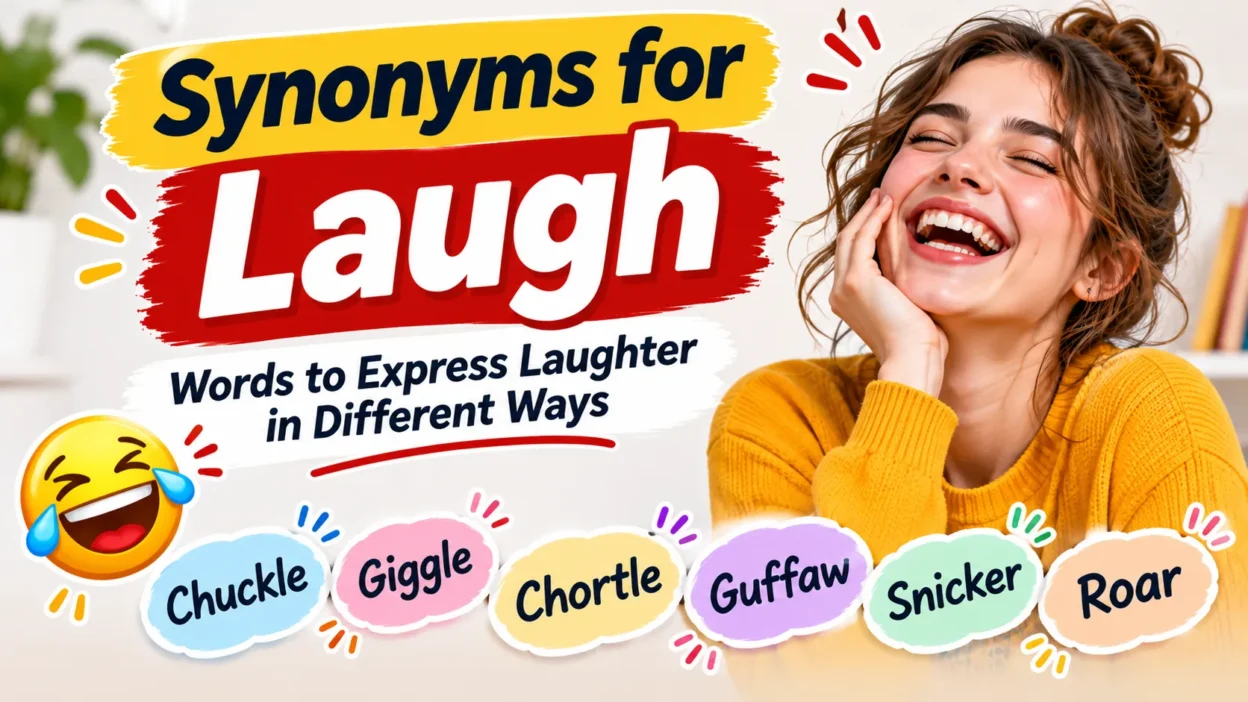
Looking for synonyms for laugh to make your writing more expressive, engaging, and natural? Whether you’re describing a friend’s cheerful giggle, a child’s uncontrollable laughter, a character’s sarcastic chuckle, or a room full of people bursting into laughter, choosing the right word can bring your sentences to life.
The word laugh covers a wide range of emotions and reactions. Someone might giggle because something is cute, chuckle at a mildly amusing comment, cackle with loud amusement, or snicker in a quiet, sometimes mocking way. Although these words all relate to laughter, each creates a different impression.
In this guide, you’ll discover more than 100 synonyms for laugh, organized by meaning, intensity, tone, and context. You’ll also find detailed comparison tables, examples, formal alternatives, descriptive phrases, and practical tips for choosing the right word in everyday conversations, creative writing, and professional content.
😂 Best Synonyms for Laugh
If you need a quick alternative to laugh, the following words are among the most useful. The best choice depends on how someone laughs and what emotion the laughter expresses.
| Synonym | Meaning | Example |
|---|---|---|
| Giggle | Laugh lightly, often in a nervous or playful way | The children giggled at the joke. |
| Chuckle | Laugh quietly or gently | He chuckled at the funny comment. |
| Cackle | Laugh loudly, often in a sharp or distinctive way | The witch cackled in the story. |
| Snicker | Laugh quietly, sometimes mockingly | They snickered at his mistake. |
| Guffaw | Laugh loudly and heartily | She let out a loud guffaw. |
| Chortle | Laugh with a mixture of amusement and satisfaction | He chortled at the clever punchline. |
| Titter | Laugh nervously or in restrained little bursts | The audience tittered at the awkward remark. |
| Roar | Laugh very loudly | Everyone roared with laughter. |
| Howl | Laugh uncontrollably or very loudly | We howled at the comedian’s routine. |
| Grin | Smile broadly, sometimes showing amusement without laughing | She grinned at the playful remark. |
| Snort | Make a sudden, snorting sound while laughing | He snorted with laughter. |
| Beam | Smile brightly with happiness | She beamed when she heard the news. |
| Tee-hee | Express a light, playful giggle | “Tee-hee!” she whispered. |
| Burst out laughing | Begin laughing suddenly | I burst out laughing at his impression. |
| Crack up | Laugh a great deal; informal | That video always makes me crack up. |
Best everyday choices: Giggle, chuckle, guffaw, snicker, and roar are especially useful because they describe different types of laughter rather than simply repeating the same word.
🔍 Synonyms for Laugh by Meaning
Laughter can be quiet, loud, nervous, sarcastic, joyful, or uncontrollable. Grouping synonyms by the kind of laughter you want to describe makes choosing the right word easier.
😊 Words That Mean Laugh Softly
Use these words when someone laughs quietly, gently, or in a restrained way.
- Giggle
- Chuckle
- Titter
- Snicker
- Chortle
- Tee-hee
- Suppress a laugh
- Stifle a laugh
- Smother a laugh
- Laugh under one’s breath
- Give a little laugh
- Let out a quiet laugh
- Smile with amusement
- Laugh softly
- Break into a giggle
Examples:
- She giggles whenever her brother tells a silly joke.
- He chuckled quietly while reading the message.
- The students tittered when the teacher made an unexpected comment.
- I tried to stifle a laugh during the serious meeting.
- She laughed under her breath at the amusing remark.
A giggle often sounds playful or nervous, while a chuckle is generally more restrained and relaxed. A titter can suggest nervousness or embarrassment.
🤣 Words That Mean Laugh Loudly
When someone laughs with considerable volume or intensity, these words can make your description more vivid.
- Guffaw
- Cackle
- Roar
- Howl
- Bellow
- Chortle
- Burst into laughter
- Double over laughing
- Crack up
- Split one’s sides laughing
- Laugh uproariously
- Explode with laughter
- Break into loud laughter
- Roll with laughter
- Laugh hysterically
Examples:
- Everyone roared when the comedian delivered the punchline.
- He let out a hearty guffaw at the unexpected joke.
- The children howled with laughter during the game.
- She doubled over laughing at his ridiculous impression.
- We burst into laughter when the dog stole the sandwich.
Words such as roar, howl, and guffaw communicate strong, audible laughter. Expressions such as double over laughing describe the physical effect of laughing intensely.
😏 Words That Mean Laugh Sarcastically or Mockingly
Some kinds of laughter suggest ridicule, disbelief, or an attempt to make someone feel embarrassed.
- Snicker
- Sneer
- Scoff
- Smirk
- Snort
- Deride
- Ridicule
- Mock
- Jeer
- Laugh scornfully
- Give a mocking laugh
- Laugh dismissively
- Sneer with amusement
- Snigger
- Scoff with disbelief
Examples:
- The students snickered when their classmate made a mistake.
- He scoffed at the suggestion that the plan would work.
- She gave a mocking laugh after hearing the excuse.
- The character sneered at his opponent.
- They jeered at the player after the missed shot.
These words are related but not interchangeable. Snicker and snigger describe certain kinds of laughter, while scoff, sneer, jeer, and deride can involve contempt or ridicule without necessarily describing laughter itself.
😌 Words That Mean Laugh With Joy
When laughter comes from happiness, excitement, or genuine delight, these alternatives may fit better than a neutral word.
- Giggle
- Chuckle
- Chortle
- Beam
- Grin
- Rejoice
- Delight
- Laugh joyfully
- Burst with laughter
- Laugh gleefully
- Titter with delight
- Smile broadly
- Laugh with pleasure
- Be amused
- Bubble with laughter
Examples:
- She beamed when she saw her family.
- The children giggled with delight at the surprise.
- He chortled happily at the clever joke.
- Everyone laughed joyfully during the celebration.
- Her face lit up, and she grinned from ear to ear.
Remember that beam and grin describe smiling rather than necessarily making a laughing sound. They work well when you want to show amusement or happiness without implying loud laughter.
🌸 Cute and Playful Synonyms for Laugh
For captions, children’s stories, friendly messages, and lighthearted writing, playful expressions can make a description feel warmer.
| Word or Phrase | Tone | Example |
|---|---|---|
| Giggle | Sweet and playful | She giggled at the kitten’s antics. |
| Tee-hee | Light and mischievous | “Tee-hee!” she said behind her hand. |
| Chuckle | Gentle and friendly | Grandpa chuckled at the silly drawing. |
| Titter | Light and often nervous | The girls tittered over the secret joke. |
| Chortle | Cheerful and expressive | He chortled at the funny story. |
| Snicker | Quiet and sometimes mischievous | The children snickered at the playful prank. |
| Burst into giggles | Energetic and spontaneous | They burst into giggles during the game. |
| Bubble with laughter | Joyful and expressive | She bubbled with laughter all afternoon. |
| Smile and giggle | Sweet and affectionate | The toddler smiled and giggled at the bubbles. |
| Laugh like a little bird | Figurative and whimsical | She laughed like a little bird. |
Example: Instead of writing, “The child laughed at the puppy,” you could write, “The child burst into giggles as the puppy chased its own tail.”
The second sentence paints a clearer picture because it describes both the laughter and the situation that caused it.
💼 Formal Synonyms for Laugh
In professional writing, reports, literary analysis, or academic work, the best alternative is often a precise description rather than an elaborate synonym.
| Word or Phrase | Meaning | Example |
|---|---|---|
| Chuckle | Laugh quietly | The audience chuckled at the remark. |
| Guffaw | Laugh loudly and heartily | The speaker’s comment prompted a guffaw. |
| Laugh audibly | Laugh in a clearly noticeable way | Several participants laughed audibly. |
| Respond with laughter | React by laughing | The audience responded with laughter. |
| Express amusement | Show that something is funny | She expressed amusement at the anecdote. |
| Smile with amusement | Show mild pleasure or humor | He smiled with amusement. |
| Break into laughter | Start laughing suddenly | The group broke into laughter. |
| Laugh heartily | Laugh with energy and enjoyment | They laughed heartily throughout the performance. |
| Suppress laughter | Try not to laugh | The presenter suppressed laughter. |
| Laugh derisively | Laugh to express contempt | The character laughed derisively at the proposal. |
For formal writing, avoid choosing a rare word simply to sound sophisticated. Responded with laughter may be more appropriate in a report than chortled, while guffawed can be ideal when the volume and intensity of laughter matter to the scene.
⚖️ Laugh vs. Giggle vs. Chuckle vs. Guffaw
These words all describe laughter, but each suggests a different sound, intensity, or emotional tone.
| Word | Intensity | Typical Tone | Example |
|---|---|---|---|
| Laugh | General | Any kind of amusement | They laughed at the joke. |
| Giggle | Light | Playful, nervous, or excited | She giggled at the silly picture. |
| Chuckle | Mild | Quiet and relaxed | He chuckled at the comment. |
| Guffaw | Strong | Loud and hearty | She let out a guffaw. |
| Cackle | Often loud | Sharp, distinctive, sometimes sinister | The villain cackled loudly. |
| Snicker | Quiet | Often mocking or mischievous | They snickered at the mistake. |
| Chortle | Moderate to strong | Amused and often delighted | He chortled at the punchline. |
| Titter | Light and restrained | Nervous or embarrassed | The audience tittered. |
| Roar | Very loud | Collective or intense amusement | The crowd roared with laughter. |
How to choose:
- Use laugh when you want a general, neutral description.
- Use giggle for light, playful, or nervous laughter.
- Use chuckle for quiet, relaxed amusement.
- Use guffaw for loud, hearty laughter.
- Use snicker when the laughter has a mocking or mischievous quality.
- Use cackle when the sound is sharp, loud, or distinctive.
✍️ Synonyms for Laugh in Sentences
Seeing these alternatives in context helps you understand how they change a sentence’s tone.
| Original Sentence | Alternative Sentence | Difference |
|---|---|---|
| She laughed at the joke. | She giggled at the joke. | Suggests light, playful laughter. |
| He laughed quietly. | He chuckled softly. | Suggests gentle amusement. |
| Everyone laughed loudly. | Everyone roared with laughter. | Emphasizes volume and intensity. |
| They laughed at his mistake. | They snickered at his mistake. | Suggests ridicule or unkind amusement. |
| The children laughed happily. | The children bubbled with laughter. | Creates a more vivid, joyful image. |
| He laughed suddenly. | He burst into laughter. | Emphasizes an abrupt reaction. |
| She laughed at the absurd idea. | She scoffed at the absurd idea. | Suggests disbelief or contempt rather than simple amusement. |
| The audience laughed throughout the show. | The audience responded with laughter throughout the show. | Creates a more formal tone. |
A strong synonym should clarify the type of laughter rather than simply replace the original word.
📚 Words Related to Laugh That Are Not Exact Synonyms
Some words are associated with laughter but describe different actions or emotional reactions. Understanding these distinctions prevents awkward word choices.
| Word | What It Describes | Example |
|---|---|---|
| Smile | Turning up the corners of the mouth to express happiness or amusement | She smiled at the compliment. |
| Grin | A broad smile | He grinned when he heard the news. |
| Smirk | A self-satisfied or sometimes smug smile | She smirked at the clever remark. |
| Sneer | A contemptuous facial expression | He sneered at the suggestion. |
| Scoff | Expressing disbelief or contempt, sometimes with a mocking laugh | She scoffed at the unlikely claim. |
| Beam | A broad, happy smile | He beamed with pride. |
| Giggle | Light, often repeated laughter | The children giggled together. |
| Snort | A short, forceful sound, sometimes made while laughing | He snorted with laughter. |
| Gasp | A sudden intake of breath | She gasped in surprise. |
| Choke with laughter | Struggle to speak or breathe normally because of laughter | He choked with laughter while telling the story. |
For example, “She smiled at the joke” does not necessarily mean she laughed out loud. Likewise, “He scoffed at the idea” communicates disbelief or contempt and may not involve laughter at all.
🚫 Common Mistakes When Using Synonyms for Laugh
Choosing the wrong word can change the meaning of a sentence. Keep these distinctions in mind.
Mistake 1: Using Giggle for Every Kind of Laughter
A giggle is usually light, repeated, or playful. It may not fit a scene involving deep, hearty laughter.
Less precise: He giggled loudly for several minutes at the comedian’s performance.
More fitting: He guffawed at the comedian’s performance.
Mistake 2: Confusing Chuckle With Guffaw
A chuckle is generally quiet, while a guffaw is loud and hearty.
- He chuckled at the amusing remark.
- He guffawed when the comedian delivered the punchline.
Choose according to the sound and intensity you want to convey.
Mistake 3: Using Snicker When You Mean Laugh Kindly
Snicker often suggests mocking or mischievous laughter. If someone laughs warmly at a harmless joke, chuckle or giggle may be more appropriate.
Mistake 4: Treating Smile and Laugh as Identical
A smile can express happiness or amusement without audible laughter. If someone laughs out loud, smile alone may not accurately describe the action.
Mistake 5: Overusing Dramatic Expressions
Phrases such as roll on the floor laughing, split one’s sides laughing, and explode with laughter are vivid but informal. They work well in casual writing and dialogue, but may be excessive in a professional report.
💡 How to Choose the Best Synonym for Laugh
Before replacing laugh, consider the emotion, sound, and situation.
- For gentle amusement: Choose chuckle or giggle.
- For loud laughter: Choose guffaw, roar, or howl.
- For playful laughter: Choose giggle, chortle, or tee-hee.
- For nervous laughter: Choose titter, giggle, or laugh awkwardly.
- For mocking laughter: Choose snicker, snigger, or laugh derisively.
- For sudden laughter: Choose burst out laughing or break into laughter.
- For formal descriptions: Choose respond with laughter, laugh audibly, or express amusement.
- For silent amusement: Choose smile, grin, or smirk, depending on the expression.
The most effective word is not necessarily the most unusual one. It is the word that helps the reader hear, imagine, or understand the reaction.
📝 Practice Quiz: Choose the Best Synonym for Laugh
Test your knowledge by choosing the word that best fits each sentence.
1. The children made quiet, playful sounds while watching the funny cartoon.
A. Giggle
B. Guffaw
C. Sneer
2. He let out a loud, hearty laugh when he heard the punchline.
A. Titter
B. Guffaw
C. Smirk
3. The students laughed quietly at their classmate’s mistake in an unkind way.
A. Beam
B. Snicker
C. Rejoice
4. She tried not to laugh during the serious presentation.
A. Suppress a laugh
B. Roar
C. Cackle
5. The audience laughed very loudly together.
A. Whisper
B. Roar with laughter
C. Smile faintly
Answer Key
| Question | Correct Answer | Explanation |
|---|---|---|
| 1 | A — Giggle | A giggle is light and often playful. |
| 2 | B — Guffaw | A guffaw is a loud, hearty laugh. |
| 3 | B — Snicker | A snicker can suggest mocking or unkind amusement. |
| 4 | A — Suppress a laugh | This means trying to keep yourself from laughing. |
| 5 | B — Roar with laughter | This describes loud, collective laughter. |
❓ Frequently Asked Questions About Synonyms for Laugh
What is the best synonym for laugh?
Giggle, chuckle, guffaw, chortle, and snicker are common alternatives. The best choice depends on whether the laughter is playful, quiet, loud, or mocking.
What is another word for laughing a lot?
You can use guffaw, roar with laughter, howl with laughter, crack up, or double over laughing. The first three emphasize strong laughter, while crack up is an informal expression.
What is a cute synonym for laugh?
Giggle, tee-hee, chuckle, and bubble with laughter can create a playful or affectionate tone. These choices work well in children’s stories, captions, and casual descriptions.
What is a formal synonym for laugh?
Depending on the context, use chuckle, guffaw, respond with laughter, laugh audibly, or express amusement. Formal writing often benefits from precise descriptions rather than elaborate synonyms.
What is the difference between giggle and chuckle?
A giggle is generally light and may sound playful, nervous, or excited. A chuckle is usually quieter and expresses mild amusement.
What is the difference between snicker and snicker at someone?
Snicker describes a quiet laugh that can be mischievous or mocking. When someone snickers at another person, the phrase often suggests that they are laughing at that person rather than sharing a joke with them.
What is a synonym for laugh that starts with C?
Common options include chuckle, chortle, and cackle. A chuckle is quiet, a chortle expresses amused delight, and a cackle is often louder and sharper.
What is a synonym for laugh that starts with G?
Giggle and guffaw are common alternatives. A giggle is light and playful, while a guffaw is a loud, hearty laugh.
Are smile and laugh synonyms?
They are related but not exact synonyms. A smile is a facial expression, while a laugh usually involves an audible or physical reaction. Someone can smile without laughing or laugh without smiling broadly.
How can I avoid repeating the word laugh in an article?
Choose alternatives based on the reaction you’re describing. Use chuckle for mild amusement, giggle for playful laughter, guffaw for hearty laughter, and snicker for mocking laughter. You can also vary sentence structure with phrases such as “the room erupted in laughter” or “the audience responded with amusement.”
✅ Conclusion
The best synonyms for laugh depend on the sound, intensity, and emotion behind the reaction. Words such as giggle, chuckle, guffaw, cackle, chortle, and snicker help distinguish between playful, gentle, loud, joyful, and mocking laughter.
For casual writing, giggle and crack up can make a sentence feel natural and lively. For creative writing, guffaw, cackle, and roar with laughter create stronger imagery. Also For professional content, respond with laughter or express amusement may be more appropriate.
Instead of replacing laugh with a random synonym, think about what the person is feeling and how the laughter sounds. That small choice can make your writing clearer, more descriptive, and much more engaging.

Vivian Mercer is an English language writer and vocabulary enthusiast who specializes in synonyms, word meanings, grammar, idioms, and language usage. She creates accurate, easy-to-understand content that helps readers improve their English skills with confidence.