Finding the right synonyms for which can help you improve your English vocabulary, write clearer sentences, and avoid unnecessary repetition. The word which is commonly used to ask questions, introduce additional information, identify a particular choice, or refer to something previously mentioned. However, replacing it with another word depends on how it functions in a sentence.
Common alternatives for which include what, that, whichever, who, where, and what kind of. In certain situations, you can also use expressions such as the one that, the particular one, or the option that. However, these alternatives do not always have the same grammatical function.
Whether you are writing an academic paper, professional email, blog post, or everyday conversation, understanding different ways to use which can make your communication more effective. This guide explores more than 100 synonyms, alternatives, and related expressions, along with meanings, sentence examples, grammar rules, and practical tips for choosing the right word.
🔍 Best Synonyms for Which
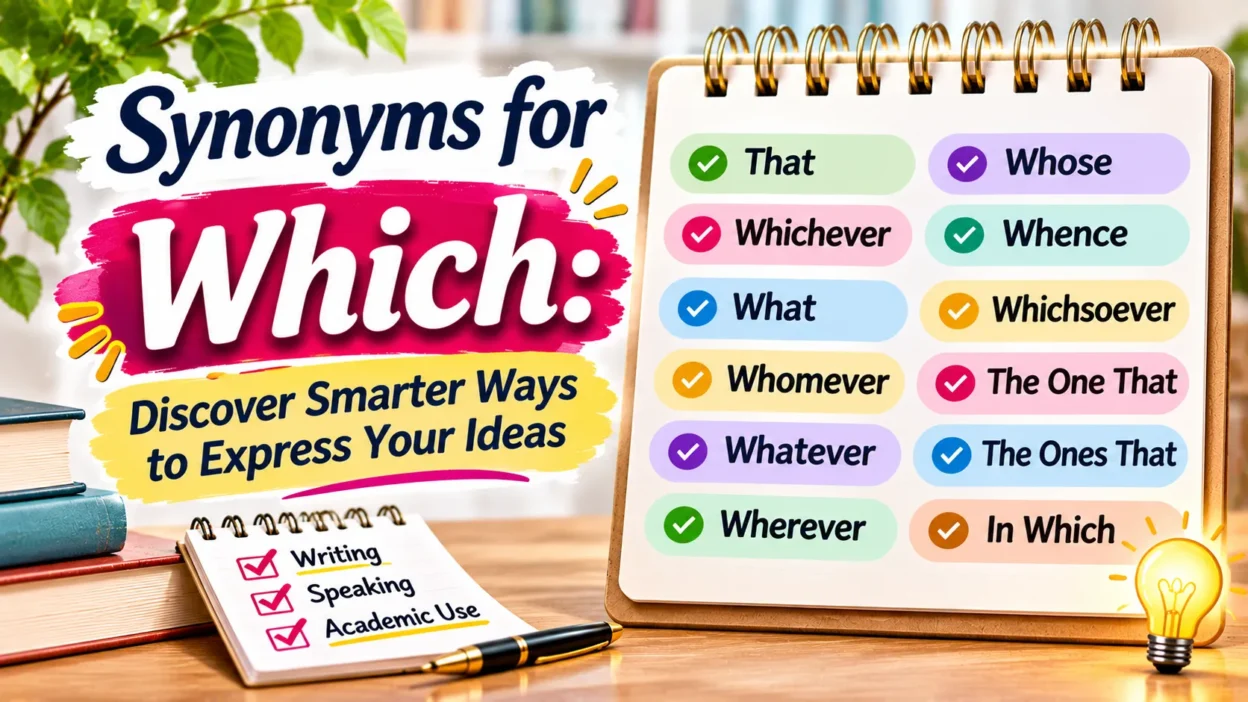
The best alternative for which depends on the sentence’s meaning and grammatical structure. Sometimes you want to ask about a choice, while other times you want to identify a specific object or introduce additional information.
Here are some commonly used alternatives and related expressions:
- What
- That
- Whichever
- Whatever
- What one
- Which one
- The one that
- The one which
- The particular one
- The specific one
- What kind of
- What type of
- What sort of
- What option
- What choice
- Which particular
- Which specific
- The option that
- The item that
- The thing that
- The choice that
- The selection that
- The alternative that
- The variety that
- The version that
- The method that
- The approach that
- The situation in which
- The case in which
- The circumstances under which
Examples:
- Which book do you prefer? → What book do you prefer?
- Choose whichever option works best.
- I selected the one that you recommended.
- Tell me what kind of music you enjoy.
- We discussed the situation in which the problem occurred.
Remember that some entries are alternative phrases rather than direct synonyms. Their suitability depends on the sentence.
📖 What Does Which Mean?
Which is a pronoun or determiner used to identify a particular person, thing, or choice from a known or limited group. It can also introduce a relative clause that provides additional information about a noun.
The word commonly appears in questions and statements.
Which as an interrogative pronoun:
- Which is your favorite?
- Which do you want to buy?
- Which should we choose?
- Which belongs to you?
- Which as an interrogative determiner:
- Which book are you reading?
- Which color do you prefer?
- Which restaurant should we visit?
- Which student won the competition?
Which in a relative clause:
- I bought a laptop, which works very well.
- She chose the blue dress, which looked beautiful.
- We visited the museum, which opened last year.
- He missed the meeting, which surprised everyone.
Understanding these uses will help you find an appropriate alternative without changing the sentence’s meaning.
✍️ Synonyms for Which in Questions
When which appears in a question, it usually asks someone to identify or select something. Depending on the context, you can sometimes replace it with what, what one, what kind of, or what type of.
Here are useful alternatives for questions:
- What
- What one
- What kind
- What type
- What sort
- Which one
- Which option
- Which choice
- Which alternative
- What selection
- What variety
- What version
- What category
- What model
- What particular item
- What specific option
- What alternative
- What product
- What method
- What approach
Examples:
- Which movie do you want to watch?
- What movie do you want to watch?
- Which option would you prefer?
- What option would you prefer?
- Which type of phone do you use?
- What kind of phone do you use?
Although these questions may communicate similar ideas, what and which are not always interchangeable. Which generally suggests a known or limited selection, while what can introduce a broader range of possibilities.
🔄 Synonyms for Which in Different Sentence Structures
The word which can perform different grammatical functions. Therefore, the best alternative changes according to the structure of your sentence.
| Original expression | Possible alternative | Example |
|---|---|---|
| Which one | What one | Which one should I choose? |
| Which option | What option | Which option is better? |
| Which type | What kind | Which type do you prefer? |
| The book which I bought | The book that I bought | The book that I bought is interesting. |
| The situation in which | The situation where | The situation where we met was unusual. |
| Whichever option | Any option that | Choose whichever option works. |
| Which particular | What specific | Which particular model do you want? |
| The method which works | The method that works | Use the method that works best. |
Not every alternative fits every grammatical structure. Always check whether the replacement preserves the original meaning.
🎓 Formal Synonyms and Alternatives for Which
Formal writing often uses which to introduce questions, explain choices, or connect ideas. In academic papers, reports, and professional documents, you can sometimes replace it with a more specific expression.
Here are useful formal alternatives:
- What particular
- What specific
- The one that
- The particular option
- The specific choice
- The selected option
- The relevant alternative
- The corresponding item
- The applicable method
- The appropriate approach
- The chosen alternative
- The designated option
- The respective item
- The particular category
- The relevant selection
- The option that
- The method that
- The approach that
- The circumstances under which
- The conditions in which
Examples:
- Which method is most effective?
- What particular method is most effective?
- We examined the circumstances under which the results changed.
- The researcher selected the approach that produced the most reliable results.
- The report identifies the specific factors that influenced the outcome.
These expressions can make formal writing more precise, but avoid replacing which when the original word already provides the clearest construction.
💼 Professional Alternatives for Which
Professional communication often requires clear questions and precise descriptions. When discussing products, decisions, processes, and business options, you can use expressions that identify a specific choice.
Useful alternatives include:
- Which option
- What alternative
- The selected option
- The preferred choice
- The relevant item
- The specific requirement
- The applicable method
- The appropriate solution
- The particular approach
- The chosen alternative
- The corresponding option
- The relevant category
- The designated choice
- The available selection
- The recommended approach
- The suitable method
- The preferred alternative
- The specific model
- The required version
- The applicable option
Examples:
- Which solution would you recommend?
- What alternative would you recommend?
- Please confirm the option that best meets your requirements.
- We need to identify the appropriate method.
- Let us review the specific requirements before making a decision.
📚 Academic Alternatives for Which
Academic writing uses which to ask questions, introduce additional details, and identify particular elements in research. In some situations, a more specific phrase can improve clarity.
Consider these alternatives:
- What specific
- What particular
- The one that
- The method that
- The approach that
- The factor that
- The variable that
- The condition under which
- The circumstances in which
- The process through which
- The context in which
- The extent to which
- The degree to which
- The situation where
- The relevant factor
- The corresponding variable
- The applicable condition
- The selected method
- The particular category
- The identified component
Examples:
- Which variable affects the outcome?
- What specific variable affects the outcome?
- The study examined the conditions under which the reaction occurred.
- Researchers identified the factors that influenced the results.
- The paper discusses the extent to which the treatment was effective.
🗣️ Everyday Alternatives for Which
In everyday conversations, people often use simple expressions instead of formal or lengthy phrases. Depending on the sentence, you can use what, which one, what kind, or the one that.
Here are some natural alternatives:
- What
- Which one
- What one
- What kind
- What type
- What sort
- The one that
- The one you want
- The one you prefer
- The particular one
- The other one
- Any one that
- Whatever
- Whichever
- The option you choose
- The thing you mean
- The choice you like
- The one you need
- The version you prefer
- The item you selected
Examples:
- Which dress do you like?
- What dress do you like?
- Which one is yours?
- What one do you want?
- Choose whichever you prefer.
- Take the one that looks best.
🔎 Which vs. What vs. That: What’s the Difference?
Which, what, and that are related words, but they serve different grammatical purposes. Understanding their differences will help you choose the correct alternative.
| Word | Main function | Example |
|---|---|---|
| Which | Identifies a choice or introduces a relative clause | Which color do you prefer? |
| What | Asks about information or identifies something | What color do you like? |
| That | Introduces a defining relative clause or points to something | The color that I chose is blue. |
| Whichever | Refers to any choice from available options | Choose whichever color you like. |
| Whatever | Refers to anything or any thing that fits | Take whatever you need. |
- Which vs. what: Which usually refers to a known or limited set of options, while what can ask about a wider range of possibilities.
- Which vs. that: Which often introduces nonessential information in a relative clause, while that commonly introduces essential information.
- Which vs. whichever: Which asks someone to identify a choice, while whichever means any option that meets the condition.
🧠 How to Choose the Right Alternative for Which
Replacing which with another expression requires attention to grammar and meaning. A suitable alternative should preserve the purpose of the original sentence.
Use these tips:
- Use what for open questions: Choose what when you want someone to provide information without limiting the possible answers.
- Use whichever for flexible choices: Choose whichever when any suitable option is acceptable.
- Use that for defining clauses: Use that when the information identifies the specific noun being discussed.
- Use the one that for clarity: This phrase works when you are identifying a particular object or selection.
- Use specific or particular for precision: These words help identify an exact item or category.
- Keep the original meaning: Do not replace which simply to avoid repetition if the new expression changes the sentence.
For example, “Which phone should I buy?” asks someone to select a phone. “What phone should I buy?” asks a more open question. Both can work, but the context determines the better choice.
🚫 Common Mistakes When Using Synonyms for Which
Although many expressions can replace which, some substitutions create grammatical errors or change the original meaning.
Avoid these common mistakes:
- Using what in every question: What and which have different meanings when a limited selection is involved.
- Replacing every which with that: That cannot replace which in every relative clause.
- Confusing whichever with which: Whichever means any one that meets a condition, while which asks someone to identify a choice.
- Using where for every relative clause: Where usually refers to a place or situation, not every object or idea.
- Ignoring sentence structure: A phrase such as the one that may require changes to the surrounding sentence.
- Using unnecessary formal expressions: Simple words often communicate more clearly than lengthy alternatives.
Incorrect: The book that I bought yesterday, it was interesting.
Better: The book that I bought yesterday was interesting.
Incorrect: Which kind of music you like?
Correct: What kind of music do you like?
Incorrect: Choose which you prefer, any option is acceptable.
Better: Choose whichever option you prefer.
📋 More Than 50 Synonyms and Related Alternatives for Which
If you want to expand your vocabulary, the following list includes alternative words, phrases, and related expressions that may replace which in suitable contexts.
- What
- That
- Whichever
- Whatever
- Which one
- What one
- What kind
- What type
- What sort
- What particular
- What specific
- What option
- What choice
- What alternative
- What selection
- What variety
- What version
- What category
- What model
- The one that
- The one which
- The particular one
- The specific one
- The selected one
- The chosen one
- The preferred one
- The relevant one
- The appropriate one
- The suitable one
- The correct one
- The best one
- The option that
- The choice that
- The item that
- The thing that
- The product that
- The method that
- The approach that
- The process that
- The system that
- The factor that
- The reason that
- The result that
- The condition that
- The situation that
- The alternative that
- The version that
❓ Frequently Asked Questions About Synonyms for Which
What is the best synonym for which?
What, whichever, that, and the one that are common alternatives, depending on the sentence. And What works in many questions, while whichever refers to any suitable choice.
What is another word for which in a question?
You can sometimes use what, which one, what kind, what type, or what option. The correct alternative depends on whether you are asking about a specific selection or an open-ended topic.
What is a formal synonym for which?
Formal alternatives include the particular option, the specific item, the relevant selection, the applicable method, and the circumstances under which. These phrases work in suitable professional and academic contexts.
Can I use what instead of which?
Sometimes. What usually introduces an open question, while which commonly asks someone to choose from a known or limited group. For example, “What do you want?” is broader than “Which one do you want?”
Is that a synonym for which?
That can replace which in some defining relative clauses. However, the two words do not have identical grammatical uses. For example, “The book that I bought is interesting” is correct.
What is the difference between which and whichever?
Which asks someone to identify a particular choice. Whichever means any option that meets a condition or preference. For example, “Which dress do you like?” and “Choose whichever dress you like.”
What is another way to say which one?
You can say what one, the particular one, the specific option, the selected item, or the one that, depending on the context.
What is the difference between which and what?
Which usually identifies a choice from a limited set, while what asks for information or identifies something more generally.
Can I start a sentence with which?
Yes. You can start a question with which, such as “Which option is best?” You can also begin a relative or explanatory construction with which in certain sentence structures.
What is the opposite of which?
Which does not have a direct antonym because it is primarily a question word or relative pronoun. Its alternatives depend on the sentence rather than an opposite meaning.
🎯 Conclusion
Learning different synonyms for which can help you improve sentence variety and communicate your ideas more clearly. Words and expressions such as what, whichever, that, the one that, the particular option, and the specific choice can work as alternatives in suitable contexts.
For everyday questions, what and which one are often useful. In professional and academic writing, expressions such as the applicable method, the relevant option, and the circumstances under which can provide greater precision. However, these alternatives are not interchangeable in every sentence.
The best approach is to understand how which functions before replacing it. Choose an alternative that preserves the original meaning, follows the correct grammar, and makes your writing easier to understand.

Vivian Mercer is an English language writer and vocabulary enthusiast who specializes in synonyms, word meanings, grammar, idioms, and language usage. She creates accurate, easy-to-understand content that helps readers improve their English skills with confidence.