
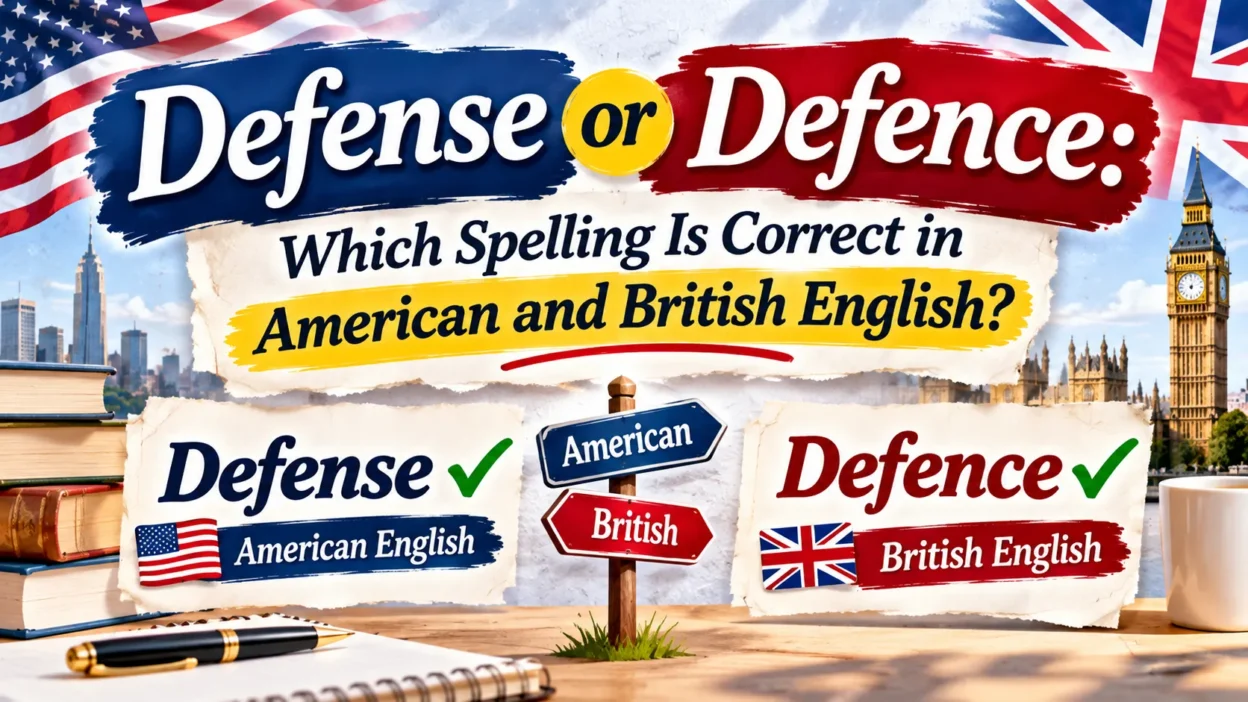
Defense or defence? Both spellings are correct, but the right choice depends on the type of English you’re using. The difference between these two words often confuses writers, students, professionals, and English learners because they have the same meaning and pronunciation but different spellings.
The main distinction is regional. Defense is the standard spelling in American English, while defence is the preferred spelling in British English. You will also commonly see defence in Canadian, Australian, and other varieties of English that follow British spelling conventions. Both words refer to the act of protecting someone or something against danger, attack, criticism, or opposition.
For example, an American newspaper might write, “The team played strong defense,” while a British newspaper would write, “The team played strong defence.” Neither sentence is incorrect; each follows a different spelling convention.
In this guide, you’ll learn the difference between defense and defence, discover when to use each spelling, explore practical examples, and understand related words such as defensive, defensible, and defenseless. By the end, you’ll know exactly which version belongs in your writing.
🔍 Defense vs Defence: What’s the Difference?
The difference between defense and defence is spelling, not meaning. Both words are nouns that describe protection against an attack, threat, criticism, or other form of harm. Your choice depends on the English variety you’re following.
| Word | English Variety | Example |
|---|---|---|
| Defense | American English | The country strengthened its defense system. |
| Defence | British English | The country strengthened its defence system. |
Defense is the standard spelling in the United States. American dictionaries, newspapers, schools, businesses, and government publications generally use this form.
Defence is the standard spelling in British English. It also appears in many other English-speaking countries, including Australia and Canada, although regional preferences and official style guides can vary.
Here are a few examples:
- The player showed excellent defense. (American English)
- The player showed excellent defence. (British English)
- The company improved its cybersecurity defense. (American English)
- The company improved its cybersecurity defence. (British English)
Both versions communicate the same idea. The important thing is to choose the spelling that matches your intended audience and remain consistent throughout your writing.
🇺🇸 What Does Defense Mean in American English?
Defense is the correct spelling in American English. It refers to the action of protecting someone or something from danger, attack, damage, criticism, or opposition. Americans use this spelling in everyday conversations, academic writing, legal documents, sports, military discussions, and professional communication.
The word can describe physical protection, a legal argument, a sports strategy, or an explanation used to justify an action.
Examples of defense in American English:
- The country invested more money in national defense.
- Our basketball team needs better defense.
- The lawyer prepared a strong defense for her client.
- The company introduced new defenses against cyberattacks.
- He presented a convincing defense of his decision.
- The soldiers organized a defensive position.
- The school improved its emergency defense procedures.
- The football team struggled with its defensive strategy.
In the United States, writing defence instead of defense may look unusual or inconsistent with American spelling conventions. If your content targets American readers, use defense as your default spelling.
🇬🇧 What Does Defence Mean in British English?
Defence is the preferred spelling in British English. It carries exactly the same meaning as defense and describes protection, resistance, or an argument supporting someone or something.
British writers use this spelling in newspapers, books, legal documents, educational materials, and everyday communication.
Examples of defence in British English:
- The country increased its spending on national defence.
- The football team played excellent defence.
- The solicitor prepared a defence for the accused.
- The government introduced new defence policies.
- She presented a strong defence of her research.
- The soldiers strengthened the country’s defences.
- The school developed a better defence against online threats.
- The team needs to improve its defensive performance.
In the United Kingdom, defense is generally considered the American spelling. Although readers will understand it, British publications usually prefer defence.
🌎 Defense or Defence: Which Countries Use Each Spelling?
English spelling varies across countries because different regions follow different historical and editorial conventions. Understanding these preferences can help you choose the correct spelling for your audience.
| Country or Region | Commonly Preferred Spelling |
|---|---|
| United States | Defense |
| United Kingdom | Defence |
| Canada | Defence (with some variation) |
| Australia | Defence |
| New Zealand | Defence |
| Ireland | Defence |
| South Africa | Defence |
American English generally uses defense, while British English and many Commonwealth varieties traditionally use defence.
Canada deserves a little extra attention because Canadian English combines British and American influences. Canadian dictionaries and style guides generally favor defence, although some organizations may follow American spelling conventions.
If you’re writing for a particular publication, organization, or country, check its preferred style guide before making a final decision.
✍️ When to Use Defense in a Sentence
Use defense when writing for an American audience or following American English spelling conventions. The word appears in several contexts, so understanding its different uses will help you write accurately.
⚖️ Legal Defense
In legal contexts, defense refers to the arguments, evidence, or legal representation used to protect a person accused of a crime or involved in a legal dispute.
Examples:
- The defense presented new evidence during the trial.
- Her lawyer prepared a strong defense.
- The defendant rejected the accusations in his defense.
- The defense attorney questioned the witness.
- The jury listened carefully to both sides of the case.
🪖 Military Defense
In military and national security contexts, defense describes measures taken to protect a country, territory, or population against external threats.
Examples:
- The government increased its defense budget.
- National defense remains an important priority.
- The military strengthened its coastal defenses.
- The country developed a new defense strategy.
- Defense officials discussed regional security.
🏀 Sports Defense
In sports, defense refers to the actions players take to prevent opponents from scoring or gaining an advantage.
Examples:
- The team played excellent defense throughout the match.
- Our defense stopped the opposing team’s attack.
- The coach introduced a new defensive strategy.
- Strong defense helped the team win the championship.
- The player is known for his defensive skills.
🛡️ Personal and General Protection
Defense can also describe protecting yourself, your reputation, your property, or your ideas.
Examples:
- She spoke in defense of her friend.
- The building has a strong defense against fire.
- He used the truth as his best defense.
- The company improved its data defense systems.
- Everyone has the right to defend their beliefs.
📝 When to Use Defence in a Sentence
Use defence when writing in British English or following a spelling convention that prefers the British form. Its meanings and grammatical uses are identical to those of defense.
Here are some common situations where British writers use defence.
⚖️ Legal Defence
British legal writing uses defence when referring to legal arguments, representation, or evidence presented to protect an accused person.
Examples:
- The defence challenged the witness’s statement.
- The solicitor prepared a detailed defence.
- The accused entered a plea of self-defence.
- The defence presented its final arguments.
- The court considered the evidence offered by the defence.
🪖 National Defence
In British English, defence commonly appears in discussions about military protection, national security, and government policy.
Examples:
- The government announced a new national defence policy.
- Defence spending increased this year.
- The country strengthened its coastal defences.
- The minister discussed international defence cooperation.
- The armed forces developed a new defence strategy.
⚽ Sports Defence
British sports writing also uses defence to describe players and strategies that prevent opponents from scoring.
Examples:
- The team’s defence remained strong throughout the season.
- The goalkeeper organized the defence.
- Their defensive performance impressed the manager.
- The club needs to improve its defence.
- A strong defence helped them secure the victory.
🛡️ General Protection
The word can also describe protection against criticism, danger, or other forms of opposition.
Examples:
- She spoke in defence of her colleagues.
- The organization created a defence against online fraud.
- He offered a reasonable defence of his actions.
- The community organized a defence against the proposed changes.
- The new system provides better protection and defence.
🔤 Defense or Defence: Examples Side by Side
Comparing both spellings in identical sentences is one of the easiest ways to understand their relationship. Notice that the meaning and sentence structure remain unchanged; only the regional spelling differs.
| American English | British English |
|---|---|
| The defense was successful. | The defence was successful. |
| She works in national defense. | She works in national defence. |
| The defense attorney arrived early. | The defence solicitor arrived early. |
| Our team has excellent defense. | Our team has excellent defence. |
| He spoke in defense of his friend. | He spoke in defence of his friend. |
| The defense system needs improvement. | The defence system needs improvement. |
| The country strengthened its defenses. | The country strengthened its defences. |
| Self-defense is important. | Self-defence is important. |
| The defense presented its case. | The defence presented its case. |
| The player has strong defensive skills. | The player has strong defensive skills. |
Notice that some related vocabulary can also differ between American and British English. For example, Americans commonly say defense attorney, while British legal terminology often uses defence solicitor or defence barrister, depending on the role.
🧠 Why Do Defense and Defence Have Different Spellings?
The spelling difference comes from the historical development of American and British English. Both forms trace their origins to French and Latin vocabulary, but English spelling conventions developed differently across regions.
The word ultimately comes from Latin defendere, meaning to ward off or protect. It entered English through Old French and Middle English forms.
Over time, American English adopted spelling reforms associated with simplifying certain French-derived endings. These changes helped establish spellings such as:
- Defense instead of defence
- Offense instead of offence
- License instead of licence (as a noun in American English)
- Practice instead of practise (for both noun and verb in American English)
British English generally retained the traditional -ce spelling for certain nouns, including defence and offence.
These differences are not mistakes. They are part of the natural variation between American and British English.
📚 Defense, Defence, Defensive, and Defenseless: Related Words
Understanding related forms can help you expand your vocabulary and avoid spelling confusion. Although defense and defence differ regionally, several related words follow their own spelling patterns.
| American English | British English | Meaning |
|---|---|---|
| Defense | Defence | Protection against attack or harm |
| Defensive | Defensive | Protecting against attack or criticism |
| Defenseless | Defenceless | Without protection |
| Defensibly | Defensibly | In a way that can be justified |
| Defensible | Defensible | Capable of being justified or protected |
| Self-defense | Self-defence | Protecting yourself from harm |
🛡️ Defensive
Defensive is an adjective that describes someone or something that protects against attack, criticism, or danger.
Examples:
- The team adopted a defensive strategy.
- She became defensive when questioned.
- The country strengthened its defensive capabilities.
- His defensive attitude made the discussion difficult.
Interestingly, both American and British English spell this word defensive, with an s.
🚫 Defenseless or Defenceless
Defenseless is the American spelling, while defenceless is the British spelling. Both describe someone or something without adequate protection.
Examples:
- The small animal was defenseless against predators. (American English)
- The small animal was defenceless against predators. (British English)
- The village was left defenseless after the evacuation.
- The village was left defenceless after the evacuation.
⚖️ Defensible
Defensible describes something that can be justified, supported with evidence, or protected against criticism.
Examples:
- Her decision was reasonable and defensible.
- The company presented a defensible business strategy.
- This is a defensible interpretation of the evidence.
- The position is legally defensible.
The spelling defensible is the same in standard American and British English.
⚠️ Common Mistakes When Using Defense and Defence
Writers sometimes mix American and British spellings without realizing it. Although both forms are correct, inconsistent spelling can make an article, essay, or professional document look less polished.
Here are some mistakes to avoid:
| Common Mistake | Better Choice | Explanation |
|---|---|---|
| Using defence in American English writing | Defense | American English prefers the -se ending. |
| Using defense in British English writing | Defence | British English generally prefers the -ce ending. |
| Writing defense in one paragraph and defence in another | Choose one spelling | Maintain consistency. |
| Assuming defence is incorrect | Both are correct | The spelling depends on regional conventions. |
| Writing defensiv | Defensive | The correct related adjective is defensive. |
| Writing self defence in an American text | Self-defense | American English uses the hyphenated form. |
One important point: don’t automatically replace every word ending in -ce with -se. English spelling differences follow specific patterns, and not every word changes in the same way.
🎯 Is Defense or Defence More Common?
The answer depends on the region and the type of English being used. In the United States, defense is the standard and more common spelling. In the United Kingdom, defence is the traditional and preferred form.
Neither spelling is universally better or more correct. Each belongs to a different regional spelling system.
If you are publishing content for American readers, defense is the appropriate choice. If your audience is primarily British, use defence. For international content, choose the spelling that best matches your target readers and maintain consistency.
💡 Easy Ways to Remember Defense vs Defence
A simple memory trick can help you select the right spelling whenever you’re writing.
Remember DEFENSE = American English
The spelling defense ends in -se, just like the American spelling of offense. If you’re writing for readers in the United States, choose this version.
Remember DEFENCE = British English
The spelling defence ends in *-ce, following the traditional British spelling pattern found in words such as offence.
You can also remember the difference with these examples:
- American: The team has a strong defense.
- British: The team has a strong defence.
- American: Self-defense is important.
- British: Self-defence is important.
The easiest rule is to remember your audience. American readers generally expect defense, while British readers generally expect defence.
📝 Practice Quiz: Defense or Defence?
Test your understanding with these sentences. Choose the spelling that best fits the English variety mentioned in each example.
- The American football team improved its ______ strategy.
- The British government announced a new national ______ policy.
- She spoke in ______ of her decision. (American English)
- The solicitor prepared a strong ______. (British English)
- Self-______ classes teach people how to protect themselves. (American English)
- The country increased its ______ spending. (British English)
- The lawyer presented a strong ______ in court. (American English)
- The club needs to strengthen its ______. (British English)
- The soldiers organized the country’s ______. (American English)
- The minister discussed national ______ with other officials. (British English)
Answer Key:
- Defense
- Defence
- Defense
- Defence
- Defense
- Defence
- Defense
- Defence
- Defense
- Defence
If you got all ten answers correct, you understand how regional spelling conventions determine the choice between these two words.
❓ Frequently Asked Questions About Defense or Defence
Is defense or defence correct?
Both spellings are correct. Defense is the standard American English spelling, while defence is the preferred British English spelling. They have the same meaning and pronunciation.
Is defense American or British?
Defense is American English. It is the preferred spelling in the United States and appears in American dictionaries, newspapers, academic writing, and official documents.
Is defence British or American?
Defence is British English. It is commonly used in the United Kingdom and many other English-speaking countries that follow British spelling conventions.
Does Canada use defense or defence?
Canadian English generally prefers defence, although American spelling influences some Canadian publications and organizations. When writing for a specific Canadian audience, follow the relevant style guide.
Is it self-defense or self-defence?
Both are correct, depending on the regional spelling system. Americans write self-defense, while British writers generally use self-defence. Both refer to protecting yourself from physical harm or danger.
Is defensive spelled the same in American and British English?
Yes. Both American and British English use defensive. Unlike the noun defense/defence, the adjective does not change its spelling between these varieties.
Is offense or defence the correct opposite of defense?
The opposite is generally offense in American English and offence in British English. These words describe attacking or taking action against an opponent, rather than protecting against an attack.
Why does American English use defense instead of defence?
American English adopted several spelling simplifications over time. In words such as defense and offense, American spelling uses -se, while traditional British spelling generally retains -ce.
Can I use defense in British English writing?
Readers in Britain will understand defense, but it is not the standard British spelling. If you’re writing for a British audience, use defence to follow local spelling conventions.
Which spelling should I use for an American website?
Use defense if your website targets readers in the United States. It matches American dictionaries, search language, and common editorial standards.
✅ Conclusion: Defense or Defence — Which Spelling Should You Choose?
The choice between defense and defence depends entirely on your audience. Both words have the same meaning, pronunciation, and grammatical function, but they follow different regional spelling conventions.
Use defense when writing in American English, especially for US-based websites, school assignments, professional documents, and everyday communication. Choose defence when following British English or a style guide that prefers the traditional -ce spelling.
Remember this simple rule: Defense is American, and defence is British. Once you understand this regional difference, you’ll find it much easier to choose the correct spelling and keep your writing consistent.

Vivian Mercer is an English language writer and vocabulary enthusiast who specializes in synonyms, word meanings, grammar, idioms, and language usage. She creates accurate, easy-to-understand content that helps readers improve their English skills with confidence.