
Have you ever wondered whether to write aid or aide? These two words sound exactly alike, but they have different meanings and uses. Choosing the correct spelling can make your writing clearer, especially when you are discussing help, support, or someone who assists another person.
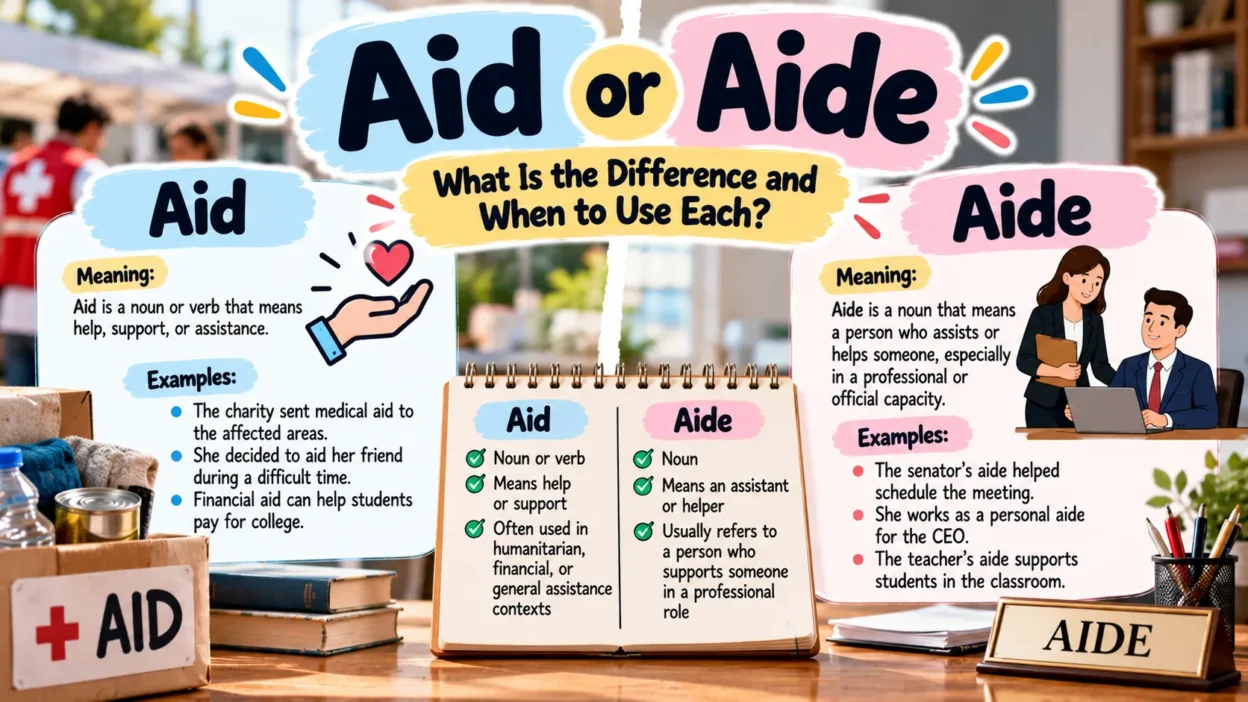
The word aid usually refers to help, assistance, or something that provides support. It can also function as a verb meaning to help someone. In contrast, aide is a noun that describes a person whose job is to assist another person, such as a teacher’s aide or a political aide.
Although the difference seems small, using the wrong word can change the meaning of your sentence. This guide explains the meanings of aid and aide, shows how to use each word correctly, and provides practical examples to help you remember the difference.
📖 What Does Aid Mean?
Aid means help, assistance, or support given to someone who needs it. It can refer to financial assistance, medical treatment, emergency supplies, educational support, or help with completing a task.
Aid can function as both a noun and a verb.
As a noun, it describes the help or resources someone receives. As a verb, it means to help, support, or make something easier.
Examples of aid as a noun:
- The organization provided financial aid to struggling families.
- The country sent emergency aid after the earthquake.
- First aid helped stabilize the injured person.
- The student received additional aid with her assignments.
- The new software is a useful aid for learning languages.
Examples of aid as a verb:
- The new technology can aid doctors in diagnosing diseases.
- Volunteers worked together to aid the local community.
- Regular exercise may aid recovery after an injury.
- The teacher used diagrams to aid understanding.
- The donations will aid families affected by the storm.
In each example, aid refers to assistance or the act of helping. It does not identify a person whose job is to provide that assistance.
👩💼 What Does Aide Mean?
Aide is a noun that refers to a person who helps or assists someone, often as part of a professional role. An aide may support a teacher, executive, politician, healthcare professional, or another person who needs assistance.
Unlike aid, the word aide is used to describe a person rather than help itself.
Common expressions include:
- Teacher’s aide: A person who assists a teacher in a classroom.
- Political aide: Someone who helps a politician with daily responsibilities.
- Executive aide: A person who supports an executive with administrative tasks.
- Nursing aide: A worker who assists with certain patient-care duties.
- Personal care aide: Someone who helps another person with daily activities.
- Administrative aide: A person who helps with office and organizational tasks.
Examples of aide in sentences:
- The teacher’s aide helped students complete their assignments.
- The senator’s aide arranged the meeting.
- A nursing aide assisted the patient with daily activities.
- The principal thanked the classroom aide for her support.
- The executive asked his aide to organize the schedule.
In these sentences, aide identifies a person who provides assistance.
⚖️ Aid vs. Aide: Key Differences
The main difference between aid and aide is their meaning. Although both words are pronounced the same way, they are not interchangeable.
| Feature | Aid | Aide |
|---|---|---|
| Part of speech | Noun and verb | Noun |
| Main meaning | Help, assistance, or support | A person who assists |
| Refers to | Help or the act of helping | A person |
| Example | The charity provided aid. | The charity hired an aide. |
| Verb usage | Yes: “They aid patients.” | No: “They aide patients” is incorrect. |
| Common phrases | Financial aid, first aid, emergency aid | Teacher’s aide, political aide |
Easy way to remember: If you mean help, use aid. If you mean a person who helps, use aide.
📝 When Should You Use Aid?
Use aid when you are talking about assistance, resources, or the action of helping someone. It works in many formal and everyday situations.
1. When Talking About Financial Assistance
Financial aid refers to money or resources provided to help someone pay for education, housing, healthcare, or other expenses.
Examples:
- She applied for financial aid to attend college.
- The government announced additional aid for low-income households.
- The nonprofit provides aid to families experiencing hardship.
2. When Talking About Medical Assistance
Aid is common in healthcare and emergency situations. Expressions such as first aid and medical aid describe help given to someone who is sick or injured.
Examples:
- The hiker received first aid after falling.
- Medical aid arrived shortly after the accident.
- The treatment may aid the patient’s recovery.
3. When Describing Help With a Task
Use aid as a verb when a person, tool, or action helps someone accomplish something.
Examples:
- A calculator can aid students with complex calculations.
- Clear instructions aid the learning process.
- The guide will aid visitors in finding their way.
4. When Referring to Emergency Support
Emergency aid can include food, water, shelter, medical supplies, and other resources provided during a crisis.
Examples:
- Volunteers delivered aid to communities affected by flooding.
- Emergency aid reached the region within two days.
- Local organizations coordinated aid for displaced residents.
👨🏫 When Should You Use Aide?
Use aide when referring to a person who assists another person or performs a supporting role.
1. In Schools and Classrooms
A teacher’s aide helps a teacher with classroom activities, student supervision, and learning support.
Examples:
- The teacher’s aide helped prepare materials for the lesson.
- A classroom aide worked with students who needed extra support.
- The school hired a new aide for the kindergarten class.
2. In Government and Politics
Political aides support elected officials and other public figures. Their responsibilities may include organizing schedules, preparing documents, coordinating meetings, and communicating with staff.
Examples:
- The mayor’s aide confirmed the appointment.
- A political aide prepared notes before the interview.
- The senator met with a senior aide to discuss the proposal.
3. In Healthcare
An aide may assist healthcare professionals or patients, depending on the specific job and training.
Examples:
- The nursing aide helped the patient get comfortable.
- A healthcare aide assisted residents during mealtimes.
- The care aide reported the patient’s concerns to the appropriate staff member.
4. In Offices and Businesses
An aide may provide administrative or organizational support to an executive, manager, or other professional.
Examples:
- The executive aide arranged the conference schedule.
- Her aide prepared the documents for the meeting.
- The director asked an administrative aide to update the records.
💡 Aid or Aide? Simple Tricks to Remember
Because aid and aide are homophones, they sound alike even though their meanings differ. A few simple memory tricks can help you choose the correct word.
Trick 1: Think About Help Versus Helper
Remember this basic distinction:
- Aid = help
- Aide = helper
For example, a teacher’s aide is a person, while educational aid is the assistance or resources provided to students.
Trick 2: Look at the Sentence
Ask yourself whether the sentence refers to assistance or a person.
- “The school received financial ___.” The answer is aid because the school received assistance.
- “The teacher’s ___ helped organize the classroom.” The answer is aide because the sentence refers to a person.
Trick 3: Check Whether It Works as a Verb
Aid can describe an action, as in “The medicine may aid recovery.”
Aide is a noun, so it cannot replace the verb in that sentence.
Trick 4: Memorize Common Expressions
Remember these familiar combinations:
Aid: first aid, financial aid, foreign aid, emergency aid, medical aid.
Aide: teacher’s aide, political aide, nursing aide, executive aide.
Learning these expressions can help you recognize the correct spelling more quickly.
✍️ Aid vs. Aide: Example Sentences
The following examples show how each word works in different contexts.
| Sentence | Correct word | Why? |
|---|---|---|
| The organization provided disaster ___ to the region. | Aid | It refers to assistance. |
| The teacher’s ___ handed out the worksheets. | Aide | It refers to a person. |
| The new device may ___ people with limited mobility. | Aid | It is used as a verb meaning help. |
| The politician’s ___ answered the phone. | Aide | It identifies an assistant. |
| She received financial ___ for college. | Aid | It refers to financial support. |
| The nursing ___ checked on the resident. | Aide | It refers to a worker. |
| Volunteers arrived to ___ the injured hikers. | Aid | It describes the act of helping. |
| The executive asked his ___ to arrange the meeting. | Aide | It refers to a person who assists. |
Notice that the correct spelling depends on the meaning of the sentence, not the pronunciation.
🔎 Common Phrases With Aid and Aide
Both words appear in common expressions, but each belongs in a different context.
Common Expressions With Aid
- First aid: Immediate assistance given to someone who is injured or suddenly ill.
- Financial aid: Money or resources that help cover expenses.
- Foreign aid: Assistance provided by one country to another.
- Emergency aid: Help provided during a crisis or disaster.
- Medical aid: Assistance related to medical needs.
- Visual aid: An image, chart, or other resource that supports understanding.
- Aid and assistance: Help provided to someone who needs it.
- Aid someone in doing something: Help someone complete an action.
Common Expressions With Aide
- Teacher’s aide: A person who assists a teacher.
- Political aide: A person who supports a politician.
- Nursing aide: A worker who assists with patient care.
- Executive aide: A person who helps an executive.
- Personal care aide: Someone who assists with everyday personal needs.
- Classroom aide: A person who supports classroom activities.
- Administrative aide: Someone who helps with office responsibilities.
- Senior aide: An experienced assistant who supports a person in a position of responsibility.
These expressions are useful clues when deciding which spelling belongs in your sentence.
🚫 Common Mistakes to Avoid
Although the difference between aid and aide is straightforward, their identical pronunciation can lead to spelling mistakes.
Mistake 1: Using Aide as a Verb
Incorrect: The volunteers will aide the families.
Correct: The volunteers will aid the families.
Why? Aid is the verb meaning to help. Aide is a noun that refers to a person who helps.
Mistake 2: Using Aid When Referring to a Person
Incorrect: The teacher’s aid prepared the classroom.
Correct: The teacher’s aide prepared the classroom.
Why? The sentence refers to a person who assists the teacher, so aide is the appropriate word.
Mistake 3: Confusing Financial Aid With a Financial Aide
Incorrect: She applied for financial aide to pay for college.
Correct: She applied for financial aid to pay for college.
Why? Financial aid is assistance, usually money or resources. A financial aide would mean a person who assists with financial matters, not the assistance itself.
Mistake 4: Relying Only on Pronunciation
Both words sound the same, so saying a sentence aloud will not help you identify the correct spelling.
Instead, focus on what the word means in context. If it refers to support, use aid. If it refers to a person, use aide.
🧠 Quick Practice: Choose Aid or Aide
Test your understanding with these sentences. Select the word that best completes each one.
- The organization provided emergency ___ after the storm.
- The principal’s ___ helped prepare for the school event.
- The new program may ___ students who struggle with reading.
- She received financial ___ to cover her tuition.
- The nursing ___ assisted the patient during lunch.
- The guide used pictures as a visual ___.
- The politician’s ___ arranged an interview.
- Volunteers arrived to ___ the affected families.
Answers:
- Aid
- Aide
- Aid
- Aid
- Aide
- Aid
- Aide
- Aid
The pattern is simple: aid refers to assistance or the act of helping, while aide refers to the person providing help.
❓ Frequently Asked Questions About Aid or Aide
Is aid or aide correct?
Both spellings are correct, but they have different meanings. Aid means help or assistance and can also be a verb. Aide is a noun meaning a person who assists someone.
Is aide a person or a thing?
An aide is a person who helps or assists another person. For example, a teacher’s aide supports a teacher with classroom responsibilities.
Can aid be used as a verb?
Yes. Aid can mean to help or support someone or something. For example, “The new system will aid employees in completing their tasks.”
Is it financial aid or financial aide?
The correct phrase is financial aid when referring to money or resources that help cover expenses, such as college tuition. Aide refers to a person who provides assistance.
Is it teacher’s aid or teacher’s aide?
The correct expression for a person who assists a teacher is teacher’s aide. The word aid may refer to teaching assistance or resources, but it does not mean the person in this phrase.
Are aid and aide pronounced the same?
Yes. In standard English, aid and aide are homophones, meaning they have the same pronunciation but different spellings and meanings.
What is the plural of aide?
The plural of aide is aides. For example, “The senator met with two aides before the announcement.”
The noun aid is generally used as an uncountable noun when it means assistance, although its use can vary in specialized contexts.
What is the difference between an aid and an aide?
An aid is a form of assistance or support, while an aide is a person who provides assistance. For example, a first-aid kit contains supplies, while a teacher’s aide is a person who helps in a classroom.
✅ Final Verdict: Aid or Aide?
The difference between aid and aide comes down to one simple distinction: aid means help, while aide means a person who helps.
Use aid when discussing financial support, emergency assistance, medical help, or the act of helping someone. Use aide when referring to an assistant, such as a teacher’s aide, political aide, or nursing aide.
Whenever you are unsure, ask yourself one question: Am I talking about help or a helper? If you mean help, choose aid. If you mean a person who provides help, choose aide. This simple rule will help you use both words correctly in everyday writing.

Vivian Mercer is an English language writer and vocabulary enthusiast who specializes in synonyms, word meanings, grammar, idioms, and language usage. She creates accurate, easy-to-understand content that helps readers improve their English skills with confidence.