Looking for synonyms for little to make your writing more descriptive, natural, and engaging? Whether you’re describing a small object, a tiny animal, a young child, a short amount of time, or a person you love, choosing the right word can make a big difference.
The word little has several meanings. It can describe something small in size, a limited quantity, a young age, or an amount that is not significant. Because of these different meanings, no single synonym works perfectly in every sentence.
For example, tiny emphasizes very small size, slight describes a small degree, brief refers to a short period, and scarce suggests that something is available in limited amounts.
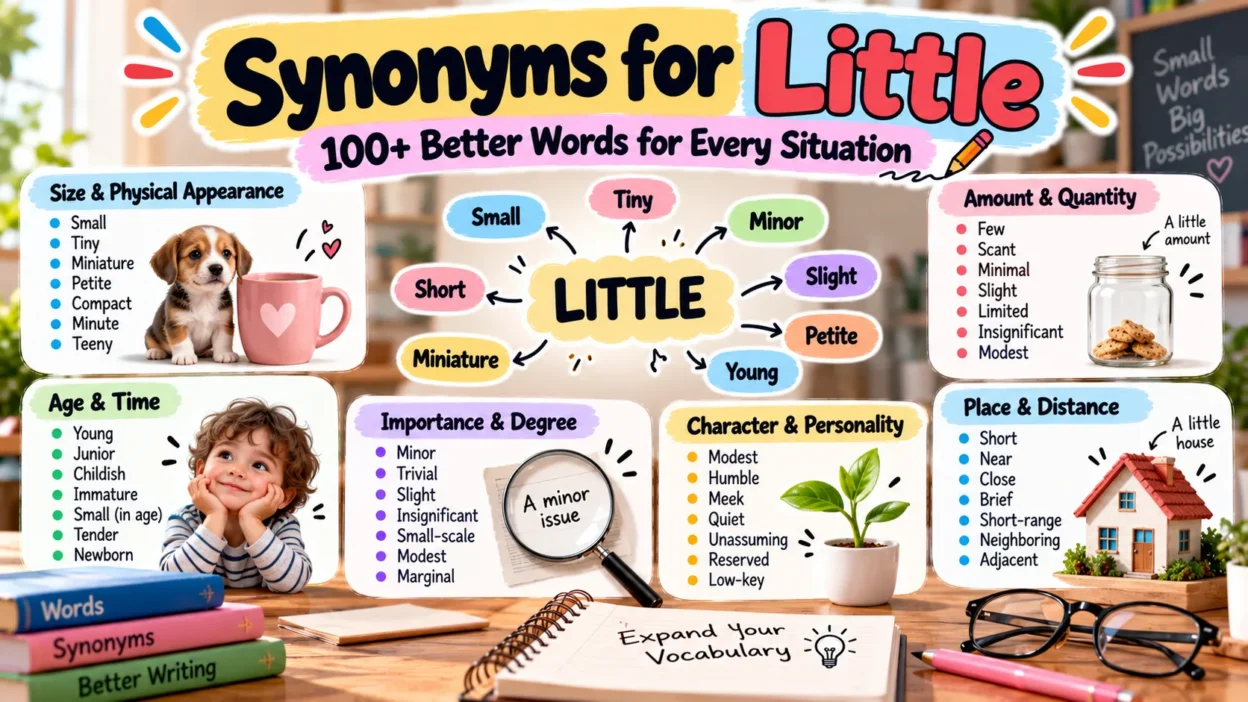
This guide explores more than 100 synonyms for little, organized by meaning and context. You’ll find useful comparison tables, example sentences, formal alternatives, cute words, and practical tips for choosing the most accurate synonym.
📏 Best Synonyms for Little
If you need a quick replacement for little, several words work well in everyday English. The best choice depends on how small something is and what you want to emphasize.
| Synonym | Meaning | Example |
|---|---|---|
| Small | Limited in size | We live in a small apartment. |
| Tiny | Extremely small | A tiny bird sat on the branch. |
| Miniature | A small-scale version | She collected miniature houses. |
| Petite | Small and delicately proportioned | She wore a petite gold necklace. |
| Little | Small in size or amount | The little puppy followed me. |
| Slight | Small in degree | There was a slight change in temperature. |
| Minor | Not very important or serious | The car had minor damage. |
| Modest | Limited or not excessive | They live in a modest home. |
| Compact | Small and efficiently arranged | This compact desk fits the room. |
| Diminutive | Unusually or noticeably small | The diminutive plant grew beside the wall. |
| Minute | Extremely small | A minute detail caught her attention. |
| Petite-sized | Small in physical dimensions | The store offers petite-sized clothing. |
| Wee | Very small; informal | What a wee kitten! |
| Slightly sized | Small in dimensions; less idiomatic | Choose a more natural phrase such as small-sized. |
| Undersized | Smaller than expected or required | The undersized jacket felt uncomfortable. |
Best everyday choices: Small, tiny, miniature, slight, and minor are especially useful, but they are not interchangeable in every context.
🔎 Synonyms for Little by Meaning
The word little can refer to size, quantity, importance, age, or duration. Grouping synonyms by meaning helps you choose a word that fits your sentence.
🏠 Words That Mean Small in Size
Use these alternatives when describing the physical dimensions of an object, building, animal, or space.
- Small
- Tiny
- Miniature
- Petite
- Compact
- Diminutive
- Minute
- Wee
- Little-bitty
- Pint-sized
- Pocket-sized
- Undersized
- Mini
- Microscopic
- Lilliputian
Examples:
- We found a tiny shell on the beach.
- She lives in a compact studio apartment.
- The artist created a miniature garden.
- A pint-sized dog ran across the yard.
- The scientist examined a microscopic organism.
Use microscopic when something is so small that it generally requires a microscope to see clearly. Use pint-sized for an informal, playful description of a person or thing that is small.
📦 Words That Mean a Small Amount
When little describes quantity, these words may be more precise.
- Limited
- Minimal
- Modest
- Slight
- Scant
- Meager
- Sparse
- Insufficient
- Inadequate
- Negligible
- Paltry
- Dwindling
- Restricted
- Scarce
- Bare
Examples:
- We have limited time to finish the project.
- She added a small amount of sugar.
- There was scant evidence to support the claim.
- The team made minimal progress.
- The difference was negligible.
These words carry different implications. Limited simply means restricted, while meager and paltry often suggest that an amount is disappointingly small. Insufficient means there is not enough for a particular purpose.
⭐ Words That Mean Unimportant or Minor
Sometimes little describes the importance or seriousness of something rather than its physical size.
- Minor
- Slight
- Insignificant
- Trivial
- Inconsequential
- Negligible
- Modest
- Unimportant
- Superficial
- Secondary
- Peripheral
- Small-scale
Examples:
- We made a minor adjustment to the schedule.
- The error was trivial and easy to fix.
- A slight misunderstanding delayed the meeting.
- The change had a negligible effect on performance.
- They operate a small-scale business.
Choose minor for something relatively unimportant or not serious. Use trivial when the matter is of very little importance, and negligible when its effect is too small to matter significantly.
🐣 Cute Synonyms for Little
If you’re writing captions, children’s stories, greeting cards, or descriptions of pets, playful alternatives can make your writing warmer.
| Word | Tone | Example |
|---|---|---|
| Tiny | Sweet and simple | Look at that tiny kitten! |
| Wee | Playful and charming | A wee little bird landed nearby. |
| Teeny | Casual and cute | She wore a teeny pair of shoes. |
| Teeny-tiny | Very playful | The puppy had teeny-tiny paws. |
| Little-bitty | Informal and affectionate | He found a little-bitty frog. |
| Pint-sized | Cheerful and humorous | Our pint-sized explorer loves nature. |
| Mini | Modern and casual | She carried a mini backpack. |
| Petite | Delicate and elegant | A petite bouquet sat on the table. |
| Dainty | Delicate and graceful | The kitten had dainty paws. |
| Diminutive | More literary | The diminutive bird hopped along the fence. |
| Pocket-sized | Cute and descriptive | The pocket-sized notebook fit her bag. |
| Itsy-bitsy | Whimsical and playful | An itsy-bitsy spider crawled across the wall. |
Example: Instead of writing, “The little puppy slept in a box,” you could write, “The teeny-tiny puppy curled up in a cozy box.”
Remember that some of these words are informal or expressive. Teeny-tiny and itsy-bitsy suit playful writing, while petite and dainty sound more refined.
👶 Synonyms for Little When Describing Children
When little refers to a child, it often suggests youth, affection, or small physical size. The best alternative depends on whether you want a neutral, affectionate, or literary tone.
- Young
- Youngest
- Small
- Tiny
- Little one
- Toddler
- Infant
- Baby
- Petite
- Wee
- Small-framed
- Pint-sized
- Little-known? No — this describes familiarity, not a child’s size.
Examples:
- The young child played in the garden.
- Her youngest son starts school next year.
- The toddler laughed at the colorful balloons.
- The little one fell asleep in the car.
- The baby reached for the toy.
Not every word is a direct synonym. Infant, baby, and toddler identify particular age groups, while young describes age more generally. Use the word that accurately reflects the child and the context.
⏳ Synonyms for Little When Describing Time
When little refers to time, words such as brief and short are often more natural.
| Synonym | Best Use | Example |
|---|---|---|
| Brief | A short period or event | We had a brief conversation. |
| Short | A limited duration | It was a short meeting. |
| Momentary | Lasting a very short time | There was a momentary pause. |
| Fleeting | Passing quickly | It was a fleeting opportunity. |
| Temporary | Lasting for a limited period | We found a temporary solution. |
| Quick | Taking little time | Let’s take a quick break. |
| Short-lived | Not lasting long | Their excitement was short-lived. |
| Transient | Lasting for a limited time; formal | The pain was transient. |
Examples:
- We had a brief discussion before the presentation.
- She took a short break after lunch.
- The feeling of uncertainty was momentary.
- It was a fleeting moment of happiness.
For time-related writing, brief and short are generally the most natural replacements. Temporary describes something that is not permanent, which is not necessarily the same as something that lasts only a few seconds or minutes.
📉 Synonyms for Little in Formal and Academic Writing
In professional reports, academic papers, and business documents, a more precise word can improve clarity.
| Word | Meaning | Example |
|---|---|---|
| Minimal | The smallest amount necessary or present | The procedure requires minimal supervision. |
| Limited | Restricted in amount or scope | The study had limited participants. |
| Marginal | Small or relatively insignificant | The treatment produced marginal improvement. |
| Negligible | So small that it has little practical effect | The cost difference was negligible. |
| Modest | Relatively small but meaningful | The program achieved modest growth. |
| Insignificant | Not important or statistically meaningful, depending on context | The analysis found an insignificant difference. |
| Inconsequential | Having little effect or importance | The error was inconsequential. |
| Substantial? | Not a synonym for little; means considerable | Avoid using it as a replacement. |
| Scant | Very limited or barely sufficient | The report provided scant detail. |
| Sparse | Thinly distributed or limited | The region has sparse vegetation. |
| Meager | Inadequate or disappointingly small | The project received meager funding. |
| Marginally | To a small degree | Sales improved marginally. |
Choose your wording carefully in academic contexts. For example, statistically insignificant has a specific statistical meaning and should not be used merely to mean “unimportant.” Similarly, minimal and negligible do not always mean the same thing.
🗣️ Synonyms for Little in Everyday Conversation
For casual speech, simple and familiar alternatives usually sound the most natural.
- Small
- Tiny
- Short
- Slight
- A bit
- A little bit
- Not much
- A small amount
- A touch
- Mini
- Petite
- Barely any
- A handful
- Just a little
Examples:
- Could you give me a little bit of water?
- I need a bit more time.
- There is not much milk left.
- Add a touch of salt to the soup.
- We have barely any sugar remaining.
These expressions are not all interchangeable. A handful usually refers to a small number or an amount that can be held in one hand, while a touch often refers to a small quantity of an ingredient or a subtle quality.
🔤 Synonyms for Little in Different Parts of Speech
The word little can function as a determiner, adjective, pronoun, or adverb in different contexts. Its replacement depends on the grammatical role it plays.
| Use | Example With Little | Possible Alternative |
|---|---|---|
| Size | A little house | A small house |
| Quantity | Little water remained | Not much water remained |
| Amount | A little patience | Some patience |
| Importance | A little problem | A minor problem |
| Duration | A little while | A short while |
| Degree | Little changed | Very little changed |
| Affection | My little brother | My younger brother |
| Frequency or extent | He knew little about it | He knew very little about it |
The phrase a little often suggests a small but positive amount, as in “I have a little time.” By contrast, little without a can suggest that there is hardly any, as in “I have little time.”
That distinction matters because replacing little with small may change the meaning or make the sentence sound unnatural.
⚖️ Little vs. Small vs. Tiny: What’s the Difference?
Although these words are closely related, they have slightly different uses.
| Word | Main Meaning | Typical Context | Example |
|---|---|---|---|
| Little | Small in size or amount; sometimes affectionate | Children, quantities, familiar objects | The little boy smiled. |
| Small | Limited in size, quantity, or scale | General descriptions | They bought a small table. |
| Tiny | Extremely small | Objects, animals, details | A tiny insect landed on the leaf. |
| Petite | Small and delicately proportioned | People, clothing, objects | She chose a petite frame. |
| Miniature | A small-scale representation | Models, replicas, decorative objects | He built a miniature train. |
| Minor | Small in importance or seriousness | Problems, changes, injuries | It was a minor mistake. |
| Slight | Small in degree or intensity | Changes, differences, feelings | There was a slight delay. |
Which word should you choose?
- Use small for a neutral description.
- Use tiny when something is very small.
- Use little when you want a familiar or affectionate tone.
- Use petite for a delicate or relatively small build.
- Use miniature for a scaled-down model.
- Use minor for something that is not very serious.
- Use slight for a small degree or change.
💡 How to Choose the Best Synonym for Little
Before replacing little, consider what you actually mean. This simple process helps you select a word that fits the sentence rather than choosing a synonym just because it appears in a list.
- If you mean physical size: Try small, tiny, compact, or miniature.
- If you mean quantity: Consider limited, minimal, scant, or meager.
- If you mean importance: Use minor, trivial, or negligible, depending on the context.
- If you mean a short period: Choose brief, short, or momentary.
- If you want an affectionate tone: Try wee, teeny, little-bitty, or pint-sized.
- If you need a formal alternative: Consider minimal, limited, modest, or marginal.
Always check the sentence after replacing the word. A synonym should preserve the intended meaning, not merely sound more sophisticated.
❌ Common Mistakes When Using Synonyms for Little
Choosing an alternative without considering its meaning can make a sentence confusing or unnatural.
Mistake 1: Using Tiny for Every Small Amount
Less natural: We have a tiny amount of time to finish.
More natural: We have very little time to finish.
Tiny is useful for emphasizing extreme smallness, but phrases such as very little time or a short amount of time are often more natural.
Mistake 2: Confusing Minor With Small
A minor problem is not necessarily physically small. It is relatively unimportant or not serious.
- Natural: We found a minor error in the report.
- Natural: We found a small box in the office.
Use minor for importance or severity and small for physical size.
Mistake 3: Using Meager as a Neutral Synonym
Meager usually implies that an amount is inadequate or disappointing.
- Neutral: The project received limited funding.
- More negative: The project received meager funding.
If you want a neutral description, limited may be more appropriate.
Mistake 4: Using Petite for Objects in Every Context
Petite is often used for people, clothing, and objects with small or delicate proportions. It does not fit every situation.
- Natural: She bought a petite jacket.
- More natural: We need a small storage room.
Choose a word that fits the object and context.
❓ Frequently Asked Questions About Synonyms for Little
What is the best synonym for little?
Small is the most versatile everyday synonym for little. However, tiny works better for something extremely small, minor for something unimportant, and brief for a short period.
What is another word for little in formal writing?
Depending on the context, use minimal, limited, modest, marginal, slight, or negligible. Each word has a different meaning, so select one that accurately describes the amount, size, or importance involved.
What is a cute synonym for little?
Cute alternatives include tiny, wee, teeny, teeny-tiny, little-bitty, pint-sized, and itsy-bitsy. These are especially useful in captions, children’s writing, and playful descriptions.
What is a stronger word for little?
If you mean extremely small, tiny, minute, microscopic, or minuscule may work. If you mean an extremely small amount, scant or negligible may be more precise.
What is a synonym for little amount?
You can use small amount, limited quantity, minimal amount, scant amount, or a bit. For example, “Add a small amount of salt” is a clear alternative to “Add a little salt.”
What is another word for little time?
Common alternatives include a short time, a brief period, a moment, a little while, and a limited amount of time. The best choice depends on how long the period is and how formal your writing needs to be.
What is the difference between little and few?
Little generally describes an amount of an uncountable noun, such as water, time, or patience. Few describes a small number of countable items, such as books, people, or apples.
Examples:
- We have little time.
- We have few options.
Are little and tiny interchangeable?
Sometimes. Both can describe small objects, but tiny usually emphasizes that something is extremely small. Little can also convey affection or familiarity, as in “my little sister.”
What is a synonym for little that starts with M?
Useful options include miniature, mini, minute, modest, minor, marginal, and meager. Their meanings differ: miniature refers to small scale, minor to low importance, and meager to an inadequate amount.
How can I avoid repeating the word little?
Choose alternatives according to the meaning. Use small for size, tiny for extreme smallness, minor for importance, limited for quantity, and brief for time. You can also rewrite the sentence to sound more natural rather than forcing in a synonym.
✅ Conclusion
Finding the right synonym for little depends on the meaning, tone, and context of your sentence. Although small is the most versatile alternative, words such as tiny, miniature, petite, minor, slight, minimal, and brief can make your writing more precise.
For casual descriptions, playful words such as wee and teeny-tiny add personality. In professional and academic writing, alternatives such as limited, minimal, and negligible may communicate the intended meaning more accurately.
Rather than replacing little with the first synonym you find, consider whether you’re describing size, quantity, importance, or duration. Choosing the right word will make your writing clearer, more natural, and more engaging.

Vivian Mercer is an English language writer and vocabulary enthusiast who specializes in synonyms, word meanings, grammar, idioms, and language usage. She creates accurate, easy-to-understand content that helps readers improve their English skills with confidence.