
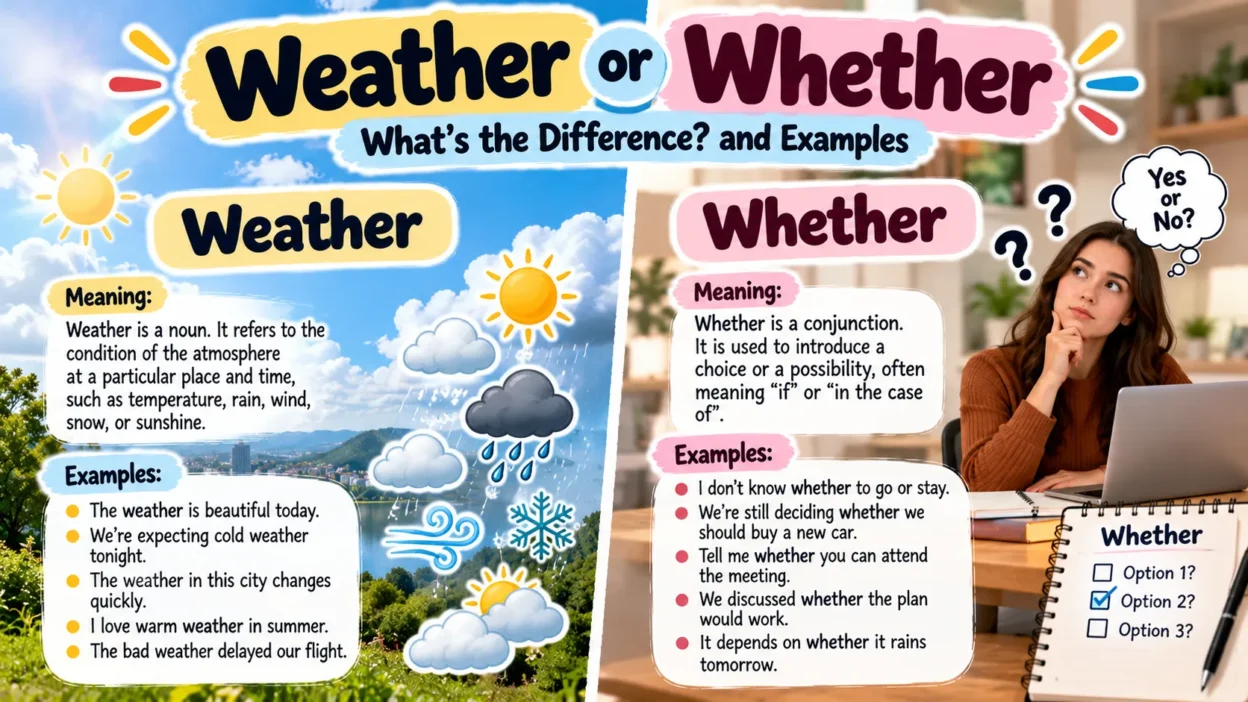
Have you ever wondered whether to write weather or whether? These two words sound exactly alike, but their meanings and uses are completely different. Choosing the wrong one can change the meaning of your sentence and create confusion for your readers.
The word weather refers to outdoor atmospheric conditions, such as rain, sunshine, wind, snow, and temperature. On the other hand, whether is used when discussing choices, alternatives, possibilities, or uncertainty. For example, you might check the weather before leaving home, but you might wonder whether you should bring an umbrella.
Understanding the difference between weather and whether is easier than it seems. In this guide, you will learn their meanings, grammatical uses, common expressions, and practical examples. You will also discover simple tricks to remember the correct spelling and avoid common mistakes in everyday writing.
📖 What Does Weather Mean?
Weather is a noun that describes the condition of the atmosphere at a particular time and place. It includes temperature, rainfall, humidity, wind, cloud cover, sunshine, and other atmospheric conditions.
Weather can change throughout the day. A morning may begin with sunshine and become cloudy or rainy by the afternoon.
In some contexts, weather can also function as a verb. As a verb, it means to endure a difficult situation or to become changed by exposure to environmental conditions.
Examples of Weather as a Noun
- The weather is beautiful today.
- We canceled the picnic because of the bad weather.
- The weather forecast predicts heavy rain tomorrow.
- I enjoy warm weather during the summer.
- The cold weather made it difficult to work outside.
- The weather in the mountains can change quickly.
Examples of Weather as a Verb
- The old wooden fence has weathered many storms.
- The company managed to weather the financial crisis.
- The hikers waited for the storm to pass before continuing.
- Years of exposure to sunlight caused the paint to weather.
In everyday conversation, weather most commonly refers to atmospheric conditions. It is the word you use when talking about rain, sunshine, snow, or temperature.
❓ What Does Whether Mean?
Whether is a conjunction used to introduce alternatives, choices, possibilities, or uncertainty. It often appears when someone is considering two or more options or does not know which situation is true.
Unlike weather, whether does not describe atmospheric conditions.
Examples of Whether in Sentences
- I don’t know whether she will attend the meeting.
- We need to decide whether to travel by car or train.
- He asked whether the store was open.
- She couldn’t decide whether to wear the blue dress or the black one.
- I wonder whether it will rain tomorrow.
- They discussed whether the project should continue.
In each sentence, whether introduces a question, possibility, or decision.
Whether With Two Choices
Whether often appears when comparing two alternatives.
Examples:
- I can’t decide whether to study tonight or tomorrow.
- She asked whether we preferred coffee or tea.
- We must determine whether the plan is practical or unrealistic.
- He wondered whether to accept the offer or decline it.
Whether With Uncertainty
You can also use whether when you are unsure about something.
Examples:
- I don’t know whether he received my message.
- We aren’t sure whether the event will take place.
- She wondered whether her application had been approved.
- They need to confirm whether the information is correct.
The key is that whether introduces uncertainty or alternatives rather than describing the weather outside.
⚖️ Weather vs. Whether: Key Differences
Although weather and whether sound alike, their meanings, grammatical roles, and uses differ.
| Feature | Weather | Whether |
|---|---|---|
| Meaning | Atmospheric conditions | A choice, possibility, or uncertainty |
| Part of speech | Noun; also a verb | Conjunction |
| Common use | Talking about rain, sunshine, wind, or temperature | Discussing alternatives or asking indirectly about something |
| Example | The weather is sunny. | I wonder whether it is sunny. |
| Related expressions | Weather forecast, cold weather, severe weather | Whether or not, whether to go, whether it matters |
| Memory clue | Think of rain and sunshine | Think of choices and possibilities |
The easiest rule to remember: Use weather for conditions outside and whether for choices or uncertainty.
📝 When Should You Use Weather?
Use weather whenever you are discussing atmospheric conditions or describing how something changes after exposure to the elements.
1. When Talking About Rain or Sunshine
Weather is the correct choice when describing the conditions outside.
Examples:
- The weather is sunny and warm.
- We stayed home because the weather was terrible.
- The weather looks perfect for a beach trip.
- Rainy weather can make driving more difficult.
2. When Discussing Temperature
Weather is also used to describe hot, cold, mild, or freezing conditions.
Examples:
- The cold weather made everyone wear jackets.
- Warm weather is ideal for outdoor activities.
- The weather became colder after sunset.
- Extreme hot weather can create health risks.
3. When Referring to a Forecast
A weather forecast provides information about expected atmospheric conditions.
Examples:
- I checked the weather forecast before leaving.
- The weather report says it may snow tonight.
- We should check the weather before planning a hike.
- The forecast predicts stormy weather this weekend.
4. When Describing Difficult Conditions
As a verb, weather can mean to survive or endure a difficult experience.
Examples:
- The business weathered a challenging financial year.
- The town weathered the storm without major damage.
- Their friendship weathered several difficult periods.
- The building has weathered decades of harsh conditions.
💭 When Should You Use Whether?
Use whether when you are discussing a decision, expressing uncertainty, or introducing alternatives.
1. When Making a Decision
Whether is commonly used when someone must choose between possibilities.
Examples:
- I can’t decide whether to buy a new laptop.
- She is considering whether to move to another city.
- We need to determine whether to postpone the meeting.
- He asked whether we should leave early.
2. When Expressing Uncertainty
Use whether when you are unsure about a fact or situation.
Examples:
- I don’t know whether the package has arrived.
- She wondered whether her friend was upset.
- We need to find out whether the office is open.
- He wasn’t sure whether he had locked the door.
3. When Asking an Indirect Question
Whether can introduce a question inside a larger sentence.
Examples:
- Can you tell me whether the restaurant accepts reservations?
- I asked whether the teacher had assigned homework.
- They wanted to know whether the train was delayed.
- Please confirm whether the payment was received.
These sentences do not ask the question directly. Instead, they include the question as part of a statement or request.
4. When Using “Whether or Not”
The expression whether or not emphasizes that a situation applies regardless of the outcome.
Examples:
- We will attend the event whether or not it rains.
- She plans to finish the project whether or not she receives help.
- You should follow the instructions whether or not they seem complicated.
- He will continue practicing whether or not he wins.
Notice the first example uses both words correctly: whether introduces the alternatives, while rains describes a weather condition.
🌦️ Weather or Whether? Side-by-Side Examples
Comparing the two words in similar sentences makes the difference easier to understand.
| Sentence | Correct word | Explanation |
|---|---|---|
| The ___ is beautiful today. | Weather | It describes atmospheric conditions. |
| I don’t know ___ she is coming. | Whether | It introduces uncertainty. |
| We checked the ___ forecast. | Weather | It refers to a forecast of atmospheric conditions. |
| He asked ___ I wanted tea or coffee. | Whether | It introduces two choices. |
| The cold ___ made the roads slippery. | Weather | It describes outdoor conditions. |
| She wondered ___ the shop was open. | Whether | It introduces an indirect question. |
| The team managed to ___ the crisis. | Weather | It means to endure or survive. |
| I can’t decide ___ to stay or leave. | Whether | It introduces alternatives. |
The correct word depends on what the sentence means, not how the word sounds.
💡 Easy Tricks to Remember Weather vs. Whether
If you frequently confuse these words, a few simple memory tricks can help.
Trick 1: Associate Weather With Rain
The word weather contains the same opening letters as wet. Although this is only a memory aid, it can help you connect weather with rain, clouds, and outdoor conditions.
Think of this example:
- The weather is wet and rainy.
Whenever you are talking about atmospheric conditions, remember weather.
Trick 2: Associate Whether With Choices
Think of whether as the word you use when considering different possibilities.
For example:
- I don’t know whether to stay or go.
- She asked whether I wanted lunch or dinner.
Both sentences involve a choice or uncertainty.
Trick 3: Replace the Word With Its Meaning
If you are unsure which spelling to use, replace the word with a simple definition.
- If you can replace it with conditions outside, use weather.
- If you can replace it with if or which of two possibilities, whether may be correct.
For example:
“I wonder whether he is home.”
You could say, “I wonder if he is home.” Therefore, whether is appropriate.
However, “The weather is pleasant” cannot be replaced with “The if is pleasant.” The correct word is weather.
Trick 4: Look for Common Expressions
Certain phrases can help you identify the correct word immediately.
Weather expressions:
- Weather forecast
- Severe weather
- Cold weather
- Weather conditions
- Weather report
Whether expressions:
- Whether or not
- Whether to go
- Whether it matters
- Whether she agrees
- Whether it is possible
Memorizing these expressions will help you use both words confidently.
🚫 Common Weather and Whether Mistakes
Because the words are pronounced alike, writers sometimes choose the wrong spelling. Here are common errors and their corrections.
Mistake 1: Using Whether for Atmospheric Conditions
Incorrect: The whether is sunny today.
Correct: The weather is sunny today.
Why? The sentence describes outdoor conditions, so weather is required.
Mistake 2: Using Weather for a Choice
Incorrect: I don’t know weather I should call her.
Correct: I don’t know whether I should call her.
Why? The sentence expresses uncertainty about what action to take.
Mistake 3: Confusing Weather Forecast and Whether Forecast
Incorrect: Did you check the whether forecast?
Correct: Did you check the weather forecast?
Why? A forecast predicts atmospheric conditions, making weather the correct word.
Mistake 4: Using Weather in “Whether or Not”
Incorrect: We will go weather or not it rains.
Correct: We will go whether or not it rains.
Why? The expression whether or not means that something will happen regardless of the circumstances.
Mistake 5: Forgetting That Weather Can Be a Verb
Incorrect: The company managed to whether the economic crisis.
Correct: The company managed to weather the economic crisis.
Why? Here, weather means to endure or survive a difficult situation.
🔤 Weather vs. Whether vs. Wether
There is a third word worth knowing: wether. It is less common in everyday writing but has a different meaning from both weather and whether.
A wether is a castrated male sheep or, in some usage, a castrated male goat.
Here is a quick comparison:
| Word | Meaning | Example |
|---|---|---|
| Weather | Atmospheric conditions; to endure | The weather is changing. |
| Whether | A choice or possibility | I wonder whether she knows. |
| Wether | A castrated male sheep or goat | The farmer cared for the wether. |
Although all three words sound the same in many English accents, their meanings are distinct. In most everyday writing, you will mainly need to distinguish weather from whether.
🧠 Quick Practice: Choose Weather or Whether
Test your understanding by filling in each blank with the correct word.
- I checked the ___ before planning our picnic.
- She doesn’t know ___ he will attend the party.
- The ___ forecast predicts thunderstorms.
- We need to decide ___ to take the bus or walk.
- The old house has managed to ___ many storms.
- Please tell me ___ the office is open.
- Cold ___ can make driving dangerous.
- They will continue the project ___ or not they receive additional funding.
- I wonder ___ it will snow tonight.
- The company managed to ___ a difficult economic period.
Answers
- Weather
- Whether
- Weather
- Whether
- Weather
- Whether
- Weather
- Whether
- Whether
- Weather
If you answered all ten correctly, you understand the main difference between these commonly confused words.
❓ Frequently Asked Questions About Weather or Whether
What is the difference between weather and whether?
Weather refers to atmospheric conditions such as rain, sunshine, wind, and temperature. Whether introduces choices, possibilities, or uncertainty. For example, “The weather is cold” and “I wonder whether it will snow” use both words correctly.
How do you remember weather or whether?
Remember that weather relates to rain, sunshine, and outdoor conditions. Whether relates to decisions and possibilities. If the sentence involves a choice or uncertainty, whether is usually the correct option.
Is it “whether or not” or “weather or not”?
The correct expression is whether or not. It means that something will happen regardless of a particular condition or outcome. For example, “We will leave whether or not it rains.”
Can whether and if be used interchangeably?
In many sentences, whether and if can both introduce an indirect yes-or-no question. For example, “I don’t know whether she is coming” and “I don’t know if she is coming” are both correct. However, whether is necessary or more natural in certain constructions, especially when presenting explicit alternatives or using whether or not.
Is weather a noun or a verb?
Weather can be both a noun and a verb. As a noun, it describes atmospheric conditions. As a verb, it can mean to endure a difficult experience or to change through exposure to environmental conditions.
Is whether a noun or a verb?
Whether is a conjunction. It introduces alternatives, possibilities, or indirect questions. It does not function as a noun or verb in standard English.
Which is correct: “I wonder weather” or “I wonder whether”?
The correct phrase is “I wonder whether.” For example, “I wonder whether the store is open.” The word introduces uncertainty, so whether is the right choice.
Why do weather and whether sound the same?
Weather and whether are homophones in standard English. Homophones are words that share the same pronunciation but have different meanings and spellings. Their identical pronunciation makes them easy to confuse when writing.
✅ Final Verdict: Weather or Whether?
The difference between weather and whether is simple once you focus on meaning.
Use weather when discussing rain, sunshine, temperature, forecasts, or enduring a difficult situation. Use whether when expressing uncertainty, presenting alternatives, or introducing an indirect question.
For example, “I checked the weather to decide whether to go outside” uses both words correctly. The first refers to atmospheric conditions, while the second introduces a decision.
Keep this rule in mind: Weather is about conditions; whether is about choices. With this simple distinction, you can avoid one of the most common spelling mistakes in everyday English.

Vivian Mercer is an English language writer and vocabulary enthusiast who specializes in synonyms, word meanings, grammar, idioms, and language usage. She creates accurate, easy-to-understand content that helps readers improve their English skills with confidence.


