
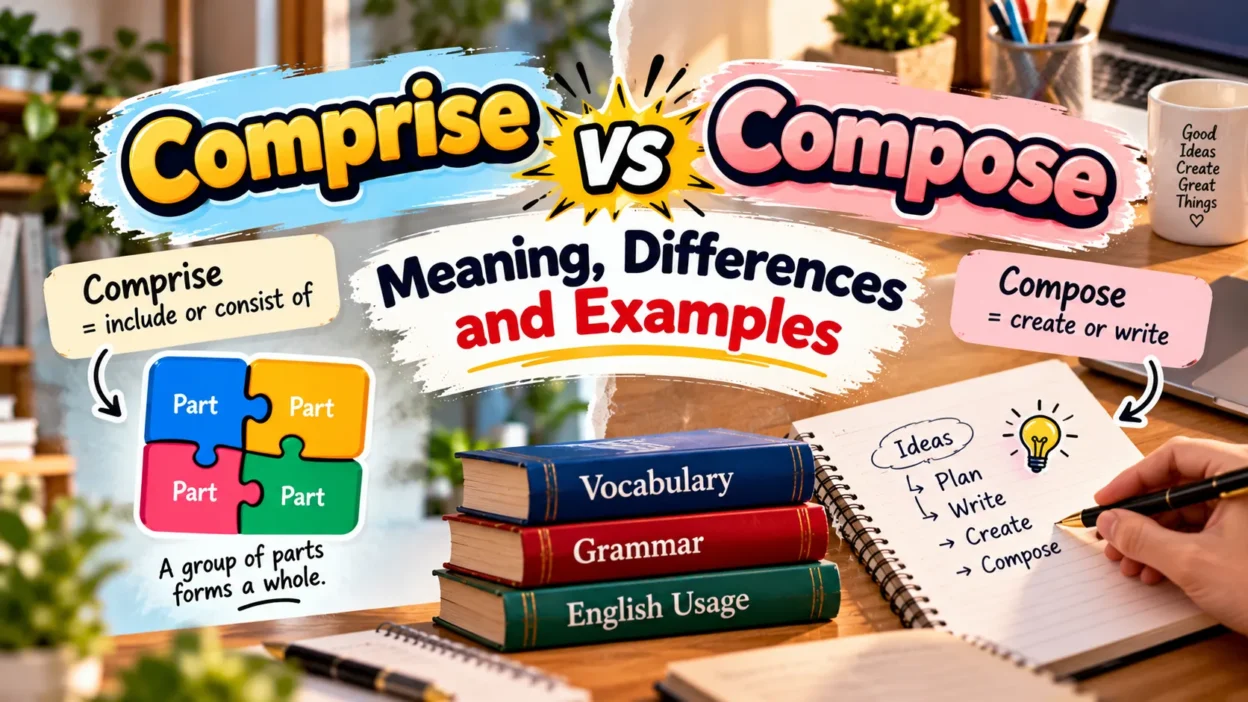
Comprise vs. compose is a common English grammar comparison because both words describe how parts relate to a whole. However, they express this relationship from different perspectives. Comprise means to consist of or include the parts that make up something, while compose means to form or make up a larger whole from individual parts.
For example, “The team comprises eleven players” means the team consists of eleven players. In contrast, “Eleven players compose the team” means those players form the team.
Although the words are closely related, using them correctly can make your writing clearer and more precise. In this guide, you will learn their meanings, differences, grammar rules, common mistakes, and practical examples.
📚 What Does Comprise Mean?
Comprise is a verb that means to consist of, include, or contain different parts or elements. It describes a whole and identifies the components that belong to it.
In a typical sentence, the whole comes before comprise, followed by the parts that make up that whole.
Common meanings of comprise
- To consist of: To have particular parts or elements.
- To include: To contain something as a component.
- To be made up of: To describe the elements that form a complete unit.
Examples of comprise in sentences
- The committee comprises ten members.
- The United States comprises fifty states.
- The course comprises twelve lessons.
- The collection comprises paintings from several artists.
- The research team comprises scientists from different countries.
- The festival comprises music, food, and cultural performances.
- The book comprises fifteen chapters.
- The package comprises several essential components.
In each example, the subject is the whole, and the words following comprises identify its parts.
How to use comprise correctly
A helpful structure is:
Whole + comprise + parts
For example:
- The class comprises thirty students.
- The committee comprises five representatives.
- The report comprises three main sections.
Remember that comprise is commonly used to describe what something consists of.
🧩 What Does Compose Mean?
Compose is a verb that means to form, create, or make up something by bringing together different parts. It can describe the components that form a whole, as well as the act of creating music, writing, or other works.
When compose describes the relationship between parts and a whole, the parts usually come before the verb, followed by the whole.
Common meanings of compose
- To make up: To form a larger whole from individual parts.
- To create: To write or produce something, such as music or a piece of writing.
- To arrange: To organize elements into a complete structure.
- To form: To constitute part of a larger unit.
Examples of compose in sentences
- Ten members compose the committee.
- Water is composed of hydrogen and oxygen.
- Several musicians compose the orchestra.
- The artist composed a beautiful piece of music.
- Volunteers compose the majority of the organization.
- Three main sections compose the report.
- The writer composed a letter to the editor.
- Different ingredients compose the final mixture.
In these sentences, compose either describes the parts that form a whole or the act of creating something.
How to use compose correctly
A helpful structure is:
Parts + compose + whole
For example:
- Thirty students compose the class.
- Five representatives compose the committee.
- Several chapters compose the book.
Compose also has other uses, such as “compose a song” or “compose an email.” In those examples, it means to create or write something.
📊 Comprise vs. Compose: Key Differences
The main difference between comprise and compose is the direction in which the relationship is described. Comprise typically introduces the parts contained in a whole, while compose can describe the parts that form that whole.
| Feature | Comprise | Compose |
|---|---|---|
| Main meaning | To consist of or include | To form, create, or make up |
| Typical perspective | Whole to parts | Parts to whole |
| Common structure | Whole + comprise + parts | Parts + compose + whole |
| Example | The team comprises eleven players. | Eleven players compose the team. |
| Other uses | Describe what something includes | Create music, writing, or other works |
| Related form | Comprises, comprised | Composes, composed, composing |
These structures are useful guidelines, but the verbs also have other grammatical uses. For instance, compose can take an object when it means to create something, as in “She composed a song.”
✍️ Comprise vs. Compose in Example Sentences
Comparing the words in similar sentences makes the difference easier to recognize.
| Comprise | Compose |
|---|---|
| The team comprises eleven players. | Eleven players compose the team. |
| The book comprises ten chapters. | Ten chapters compose the book. |
| The committee comprises five members. | Five members compose the committee. |
| The course comprises six modules. | Six modules compose the course. |
| The collection comprises rare coins. | Rare coins compose the collection. |
| The report comprises three sections. | Three sections compose the report. |
| The orchestra comprises talented musicians. | Talented musicians compose the orchestra. |
| The meal comprises several dishes. | Several dishes compose the meal. |
The examples show how the same relationship can be described from two perspectives. The whole is the subject of comprise, while the parts are the subject of compose in these constructions.
🧠 Easy Tricks to Remember Comprise vs. Compose
If you find these words confusing, try using a simple memory trick.
1. Remember that the whole comprises the parts
Think of a box containing several objects. The box is the whole, and the objects are its contents.
Example: “The box comprises six smaller packages.”
The whole comes first, followed by the components.
2. Remember that the parts compose the whole
Now imagine those six packages being arranged into a larger shipment.
Example: “Six packages compose the shipment.”
The parts come first because they form the whole.
3. Use a simple sentence pattern
Ask yourself whether you are describing the whole or identifying the elements that form it.
- The whole comprises the parts.
- The parts compose the whole.
This distinction is especially helpful in academic writing, business reports, and formal descriptions.
4. Remember compose as create
The word compose can also mean to create music or writing.
Examples:
- She composed a song.
- He composed an email.
- The poet composed a poem.
This meaning is different from comprise, which generally describes what something includes.
⚖️ Comprise vs. Compose vs. Consist Of
Another phrase that often appears in this comparison is consist of. It has a meaning similar to comprise, and it is often useful when describing the components of something.
| Expression | Meaning | Example |
|---|---|---|
| Comprise | Include or consist of | The team comprises eleven players. |
| Compose | Form or make up | Eleven players compose the team. |
| Consist of | Be made up of | The team consists of eleven players. |
Examples in context
- The meal comprises three courses.
- Three courses compose the meal.
- The meal consists of three courses.
All three sentences describe the same general relationship, but the grammatical structures differ.
Important grammar note: In standard edited English, use “consists of,” not “is consisted of.” For example, write “The team consists of eleven players,” rather than “The team is consisted of eleven players.”
⚠️ Common Mistakes When Using Comprise and Compose
Although the meanings are related, the verbs are not always interchangeable. Here are some common errors and their corrections.
Mistake 1: Reversing the sentence structure
Incorrect: Eleven players comprise the team.
This wording is traditionally avoided when the intended meaning is that the players form the team. A clearer option is:
Correct: Eleven players compose the team.
Alternatively, write “The team comprises eleven players.”
Mistake 2: Using compose when describing what a whole includes
Less suitable: The committee composes five members.
Correct: The committee comprises five members.
You could also write “Five members compose the committee.”
Mistake 3: Confusing compose with comprise in creative writing
Incorrect: She comprised a new song for the performance.
Correct: She composed a new song for the performance.
Use compose when you mean to write or create a song, poem, or similar work.
Mistake 4: Writing “comprised of” in formal writing
The phrase “comprised of” is widely used and is accepted by many dictionaries and style guides, but some editors prefer alternatives such as “comprises” or “consists of.”
For the clearest formal wording, consider:
- The committee comprises five members.
- The committee consists of five members.
Following a consistent style guide can help you make the right choice for academic or professional work.
Mistake 5: Assuming the two verbs always have opposite meanings
The verbs are related, but compose also means to create something. For example, “He composed a letter” does not have a direct equivalent using comprise.
Always consider the meaning of the entire sentence before choosing a verb.
🔍 Comprise vs. Compose vs. Composed Of
The phrase composed of is another important construction. It describes the materials or elements from which something is formed.
| Expression | Example | Meaning |
|---|---|---|
| Comprise | The mixture comprises water and salt. | The mixture includes water and salt. |
| Compose | Water and salt compose the mixture. | Water and salt form the mixture. |
| Composed of | The mixture is composed of water and salt. | The mixture is formed from water and salt. |
When should you use composed of?
Use composed of when you want to emphasize the materials or elements that form something.
Examples:
- The atmosphere is composed of several gases.
- The sculpture is composed of metal and glass.
- The committee is composed of representatives from different departments.
The phrase is common in science, academic writing, and descriptive prose.
📖 Comprise vs. Compose in Academic and Professional Writing
Choosing the right verb can make your writing more precise, especially when explaining the structure of a project, organization, report, or scientific subject.
In academic writing
- The study comprises four experiments.
- Four experiments compose the study.
- The sample comprises participants from three age groups.
The first sentence is often the most natural way to describe the components of a study.
In business writing
- The department comprises three teams.
- Three teams compose the department.
- The proposal comprises a budget, a timeline, and a risk assessment.
These constructions help describe how projects and organizations are structured.
In science writing
- Water is composed of hydrogen and oxygen.
- Hydrogen and oxygen compose a water molecule.
- The atmosphere comprises several gases.
Scientific writing often uses composed of to explain a substance’s constituent materials.
📝 Comprise vs. Compose Practice Quiz
Test your understanding by selecting the most appropriate word or phrase for each sentence.
- The committee (comprises / composes) twelve members.
- Twelve musicians (comprise / compose) the orchestra.
- She (comprised / composed) a song for the school concert.
- The report (comprises / composes) five main sections.
- Five main sections (comprise / compose) the report.
- The mixture is (composed of / comprised of) water and salt.
- The course (comprises / composes) eight lessons.
- Several ingredients (comprise / compose) the final dish.
Answer key
- Comprises — The committee is the whole.
- Compose — The musicians form the orchestra.
- Composed — The verb means to create a song.
- Comprises — The report includes five sections.
- Compose — The sections form the report.
- Composed of — This phrase describes the mixture’s components.
- Comprises — The course includes eight lessons.
- Compose — The ingredients form the dish.
❓ Frequently Asked Questions About Comprise vs. Compose
What is the main difference between comprise and compose?
Comprise means to consist of or include parts, while compose means to form a whole from individual parts. For example, “The team comprises eleven players” and “Eleven players compose the team.”
Is it comprise or compose a team?
Both can be correct, depending on the sentence structure. Write “The team comprises eleven players” or “Eleven players compose the team.”
Is composed of correct?
Yes. “Composed of” is a standard expression used to describe the elements that form something. For example, “Water is composed of hydrogen and oxygen.”
Is comprised of grammatically correct?
“Comprised of” is widely used and accepted by many language references, although some style guides discourage it. In formal writing, “comprises” or “consists of” can be simpler alternatives.
Can comprise and compose be used interchangeably?
Not in every sentence. They can describe the same relationship from different perspectives, but their grammatical structures differ. Compose also means to create something, a meaning that comprise does not generally share.
What is an example of comprise in a sentence?
“The course comprises six modules.” Here, comprises means the course consists of six modules.
What is an example of compose in a sentence?
“Six modules compose the course.” Here, compose means the modules form the course. Another example is “She composed a beautiful melody,” where it means to create music.
What is the difference between comprise and consist of?
Both describe what makes up a whole. For example, “The team comprises eleven players” and “The team consists of eleven players” express essentially the same idea.
🏁 Conclusion
The difference between comprise vs. compose becomes easier to understand when you focus on the relationship between the whole and its parts. Comprise describes the parts included in a whole, while compose describes the parts that form that whole. The word compose can also mean to create something, such as a song or letter.
Remember this simple rule: the whole comprises the parts, and the parts compose the whole. Using this guideline will help you choose the right verb in everyday conversations, academic assignments, and professional writing.

Vivian Mercer is an English language writer and vocabulary enthusiast who specializes in synonyms, word meanings, grammar, idioms, and language usage. She creates accurate, easy-to-understand content that helps readers improve their English skills with confidence.