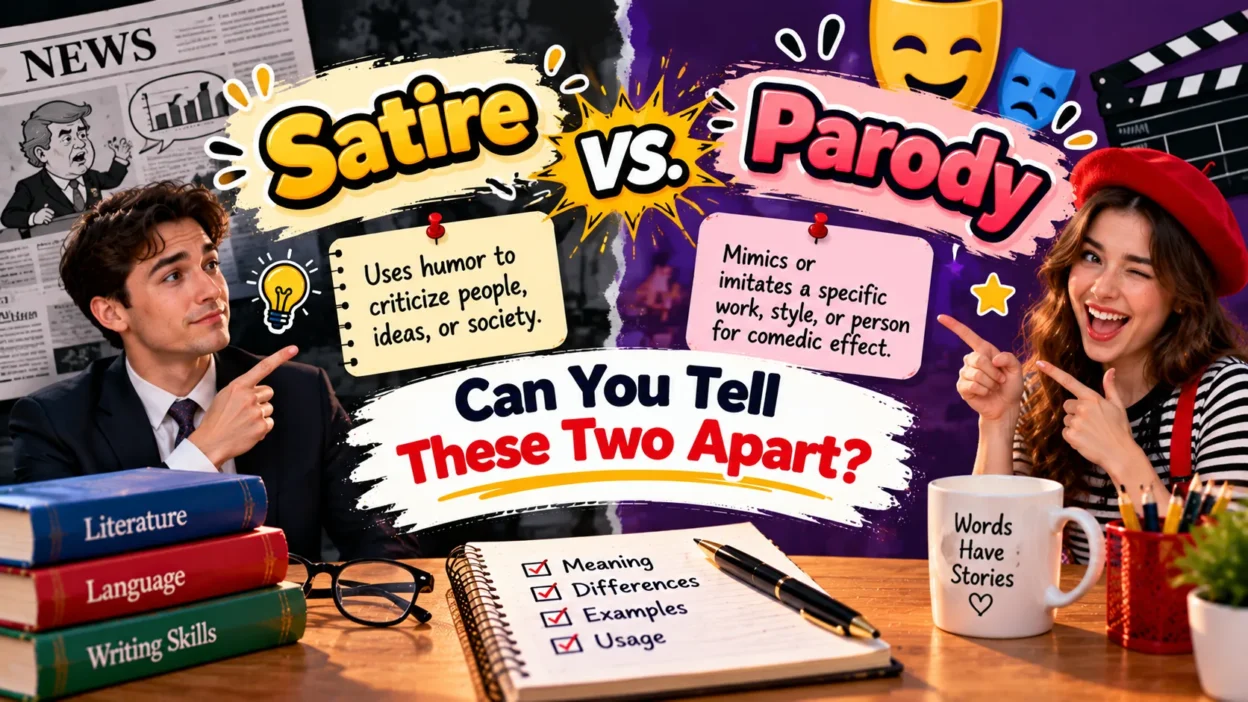
Satire vs. parody is a common comparison because both use humor, imitation, and exaggeration to entertain audiences. However, they serve different purposes. Satire criticizes human behavior, social problems, or institutions, while parody imitates a particular work, style, or creator for humorous effect.
For example, a comedy sketch that mocks politicians for making unrealistic promises is an example of satire. A funny video that imitates a famous movie scene with exaggerated acting is an example of parody.
Although satire and parody often overlap, understanding their differences can help you recognize them in books, movies, television shows, social media posts, and everyday conversations.
🎭 What Is Satire?
Satire is a literary and artistic technique that uses humor, irony, sarcasm, exaggeration, or ridicule to expose flaws in people, institutions, and society. Its main purpose is often to encourage reflection or criticize something that deserves attention.
Satire can be entertaining, but it usually has a deeper message. It may target corruption, hypocrisy, greed, political dishonesty, unfair social expectations, or other problems.
Key characteristics of satire
- Criticism: It highlights problems in society, politics, culture, or human behavior.
- Humor: It often uses comedy to make criticism more engaging.
- Irony: It may reveal the difference between what people say and what they actually do.
- Exaggeration: It can make a flaw seem absurd to help audiences recognize it.
- Social commentary: It encourages people to think critically about an issue.
- Underlying message: It often communicates an opinion or invites change.
Examples of satire
- A cartoon shows a politician promising to eliminate corruption while secretly accepting bags of money.
- A television sketch portrays a company requiring employees to attend meetings about how to reduce unnecessary meetings.
- A fictional news report announces that a city has solved traffic congestion by banning everyone from leaving home.
- A writer describes a wealthy character who gives speeches about generosity but refuses to help anyone in need.
- A social media post mocks people who claim to care about the environment while wasting resources unnecessarily.
In each example, the humor exposes a contradiction, bad habit, or social problem. The main goal is not simply to imitate something but to make a critical point.
🎬 What Is Parody?
Parody is a creative work that imitates the recognizable features of another work, genre, artist, or style to create humor or a comic effect. It may copy familiar dialogue patterns, characters, visual elements, storytelling conventions, or musical styles in an exaggerated way.
Parody is often playful and entertaining. Although it can also criticize its subject, its central feature is recognizable imitation.
Key characteristics of parody
- Imitation: It copies recognizable features of an existing work or style.
- Exaggeration: It makes familiar elements more ridiculous or dramatic.
- Humor: It uses the audience’s familiarity with the original to create comedy.
- Recognition: The audience usually needs to recognize the source or style being imitated.
- Creative transformation: It changes the original material to produce a new comic effect.
- Entertainment: Its main purpose is often to amuse the audience.
Examples of parody
- A comedy sketch imitates a superhero movie by giving the hero an extremely dramatic entrance to save someone from a broken vending machine.
- A YouTube creator recreates a famous cooking show but treats making instant noodles like preparing a five-star meal.
- A cartoon imitates the style of detective movies, complete with dramatic music and an overly serious investigator searching for a missing sock.
- A comedian performs a song that imitates the conventions of dramatic love ballads but uses lyrics about doing laundry.
- A short film imitates a horror movie by presenting an ordinary household vacuum cleaner as a terrifying monster.
These examples imitate recognizable styles or conventions. The humor comes from the contrast between the original style and the exaggerated or unexpected version.
📊 Satire vs. Parody: Key Differences
The main difference between satire and parody is their primary purpose. Satire focuses on criticism, while parody focuses on imitation for humorous effect.
| Feature | Satire | Parody |
|---|---|---|
| Main purpose | Criticize flaws or problems | Imitate something humorously |
| Main target | Behavior, institutions, ideas, or society | A specific work, creator, genre, or style |
| Common techniques | Irony, sarcasm, exaggeration, ridicule | Imitation, exaggeration, comic transformation |
| Main focus | The message or criticism | The recognizable imitation |
| Tone | Often witty, critical, or provocative | Often playful, absurd, or humorous |
| Audience recognition | Helps audiences understand the criticism | Often essential to recognizing the joke |
| Social commentary | Usually central | Optional |
| Example | Mocking political corruption | Imitating a political debate show |
These distinctions are helpful, but they are not absolute. A parody can criticize its source, and satire can imitate a recognizable work or genre.
😂 Satire vs. Parody Examples in Everyday Life
Understanding these terms becomes easier when you compare examples from familiar situations.
Example 1: Politics
Satire: A cartoon depicts a politician installing a giant microphone to announce promises while a sign behind them reads, “Promises never delivered.”
This criticizes political dishonesty.
Parody: A comedian imitates the dramatic speeches, gestures, and slogans used in election advertisements, making them increasingly exaggerated.
This imitates a recognizable political advertising style.
Example 2: Social media
Satire: A post jokes that people spend so much time taking pictures of their meals that they forget to eat them.
The humor criticizes social media habits.
Parody: A creator recreates a popular influencer’s video format, including exaggerated facial expressions and elaborate product introductions, but uses a potato as the featured product.
The humor comes from imitating the influencer’s style.
Example 3: Movies
Satire: A film portrays a fictional entertainment company that values profit so much that it ignores the safety of its workers.
The story criticizes corporate greed.
Parody: A comedy film imitates familiar action-movie scenes, including dramatic slow motion, exaggerated explosions, and an impossibly confident hero.
The film humorously copies action-movie conventions.
Example 4: School
Satire: A cartoon shows students carrying enormous backpacks while school administrators announce a new policy designed to make learning more comfortable.
The image criticizes an inconsistency in school policy.
Parody: A student performs a mock version of a famous superhero scene in which a school principal becomes a superhero who fights late homework submissions.
The sketch imitates superhero storytelling.
🧠 How to Tell Satire and Parody Apart
If you are unsure whether something is satire or parody, ask two simple questions: What is it making fun of, and how does it do so?
1. Identify the target
Satire often targets a problem, such as corruption, greed, hypocrisy, or an unhealthy social habit.
Parody often targets a recognizable creative work or style, such as a movie, song, advertisement, or television genre.
2. Look for imitation
If the humor depends on copying a particular work or recognizable style, it may be parody.
For example, a sketch that copies the dramatic narration of nature documentaries to describe people waiting for a bus is a parody of that documentary style.
3. Look for criticism
If the main point is to expose a flaw or encourage people to question something, it may be satire.
For example, a sketch showing a company celebrating employee well-being while requiring staff to work excessive hours is satirical.
4. Remember that both can apply
A work can be both satire and parody. A comedian might imitate the style of a political news broadcast while criticizing biased reporting. The imitation makes it a parody, while the criticism makes it satire.
📚 Types of Satire
Satire appears in many forms of writing, entertainment, and visual media. Different approaches use humor and criticism in different ways.
Horatian satire
Horatian satire uses lighthearted humor, wit, and gentle ridicule to point out human weaknesses. It tends to be playful rather than harsh.
Example: A humorous essay pokes fun at people who spend hours choosing the perfect profile picture.
Juvenalian satire
Juvenalian satire is sharper, more serious, and often more aggressive. It targets issues such as corruption, injustice, abuse of power, and social inequality.
Example: A political cartoon depicts powerful officials protecting their own wealth while ordinary citizens struggle to afford basic necessities.
Menippean satire
Menippean satire often criticizes ways of thinking, ideologies, or intellectual attitudes rather than focusing on one individual. It may use unusual characters, absurd situations, and a mixture of styles.
Example: A fictional story portrays a society in which people blindly follow every new trend, even when the trends contradict one another.
These categories describe common approaches to satire. A single work may combine elements of more than one type.
🎨 Types of Parody
Parody can imitate almost any recognizable form of creative expression. Its style depends on the subject being copied.
Literary parody
Literary parody imitates a writer’s style, a literary genre, or a particular book.
Example: A short story imitates the language of an epic adventure to describe someone searching for a lost television remote.
Film parody
Film parody imitates movie genres, scenes, characters, or storytelling conventions.
Example: A comedy sketch copies the dramatic style of a spy movie but makes the secret mission about delivering a sandwich.
Musical parody
Musical parody uses recognizable musical styles or transforms a song’s conventions for comic effect. Some parodies rewrite lyrics, while others imitate a musical genre.
Example: A humorous song uses the dramatic sound of a power ballad to celebrate finishing household chores.
Advertising parody
Advertising parody imitates commercials, slogans, or promotional techniques to create humor.
Example: A fake advertisement presents an ordinary pencil as a revolutionary product that will transform every aspect of a person’s life.
Genre parody
Genre parody imitates the familiar conventions of an entire category, such as horror, romance, fantasy, or detective fiction.
Example: A romantic comedy imitates dramatic love-story clichés but gives its characters an absurd disagreement about pizza toppings.
⚖️ Can Something Be Both Satire and Parody?
Yes. Satire and parody can overlap because they are not mutually exclusive techniques.
Imagine a comedy video that imitates the style of a serious political debate. The speakers interrupt one another, repeat slogans, and make exaggerated gestures. During the video, they also reveal how politicians avoid answering direct questions.
This example uses parody because it imitates a recognizable debate format. It also uses satire because it criticizes evasive political communication.
The same principle applies to films, cartoons, novels, online videos, and advertisements. A creator can imitate something to make people laugh while also exposing the problems associated with it.
However, not every parody is satire. A humorous imitation of a fantasy movie might simply entertain viewers without criticizing a social issue. Similarly, satire does not always need to imitate a particular work.
⚠️ Common Mistakes When Using Satire and Parody
Although the terms are related, treating them as interchangeable can lead to confusion.
Mistake 1: Assuming all comedy is satire
Not every joke criticizes society or human behavior. A joke about a fictional character slipping on a banana peel may simply be physical comedy.
Better understanding: Satire typically uses humor to expose a flaw, contradiction, or problem.
Mistake 2: Assuming parody must copy exact words
Parody does not have to reproduce exact dialogue or lyrics. It can imitate a style, format, character type, or set of recognizable conventions.
Better understanding: The defining feature is recognizable imitation, not exact duplication.
Mistake 3: Assuming parody cannot have a serious message
Parody is often playful, but it can also criticize its source or comment on broader social issues.
Better understanding: Parody can entertain and criticize at the same time.
Mistake 4: Confusing sarcasm with satire
Sarcasm is a form of expression that often uses sharp or ironic remarks. Satire is a broader technique that uses humor and related methods to criticize flaws or problems.
Better understanding: Sarcasm can appear in satire, but the two terms do not mean the same thing.
Mistake 5: Assuming satire must be political
Satire frequently addresses politics, but it can also target workplace culture, consumerism, celebrity culture, education, relationships, and everyday habits.
Better understanding: Satire can criticize almost any human behavior or social practice.
🔍 Satire vs. Parody vs. Sarcasm vs. Irony
These terms are related, but each describes something different.
| Term | Meaning | Example |
|---|---|---|
| Satire | Humor or ridicule used to criticize flaws | A sketch mocking corporate greed |
| Parody | Humorous imitation of a work or style | A sketch imitating superhero movies |
| Sarcasm | A sharp or mocking remark, often ironic | Saying “Brilliant idea!” after someone makes an obvious mistake |
| Irony | A contrast between expectation and reality, or between literal and intended meaning | A fire station catches fire |
Satire may use sarcasm and irony, while parody may use both as part of its imitation. However, irony and sarcasm can also appear without satire or parody.
❓ Frequently Asked Questions About Satire vs. Parody
Is satire the same as parody?
No. Satire primarily criticizes human behavior, institutions, or social problems through humor and related techniques. Parody primarily imitates a recognizable work, genre, or style for comic effect. A single work can use both.
What is the main difference between satire and parody?
The main difference is the purpose. Satire aims to expose or criticize flaws, while parody imitates something recognizable to create humor. Satire emphasizes criticism; parody emphasizes imitation.
Is parody always funny?
Parody is generally intended to create a comic or humorous effect, although the humor may be subtle, dry, or directed toward a particular audience. Some parodies also make serious observations about their subjects.
Can satire exist without humor?
Satire usually relies on humor, irony, ridicule, or exaggeration, but its tone can be dark or serious. Its criticism may be more noticeable than its entertainment value.
Is a political cartoon satire or parody?
It depends on what the cartoon does. A cartoon criticizing political corruption is satire. A cartoon imitating the style of a recognizable political advertisement may be parody. It can be both if it imitates the advertisement while criticizing corruption.
What is an example of satire and parody together?
A comedy sketch imitates a political news program while exposing how its fictional hosts spread misleading information. The imitation is parody, and the criticism of misleading reporting is satire.
What is the difference between satire and sarcasm?
Satire is a broader form of criticism that can appear in stories, cartoons, performances, and other works. Sarcasm is a particular way of speaking or writing that uses mocking or cutting remarks.
Why are satire and parody important?
Both can entertain audiences and encourage them to look at familiar subjects differently. Satire can draw attention to social problems, while parody can reveal the conventions and exaggerations of creative works and popular culture.
🏁 Conclusion
The difference between satire vs. parody comes down to their primary purpose. Satire uses humor, irony, and ridicule to criticize flaws in people, institutions, or society. Parody imitates a recognizable work, genre, or style to create a humorous effect.
Remember this simple rule: satire criticizes, while parody imitates. A comedy sketch can do both, but the distinction becomes clearer when you identify whether its main focus is exposing a problem or copying something recognizable.
Understanding these terms will help you analyze comedy, recognize literary techniques, and describe movies, cartoons, books, and online content more accurately.

Vivian Mercer is an English language writer and vocabulary enthusiast who specializes in synonyms, word meanings, grammar, idioms, and language usage. She creates accurate, easy-to-understand content that helps readers improve their English skills with confidence.