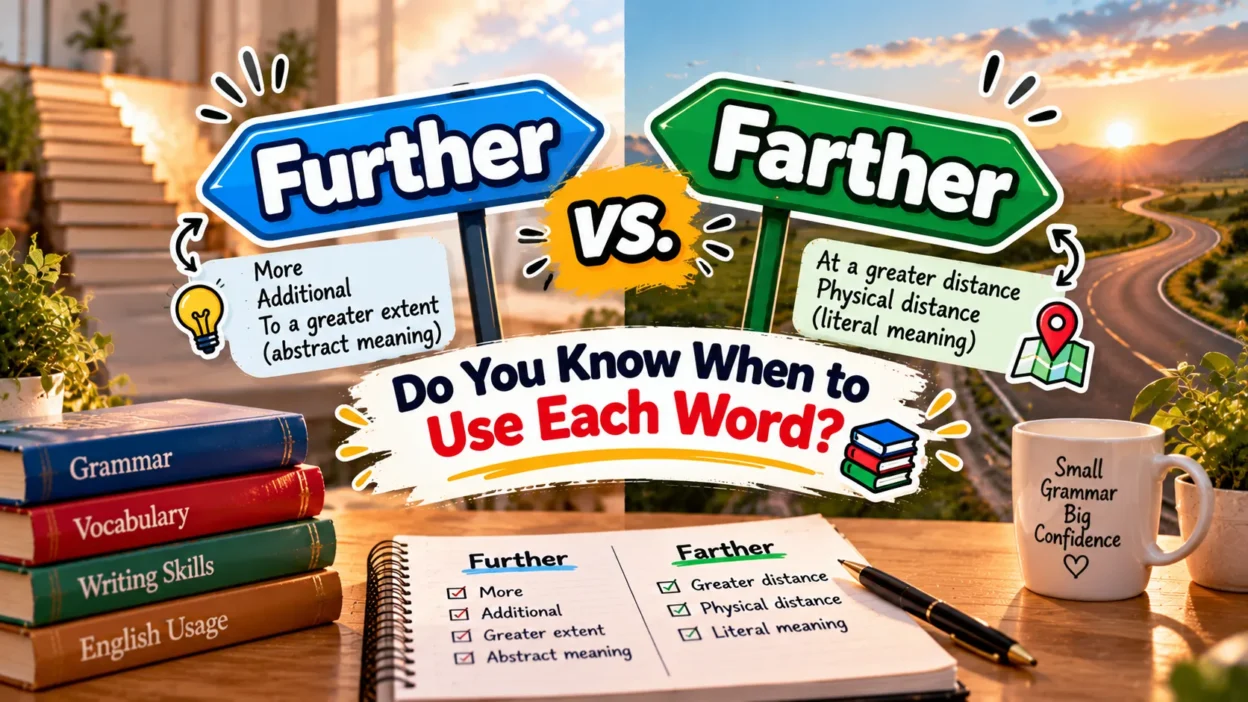
Further vs. farther is a common English grammar comparison because both words can refer to something beyond a particular point. However, they are traditionally used in different contexts. Farther usually refers to physical distance, while further often refers to additional progress, a greater extent, or more information.
For example, “The gas station is farther down the road” describes physical distance. In contrast, “We need to discuss this matter further” means that the discussion needs to continue.
Although these words are sometimes used interchangeably, especially in American English, understanding their traditional differences can help you write more clearly and accurately. This guide explains their meanings, common uses, examples, and simple ways to remember which word to choose.
📏 What Does Farther Mean?
Farther is an adverb or adjective most commonly used to describe physical distance. It helps explain how far away a place, person, or object is from another point.
In everyday English, farther often appears when discussing travel, directions, locations, and measurable distances.
Common meanings of farther
- Greater physical distance: Something is located at a greater distance.
- Traveling a longer distance: Someone moves beyond a particular point.
- More distant: A place or object is farther away than another.
- Additional distance traveled: Someone continues moving over a physical route.
Examples of farther in sentences
- The grocery store is farther from my house than the pharmacy.
- We walked farther than we had planned.
- The mountain looks farther away than it really is.
- Can you drive a little farther before stopping?
- Their new home is farther from the city center.
- She ran farther than anyone else on the team.
- The campsite is two miles farther down the trail.
- We could see the village from a farther point along the road.
In these examples, farther refers to actual physical distance. It helps readers understand how far a person or object is from a specific location.
➕ What Does Further Mean?
Further can mean additional, more, or to a greater extent. It is commonly used when discussing ideas, information, progress, discussions, research, or abstract situations.
It can function as an adverb, adjective, and verb. As an adverb, it often means to a greater extent or additionally. As an adjective, it can mean additional or more. As a verb, it means to advance or help develop something.
Common meanings of further
- Additional: More of something is needed or available.
- To a greater extent: Something continues or develops more deeply.
- More information: Additional details or explanation.
- Progress: Moving an idea, plan, or goal forward.
- Advancement: Helping a cause, career, or objective develop.
Examples of further in sentences
- We need to investigate the issue further.
- Please contact me if you need further information.
- The teacher explained the topic further.
- She wants to further her education.
- The committee will discuss the proposal further.
- No further action is required at this time.
- The new policy could further improve workplace safety.
- We cannot make a decision without further evidence.
In these examples, further refers to additional information, continued discussion, or progress rather than a measurable physical distance.
📊 Further vs. Farther: Key Differences
The main distinction between further and farther is their traditional meaning. Farther usually describes physical distance, whereas further often describes additional amounts, abstract extent, or progress.
| Feature | Further | Farther |
|---|---|---|
| Main meaning | Additional or to a greater extent | At a greater physical distance |
| Common use | Information, discussion, research, progress | Travel, locations, measurable distance |
| Part of speech | Adverb, adjective, and verb | Adverb and adjective |
| Example | We need further research. | The park is farther away. |
| Common phrase | Further information | Farther down the road |
| Memory clue | Further means more | Farther means physical distance |
These are traditional guidelines, not absolute rules. In modern American English, further is also commonly used for physical distance, so the two words sometimes overlap.
✍️ Further vs. Farther in Example Sentences
Comparing both words side by side makes their differences easier to understand.
| Further | Farther |
|---|---|
| We need further explanation. | The school is farther away. |
| Please provide further details. | We walked farther into the forest. |
| The team will investigate the problem further. | The next town is farther north. |
| She hopes to further her career. | He ran farther than his brother. |
| No further questions were asked. | The airport is farther from here. |
| We discussed the issue further. | Drive farther down this street. |
| The organization wants to further its mission. | The cabin is farther up the mountain. |
| Further research may reveal the answer. | She traveled farther than expected. |
Notice that further is generally preferred when talking about ideas, information, and advancement. Farther is traditionally preferred when the sentence describes a physical distance.
🧠 Easy Tricks to Remember Further vs. Farther
You can remember the difference between these words by connecting each one with a simple idea.
1. Remember that farther means physical distance
Think of the word far inside farther. Both relate naturally to distance.
Example: “The library is farther from my home than the grocery store.”
If you can measure the distance between two places, farther is often a good choice.
2. Remember that further means more
Think of further as another way to say “additional” or “more.”
Example: “We need further information before making a decision.”
If you can replace the word with additional or more without changing the intended meaning, further is likely appropriate.
3. Use a simple question
Ask yourself: Am I talking about physical distance or additional progress?
- Physical distance: “How much farther is the station?”
- Additional information: “Can you provide further details?”
- Progress toward a goal: “This training will further my career.”
- More discussion: “Let’s discuss the matter further.”
4. Remember that usage can overlap
In modern English, especially American English, further can also describe physical distance.
For example, “We walked further down the road” is a common and acceptable sentence.
If you want to make a clear distinction in formal writing, use farther for physical distance and further for additional information or abstract progress.
🛣️ When to Use Farther for Physical Distance
Use farther when you want to describe how distant one physical location or object is from another. It is especially useful when comparing travel distances or describing movement along a route.
Examples of farther for distance
- The nearest hospital is farther away than we thought.
- We drove farther to find a cheaper hotel.
- The finish line is much farther from the starting point.
- The hikers traveled farther than their original plan allowed.
- My office is farther from the station than yours.
- The bird flew farther across the lake.
- Keep walking until you reach a farther section of the trail.
Further or farther with measurements
When a sentence includes miles, kilometers, feet, or other units of physical distance, farther is a natural choice.
For example:
- The cabin is three miles farther along the road.
- We traveled five kilometers farther than yesterday.
- The parking lot is 200 feet farther from the entrance.
Although further is also used for physical distance, farther makes the physical meaning especially clear.
📖 When to Use Further for Additional Information
Use further when you mean more information, another explanation, or additional investigation. It is especially common in professional, academic, and formal writing.
Examples of further for information
- Please send further information about the application.
- The report requires further analysis.
- We need further evidence to support the claim.
- The manager requested further clarification.
- The research team plans to conduct further experiments.
- Contact customer support for further assistance.
- The teacher provided further examples to explain the rule.
In these sentences, further means additional or more. Replacing it with farther would generally sound incorrect or unnatural.
🚀 Further as a Verb: Meaning and Examples
One important difference is that further can function as a verb, while farther is not normally used as a verb in standard modern English.
As a verb, further means to advance, promote, or help something develop.
Examples of further as a verb
- She took additional courses to further her career.
- The organization works to further educational opportunities.
- These discussions could further our understanding of the issue.
- He volunteered to further the team’s objectives.
- The new initiative aims to further scientific research.
In each sentence, further means to help something progress or advance.
⚠️ Common Mistakes When Using Further and Farther
Because the words have overlapping meanings, it is easy to become uncertain about which one to choose. The following examples explain common errors and how to avoid them.
Mistake 1: Using farther for additional information
Incorrect: Please provide farther information about the course.
Correct: Please provide further information about the course.
Use further when you mean additional information or details.
Mistake 2: Using further when a clear physical distinction is needed
Less precise: We walked further than the other group.
Clearer traditional choice: We walked farther than the other group.
Both forms can be acceptable in modern English, but farther is traditionally preferred when comparing physical distances.
Mistake 3: Confusing further with farther in professional writing
Incorrect: The committee requires farther investigation before approving the proposal.
Correct: The committee requires further investigation before approving the proposal.
Investigation is an abstract activity, so further is the natural choice.
Mistake 4: Assuming further can never refer to distance
This is a common misunderstanding. Although traditional grammar often distinguishes the words, further is frequently used for physical distance, too.
For example, “The gas station is further down the road” is common in everyday American English.
Mistake 5: Forgetting that further can mean advance
Incorrect: The program aims to farther scientific progress.
Correct: The program aims to further scientific progress.
When the meaning is to advance or promote a goal, further is the correct verb.
🔍 Further vs. Farther vs. Furthermore
Another word that can be confused with further is furthermore. Although the words are related, they have different functions in a sentence.
| Word | Meaning | Example |
|---|---|---|
| Further | Additional or to a greater extent | We need further research. |
| Farther | At a greater physical distance | The store is farther away. |
| Furthermore | In addition; used to add another point | Furthermore, the plan is affordable. |
Examples in sentences
- We need further evidence before reaching a conclusion.
- The next village is farther from the highway.
- Furthermore, the proposed solution would save time.
Furthermore is a transition word used to introduce another related point. It does not ordinarily describe distance.
📝 Further vs. Farther Practice Quiz
Test your understanding by selecting the correct word for each sentence.
- The airport is much (further / farther) from our hotel.
- Please send me (further / farther) details about the event.
- We walked (further / farther) than we planned.
- The company wants to (further / farther) its research.
- Do you have any (further / farther) questions?
- The hikers traveled (further / farther) into the mountains.
- The teacher offered (further / farther) explanation.
- She hopes to (further / farther) her professional development.
Answer key
- Farther — Traditionally preferred for physical distance.
- Further — Means additional details.
- Farther — Traditionally preferred for physical distance, though further is also common.
- Further — Means to advance or promote research.
- Further — Means additional questions.
- Farther — Traditionally preferred for physical distance, though further is also acceptable.
- Further — Means additional explanation.
- Further — Means to advance professional development.
If you answered all eight correctly, you understand the traditional distinction between these words.
❓ Frequently Asked Questions About Further vs. Farther
What is the main difference between further and farther?
Farther traditionally refers to physical distance, while further usually refers to additional information, greater extent, or progress. In modern English, however, further can also describe physical distance.
Is further or farther correct in American English?
Both are correct in American English. The traditional guideline is to use farther for physical distance and further for additional information or abstract progress. Everyday usage often overlaps.
Is it further information or farther information?
The correct expression is further information because further means additional or more. Farther information is not standard in this context.
Is it further down the road or farther down the road?
Both expressions are commonly used. Farther down the road emphasizes physical distance, while further down the road can refer to physical distance or, figuratively, a later stage in a process.
Can further and farther be used interchangeably?
Sometimes. They can overlap when referring to physical distance, particularly in American English. However, further is the preferred choice for additional information, investigation, or progress.
Is further a verb?
Yes. Further can be a verb meaning to advance, promote, or help something develop. For example, “She took classes to further her career.”
What is the opposite of farther?
Depending on the context, possible opposites include nearer and closer. For example, “The second store is nearer to our house.”
What is the opposite of further?
The opposite depends on the intended meaning. If further means additional, an opposite might be less or no more. If it means advance or promote, an opposite could be hinder or impede.
🏁 Conclusion
The difference between further vs. farther becomes easier to understand when you focus on the meaning of each word. Farther is traditionally used for physical distance, while further refers to additional information, continued discussion, or progress toward a goal.
Remember this simple rule: farther means physical distance, and further means more. Although the words sometimes overlap in modern American English, this guideline will help you choose the most appropriate word for most writing situations.

Vivian Mercer is an English language writer and vocabulary enthusiast who specializes in synonyms, word meanings, grammar, idioms, and language usage. She creates accurate, easy-to-understand content that helps readers improve their English skills with confidence.