Is it truely or truly? Although both spellings may look correct at first glance, only one is accepted in standard English. If you want to write accurately in emails, blog posts, academic assignments, or professional documents, knowing the difference is essential.
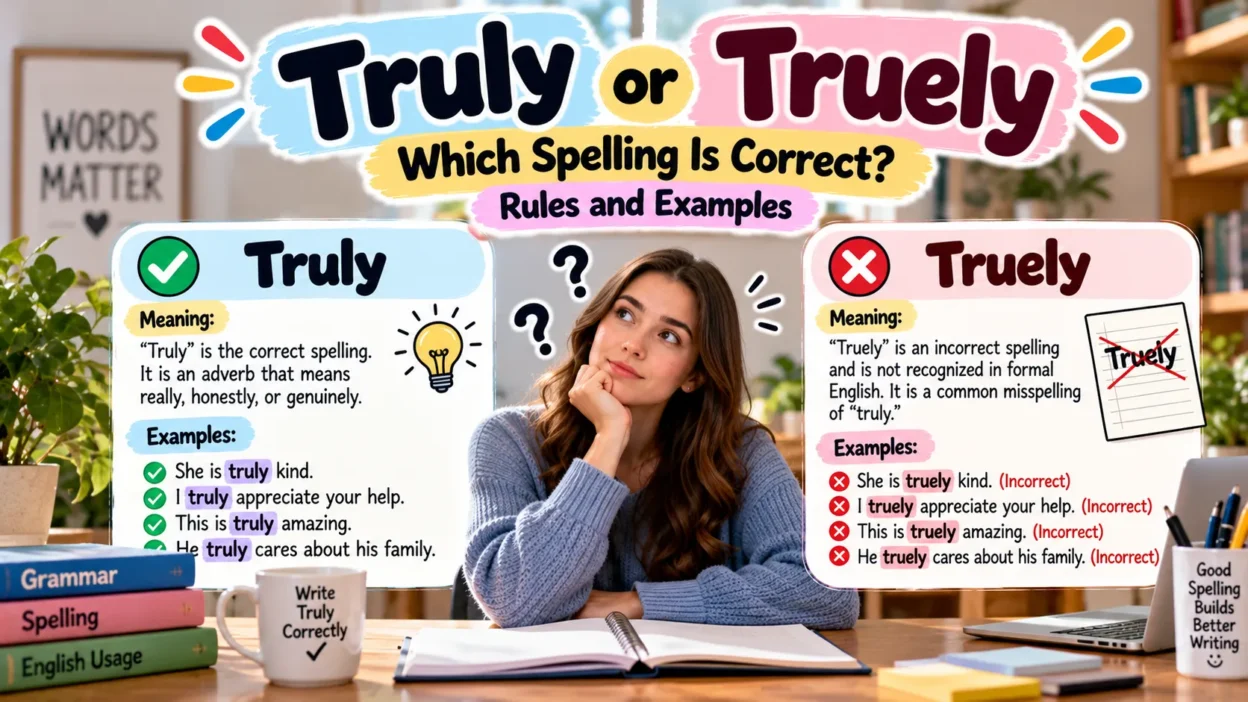
Truly is the correct spelling. Truely is a common misspelling that occurs because people often assume the word true keeps its final e when the suffix -ly is added.
The correct spelling follows a specific pattern: true becomes truly. The final e is dropped before adding -ly.
In this guide, you’ll learn the meaning of truly, the spelling rule behind it, how to use it correctly in different contexts, and how it differs from related words such as true, truth, and truthfully. You’ll also find comparison tables, practical examples, common mistakes, and answers to frequently asked questions.
📌 Truely or Truly: Which One Is Correct?
Truly is the only correct standard spelling when you want to express the meaning of genuinely, sincerely, or honestly. The spelling truely is incorrect in standard English.
Although truely may seem logical because the original adjective is true, English spelling does not always preserve every letter when a suffix is added.
Compare the two forms below.
| Spelling | Correct? | Meaning or Explanation | Example |
|---|---|---|---|
| Truly | Yes | Genuinely or sincerely | I truly appreciate your support. |
| Truely | No | Common misspelling of truly | I truely appreciate your support. |
| True | Yes | Genuine, accurate, or correct | Her statement is true. |
| Truth | Yes | The quality or fact of being true | He finally told the truth. |
| Truthful | Yes | Honest or accurate | She gave a truthful answer. |
| Truthfully | Yes | Honestly or sincerely | Truthfully, I didn’t know. |
The difference is straightforward: use truly whenever you need the adverb. Do not use truely in standard writing.
Quick answer: If you’re wondering whether to write truely or truly, always choose truly.
📖 What Does Truly Mean?
Truly is an adverb that means genuinely, sincerely, honestly, or in a way that reflects the truth. It is used to emphasize that a feeling, statement, belief, or situation is real rather than exaggerated or pretended.
The word can strengthen a description, express sincere emotions, or communicate that someone genuinely believes something.
For example:
- I truly appreciate everything you have done for me.
- She is truly one of the most thoughtful people I know.
- He truly believes that practice makes a difference.
- This is truly an impressive achievement.
- We are truly grateful for your generosity.
In these sentences, truly emphasizes sincerity or authenticity. It tells the reader that the feeling or statement is genuine.
The word is also common in personal messages, professional communication, speeches, and creative writing. Phrases such as truly grateful, truly happy, and truly remarkable are natural ways to express genuine feelings or emphasize a quality.
💬 Examples of Truly in Everyday English
Understanding a word becomes easier when you see how it works in different situations.
Personal conversations
- I truly care about your happiness.
- You are truly special to me.
- I truly enjoyed spending time with you.
- She truly understands what I’m going through.
Professional communication
- We truly appreciate your continued support.
- Your feedback has truly helped us improve.
- I am truly thankful for this opportunity.
- The team has truly exceeded our expectations.
Descriptions and opinions
- The view from the mountain was truly beautiful.
- That was truly an unforgettable experience.
- She is truly talented at what she does.
- It was truly a pleasure meeting you.
In each example, truly adds emphasis and communicates that the statement is sincere or genuine.
🧠 Why Is Truly Correct Instead of Truely?
The spelling difference comes from how English forms certain adverbs.
The adjective true ends in a silent e. When it becomes the adverb truly, that final e is removed before the suffix -ly is added.
The spelling transformation is:
True − e + ly = truly
This is why truely is incorrect. It keeps the final e even though the standard spelling drops it.
Here are other words that follow similar spelling patterns.
| Adjective | Correct Adverb | Incorrect Form |
|---|---|---|
| True | Truly | Truely |
| Due | Duly | Duely |
| Whole | Wholly | Wholely |
| Gentle | Gently | Gentlely |
| Simple | Simply | Simplely |
| Possible | Possibly | Possiblely |
These examples show that English spelling patterns can require changes when suffixes are added. However, not every adjective ending in e drops that letter. For example, nice becomes nicely, and safe becomes safely.
Therefore, it is helpful to learn the established spelling of each word rather than assume that one rule applies to every adjective.
🔍 Truly vs. True vs. Truthfully
Truly, true, and truthfully are related words, but they serve different grammatical purposes. Understanding those differences will help you select the correct word for each sentence.
| Word | Part of Speech | Main Meaning | Example |
|---|---|---|---|
| True | Adjective | Genuine, accurate, or correct | The information is true. |
| Truly | Adverb | Genuinely or sincerely | I truly admire your work. |
| Truth | Noun | A fact or something that is true | She told the truth. |
| Truthful | Adjective | Honest or accurate | He gave a truthful response. |
| Truthfully | Adverb | Honestly or in accordance with the truth | Truthfully, I forgot. |
| Truely | Incorrect spelling | Not standard English | Use truly instead. |
When Should You Use True?
Use true to describe something that is accurate, genuine, or real.
Examples:
- Her story is true.
- That is a true statement.
- He is a true friend.
- The report contains true information.
When Should You Use Truly?
Use truly to emphasize a verb, adjective, or statement.
Examples:
- I truly believe in you.
- She is truly talented.
- We are truly thankful.
- It was truly extraordinary.
When Should You Use Truthfully?
Use truthfully when you want to emphasize honesty or explain that something is being said honestly.
Examples:
- Truthfully, I don’t remember what happened.
- She answered the question truthfully.
- I can truthfully say that I enjoyed the experience.
Although truly and truthfully can overlap, they are not always interchangeable. Truly often emphasizes sincerity or genuineness, while truthfully more directly emphasizes honesty or factual accuracy.
✍️ How to Use Truly Correctly in a Sentence
The word truly can appear in different positions depending on the sentence. It commonly modifies verbs, adjectives, and sometimes entire statements.
Truly Before a Verb
When truly modifies a verb, it emphasizes the action, belief, or feeling.
- I truly appreciate your kindness.
- She truly understands the problem.
- They truly believe in their mission.
- We truly value your opinion.
Truly Before an Adjective
When truly appears before an adjective, it emphasizes a quality or characteristic.
- This is a truly beautiful place.
- She is a truly remarkable leader.
- It was a truly memorable occasion.
- He is a truly generous person.
Truly in a Sentence’s Closing Phrase
The Truly can also appear near the end of a sentence to emphasize a statement.
- I believe you are truly wonderful.
- The experience was truly unforgettable.
- Her kindness made the occasion truly special.
Truly in Formal Writing
The word is suitable for professional and formal communication when it fits the intended meaning.
- We truly appreciate your patience during this process.
- This research provides a truly valuable contribution to the field.
- I am truly grateful for the opportunity to participate.
For formal writing, use truly where it adds meaning rather than repeating it throughout the same paragraph. Overusing emphasis words can make writing sound less precise.
⚠️ Common Mistakes to Avoid With Truly
Even simple words can cause spelling and grammar problems when their forms resemble familiar patterns. Here are mistakes worth avoiding.
Mistake 1: Writing Truely Instead of Truly
Incorrect: I truely appreciate your help.
Correct: I truly appreciate your help.
The standard spelling removes the final e from true before adding -ly.
Mistake 2: Assuming Every Adverb Keeps the Final E
Incorrect assumption: If an adjective ends in e, its adverb must keep that letter.
Correct understanding: Spelling changes vary by word. True becomes truly, but nice becomes nicely.
Mistake 3: Using Truly Instead of True
Incorrect: Her answer is truly.
Correct: Her answer is true.
In this example, true is needed because it describes the answer. Truly is an adverb and usually modifies a verb, adjective, or statement.
Mistake 4: Confusing Truly With Truthfully
Incorrect choice for the intended meaning: “Truthfully grateful for your help.”
More natural: “Truly grateful for your help.”
Truly grateful emphasizes sincere gratitude. Truthfully is more commonly used to describe honest speech or an honest response.
Mistake 5: Repeating Truly Too Often
Less polished: I truly believe this is truly a great idea and truly the best option.
More polished: I truly believe this is a great idea and the best option.
Use truly when it adds emphasis. Removing unnecessary repetitions makes your writing clearer and more professional.
💡 Easy Tricks to Remember the Correct Spelling
If you often confuse truely and truly, a simple memory technique can help.
Remember the Original Word
Start with the adjective true. Remove the final e, then add -ly.
TRUE → TRULY
You can repeat the phrase “True becomes truly” whenever you need to recall the spelling.
Learn It in a Familiar Sentence
Memorize a short sentence such as:
“I truly mean what I say.”
Because the word appears in a natural sentence, it becomes easier to recognize its correct spelling.
Compare It With Related Words
Remember these pairs:
- True → Truly
- Due → Duly
- Whole → Wholly
- Simple → Simply
These comparisons reinforce the spelling pattern without requiring you to memorize a complicated grammar explanation.
Use Spell-Checking Tools
If you are writing a long article, email, or assignment, a spell-checking tool can help identify truely. However, learning the correct form is still useful because spell-checking tools do not always catch every contextual mistake.
📚 Truly: Synonyms and Related Expressions
Depending on the context, several words can express meanings similar to truly. However, each synonym has a slightly different emphasis.
| Synonym | Meaning | Example |
|---|---|---|
| Genuinely | In a real or sincere way | She is genuinely interested. |
| Sincerely | Honestly or with genuine feeling | I sincerely appreciate your help. |
| Honestly | In an honest or frank manner | Honestly, I didn’t expect that. |
| Really | Actually or to a significant degree | This is really impressive. |
| Indeed | Used to emphasize or confirm a statement | It is indeed a remarkable result. |
| Authentically | In a genuine or original way | He expressed himself authentically. |
Choose a synonym based on the meaning you want to communicate. For example, sincerely is often suitable for expressing gratitude, while honestly works well when emphasizing frankness or truthfulness.
📝 Practice Quiz: Truly or Truely?
Test your understanding by choosing the correct word in each sentence.
1. I _____ appreciate everything you’ve done.
- A. Truely
- B. Truly
2. She is _____ talented at painting.
- A. Truly
- B. Truely
3. Which is the correct spelling?
- A. Truely
- B. Truly
4. We are _____ grateful for your support.
- A. Truely
- B. Truly
5. The adjective true becomes which adverb?
- A. Truely
- B. Truly
Answer Key
| Question | Correct Answer | Explanation |
|---|---|---|
| 1 | B — Truly | The standard spelling drops the final e. |
| 2 | A — Truly | Truly modifies the adjective talented. |
| 3 | B — Truly | Truely is a misspelling. |
| 4 | B — Truly | Truly grateful is a correct expression. |
| 5 | B — Truly | True becomes truly. |
If you answered all five correctly, you’ve mastered the difference between the correct spelling and the common mistake.
❓ Frequently Asked Questions About Truly or Truely
Is it truly or truely?
Truly is correct. Truely is a misspelling in standard English. Use truly in formal documents, emails, articles, and everyday writing.
Why is truly spelled without an e?
The word is formed from true by dropping the final e and adding -ly. This produces truly, which is the accepted spelling.
Is truely ever accepted as a standard spelling?
No. Truely is not the standard spelling of the adverb meaning genuinely or sincerely. In ordinary English writing, use truly.
What does truly mean?
Truly means genuinely, sincerely, honestly, or in a way that reflects the truth. For example, “I truly appreciate your support” expresses sincere appreciation.
What is the difference between true and truly?
True is an adjective meaning accurate, genuine, or correct. Truly is an adverb meaning genuinely or sincerely.
Examples: “The story is true” and “I truly believe the story.”
Is truly a formal word?
Yes. Truly can be used in both formal and informal writing. It is suitable for professional emails, articles, speeches, personal messages, and academic writing when used appropriately.
What are some synonyms for truly?
Common synonyms include genuinely, sincerely, honestly, really, and indeed. The best alternative depends on the context and the meaning you want to express.
Can I use truly at the beginning of a sentence?
Yes. For example, “Truly, this has been an unforgettable experience.” However, beginning a sentence with truly can sound emphatic or literary. In everyday writing, placing it before a verb or adjective is often more natural.
Is truly an adverb?
Yes. Truly is an adverb. It can modify verbs, adjectives, or a whole statement, depending on how it is used.
How can I stop making the truely spelling mistake?
Remember this formula: true − e + ly = truly. Practicing the word in sentences and checking your writing before publishing can also help you avoid the mistake.
✅ Final Verdict: Truely or Truly?
When choosing between truely or truly, the answer is clear: truly is the correct spelling. The word means genuinely, sincerely, or honestly, and it is appropriate in both formal and informal English.
The confusion comes from the adjective true, but the standard spelling drops its final e before adding -ly. That’s why truly is correct and truely is not.
Remember the simple formula, use the word naturally in your sentences, and check your spelling when editing longer pieces of writing. Once you learn the pattern, choosing truly becomes easy.

Vivian Mercer is an English language writer and vocabulary enthusiast who specializes in synonyms, word meanings, grammar, idioms, and language usage. She creates accurate, easy-to-understand content that helps readers improve their English skills with confidence.