
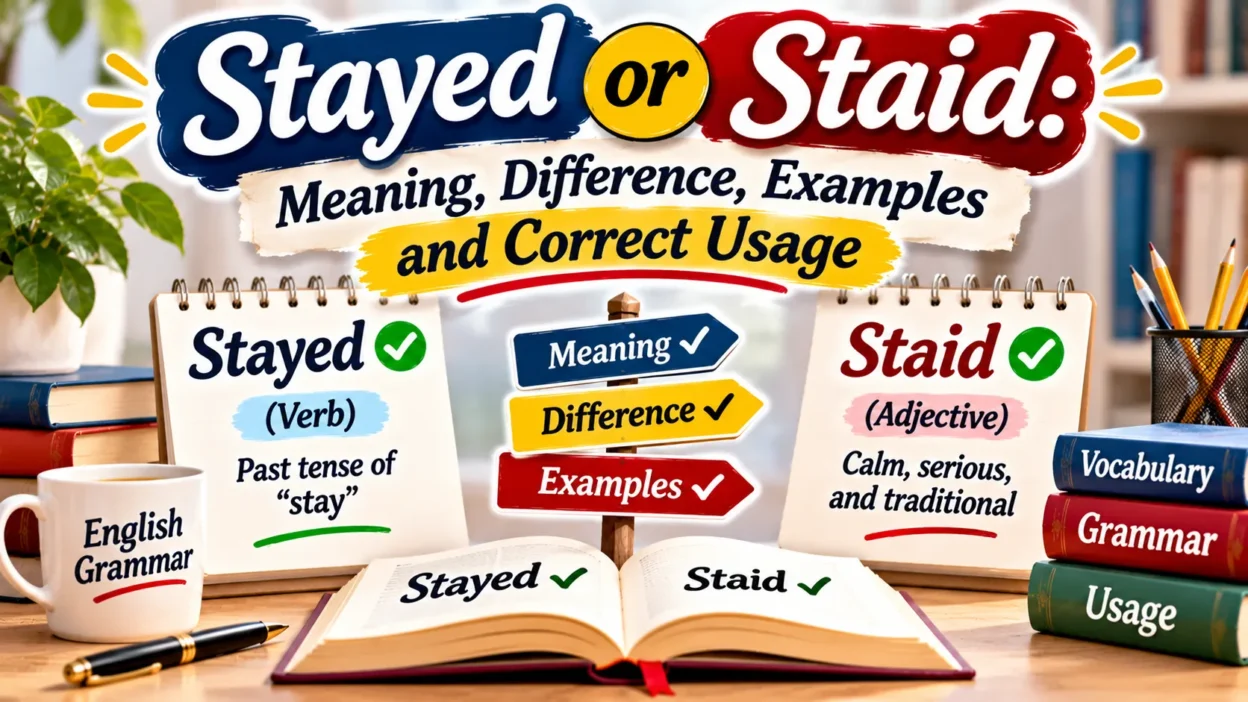
Stayed or staid? These two English words sound exactly alike, but they have different meanings and grammatical uses. Because they share the same pronunciation, it’s easy to confuse them when writing an email, completing an assignment, or creating professional content. However, understanding their meanings makes choosing the correct spelling much easier.
The word stayed is the past tense and past participle of stay. It means remained in a place, continued in a particular condition, or did not leave. For example, “She stayed at home during the weekend.” On the other hand, staid is an adjective that describes someone or something as serious, calm, reserved, traditional, or not very exciting. For example, “He has a staid personality.”
Although both words are correct, you cannot use them interchangeably. The right choice depends on whether you’re describing an action or a personality, appearance, or atmosphere. In this guide, you’ll discover the difference between stayed and staid, explore practical examples, learn common mistakes, and understand how to remember each spelling.
🔍 Stayed vs Staid: What’s the Difference?
The main difference between stayed and staid is their meaning and part of speech. Stayed is a verb form that describes remaining somewhere or continuing in a particular condition. Staid is an adjective that describes something serious, respectable, conventional, or restrained.
| Word | Part of Speech | Meaning | Example |
|---|---|---|---|
| Stayed | Verb (past tense and past participle) | Remained in a place or condition | We stayed at the hotel. |
| Staid | Adjective | Serious, reserved, or conventional | He prefers a staid lifestyle. |
Stayed answers questions such as:
- Where did someone remain?
- How long did someone remain?
- What condition continued?
Staid answers questions such as:
- What is someone’s personality like?
- How would you describe an atmosphere?
- Is something traditional or restrained?
Consider these examples:
- She stayed with her grandparents. (Correct)
- She has a staid personality. (Correct)
- She staid with her grandparents. (Incorrect in standard modern English)
- The room stayed and formal. (Incorrect)
The easiest rule is to remember that stayed describes remaining or continuing, while staid describes a serious or conventional quality.
📖 What Does Stayed Mean?
Stayed is the simple past tense and past participle of the verb stay. It means remained in a particular place, continued in a condition, or did not leave.
People use stayed in everyday conversations, travel writing, professional communication, and storytelling. It can describe physical location, emotional situations, relationships, or ongoing conditions.
For example, when you say, “I stayed at home yesterday,” you’re explaining that you remained at home instead of going somewhere else.
Examples of stayed in sentences:
- We stayed at a beautiful hotel near the beach.
- She stayed home because she wasn’t feeling well.
- He stayed calm during the difficult situation.
- They stayed together throughout the journey.
- I stayed late at the office to finish my work.
- The children stayed with their grandparents.
- She stayed positive despite the challenges.
- The weather stayed warm throughout the afternoon.
- He stayed silent during the meeting.
- We stayed in touch after graduation.
In each example, stayed describes an action or continued state. It tells the reader that someone or something remained in a particular place or condition.
📚 What Does Staid Mean?
Staid is an adjective that describes someone or something as serious, respectable, traditional, reserved, or lacking excitement. It often suggests a calm and conventional personality or atmosphere.
People commonly use staid in formal writing, literature, professional descriptions, and discussions about personality or lifestyle.
For example, if someone says, “The company has a staid corporate culture,” they mean its working environment is formal, traditional, and perhaps not particularly adventurous.
Examples of staid in sentences:
- He prefers a staid and predictable lifestyle.
- The company has a reputation for its staid culture.
- Her staid personality makes her seem very serious.
- The ceremony followed a traditional and staid format.
- The restaurant has a quiet, staid atmosphere.
- His staid appearance reflects his conservative personality.
- The organization maintains a staid approach to business.
- She chose a staid outfit for the formal event.
- The professor has a thoughtful but staid manner.
- Their conversations often focus on serious topics.
Unlike stayed, the word staid does not describe an action. It describes a quality, personality, appearance, or atmosphere.
✍️ When to Use Stayed in a Sentence
Use stayed when describing someone or something that remained in a place, continued in a condition, or did not move away. It is a common verb form with several everyday uses.
🏠 Describing a Location
Use stayed when explaining where someone remained or spent time.
Examples:
- We stayed at my uncle’s house last weekend.
- She stayed in New York for three days.
- They stayed near the airport overnight.
- I stayed inside because it was raining.
- He stayed at the hotel during the conference.
❤️ Describing Relationships
The word can also describe people who remained together or maintained a relationship.
Examples:
- They stayed together despite their differences.
- We stayed friends after leaving school.
- She stayed close to her family.
- The couple stayed committed to each other.
- They stayed in touch for many years.
😊 Describing Emotions and Conditions
Use stayed when a feeling, condition, or situation continued over time.
Examples:
- He stayed calm during the emergency.
- She stayed optimistic about her future.
- The patient stayed comfortable throughout the procedure.
- The room stayed quiet during the presentation.
- The temperature stayed below freezing.
💼 Describing Work and Activities
You can use stayed to explain that someone continued working or participating in an activity.
Examples:
- I stayed late to complete the report.
- She stayed after class to ask a question.
- The employees stayed focused on their goals.
- He stayed at the office until evening.
- We stayed involved in the project.
🧠 When to Use Staid in a Sentence
Use staid when describing someone or something that seems serious, traditional, restrained, or conventional. It is an adjective, so it usually modifies a noun or appears after a linking verb.
👔 Describing Personality
Use staid to describe someone who behaves in a serious, reserved, or conventional manner.
Examples:
- My grandfather has a staid personality.
- She is known for her staid and thoughtful nature.
- His staid manner makes him seem very mature.
- The manager has a serious, staid personality.
- Despite his staid appearance, he enjoys traveling.
🏢 Describing a Workplace or Organization
The word can describe an organization with a traditional, formal, or conservative culture.
Examples:
- The company maintains a staid business culture.
- The bank has a reputation for its staid approach.
- Their staid corporate environment discourages experimentation.
- The organization follows a staid management style.
- The institution has a long-standing and staid reputation.
🎭 Describing an Atmosphere
Use staid when discussing a setting that feels formal, restrained, or lacking excitement.
Examples:
- The conference had a rather staid atmosphere.
- The restaurant felt elegant but slightly staid.
- The event followed a staid and traditional format.
- The museum maintains a quiet, staid environment.
- The meeting was formal and somewhat staid.
👗 Describing Style and Appearance
Staid can also describe clothing, design, or presentation that looks conventional and conservative.
Examples:
- He wore a staid suit to the business meeting.
- The designer avoided bright colors in favor of a staid style.
- Her outfit looked elegant but a little staid.
- The building features a traditional and staid design.
- They selected a staid color scheme for the office.
🔤 Stayed and Staid: Parts of Speech and Word Forms
Understanding the grammatical forms of both words helps you recognize how they function in sentences.
| Word | Part of Speech | Word Form | Example |
|---|---|---|---|
| Stay | Verb | Base form | I stay at home. |
| Stays | Verb | Third-person singular | She stays with us. |
| Stayed | Verb | Past tense | We stayed overnight. |
| Stayed | Verb | Past participle | They have stayed here before. |
| Staying | Verb | Present participle | He is staying with friends. |
| Staid | Adjective | Descriptive form | She has a staid personality. |
Notice that stayed belongs to the verb family of stay. Meanwhile, staid is an adjective with a separate meaning.
Examples:
- I stay here every summer.
- She stays with her parents.
- They stayed for two weeks.
- We have stayed at that hotel before.
- He is staying with his brother.
- The professor has a staid personality.
⚖️ Stayed vs Staid: Examples Side by Side
Comparing both words in similar contexts can help you understand when each spelling belongs in a sentence.
| Stayed | Staid |
|---|---|
| She stayed at home. | She has a staid personality. |
| He stayed calm. | He prefers a staid lifestyle. |
| They stayed together. | Their relationship appears conventional and staid. |
| We stayed at the hotel. | The hotel has a quiet, staid atmosphere. |
| She stayed late at work. | She has a serious and staid manner. |
| The weather stayed warm. | The ceremony was formal and staid. |
| He stayed silent. | His appearance seemed staid. |
| They stayed focused. | The organization has a staid culture. |
| I stayed with my family. | My grandfather is rather staid. |
| The children stayed indoors. | The classroom had a staid atmosphere. |
The examples show that stayed describes what happened, while staid describes what someone or something is like.
🧩 Why Are Stayed and Staid So Often Confused?
Stayed and staid are examples of homophones. Homophones are words that share the same pronunciation but have different spellings and meanings.
Because both words sound alike, listeners cannot identify the correct spelling simply by hearing them. Writers need to understand the context to select the right word.
English has many commonly confused homophone pairs, including:
| Word Pair | Difference |
|---|---|
| Stayed / Staid | Remained somewhere / Serious or conventional |
| See / Sea | Look at something / Large body of salt water |
| Write / Right | Put words on paper / Correct or opposite of left |
| Hear / Here | Perceive sound / In this place |
| Meet / Meat | Come together / Food from animal flesh |
| Peace / Piece | Calm / A part of something |
| Brake / Break | Device that slows a vehicle / Separate or damage |
| Plain / Plane | Simple or ordinary / Aircraft |
The best way to avoid confusion is to identify the role of the word in the sentence. If you need a verb describing an action, stayed is usually the correct choice. If you need an adjective describing a serious or traditional quality, use staid.
🔄 Synonyms for Stayed and Staid
Learning synonyms helps you understand the meaning of each word and gives you more options when writing. However, the synonyms for stayed and staid are different because the words serve different grammatical purposes.
Synonyms for Stayed
The word stayed can mean remained, continued, or did not leave.
- Remained
- Continued
- Lingered
- Waited
- Resided
- Lived
- Persisted
- Endured
- Lasted
- Rested
- Maintained
- Withstood
Examples:
- She stayed at home. → She remained at home.
- He stayed calm. → He remained calm.
- They stayed in the city. → They resided in the city.
- The tradition stayed alive. → The tradition continued.
Synonyms for Staid
The word staid describes someone or something serious, conventional, or reserved.
- Serious
- Formal
- Conservative
- Traditional
- Reserved
- Conventional
- Restrained
- Dignified
- Composed
- Sedate
- Unexciting
- Respectable
Examples:
- He has a staid personality. → He has a reserved personality.
- The company has a staid culture. → The company has a conventional culture.
- The event felt staid. → The event felt formal and restrained.
⚠️ Common Mistakes When Using Stayed and Staid
Although both words are correct, using one in place of the other can change the meaning of a sentence or make it grammatically incorrect.
Here are some common mistakes to avoid:
| Incorrect Sentence | Correct Sentence | Explanation |
|---|---|---|
| She staid at home. | She stayed at home. | Describes remaining somewhere. |
| He has a stayed personality. | He has a staid personality. | Describes a serious personality. |
| We staid at the hotel. | We stayed at the hotel. | Uses the past tense of stay. |
| The company has a stayed culture. | The company has a staid culture. | Describes a traditional culture. |
| They staid together for years. | They stayed together for years. | Describes a continuing relationship. |
| The professor seemed stayed. | The professor seemed staid. | Describes a reserved personality. |
A useful distinction is that stayed normally follows a subject as a verb, while staid usually modifies a noun or follows a linking verb.
For example:
- She stayed quiet during the meeting. (She continued to be quiet.)
- She has a staid personality. (Her personality is serious and reserved.)
Both sentences are correct, but they communicate different ideas.
💡 Easy Tricks to Remember Stayed or Staid
A few simple memory techniques can help you choose the right word without checking a dictionary every time.
Trick 1: Remember STAYED = STAY
The word stayed comes directly from stay. If you’re talking about remaining somewhere or continuing in a situation, use stayed.
- I stayed home.
- She stayed calm.
- They stayed together.
Trick 2: Remember STAID = SERIOUS
Connect staid with a serious, traditional, or reserved personality. It describes a quality rather than an action.
- He has a staid personality.
- The office has a staid atmosphere.
- She prefers a staid lifestyle.
Trick 3: Check the Sentence Structure
Ask yourself whether the sentence describes an action or a quality.
- Action: We stayed at the hotel.
- Quality: The hotel has a staid atmosphere.
If you can replace the word with remained, you probably need stayed. If you can replace it with serious or conventional, you probably need staid.
📝 Practice Quiz: Stayed or Staid?
Test your understanding by choosing the correct word for each sentence. Consider the meaning and grammatical role before selecting your answer.
1. We ______ at home during the storm.
- A. Stayed
- B. Staid
2. He has a rather ______ personality.
- A. Stayed
- B. Staid
3. The children ______ with their grandparents.
- A. Stayed
- B. Staid
4. The company maintains a ______ corporate culture.
- A. Stayed
- B. Staid
5. She ______ calm during the interview.
- A. Stayed
- B. Staid
6. The restaurant has an elegant but ______ atmosphere.
- A. Stayed
- B. Staid
7. They ______ together for many years.
- A. Stayed
- B. Staid
8. His ______ manner made him appear very serious.
- A. Stayed
- B. Staid
9. We have ______ in this neighborhood since childhood.
- A. Stayed
- B. Staid
10. The professor is known for his ______ approach.
- A. Stayed
- B. Staid
Answer Key:
- A — Stayed
- B — Staid
- A — Stayed
- B — Staid
- A — Stayed
- B — Staid
- A — Stayed
- B — Staid
- A — Stayed
- B — Staid
If you answered all ten correctly, you understand the difference between these two commonly confused words.
❓ Frequently Asked Questions About Stayed or Staid
Is it stayed or staid?
Both spellings are correct English words, but they have different meanings. Stayed is the past tense of stay and means remained. Staid is an adjective that means serious, reserved, or conventional.
What does stayed mean?
Stayed is the past tense and past participle of stay. It means remained in a place, continued in a condition, or did not leave. For example, “We stayed at home yesterday.”
What does staid mean?
Staid is an adjective describing someone or something as serious, respectable, traditional, or restrained. For example, “He prefers a staid lifestyle.”
Are stayed and staid homophones?
Yes. They are homophones because they have the same pronunciation but different spellings, meanings, and grammatical functions.
Is staid a real word?
Yes. Staid is a recognized English adjective. It commonly describes someone with a serious, reserved, or conventional personality or something with a formal atmosphere.
What is the difference between stayed and stay?
Stay is the base form of the verb, while stayed is its simple past tense and past participle.
Examples:
- I stay with my parents.
- I stayed with my parents last weekend.
What is another word for staid?
Common synonyms for staid include serious, reserved, formal, traditional, conservative, conventional, restrained, and dignified.
What is another word for stayed?
Depending on the context, synonyms for stayed include remained, continued, lingered, resided, waited, and persisted.
Can staid describe a person?
Yes. You can use staid to describe someone who behaves in a serious, calm, reserved, or conventional way. For example, “My uncle has a staid personality.”
Is staid positive or negative?
The meaning depends on the context. Staid can suggest reliability, respectability, and seriousness, but it can also imply that someone or something is too formal, conservative, or lacking excitement.
Can stayed and staid appear in the same sentence?
Yes. For example: “He stayed in a quiet hotel with a rather staid atmosphere.” Here, stayed describes where he remained, while staid describes the hotel’s atmosphere.
✅ Conclusion: Stayed or Staid — Which Word Should You Choose?
The difference between stayed and staid becomes simple when you understand their meanings. Use stayed when describing someone or something that remained in a place, continued in a condition, or did not leave. Use staid when describing a serious, reserved, traditional, or conventional personality, appearance, or atmosphere.
Remember this easy rule: Stayed comes from stay, while staid describes a serious or conventional quality. Both words are correct, but they cannot replace each other in a sentence.
By paying attention to the context and grammatical role, you can choose the right spelling and make your English writing clearer, more accurate, and more professional.

Vivian Mercer is an English language writer and vocabulary enthusiast who specializes in synonyms, word meanings, grammar, idioms, and language usage. She creates accurate, easy-to-understand content that helps readers improve their English skills with confidence.