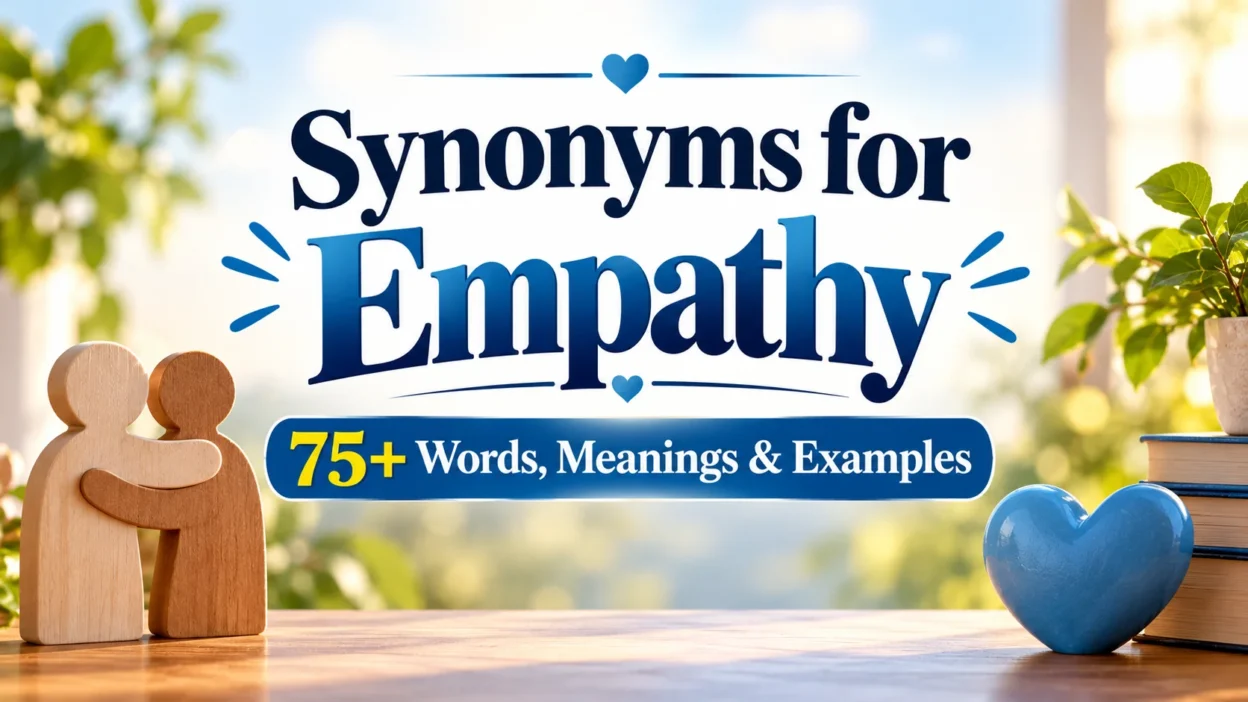
Empathy is the ability to understand another person’s feelings, emotions, and experiences from their perspective. It helps people build stronger relationships, communicate with kindness, and respond thoughtfully when someone is struggling. Learning synonyms for empathy can make your writing more expressive, whether you’re describing emotional understanding, compassion, supportive behavior, or the ability to connect with others.
Common alternatives include understanding, compassion, sensitivity, emotional intelligence, fellow feeling, and consideration. However, these words have slightly different meanings. Some emphasize sharing another person’s emotions, while others focus on caring about their well-being or recognizing their point of view.
In this guide, you’ll find useful alternatives, their meanings, example sentences, formal and informal expressions, and tips for choosing the right word for different situations.
💙 What Does Empathy Mean?
Empathy means understanding or relating to another person’s emotional experience. It involves recognizing how someone feels and trying to see a situation from their perspective, even when you have not experienced the same circumstances yourself.
For example, if a friend loses a job, an empathetic response involves acknowledging their disappointment and understanding why the experience may be difficult. You do not have to agree with every decision they make to recognize their feelings.
Empathy is related to compassion and sympathy, but the terms are not identical. Empathy focuses on understanding another person’s experience, sympathy involves feeling concern for their difficulties, and compassion adds a desire to help or ease their suffering.
✨ Common Synonyms for Empathy
Several words can express emotional understanding, sensitivity, and concern for other people. The best choice depends on whether you want to emphasize understanding someone’s feelings, caring about their situation, or responding with kindness.
- Understanding — recognizing another person’s feelings or point of view.
- Compassion — concern for another person’s suffering and a desire to help.
- Sensitivity — awareness of other people’s feelings and needs.
- Sympathy — concern for someone experiencing hardship.
- Kindness — a caring and considerate attitude toward others.
- Consideration — thoughtful attention to other people’s feelings.
- Emotional intelligence — the ability to recognize and manage emotions.
- Humanity — compassion and concern for human welfare.
- Warmth — a friendly and caring manner.
- Tenderness — gentle concern and affection.
- Thoughtfulness — careful attention to another person’s needs.
- Perceptiveness — the ability to notice and understand feelings or behavior.
- Attentiveness — giving careful attention to someone.
- Patience — willingness to listen and respond without rushing to judgment.
- Acceptance — recognizing another person without unnecessary judgment.
- Respect — treating others and their experiences with consideration.
- Open-mindedness — willingness to consider different perspectives.
- Affection — a feeling of fondness or caring.
- Supportiveness — offering encouragement or assistance.
- Fellow feeling — a sense of shared understanding or emotional connection.
These alternatives overlap, but they are not interchangeable in every sentence. For example, compassion emphasizes concern for suffering, while perceptiveness focuses on recognizing what someone may be feeling.
🤝 Synonyms for Empathy That Emphasize Understanding
When you want to describe someone’s ability to understand another person’s perspective, words such as understanding, awareness, insight, perceptiveness, and emotional intelligence can be particularly useful.
| Synonym | Meaning | Example sentence |
|---|---|---|
| Understanding | Recognizing another person’s feelings | Her understanding helped him feel heard. |
| Awareness | Recognizing emotional needs or circumstances | He showed awareness of her concerns. |
| Insight | Deep understanding of a situation | Her insight helped explain his reaction. |
| Perceptiveness | Noticing subtle feelings or behavior | His perceptiveness helped him recognize her discomfort. |
| Emotional intelligence | Recognizing and responding to emotions | Emotional intelligence improved their communication. |
| Perspective-taking | Considering another person’s viewpoint | Perspective-taking helped resolve the disagreement. |
| Attentiveness | Listening and noticing carefully | Her attentiveness made the conversation easier. |
| Receptiveness | Being willing to consider another person’s feelings or ideas | His receptiveness encouraged an honest discussion. |
For example, instead of saying, “She has empathy for her coworkers,” you could write, “She understands her coworkers’ concerns and considers their perspectives.”
This alternative makes the behavior more specific. It explains what the person does rather than relying on a general description.
💗 Synonyms for Empathy That Emphasize Compassion
Sometimes the intended meaning is less about understanding an emotion and more about caring for someone who is experiencing hardship. In these situations, compassion, kindness, humanity, tenderness, and benevolence may communicate the idea more effectively.
| Synonym | Meaning | Example sentence |
|---|---|---|
| Compassion | Concern for suffering and a wish to help | She responded with compassion. |
| Kindness | A caring and helpful attitude | His kindness comforted the family. |
| Humanity | Concern for people’s welfare | The volunteers acted with humanity. |
| Tenderness | Gentle affection or concern | She treated the child with tenderness. |
| Benevolence | A desire to do good for others | The organization showed benevolence toward vulnerable families. |
| Generosity | Willingness to give or help | His generosity made a difficult week easier. |
| Altruism | Concern for others without expecting personal gain | Their altruism inspired the community. |
| Goodwill | A friendly and helpful attitude | The team approached the disagreement with goodwill. |
Although these words can express caring behavior, they do not all mean empathy itself. Someone can be generous without fully understanding another person’s emotions, just as someone can understand a feeling without taking action to help.
Choose the term that reflects the particular quality you want to describe.
🧠 Formal Synonyms for Empathy
In academic writing, professional communication, psychology-related discussions, and workplace documents, more precise vocabulary can help explain emotional understanding without sounding repetitive.
Useful options include perspective-taking, emotional awareness, interpersonal sensitivity, affective understanding, compassionate awareness, and emotional intelligence.
| Formal expression | Example sentence |
|---|---|
| Perspective-taking | Perspective-taking helped the manager understand the employee’s concerns. |
| Emotional awareness | Emotional awareness supported more effective communication. |
| Interpersonal sensitivity | Interpersonal sensitivity is valuable in collaborative environments. |
| Affective understanding | Affective understanding involves recognizing another person’s emotional experience. |
| Emotional intelligence | Emotional intelligence can support constructive conflict resolution. |
| Compassionate awareness | Compassionate awareness encouraged a more thoughtful response. |
| Consideration | Consideration for others strengthened the team’s working relationship. |
| Receptiveness | Receptiveness to different viewpoints improved the discussion. |
The most suitable expression depends on the context. In a workplace review, interpersonal sensitivity may describe a professional skill. In an essay about understanding another person’s viewpoint, perspective-taking may be more precise.
Avoid using technical-sounding language when a simple word communicates the idea more clearly. Formal writing should be accurate and readable rather than unnecessarily complicated.
💬 Informal Words and Phrases for Empathy
In everyday conversations, text messages, and personal writing, natural expressions often work better than formal vocabulary. You can describe empathy using phrases such as understanding where someone is coming from, being there for someone, relating to someone’s feelings, or putting yourself in someone else’s shoes.
| Informal expression | Example sentence |
|---|---|
| Understanding | Thanks for understanding how I feel. |
| Being there for someone | She was there for me when things got difficult. |
| Relating to someone | I can relate to what you’re going through. |
| Putting yourself in someone’s shoes | Try putting yourself in his shoes. |
| Being considerate | He was considerate of her feelings. |
| Showing you care | She showed she cared by listening. |
| Being supportive | My friends were supportive during a hard time. |
| Getting someone’s perspective | It helped to understand his perspective. |
These phrases make emotional support sound personal and approachable. For example, “I appreciate your empathy” could become “Thanks for understanding what I’m going through.”
However, relating to someone usually suggests recognizing a similar experience, while empathy can exist even when two people have lived very different lives.
🌱 Words Related to Empathy in Personal Relationships
Empathy plays an important role in friendships, family relationships, and romantic partnerships. It helps people listen carefully, recognize emotional needs, and respond without immediately dismissing or judging another person’s experience.
Related words include trust, patience, validation, respect, acceptance, attentiveness, and supportiveness. These terms describe qualities that often help empathetic communication, even though they are not direct synonyms.
For example, a partner may show empathy by listening without interrupting, acknowledging disappointment, and asking what kind of support would help. A friend might demonstrate understanding by respecting someone’s need for space instead of insisting that they talk immediately.
| Related word | Connection to empathy | Example |
|---|---|---|
| Validation | Acknowledging someone’s feelings as real to them | He validated her frustration. |
| Trust | Creating a sense of emotional safety | Trust made the conversation more honest. |
| Patience | Allowing someone time to express feelings | She listened patiently. |
| Respect | Taking another person’s perspective seriously | He respected her point of view. |
| Supportiveness | Offering encouragement or assistance | Their support helped him recover. |
| Acceptance | Avoiding unnecessary judgment | She responded with acceptance. |
These words are especially useful when describing specific actions. Rather than simply labeling someone empathetic, you can explain how their listening, patience, or support made a difference.
🏢 Synonyms for Empathy in the Workplace
In professional settings, empathy can improve communication, teamwork, leadership, and conflict resolution. Managers and coworkers often demonstrate it by listening to concerns, considering different circumstances, and responding respectfully.
Useful workplace alternatives include understanding, consideration, interpersonal awareness, emotional intelligence, sensitivity, and supportiveness.
For example, a manager who recognizes that an employee is dealing with competing responsibilities may adjust priorities or offer practical assistance. This response combines an understanding of the person’s circumstances with thoughtful action.
Here are some examples of workplace wording:
- “The manager showed understanding toward the employee’s concerns.”
- “Her interpersonal awareness helped prevent misunderstandings.”
- “The team approached the disagreement with consideration.”
- “His emotional intelligence supported constructive feedback.”
- “Their supportive leadership created a more welcoming environment.”
In a résumé or performance review, it is often stronger to describe observable behavior than simply claim to have empathy. For example, “Listened to customer concerns and responded thoughtfully” explains the skill in practical terms.
✍️ How to Use Empathy Synonyms in Sentences
Choosing an appropriate alternative depends on the message you want to convey. A word that works well in a personal conversation may sound too casual in a research paper, while a formal expression may feel unnatural in a friendly message.
Compare these examples:
| Original sentence | Alternative sentence |
|---|---|
| She showed empathy toward her friend. | She responded to her friend with compassion. |
| His empathy helped resolve the issue. | His understanding helped resolve the issue. |
| The counselor demonstrated empathy. | The counselor showed emotional awareness and sensitivity. |
| I appreciate your empathy. | I appreciate your understanding and support. |
| Empathy is important in leadership. | Perspective-taking is valuable in effective leadership. |
| They approached the situation with empathy. | They approached the situation with consideration and compassion. |
Each alternative emphasizes a slightly different quality. Understanding highlights recognizing another person’s experience, compassion emphasizes concern, and support focuses on providing help.
To keep your writing natural, use the word that best matches the situation. You do not need to replace every occurrence of empathy if the original word is already the clearest option.
⚖️ Empathy vs. Sympathy vs. Compassion
Empathy, sympathy, and compassion are closely related, but they describe different aspects of emotional response. Understanding the distinctions helps you select the most accurate word for your sentence.
| Word | Main meaning | Example |
|---|---|---|
| Empathy | Understanding or relating to another person’s feelings | I understand why the loss hurts so much. |
| Sympathy | Feeling concern for someone’s hardship | I’m sorry you’re going through this. |
| Compassion | Caring about suffering and wanting to help | Let me help you through this difficult time. |
Empathy involves trying to understand what someone experiences emotionally. Sympathy communicates concern for their situation, while compassion often includes a motivation to reduce their suffering.
These qualities can occur together. A person might understand a friend’s grief, feel sorry that they are hurting, and offer practical help. Each response contributes something different to the interaction.
🚫 Words That Are Not Exact Synonyms for Empathy
Some words are associated with empathy but do not have the same meaning. Using them as direct replacements may change the message or make a sentence less precise.
| Word | Meaning | Difference from empathy |
|---|---|---|
| Pity | Feeling sorrow for another person’s hardship | May imply viewing someone as unfortunate rather than understanding their perspective. |
| Agreement | Sharing the same opinion | You can understand a person without agreeing with them. |
| Kindness | Acting in a caring manner | Kind behavior does not always require emotional understanding. |
| Sympathy | Concern for someone’s difficulties | It may involve concern without deeply sharing or understanding the person’s feelings. |
| Compassion | Concern for suffering and a desire to help | It emphasizes caring and action rather than understanding alone. |
| Emotional intelligence | Recognizing and managing emotions | It is a broader ability that can include empathy. |
| Sensitivity | Awareness of emotions or circumstances | It may involve noticing feelings without fully understanding them. |
For example, saying “I understand why you are upset” demonstrates an effort to recognize someone’s perspective. Saying “I agree with you” communicates agreement, which is not the same thing.
Choosing the right word allows you to describe emotional understanding accurately without implying feelings, opinions, or actions that may not be present.
❓ Frequently Asked Questions About Synonyms for Empathy
What is the most common synonym for empathy?
Understanding is one of the most common alternatives. Compassion, sensitivity, and emotional awareness are also useful, depending on the intended meaning.
What is a formal word for empathy?
Perspective-taking, emotional intelligence, and interpersonal sensitivity can work in formal or academic writing. The most appropriate choice depends on whether you mean understanding feelings, recognizing emotions, or considering another person’s viewpoint.
What is another word for empathy in a relationship?
Understanding, compassion, consideration, and supportiveness are useful options when describing emotional connection in a relationship.
What is a synonym for empathy at work?
Interpersonal awareness, emotional intelligence, consideration, and understanding can describe empathy-related skills in professional settings.
What is the difference between empathy and compassion?
Empathy involves understanding or relating to another person’s emotional experience. Compassion involves concern for their suffering and often includes a desire to help.
What is the opposite of empathy?
Depending on the context, possible opposites include indifference, insensitivity, and callousness. These words describe a lack of concern or responsiveness to another person’s feelings, but their meanings are not identical.
Can understanding replace empathy in every sentence?
No. Understanding is a useful alternative, but it can refer to intellectual comprehension rather than emotional connection. Use it when the sentence focuses on recognizing someone’s feelings or perspective.
How can I show empathy without using the word?
Describe the behavior directly. For example, write “She listened without judgment and acknowledged his frustration” rather than simply saying “She showed empathy.”
✅ Conclusion
The best synonyms for empathy depend on the quality you want to express. Understanding, compassion, sensitivity, emotional intelligence, consideration, and perspective-taking are useful alternatives, but each highlights a different aspect of emotional awareness or care.
For everyday writing, understanding and support often sound natural. In professional communication, interpersonal sensitivity or emotional intelligence may be more appropriate. When discussing concern for someone who is suffering, compassion may communicate the idea more clearly.
Choose the word that fits the context, preserves your intended meaning, and helps readers understand the behavior or feeling you are describing.

Vivian Mercer is an English language writer and vocabulary enthusiast who specializes in synonyms, word meanings, grammar, idioms, and language usage. She creates accurate, easy-to-understand content that helps readers improve their English skills with confidence.