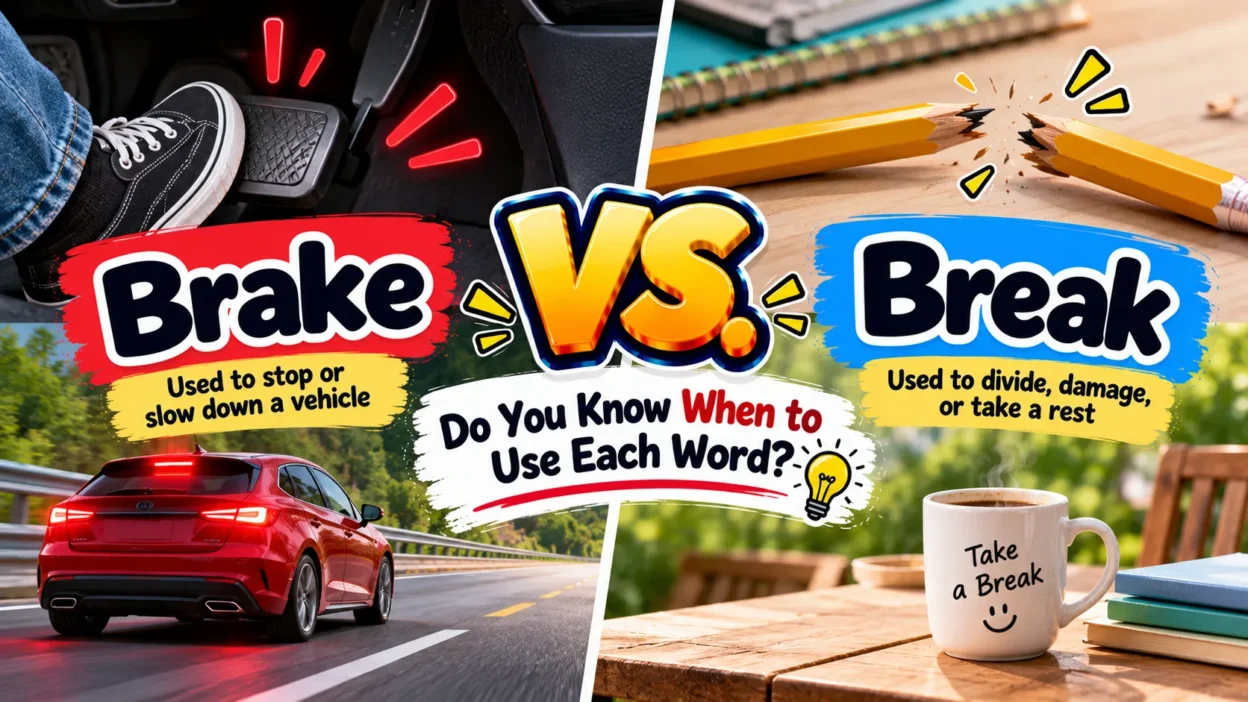
Brake vs. break is a common English word comparison because both words sound exactly alike but have different meanings and spellings. These words are called homophones, and confusing them can change the meaning of a sentence.
The word brake refers to a device or action used to slow down or stop a vehicle. In contrast, break can mean to damage something, separate something into pieces, interrupt an activity, or take a short rest.
For example, “Press the brake to stop the car” refers to controlling a vehicle, while “Be careful not to break the glass” means to avoid damaging it.
In this guide, you will learn the definitions of brake and break, explore their differences, read practical examples, and discover simple tricks to remember which word to use.
🚗 What Does Brake Mean?
Brake is a noun or verb associated with slowing down, stopping, or controlling the movement of a vehicle or machine.
As a noun, a brake is a device that reduces speed or stops movement. As a verb, brake means to apply that device to slow down or stop.
Common meanings of brake
- A stopping device: A mechanism used to slow or stop a vehicle.
- To slow down: To reduce the speed of a moving vehicle.
- To stop: To bring a vehicle or moving object to a halt.
- A control mechanism: A device that helps control movement in machinery.
Examples of brake in sentences
- The driver pressed the brake when the traffic light turned red.
- You should check your car’s brakes regularly.
- She had to brake suddenly to avoid hitting a deer.
- The bicycle’s rear brake needs adjustment.
- He applied the brakes before entering the sharp turn.
- The driver began to brake as the road became slippery.
- My mechanic replaced the worn-out brake pads.
- Always test the brakes before driving a vehicle.
In most everyday situations, brake is connected to vehicles, bicycles, and machinery. If you are talking about slowing down or stopping a car, truck, or bike, brake is usually the correct word.
💔 What Does Break Mean?
Break is a verb and a noun with several meanings. As a verb, it can mean to damage something, separate it into pieces, interrupt an activity, or fail to follow a rule. As a noun, it can refer to a rest, pause, opportunity, or interruption.
Common meanings of break
- To damage: To cause something to crack or stop functioning.
- To separate: To divide something into pieces or parts.
- To interrupt: To stop an activity temporarily.
- To rest: To take a short pause from work or another activity.
- To violate a rule: To fail to follow an agreement, law, or promise.
- To end a connection: To stop a relationship or connection.
- To discover an opportunity: To gain a useful chance or advantage.
Examples of break in sentences
- Be careful not to break the glass.
- I need a short break after working for three hours.
- She accidentally broke her phone screen.
- The students will take a lunch break at noon.
- He promised not to break the rules.
- The strong wind caused a branch to break.
- The detective hopes to break the case open.
- The athlete finally got her big break in professional sports.
The word break has a much wider range of meanings than brake. It can describe physical damage, rest periods, interruptions, and many other situations.
📊 Brake vs Break: Key Differences
The most important difference between brake and break is what each word describes. Brake is associated with stopping or slowing movement, while break refers to damage, separation, interruption, or rest.
| Feature | Brake | Break |
|---|---|---|
| Pronunciation | /breɪk/ | /breɪk/ |
| Part of speech | Noun and verb | Noun and verb |
| Main meaning | A device or action used to slow or stop movement | To damage, separate, interrupt, or rest |
| Common context | Cars, bicycles, and machinery | Objects, activities, rules, and rest periods |
| Past tense | Braked | Broke |
| Past participle | Braked | Broken |
| Example | The driver applied the brake. | She broke the cup. |
| Memory clue | Brake helps stop a vehicle | Break can damage something |
Remember that brake is often related to vehicle control, while break is used in a wide variety of everyday expressions.
✍️ Brake vs Break in Example Sentences
Comparing both words side by side can make their meanings easier to remember.
| Brake | Break |
|---|---|
| Press the brake to stop the car. | Do not break the window. |
| The driver braked suddenly. | The child broke the toy. |
| My bicycle needs a new brake. | I need a break from studying. |
| Check the brakes before your trip. | Try not to break your promise. |
| She applied the brakes near the intersection. | The storm broke several tree branches. |
| The truck’s brakes failed. | The machine broke during operation. |
| He braked before reaching the corner. | They took a short break after lunch. |
| The mechanic repaired the brake system. | The athlete broke the world record. |
Notice how each word fits a different context. If the sentence involves stopping a vehicle, use brake. If it involves damage, rest, interruption, or a change in something, break is often the right choice.
🧠 Easy Tricks to Remember Brake vs Break
You do not need to memorize every definition to distinguish these homophones. A few simple associations can help you choose the correct spelling.
1. Remember that a brake stops a vehicle
Think of a car approaching a red light. The driver presses the brake to slow down.
Example: “Always apply the brake carefully on a wet road.”
If you are discussing stopping or slowing down a vehicle, choose brake.
2. Remember that break can damage something
Think of a glass falling onto the floor and shattering into pieces.
Example: “Please do not break the glass.”
If you mean damage, crack, or separate something, choose break.
3. Connect break with taking a break
You may already use the phrase take a break at work, school, or home.
Example: “Let’s take a ten-minute break.”
A rest or pause is always a break, not a brake.
4. Check the past tense
The past forms offer another useful clue:
- Brake → braked: She braked before the turn.
- Break → broke: She broke the plate.
- Break → broken: The plate is broken.
If you need a past-tense verb meaning damage, broke is correct. If you mean slowing a vehicle, use braked.
🚦 Common Expressions With Brake
The word brake appears in many driving and transportation expressions.
- Apply the brakes: Use the braking system to slow down or stop.
- Hit the brakes: Apply the brakes suddenly or firmly.
- Brake pedal: The pedal used to operate a vehicle’s braking system.
- Brake lights: Lights that signal a vehicle is slowing down or stopping.
- Brake pads: Components that create friction to slow a vehicle.
- Emergency brake: A braking mechanism intended to hold a vehicle stationary, often called a parking brake.
- Brake system: The collection of components used to slow or stop a vehicle.
- Brake sharply: Slow down quickly by applying the brakes.
Examples in sentences
- The driver had to hit the brakes when a dog crossed the road.
- My mechanic replaced the worn-out brake pads.
- The car’s brake lights were not working properly.
- Always inspect the brake system before a long trip.
These expressions relate to vehicle control, which makes brake the correct spelling.
☕ Common Expressions With Break
The word break appears in many everyday phrases that describe rest, interruption, damage, and opportunity.
- Take a break: Stop working or doing an activity for a short time.
- Break the rules: Fail to follow established rules.
- Break a promise: Fail to do what you promised.
- Break the ice: Help people feel comfortable in a social situation.
- Break the news: Tell someone important or surprising information.
- Break a record: Achieve a result better than a previous record.
- Break down: Stop functioning, or become emotionally overwhelmed, depending on context.
- Break out: Begin suddenly or escape from somewhere.
- Give someone a break: Treat someone less harshly or allow them some relief.
- A lucky break: An unexpected opportunity or fortunate event.
Examples in sentences
- I usually take a break after finishing my morning tasks.
- The new employee told a joke to break the ice.
- She was nervous about having to break the news.
- The runner trained hard to break the record.
- Our washing machine broke down yesterday.
- Everyone deserves a break after a difficult week.
These phrases demonstrate that break has many meanings beyond physically damaging something.
⚠️ Common Mistakes When Using Brake and Break
Because the words sound identical, spelling errors are easy to make. Learning the most common mistakes can help you avoid them.
Mistake 1: Using break when referring to a vehicle’s stopping device
Incorrect: The driver pressed the break to stop the car.
Correct: The driver pressed the brake to stop the car.
The stopping device is a brake.
Mistake 2: Using brake when referring to rest
Incorrect: I need a short brake from work.
Correct: I need a short break from work.
A rest period is a break.
Mistake 3: Confusing brake and break in the past tense
Incorrect: The driver broke suddenly to avoid the obstacle.
Correct: The driver braked suddenly to avoid the obstacle.
Use braked when describing the action of slowing a vehicle. Use broke when describing damage or separation.
Mistake 4: Confusing brake pads with broken parts
Incorrect: The mechanic replaced the car’s break pads.
Correct: The mechanic replaced the car’s brake pads.
Brake pads are parts of a vehicle’s braking system.
Mistake 5: Writing “break the rules” incorrectly
Incorrect: He decided to brake the rules.
Correct: He decided to break the rules.
The expression means to violate or fail to follow rules.
🔍 Brake vs. Break vs. Braking: What’s the Difference?
The words brake, break, and braking are related in appearance, but they serve different purposes.
| Word | Meaning | Example |
|---|---|---|
| Brake | A device or action used to slow or stop movement | The brake needs repair. |
| Break | To damage, interrupt, or rest | Let’s take a break. |
| Braking | The act or process of slowing a vehicle | Braking suddenly can be dangerous. |
Examples in sentences
- The mechanic inspected the brake before the journey.
- I took a short break after lunch.
- The driver began braking when traffic slowed.
Braking is the -ing form of the verb brake. It is commonly used when discussing vehicle movement and driving techniques.
📝 Brake vs. Break Practice Quiz
Test your understanding by choosing the correct word in each sentence.
- The driver pressed the (brake / break) when the light turned red.
- I need a short (brake / break) after studying.
- Please do not (brake / break) the glass.
- The mechanic replaced the worn-out (brake / break) pads.
- She accidentally (braked / broke) her phone screen.
- The driver (braked / broke) to avoid hitting the animal.
- He promised not to (brake / break) the rules.
- Let’s take a five-minute (brake / break).
Answer key
- Brake — A device used to stop a vehicle.
- Break — A short rest.
- Break — To damage something.
- Brake — Part of a vehicle’s stopping system.
- Broke — The past tense of break.
- Braked — The past tense of brake.
- Break — To violate a rule.
- Break — A pause from an activity.
If you answered all eight correctly, you understand the main distinction between these words.
❓ Frequently Asked Questions About Brake vs. Break
Is it brake or break?
Both words are correct, but they have different meanings. Brake refers to a device or action used to slow down or stop a vehicle. Break means to damage, separate, interrupt, or take a rest.
Are brake and break homophones?
Yes. Brake and break are homophones because they have the same pronunciation but different spellings and meanings.
How do you spell brake on a car?
The correct spelling is brake. A car’s brake system helps slow down or stop the vehicle.
Is it take a brake or take a break?
The correct expression is take a break. It means to pause an activity or rest for a short time.
Is it break the rules or brake the rules?
The correct phrase is break the rules. It means to violate or fail to follow rules.
What is the past tense of brake?
The past tense of brake is braked. For example, “The driver braked before reaching the intersection.”
What is the past tense of break?
The past tense of break is broke, and its past participle is broken. For example, “She broke the cup,” and “The cup is broken.”
Can brake and break be used in the same sentence?
Yes. For example, “The driver pressed the brake to avoid hitting a box that could break if the car ran over it.” The first word refers to stopping the vehicle, while the second refers to possible damage.
🏁 Conclusion
The difference between brake vs. break is simple once you connect each word with its meaning. A brake helps slow down or stop a vehicle, while break can mean to damage something, interrupt an activity, violate a rule, or take a rest.
Remember this easy rule: brake to stop, break to damage or pause. Using this memory trick and practicing with example sentences will help you choose the correct word in everyday writing.

Vivian Mercer is an English language writer and vocabulary enthusiast who specializes in synonyms, word meanings, grammar, idioms, and language usage. She creates accurate, easy-to-understand content that helps readers improve their English skills with confidence.