
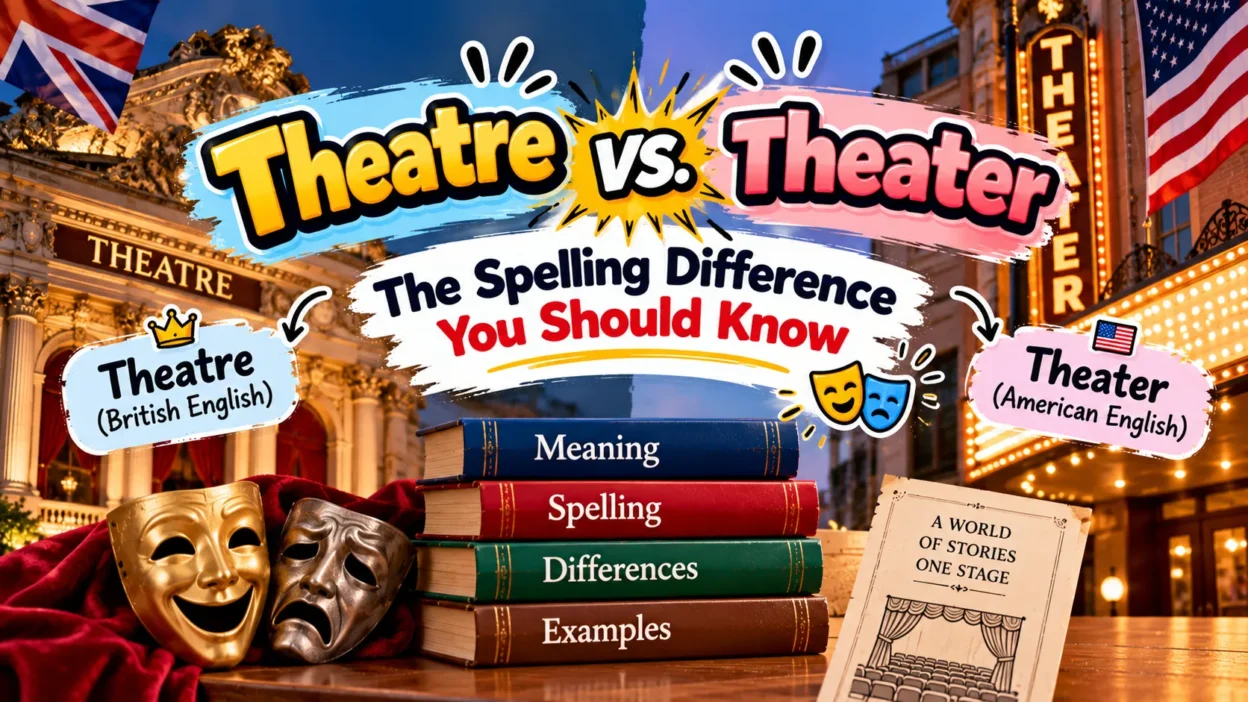
Theatre vs. theater is a common spelling comparison that confuses many English learners and writers. Both words are correct, and both refer to a place where plays are performed, the art of dramatic performance, or the world of live entertainment. The main difference is regional spelling: theatre is preferred in British English, while theater is the standard spelling in American English.
Although these words have the same basic meaning and pronunciation, choosing the correct spelling helps you maintain consistency in your writing. If you are writing an article for a US audience, theater is generally the better choice. For readers in the United Kingdom, theatre is usually preferred.
Understanding this difference is especially useful when writing blog posts, academic assignments, business documents, and educational content. In this guide, you will learn what both words mean, how they are used, why their spellings differ, and which version you should choose for your audience.
🎭 What Does Theatre Mean?
Theatre is the British English spelling of a word that describes dramatic performances, the art of acting, or a building where plays and other live performances take place.
The word can refer to both the physical venue and the broader performing arts. It may include stage plays, musicals, dramatic productions, and other live performances presented to an audience.
Examples:
- We visited the theatre to watch a new play.
- She studied theatre at university.
- The local theatre hosts live performances every weekend.
- He has a passion for musical theatre.
- The school organized a theatre production for its students.
- The historic theatre has been renovated to preserve its original design.
In British English, theatre is the preferred spelling in these contexts. It is also used in the names of many British performance venues, educational programs, and arts organizations.
The word can sometimes appear in specialized contexts, too. For example, operating theatre is a common British English term for a room where surgical procedures take place. This usage illustrates that the word is not limited to entertainment.
🇺🇸 What Does Theater Mean?
Theater is the American English spelling of the same word. It can refer to a venue for live performances, the art of dramatic production, or the entertainment industry.
In the United States, the spelling theater is widely used in everyday writing, school programs, professional discussions, and venue names.
Examples:
- We went to the theater to see a comedy.
- She wants to pursue a career in theater.
- The school has a modern theater for student performances.
- He enjoys musical theater.
- The new theater opens next month.
- The community theater offers acting classes for beginners.
In American English, theater is generally the preferred spelling for both the building and the performing art. However, some American organizations use theatre in their official names because of tradition, branding, or personal preference.
For instance, if a venue officially uses the spelling Theatre, you should preserve that spelling when referring to the organization by name.
📊 Theatre vs. Theater: Key Differences
The distinction between theatre and theater is primarily regional rather than grammatical or semantic. Both words are nouns and can be used in the same types of sentences.
| Feature | Theatre | Theater |
|---|---|---|
| Preferred variety | British English | American English |
| Meaning | A venue or dramatic art | A venue or dramatic art |
| Pronunciation | Essentially the same | Essentially the same |
| Part of speech | Noun | Noun |
| Example | We visited the theatre. | We visited the theater. |
| Common audience | UK and many British-English contexts | US audiences |
| Correct spelling? | Yes | Yes |
| Related adjective | Theatrical | Theatrical |
Neither spelling is incorrect. The appropriate choice depends on the regional variety of English you are using and the style guide you follow.
For example, a British publication may write, “The theatre is presenting a new production,” while an American publication may write, “The theater is presenting a new production.” Both sentences are grammatically correct and communicate the same idea.
✍️ Theatre vs. Theater in Example Sentences
Comparing both spellings in similar sentences is one of the easiest ways to understand their usage.
| British English | American English |
|---|---|
| We booked tickets for the theatre. | We booked tickets for the theater. |
| She studies theatre at university. | She studies theater in college. |
| The theatre is showing a new production. | The theater is showing a new production. |
| He enjoys musical theatre. | He enjoys musical theater. |
| The theatre reopened after renovations. | The theater reopened after renovations. |
| They visited a historic theatre in London. | They visited a historic theater in New York. |
| The school has a theatre department. | The school has a theater department. |
| We watched the performance at the theatre. | We watched the performance at the theater. |
| The theatre company announced its next play. | The theater company announced its next play. |
| She hopes to become a theatre director. | She hopes to become a theater director. |
Notice that the spelling changes, but the meaning stays the same. Some surrounding vocabulary may differ between British and American English, too. For example, British students commonly attend university, while American students often use college to describe higher education.
When writing for a specific audience, it is helpful to check related regional spellings and vocabulary so that the entire article follows one consistent style.
📝 Why Does British English Use Theatre and American English Use Theater?
The spelling difference comes from the development of English spelling conventions. British English has retained the -re ending in several words influenced by French spelling, including theatre and centre. American English generally favors the -er ending in words such as theater and center.
Spelling reformers in the United States, including Noah Webster, helped popularize several American spelling conventions. Over time, these forms became standard in American dictionaries, educational materials, newspapers, and publishing.
The difference is part of a wider pattern of regional spelling variation.
Here are some familiar examples:
| British English | American English |
|---|---|
| Theatre | Theater |
| Centre | Center |
| Metre | Meter |
| Litre | Liter |
| Fibre | Fiber |
| Calibre | Caliber |
| Spectre | Specter |
| Sabre | Saber |
These examples can help you recognize the pattern, but remember that English spelling has exceptions. Not every word ending in -re automatically changes to -er in American English.
Also, certain words have different meanings depending on their context. For example, meter can refer to a measuring device or a unit of length, while metre is the usual British spelling for the unit of length.
🌎 Which Spelling Should You Use?
The best spelling depends on your audience, publication requirements, and the variety of English you want to follow.
Use theatre when:
- Writing in British English.
- Preparing content for readers in the United Kingdom.
- Following a British publication’s spelling guide.
- Referring to a venue or organization that officially uses Theatre.
Use theater when:
- Writing in American English.
- Creating content primarily for readers in the United States.
- Following an American English style guide.
- Discussing the performing arts in general American usage.
For example, if you are writing a US-focused blog post about entertainment venues, theater is generally the more appropriate spelling. If your article is intended for British readers, theatre will usually fit better.
The most important rule is consistency. Avoid switching between the two forms in the same article unless you are discussing their differences or referring to official names.
🎬 Does Theatre or Theater Mean a Movie Theater?
Both spellings can refer to a place where people watch films, although usage depends on the region and context.
In the United States, movie theater is a common expression for a venue where films are shown. The word theater can also refer to a live performance venue.
In British English, cinema is generally the more common everyday term for a place where films are shown, although theatre can appear in venue names and broader contexts.
Examples:
- American English: We went to the movie theater on Saturday.
- British English: We went to the cinema on Saturday.
- Both varieties: The theater or theatre hosted a live stage performance.
The distinction is not absolute. Individual businesses may use different terms in their official names, so local usage and proper names should always be respected.
🎟️ What Is the Difference Between Theatre, Theater, and Cinema?
These words are related, but they do not always refer to exactly the same thing.
| Word | Main meaning | Example |
|---|---|---|
| Theatre | British spelling for the performing art or a venue | We watched a play at the theatre. |
| Theater | American spelling for the performing art or a venue | We watched a play at the theater. |
| Cinema | Commonly a place where films are shown; also the art of filmmaking | We saw a film at the cinema. |
| Movie theater | A venue where films are screened, especially in US usage | The movie theater has eight screens. |
| Playhouse | A building or venue used for theatrical performances | The actors performed at the local playhouse. |
| Auditorium | A large room used for audiences and performances | The school auditorium hosted the show. |
A theatre or theater may host live plays, musicals, concerts, and other performances. A cinema usually focuses on showing films. An auditorium is a broader term for a room designed to accommodate an audience.
These words can overlap in real-world settings, but they are not always interchangeable.
📚 Related Words: Theatrical, Theatrically, and Theatergoer
Understanding related words can help you use theatre and theater more accurately.
- Theatrical: Related to theatre or characterized by dramatic behavior.
- Theatrically: In a dramatic or theatrical manner.
- Theatergoer: A person who regularly attends theater performances.
- Theatergoing: The activity or habit of attending theater performances.
- Theater company: An organization that produces theatrical performances.
- Theater director: A person responsible for guiding a theatrical production.
- Theater production: A performance created and staged for an audience.
- Musical theater: A form of theatrical performance combining acting, music, and often dance.
- Theater studies: The academic study of theatrical performance and production.
- Theater arts: The creative and practical disciplines involved in theatrical performance.
The adjective theatrical uses the same spelling in both British and American English. For example, both varieties use “a theatrical performance.”
The spelling of related expressions may depend on the publication or organization. When writing an article, choose a consistent regional style for general terms while preserving official titles.
⚠️ Common Mistakes When Using Theatre and Theater
Although the difference is simple, a few common mistakes can lead to inconsistent writing.
Mistake 1: Assuming one spelling is always wrong.
Both theatre and theater are correct. The appropriate form depends on the variety of English being used.
Mistake 2: Mixing regional spellings without a reason.
Writing theatre in one paragraph and theater in another can make an article look inconsistent. Choose one spelling convention and follow it throughout.
Mistake 3: Changing an official name.
A venue may use Theatre in its official name even if it is located in the United States. Do not change the spelling of a proper name just to match your general style.
Mistake 4: Assuming theatre always means live performances.
The word can also refer to a movie venue in some contexts. In American English, movie theater is particularly common, while British English often uses cinema.
Mistake 5: Confusing spelling differences with pronunciation differences.
The words are pronounced essentially the same way. Their difference is mainly written, not spoken.
Mistake 6: Forgetting the target audience.
If you publish for American readers, use theater in your general text. If your readers are primarily British, theatre is usually the better choice.
❓ Frequently Asked Questions About Theatre vs. Theater
Is theatre or theater correct?
Both are correct. Theatre is the preferred spelling in British English, while theater is standard in American English.
Is theatre British or American?
Theatre is primarily associated with British English and is also used in other regions that follow British spelling conventions.
Is theater British or American?
Theater is the standard American English spelling. It is commonly used in US writing, educational programs, and entertainment venues.
Do theatre and theater sound the same?
Yes. The two spellings have essentially the same pronunciation. The difference is regional spelling rather than meaning.
Should I use theater or theatre for a US audience?
Use theater for a US audience unless you are referring to an organization or venue whose official name uses theatre.
Is musical theatre or musical theater correct?
Both are correct. Musical theatre is the usual British spelling, while musical theater is standard in American English.
What is the plural of theatre and theater?
The plurals are theatres and theaters, respectively. Use the spelling that matches the form you have chosen.
Why do Americans spell theater without “re”?
American English generally favors the -er ending in words such as theater and center. This reflects the development of American spelling conventions.
Does theatre have a different meaning from theater?
No. In general usage, both words have the same meaning. The difference is primarily regional spelling, although particular venues may use one form in their official names.
Is a theatre the same as a cinema?
Not always. A theatre or theater can host live performances and, in some contexts, film screenings. A cinema usually refers specifically to a place where films are shown.
🏁 Conclusion
The difference between theatre vs. theater is simple: theatre is the preferred British English spelling, while theater is the standard American English spelling. Both words describe the same performing art or venue and are pronounced essentially the same way.
Use theater when writing for a US audience and theatre when writing for a British audience. If you are referring to a venue, company, or institution by its official name, preserve its chosen spelling.
By understanding this regional difference and staying consistent throughout your writing, you can avoid common spelling mistakes and make your content more appropriate for your readers.

Vivian Mercer is an English language writer and vocabulary enthusiast who specializes in synonyms, word meanings, grammar, idioms, and language usage. She creates accurate, easy-to-understand content that helps readers improve their English skills with confidence.