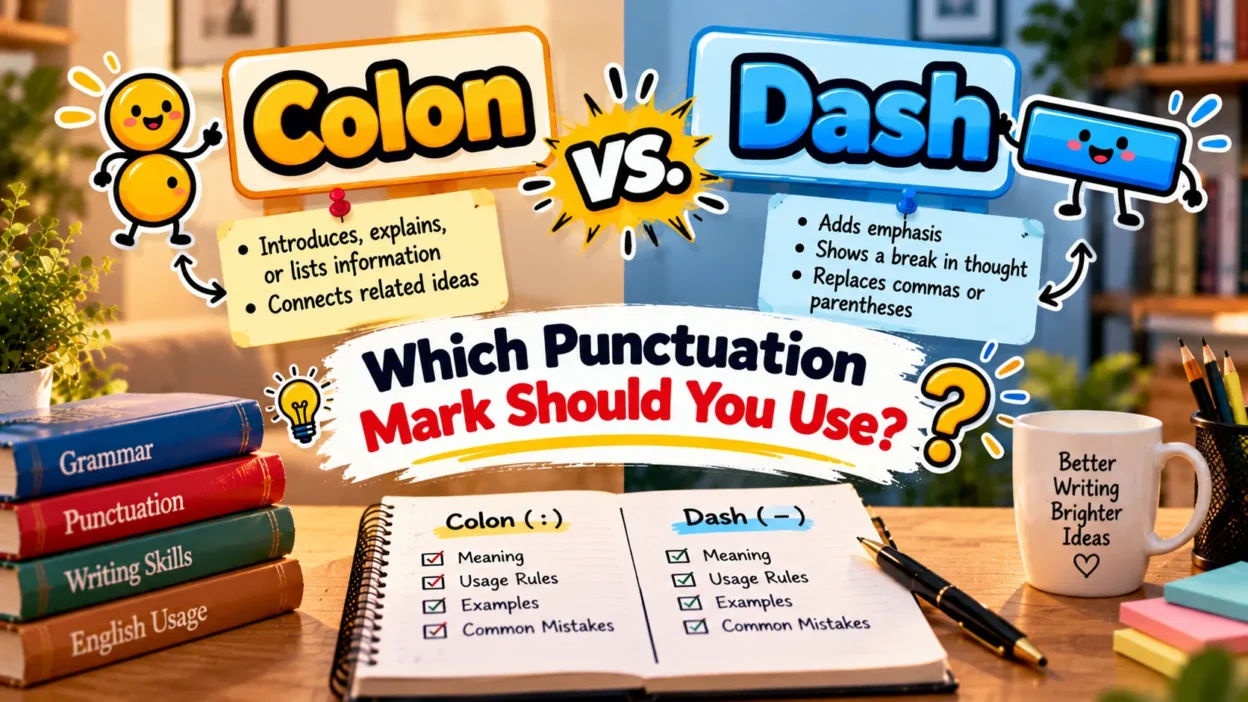
Understanding colon vs dash can make your writing clearer, more polished, and easier to read. Both punctuation marks help connect ideas, introduce information, and create emphasis, but they serve different purposes. A colon (:) often introduces a list, explanation, example, or clarification, while a dash (— or –) can add emphasis, indicate a break in thought, or set off extra information.
For example, a colon works well in “Bring three items: a notebook, a pen, and a folder.” A dash is more suitable for an interruption or dramatic pause: “I had everything ready—or so I thought.”
Although these punctuation marks sometimes appear in similar sentences, they are not interchangeable in every situation. Learning when to use each one will help you avoid punctuation mistakes and communicate your ideas more effectively.
🔎 What Is a Colon?
A colon (:) is a punctuation mark used to introduce information that explains, expands on, or illustrates what comes before it. Writers commonly use colons before lists, explanations, examples, quotations, and important details.
A colon signals that the information following it is closely connected to the preceding statement.
Examples:
- I need three things: paper, scissors, and glue.
- She had one goal: to finish the project on time.
- Remember this rule: always check your work.
- The decision was final: no changes would be accepted.
- He gave one reason for leaving: exhaustion.
In each example, the colon introduces information that develops the preceding statement. It tells the reader to expect an explanation, a clarification, or a series of items.
Colons are especially useful in academic writing, professional documents, instructions, and formal explanations because they create a clear relationship between ideas.
➖ What Is a Dash?
A dash is a punctuation mark used to create a break in a sentence, emphasize information, or separate an additional thought from the main statement. The two most common types are the em dash (—) and the en dash (–).
The em dash is frequently used in general writing to create emphasis or indicate an interruption. The en dash is commonly used to show ranges, such as page numbers or dates.
Examples of em dash usage:
- She finally revealed the truth—she had planned everything.
- My brother—the youngest in the family—is a talented musician.
- I wanted to call you—but I lost your number.
- There was only one problem—we had no transportation.
- The answer was obvious—or so everyone believed.
In these sentences, the dash creates a pause or highlights information. It often produces a more conversational or dramatic effect than a colon.
📊 Colon vs. Dash: Key Differences
The main difference between a colon and a dash is how each punctuation mark connects information and affects the rhythm of a sentence.
| Feature | Colon (:) | Dash (—) |
|---|---|---|
| Main purpose | Introduces or explains information | Creates a break or emphasizes information |
| Common uses | Lists, explanations, examples, quotations | Interruptions, emphasis, additional thoughts |
| Effect on tone | Often organized and explanatory | Often dramatic or conversational |
| Example | I need two things: time and patience. | I need one thing—time. |
| Introduces lists | Very common | Possible in some styles |
| Shows interruption | Not its usual function | Common use of the em dash |
| Formal writing | Widely used | Also used, depending on the style |
| Typical appearance | One dot above another | A horizontal line |
Both marks can connect related ideas, but they create different effects. A colon usually signals that the next part will explain or specify the first part. A dash can create a stronger pause or draw attention to a particular phrase.
📝 When Should You Use a Colon?
Use a colon when you want to introduce information that directly explains, identifies, or expands on the preceding statement. The words before the colon should generally form a complete sentence when the colon introduces a list or explanation.
1. Introducing a List
A colon can introduce a list when the introductory statement is complete.
Examples:
- We visited three cities: Boston, Chicago, and Seattle.
- You will need these supplies: a ruler, a notebook, and a calculator.
- She enjoys several activities: reading, painting, and gardening.
Avoid inserting a colon directly between a verb and its objects when the sentence structure does not support it.
Incorrect: My favorite fruits are: apples, oranges, and grapes.
Better: My favorite fruits are apples, oranges, and grapes.
You could also write, “I enjoy three fruits: apples, oranges, and grapes.”
2. Introducing an Explanation
A colon can introduce a statement that clarifies the idea before it.
Examples:
- He could not attend the meeting: he was feeling unwell.
- The reason was simple: nobody had checked the schedule.
- She made one important discovery: preparation saves time.
The second part explains why the first statement is true or what it means.
3. Introducing an Example
A colon can introduce an example that illustrates a general statement.
Examples:
- Some animals are nocturnal: owls often hunt at night.
- Certain habits improve productivity: planning your day can help you stay organized.
- One writing technique improves clarity: use specific examples.
4. Introducing a Quotation
A colon can introduce a quotation when the preceding words form a suitable introductory statement.
Example:
The teacher offered this advice: “Read the instructions carefully before beginning.”
A colon can also introduce a quotation in formal or academic writing, depending on the sentence structure and the relevant style guide.
➖ When Should You Use a Dash?
An em dash is useful when you want to emphasize a detail, add an interruption, or separate extra information from the main sentence.
1. Adding Emphasis
A dash can draw attention to a phrase that follows it.
Examples:
- She needed only one thing—an opportunity.
- The team had a clear objective—winning the championship.
- I finally understood the lesson—practice makes progress possible.
The dash creates a noticeable pause before the important information.
2. Adding Extra Information
A pair of em dashes can enclose additional information within a sentence.
Examples:
- My cousin—who lives in California—will visit us next month.
- The final proposal—which took weeks to prepare—was approved.
- The museum—one of the oldest in the city—attracts thousands of visitors.
Commas or parentheses could also be used in these examples. Dashes often give the extra information more emphasis.
3. Showing an Interruption
A dash can show that a speaker stops abruptly or changes direction.
Examples:
- “I was going to tell you—but never mind.”
- “If we leave now—we might still catch the train.”
- “I thought you said—actually, I may have misunderstood.”
In dialogue, dashes can represent interruptions or sudden changes in thought, although conventions vary between fiction styles and publishers.
4. Creating a Dramatic Pause
Writers sometimes use a dash to make a sentence more expressive.
Examples:
- She opened the envelope—and froze.
- There was something missing—the key.
- He finally reached the finish line—after years of training.
Use this technique thoughtfully. Too many dashes can make writing feel choppy or overly dramatic.
⚖️ Colon vs. Em Dash: Examples Compared
A colon and an em dash can sometimes introduce similar information, but they emphasize it differently.
| With a colon | With an em dash |
|---|---|
| She needed one thing: confidence. | She needed one thing—confidence. |
| We had a single problem: the deadline. | We had a single problem—the deadline. |
| He remembered an important lesson: patience matters. | He remembered an important lesson—patience matters. |
| There was only one option: to begin again. | There was only one option—to begin again. |
Both forms may be grammatically acceptable in these examples. The colon presents the following information as a clear explanation or specification. The dash gives it a more emphatic or conversational feel.
For formal reports and structured explanations, a colon is often a natural choice. For creative writing or a sentence that benefits from a strong pause, an em dash may be more effective.
📏 Em Dash vs. En Dash: What Is the Difference?
Not every dash serves the same purpose. The em dash and en dash have different conventional uses.
| Punctuation mark | Name | Common purpose | Example |
|---|---|---|---|
| — | Em dash | Breaks, emphasis, or extra information | She had one concern—the cost. |
| – | En dash | Ranges or relationships | Read pages 20–35. |
| – | Hyphen | Connects words or parts of words | A well-known author |
An em dash (—) is generally longer and is used to separate ideas or add emphasis.
An en dash (–) is commonly used for numerical ranges, such as “Monday–Friday” or “pages 10–15.” It can also indicate certain relationships, depending on the style guide.
A hyphen (-) is shorter and connects words, as in “well-known” or “part-time.”
Although people sometimes use the terms dash and hyphen interchangeably in casual conversation, they have different functions in standard punctuation.
🚫 Common Mistakes When Using Colons and Dashes
Knowing the rules can help you avoid punctuation errors and keep your writing consistent.
Mistake 1: Using a colon after an incomplete introduction.
A colon should not normally separate a verb or preposition from the words it introduces.
Incorrect: She bought: bread, milk, and eggs.
Correct: She bought bread, milk, and eggs.
Also correct: She bought three items: bread, milk, and eggs.
Mistake 2: Using a dash when a comma is more suitable.
Dashes are useful for emphasis, but they can make simple sentences look overly dramatic.
Overwritten: My sister—who loves reading—bought a new book.
Simpler: My sister, who loves reading, bought a new book.
Both versions are possible, but the comma creates a more neutral tone.
Mistake 3: Confusing an em dash with a hyphen.
A hyphen connects words, as in “long-term plan.” An em dash separates or emphasizes parts of a sentence, as in “The plan was simple—start early.”
Mistake 4: Using too many dashes.
Frequent em dashes can interrupt the flow of a paragraph. Use them when they improve clarity or emphasis, not as a replacement for every comma, colon, or period.
Mistake 5: Ignoring style consistency.
Some style guides recommend spaces around an em dash, while others do not. Follow the requirements of your publication or choose a consistent convention for your own writing.
🎯 Quick Guide: Should You Use a Colon or a Dash?
Use this simple guide to choose the punctuation mark that best fits your sentence.
- Introducing a list: A colon is usually the clearest option.
- Explaining a statement: A colon works well.
- Introducing a quotation: A colon may be appropriate when the preceding statement introduces it.
- Adding emphasis: An em dash is often effective.
- Showing an interruption: An em dash is commonly used.
- Adding extra information: A pair of em dashes can set it apart.
- Showing a numerical range: An en dash is usually appropriate.
- Connecting compound words: Use a hyphen when required.
The most important consideration is the relationship between the ideas. A colon introduces information in an organized way, while a dash creates a break or highlights a thought.
❓ Frequently Asked Questions About Colon vs. Dash
What is the main difference between a colon and a dash?
A colon (:) generally introduces a list, explanation, example, or clarification. An em dash (—) usually creates a break, adds emphasis, or sets off extra information.
Can a dash replace a colon?
Sometimes. Both marks can introduce a related explanation or detail, but they create different effects. A colon is generally more structured, while a dash often sounds more emphatic or conversational.
Is a colon more formal than a dash?
A colon is often associated with structured explanations and formal writing. However, both punctuation marks are acceptable in formal contexts when used correctly and consistently.
Can you use a colon before a list?
Yes. A colon can introduce a list when the preceding words form a complete introductory statement.
Example: “Bring three items: a notebook, a pen, and a folder.”
What is the difference between an em dash and an en dash?
An em dash (—) is commonly used for interruptions, emphasis, and parenthetical information. An en dash (–) is commonly used for ranges, such as “pages 12–18.”
Should there be spaces around a dash?
Spacing depends on the style guide. Some styles use an em dash without spaces, while others place spaces around it. Choose the convention required by your publication and apply it consistently.
Can you use two dashes in one sentence?
Yes. A pair of em dashes can enclose extra information in the middle of a sentence.
Example: “The proposal—which had taken months to develop—was finally approved.”
Is a dash the same as a hyphen?
No. A dash separates or emphasizes parts of a sentence, while a hyphen connects words or word parts. For example, “a well-known writer” uses a hyphen, while “The answer—at last—was clear” uses em dashes.
🏁 Conclusion
The difference between colon vs. dash comes down to purpose and tone. A colon introduces information that explains, clarifies, or expands on a statement. An em dash creates a pause, emphasizes a detail, or separates an additional thought from the main sentence.
Use a colon when introducing a list, example, or explanation. Choose an em dash when you want to highlight information or create a noticeable break. For numerical ranges, an en dash is usually appropriate, while a hyphen connects words.
By understanding these distinctions, you can use punctuation more confidently and make your writing clearer, smoother, and more effective.

Vivian Mercer is an English language writer and vocabulary enthusiast who specializes in synonyms, word meanings, grammar, idioms, and language usage. She creates accurate, easy-to-understand content that helps readers improve their English skills with confidence.