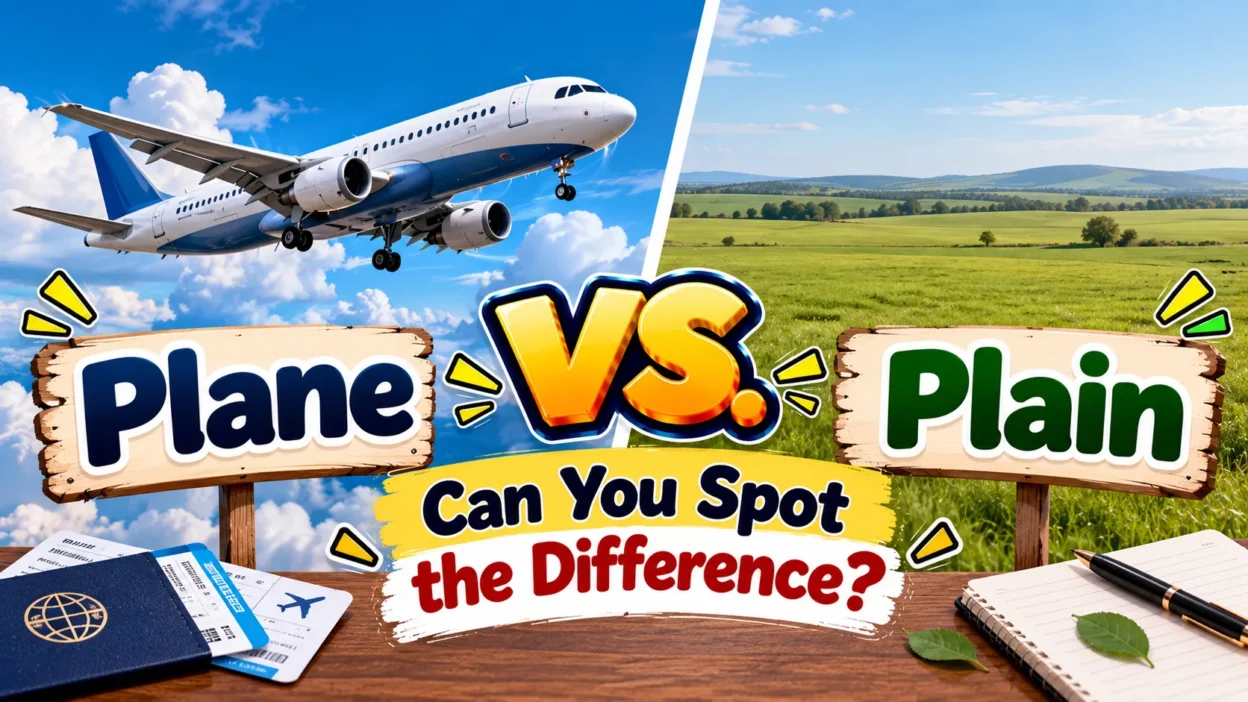
Plane vs. plain is a common English word comparison because both words sound exactly the same but have completely different meanings. These words are homophones, which means they share the same pronunciation but differ in spelling and meaning.
The word plane usually refers to an aircraft, a flat surface, or a geometric concept. In contrast, plain can describe something simple, ordinary, clear, or a large area of flat land. Although the words sound alike, using the wrong one can change the meaning of a sentence.
For example, “The plane landed safely” refers to an aircraft, while “She wore a plain white shirt” describes clothing without decoration.
In this guide, you will learn the definitions of plane and plain, discover their differences, explore example sentences, and find easy ways to remember when to use each word.
✈️ What Does Plane Mean?
Plane is a noun that most commonly refers to an aircraft designed to fly through the air. However, it has several other meanings in mathematics, geometry, construction, and everyday language.
Common meanings of plane
- Aircraft: A vehicle that travels through the air using wings and engines.
- Flat surface: A level, two-dimensional surface in geometry.
- Level or dimension: A particular level of existence, thought, or development.
- Woodworking tool: A tool used to smooth or flatten wooden surfaces.
- Flatness: The quality of being level or even in a particular context.
Examples of plane in sentences
- The plane arrived at the airport early.
- We watched the plane fly above the clouds.
- The engineer drew a geometric plane on the board.
- The carpenter used a plane to smooth the wooden door.
- The discussion moved to a different plane of thought.
- The pilot checked the aircraft before the plane took off.
- In geometry, a plane extends infinitely in two dimensions.
In everyday conversation, plane most often refers to an aircraft. In technical writing, however, it may describe a flat geometric surface or a tool used in woodworking.
🌾 What Does Plain Mean?
Plain can function as an adjective or a noun. As an adjective, it describes something simple, ordinary, clear, or without decoration. As a noun, it refers to a large area of flat or gently rolling land.
Common meanings of plain
- Simple: Something without unnecessary decoration.
- Ordinary: Something that is not unusual or elaborate.
- Clear: Something easy to understand or recognize.
- Obvious: Something easy to see or understand.
- Flat land: A broad area of relatively level ground.
- Unadorned: Something without extra features or embellishments.
Examples of plain in sentences
- She wore a plain black dress to the event.
- Please explain the instructions in plain English.
- The answer was plain to everyone in the room.
- They traveled across a wide grassy plain.
- I ordered a plain sandwich without extra toppings.
- His message made the problem plain.
- The village sits on a large open plain.
The meaning of plain depends on how it is used. In “plain clothing,” it means simple or undecorated. In “the coastal plain,” it describes a geographical landform.
📊 Plane vs. Plain: Key Differences
The main difference between plane and plain is their meaning and grammatical use. Their pronunciation is the same, but their spellings are different.
| Feature | Plane | Plain |
|---|---|---|
| Pronunciation | /pleɪn/ | /pleɪn/ |
| Part of speech | Mainly a noun; also a verb | Adjective and noun |
| Common meaning | Aircraft | Simple or ordinary |
| Other meaning | Flat geometric surface | Flat area of land |
| Example | The plane took off. | She wore a plain shirt. |
| Common phrase | Airplane or jet plane | Plain language |
| Memory clue | Plane can fly | Plain can mean simple |
Remember that plane is commonly associated with flying, geometry, and flat surfaces. Plain is associated with simplicity, clarity, and open land.
✍️ Plane vs. Plain in Example Sentences
Comparing the words in similar contexts makes their meanings easier to understand.
| Plane | Plain |
|---|---|
| The plane flew over the city. | The plain stretched across the countryside. |
| The plane landed safely. | The instructions were plain and easy to follow. |
| The pilot prepared the plane for departure. | He chose a plain white T-shirt. |
| The engineer studied the geometric plane. | The meaning of the statement was plain. |
| We boarded the plane at noon. | She prefers plain yogurt without added sugar. |
| The carpenter used a plane on the wooden surface. | The farmhouse stood on a broad plain. |
| The plane traveled through heavy clouds. | They crossed a grassy plain on horseback. |
| The diagram showed a horizontal plane. | He gave a plain explanation of the rules. |
Each word fits a different meaning. You cannot replace plane with plain when referring to an aircraft, and you should not use plane to describe something simple or undecorated.
🧠 Easy Tricks to Remember Plane vs. Plain
If you often confuse these homophones, a simple memory trick can help you choose the correct spelling.
1. Remember that a plane can fly
The word plane contains the same letters as the beginning of planet, but a useful association is to picture an airplane taking off.
Example: “The plane is flying to New York.”
Whenever you refer to an aircraft, choose plane.
2. Remember that plain means simple
Think of a plain white shirt. It has no patterns, decorations, or extra details.
Example: “He chose a plain shirt for the interview.”
When you mean simple, ordinary, clear, or undecorated, choose plain.
3. Connect plain with a plain of land
A plain can also be a large, relatively flat area of land.
Example: “Buffalo once roamed across the open plain.”
This connection helps you remember the geographical meaning.
4. Check the sentence before choosing
Ask yourself what you are trying to describe:
- Is it an aircraft? Use plane.
- Is it a flat geometric surface? Use plane.
- Does it mean simple or undecorated? Use plain.
- Is it a broad area of flat land? Use plain.
- Does it mean clear or obvious? Use plain.
This quick check will help you avoid most spelling mistakes.
📚 Common Expressions With Plane
The word plane appears in several everyday and technical expressions. Learning these phrases can help you recognize its correct use.
- Airplane: An aircraft powered by engines or other propulsion systems.
- Jet plane: An aircraft powered by jet engines.
- Plane ticket: A ticket for air travel.
- Board a plane: To enter an aircraft before departure.
- Geometric plane: A flat, two-dimensional surface in geometry.
- Plane of existence: A level or dimension of existence.
- Cutting plane: A plane or surface used to represent a cut through an object in technical drawings.
- Plane surface: A flat surface.
Example sentences
- I booked a plane ticket for my summer vacation.
- The passengers began to board the plane.
- The architect used a cutting plane in the technical drawing.
- The two lines lie on the same geometric plane.
These expressions show that plane is not limited to aircraft. Its exact meaning depends on the subject and context.
🌿 Common Expressions With Plain
The word plain appears in everyday expressions that describe simplicity, clarity, or geographical features.
- Plain English: Language that is clear and easy to understand.
- Plain clothes: Ordinary clothing rather than a uniform.
- Plain sight: Something that is easy to see.
- Plain truth: A truth expressed clearly or directly.
- Plain language: Simple, understandable wording.
- Plain food: Food prepared without elaborate additions or seasoning.
- Open plain: A broad, relatively level area of land.
- Coastal plain: Flat or gently sloping land near a coast.
- Plain text: Text without special formatting.
- Plain and simple: A phrase emphasizing a straightforward fact.
Example sentences
- Please write the instructions in plain English.
- The detective was dressed in plain clothes.
- The missing keys were hidden in plain sight.
- The plain truth was that the plan had failed.
- The settlers built their homes on an open plain.
- The document was saved as plain text.
These expressions illustrate why plain is useful in both everyday communication and formal writing.
⚠️ Common Mistakes When Using Plane and Plain
Although these words sound identical, they cannot be substituted for each other in every sentence.
Mistake 1: Writing “plain” when referring to an aircraft.
Incorrect: The plain landed safely at the airport.
Correct: The plane landed safely at the airport.
An aircraft is a plane, not a plain.
Mistake 2: Using “plane” to describe simple clothing.
Incorrect: She wore a plane black dress.
Correct: She wore a plain black dress.
The adjective plain describes clothing without decoration.
Mistake 3: Confusing a geometric plane with a plain of land.
A geometric plane is a mathematical concept representing a flat, two-dimensional surface. A plain is a geographical area of relatively level land.
Mistake 4: Forgetting the adjective form of plain.
Incorrect: The teacher gave a plane explanation.
Correct: The teacher gave a plain explanation.
Here, plain means clear and easy to understand.
Mistake 5: Assuming both words have only one meaning.
Plane can refer to an aircraft, a flat surface, or a woodworking tool. Plain can mean simple, obvious, or a flat area of land. Always use the surrounding sentence to determine the intended meaning.
⚖️ Plane vs. Plain vs. Plan: What’s the Difference?
Another word that learners sometimes confuse with plane and plain is plan. Unlike the other two, plan has a different pronunciation because it does not contain the long “a” sound.
| Word | Meaning | Example |
|---|---|---|
| Plane | An aircraft or flat geometric surface | The plane departed on time. |
| Plain | Simple, clear, or a flat area of land | She prefers plain clothing. |
| Plan | An arrangement for achieving a goal | We made a plan for the weekend. |
Example sentences
- The plane arrived before sunset.
- The plain extended toward the mountains.
- Our plan is to finish the work tomorrow.
The easiest way to remember the distinction is to connect plane with an aircraft, plain with simplicity, and plan with an arrangement for the future.
❓ Frequently Asked Questions About Plane vs. Plain
Are plane and plain homophones?
Yes. Plane and plain are homophones because they have the same pronunciation but different spellings and meanings.
Is it a plane or a plain?
Use plane when referring to an aircraft or a geometric surface. Use plain when describing something simple or a broad area of flat land.
What does plain mean in simple words?
Plain means simple, ordinary, clear, or without decoration. As a noun, it can also describe a large area of relatively flat land.
What does plane mean in simple words?
Plane most commonly means an aircraft. It can also refer to a flat surface in geometry or a tool used to smooth wood.
Is plain an adjective or a noun?
Plain can be both. It is an adjective in “plain clothes” and a noun in “a grassy plain.”
Can plane be used as a verb?
Yes. As a verb, plane can mean to smooth or level a surface using a plane tool. It can also refer to moving or gliding smoothly in certain contexts.
What is an example of plain and plane in one sentence?
“The plane flew over the wide plain.” In this sentence, plane refers to an aircraft, while plain refers to a large area of flat land.
What is the opposite of plain?
The opposite depends on the meaning. When plain means simple or undecorated, possible opposites include ornate, elaborate, or decorated. When it means clear, possible opposites include unclear or ambiguous.
🏁 Conclusion
The difference between plane vs. plain comes down to spelling and meaning. Plane commonly refers to an aircraft or a flat geometric surface, while plain describes something simple, clear, or undecorated. It can also refer to a broad area of flat land.
Remember the easy rule: a plane can fly, while a plain can be simple or stretch across the countryside. Although both words sound the same, using the correct spelling makes your sentences clearer and more accurate.

Vivian Mercer is an English language writer and vocabulary enthusiast who specializes in synonyms, word meanings, grammar, idioms, and language usage. She creates accurate, easy-to-understand content that helps readers improve their English skills with confidence.