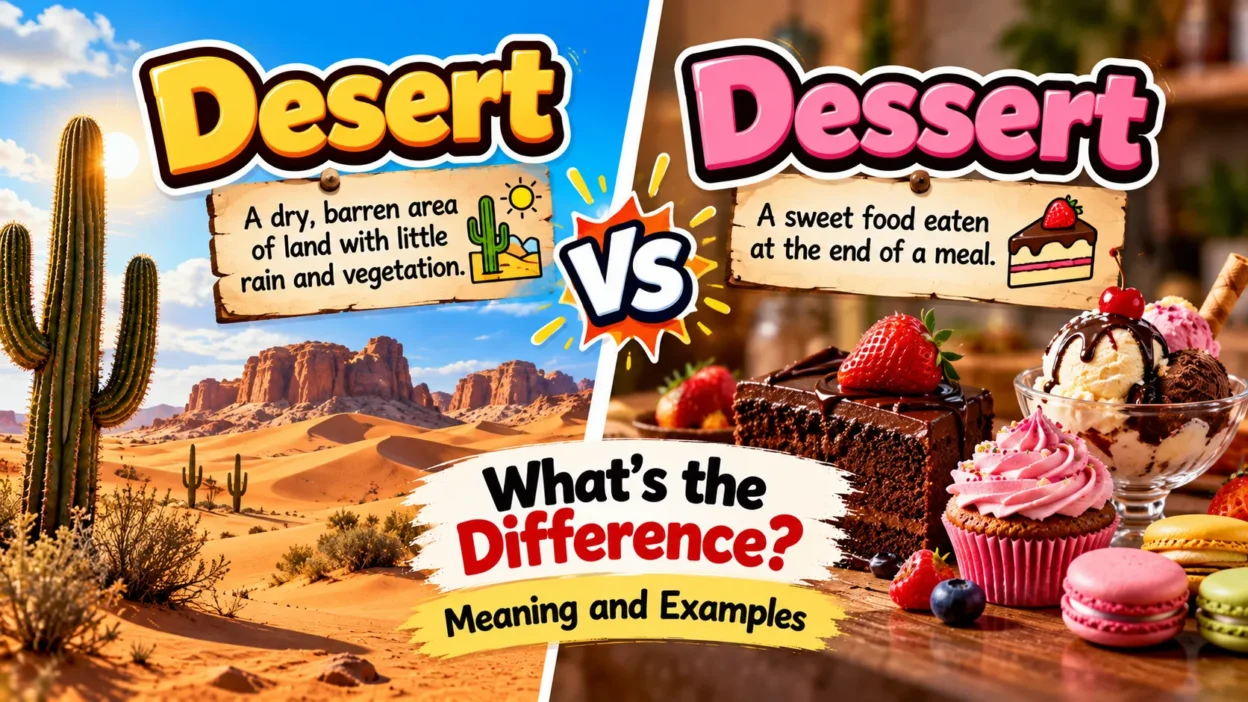
Have you ever wondered whether to write desert or dessert? These two words look almost identical, but they have different meanings and pronunciations. One describes a dry, often sandy landscape, while the other refers to a sweet treat enjoyed after a meal.
The word desert usually refers to a dry region that receives very little precipitation. It can also be used as a verb meaning to abandon someone or something. In contrast, dessert is the sweet course typically served at the end of a meal, such as cake, ice cream, pudding, or pie.
Although the difference is easy to understand, the similar spelling can cause confusion when writing. This guide explains the meanings of desert and dessert, shows how to use each word correctly, and provides examples, memory tricks, common mistakes, and practice questions to help you remember the difference.
🏜️ What Does Desert Mean?
Desert has two main meanings. As a noun, it refers to a region that receives very little precipitation. As a verb, it means to abandon someone or something, often when support or responsibility is needed.
Desert as a Noun
A desert is a geographical area characterized by very low precipitation. Deserts can be hot or cold, and they do not all consist of sand. Some have rocky terrain, gravel plains, or icy landscapes.
Examples of deserts include the Sahara Desert, the Mojave Desert, and Antarctica, which is classified as a polar desert.
Examples of desert in sentences:
- The Sahara Desert covers a large area of North Africa.
- Many desert plants have adapted to survive with little water.
- The travelers crossed the desert in search of an oasis.
- Some animals remain active at night to avoid the desert heat.
- The desert landscape looked beautiful at sunset.
- Antarctica is considered a cold desert because it receives very little precipitation.
In these examples, desert describes a landscape or environment.
Desert as a Verb
As a verb, desert means to abandon or leave someone or something, particularly when support or responsibility is expected.
Examples:
- He refused to desert his friends during a difficult time.
- The soldiers were ordered not to desert their posts.
- She felt that her team had deserted her when she needed help.
- The family did not desert their community after the disaster.
- Several residents began to desert the town as jobs disappeared.
When used as a verb, desert has a different pronunciation from the noun. The noun is usually pronounced DEZ-ert, while the verb is pronounced dih-ZERT.
🍰 What Does Dessert Mean?
Dessert is a noun that refers to a sweet dish typically served at the end of a meal. It can include cakes, cookies, pastries, ice cream, fruit-based sweets, puddings, and many other treats.
Desserts are popular at restaurants, family gatherings, birthday parties, holidays, and celebrations.
Examples of dessert in sentences:
- We ordered chocolate cake for dessert.
- My favorite dessert is strawberry cheesecake.
- The restaurant serves several homemade desserts.
- She prepared apple pie for dessert after dinner.
- The children were excited to choose their desserts.
- We shared a bowl of ice cream for dessert.
In each example, dessert refers to something sweet that people eat.
Popular Types of Dessert
Here are some common examples of desserts:
- Cake: A baked sweet treat often served at celebrations.
- Ice cream: A frozen dessert available in many flavors.
- Cheesecake: A dessert made with a creamy cheese-based filling.
- Brownies: Rich, chocolate-based baked treats.
- Apple pie: A pastry filled with seasoned apples.
- Pudding: A soft, sweet dish that can be served chilled or warm.
- Cookies: Small baked treats that come in countless varieties.
- Fruit salad: A mixture of fresh or prepared fruits, sometimes served as dessert.
- Donuts: Sweet, often fried or baked pastries.
- Crème brûlée: A custard dessert topped with a layer of caramelized sugar.
Unlike desert, the word dessert always refers to the sweet dish or course in ordinary modern usage.
⚖️ Desert vs. Dessert: Key Differences
The main difference between desert and dessert is their meaning, pronunciation, and spelling.
| Feature | Desert | Dessert |
|---|---|---|
| Main meaning | A dry geographical region | A sweet dish served after a meal |
| Part of speech | Noun and verb | Noun |
| Number of “s” letters | One | Two |
| Noun pronunciation | DEZ-ert | dih-ZERT |
| Example | The desert is dry. | The dessert is delicious. |
| Common expressions | Desert island, desert climate | Chocolate dessert, dessert menu |
The easiest rule to remember: Dessert has two S’s because you may want a second serving. Desert, the dry landscape, has only one S.
🔤 How to Pronounce Desert and Dessert
One reason these words are confusing is that their spelling differs by only one letter, while their pronunciation also depends on how they are used.
How to Pronounce Desert
When desert refers to a dry region, it is pronounced DEZ-ert, with the stress on the first syllable.
Example: “The DEZ-ert was extremely hot.”
When desert is used as a verb meaning to abandon, it is pronounced dih-ZERT, with the stress on the second syllable.
Example: “Never dih-ZERT your responsibilities.”
How to Pronounce Dessert
Dessert is pronounced dih-ZERT, with the stress on the second syllable.
Example: “We had cake for dih-ZERT.”
Notice that the verb desert and the noun dessert are pronounced the same way in standard English. Context tells you which word is intended.
💡 Easy Tricks to Remember Desert vs. Dessert
You do not need to memorize complicated grammar rules to distinguish these words. A few simple associations can make the correct spelling easier to recall.
Trick 1: Dessert Has Two S’s for Seconds
The word dessert contains two S’s. Think of wanting a second serving of your favorite sweet treat.
- Dessert has two S’s.
- You might want seconds of dessert.
- Therefore, the sweet treat gets the extra S.
This is one of the most popular memory tricks for remembering the spelling.
Trick 2: Desert Has One S for Sand
The noun desert has one S. You can associate that single S with sand, dryness, and a landscape that receives little rainfall.
For example:
- The desert has very little rainfall.
- Desert plants need to adapt to dry conditions.
- The word desert has only one S.
Not every desert is sandy, but the association can still help you remember the spelling.
Trick 3: Focus on the Meaning First
Before writing either word, consider what you want to say.
- If you are talking about a dry landscape, use desert.
- If you are talking about cake, ice cream, or another sweet dish, use dessert.
- If you mean abandoning someone or something, use desert as a verb.
Understanding the meaning is more reliable than choosing a spelling based only on how the word sounds.
📝 When Should You Use Desert?
Use desert when referring to a dry geographical region or the act of abandoning someone or something.
1. When Describing a Landscape
Examples:
- The desert stretched across the horizon.
- We saw several camels during our desert trip.
- The desert receives very little rainfall.
- Some desert regions experience extremely cold nights.
2. When Talking About Desert Wildlife
Deserts support plants and animals that have adapted to limited water and challenging temperatures.
Examples:
- The desert fox is adapted to life in dry environments.
- Many desert reptiles avoid the hottest hours of the day.
- Cacti and other plants can survive in certain desert conditions.
3. When Describing Abandonment
Examples:
- A loyal friend will not desert you when times get difficult.
- The soldier was punished for attempting to desert his post.
- The workers did not desert the project halfway through.
- She promised she would never desert her family.
4. In Common Expressions
The word desert appears in several expressions:
- Desert island: An island with no permanent inhabitants, especially in the familiar phrase “a deserted island.”
- Desert climate: A climate characterized by very low precipitation.
- Desert landscape: Scenery found in a desert region.
- Desert wildlife: Animals that live in desert environments.
- Desert a post: To abandon an assigned position or duty.
🍮 When Should You Use Dessert?
Use dessert when referring to a sweet dish or course, usually served after the main meal.
1. When Talking About a Meal
Examples:
- We had chocolate mousse for dessert.
- The waiter brought the dessert menu.
- Would you like dessert after dinner?
- They skipped dessert because they were full.
2. When Discussing Celebrations
Desserts are common at birthdays, weddings, anniversaries, and holiday gatherings.
Examples:
- We ordered a large cake for dessert.
- The family prepared several desserts for Thanksgiving.
- She served cupcakes as dessert at the party.
- The wedding reception included a dessert table.
3. When Describing Food Preferences
Examples:
- My favorite dessert is chocolate ice cream.
- He prefers fruit-based desserts to rich cakes.
- This bakery specializes in homemade desserts.
- She enjoys trying a different dessert whenever she visits a restaurant.
4. In Common Expressions
- Dessert menu: A list of sweet dishes available at a restaurant.
- Dessert table: A display of sweet treats at an event.
- Dessert course: The part of a meal devoted to sweets.
- Dessert recipe: Instructions for preparing a sweet dish.
- Dessert spoon: A spoon designed for eating dessert.
🔎 Desert or Dessert? Common Examples Compared
Comparing both words in similar contexts can help you understand how their meanings differ.
| Sentence | Correct word | Why? |
|---|---|---|
| The travelers crossed the ___ on foot. | Desert | It refers to a dry region. |
| We ordered ice cream for ___. | Dessert | It refers to a sweet dish. |
| Never ___ your friends in difficult times. | Desert | It means to abandon. |
| The restaurant offers a delicious chocolate ___. | Dessert | It refers to a sweet treat. |
| The Sahara is a famous ___. | Desert | It is a geographical region. |
| She baked a cake for ___. | Dessert | It is served as a sweet course. |
| The soldier was accused of trying to ___ his post. | Desert | It means to abandon a duty. |
| The children shared their favorite ___. | Dessert | It refers to sweet food. |
These examples demonstrate why the meaning of a sentence matters more than the similarity in spelling.
🚫 Common Mistakes to Avoid
Even experienced writers sometimes confuse desert and dessert. Here are some mistakes to watch for.
Mistake 1: Using Desert for Sweet Food
Incorrect: We had chocolate cake for desert.
Correct: We had chocolate cake for dessert.
Why? Chocolate cake is a sweet dish, so the spelling with two S’s is correct.
Mistake 2: Using Dessert for a Dry Landscape
Incorrect: The Sahara Dessert is very large.
Correct: The Sahara Desert is very large.
Why? The Sahara is a geographical region, not a sweet dish.
Mistake 3: Forgetting the Verb Meaning of Desert
Incorrect: He would never dessert his friends.
Correct: He would never desert his friends.
Why? The sentence means that he would never abandon them. The word dessert refers to sweet food.
Mistake 4: Confusing Pronunciation With Spelling
Incorrect reasoning: Both words sound similar, so either spelling works.
Correct approach: Identify the intended meaning first.
Why? The words have distinct meanings, and using the wrong spelling can make a sentence confusing or incorrect.
🧠 Quick Practice: Choose Desert or Dessert
Test your knowledge by choosing the correct word for each sentence.
- We enjoyed chocolate cake for ___.
- The travelers crossed the vast ___.
- He promised never to ___ his friends.
- The restaurant offers a wide selection of ___.
- Many animals have adapted to survive in the ___.
- Would you like ice cream for ___?
- The soldier refused to ___ his post.
- The Sahara ___ is located in North Africa.
- She prepared a delicious ___ for the guests.
- Some plants can survive with very little water in the ___.
Answers
- Dessert
- Desert
- Desert
- Desserts
- Desert
- Dessert
- Desert
- Desert
- Dessert
- Desert
If you remembered that dessert has two S’s for a second serving, you probably found the food-related answers easier.
❓ Frequently Asked Questions About Desert or Dessert
What is the difference between desert and dessert?
A desert is a dry geographical region or, as a verb, the act of abandoning someone or something. A dessert is a sweet dish usually served after a meal.
Why does dessert have two S’s?
Dessert has two S’s, and a popular memory trick is that you might want a second serving of dessert. This association can help you remember the spelling.
Is it desert or dessert after dinner?
The correct word is dessert because it refers to the sweet course served after a meal. For example, “We had cheesecake for dessert.”
Is the Sahara a desert or dessert?
The Sahara is a desert. It is a large dry region in North Africa that receives very little precipitation compared with many other environments.
Are desert and dessert pronounced the same?
Not always. The noun desert, meaning a dry region, is pronounced DEZ-ert. Dessert is pronounced dih-ZERT. The verb desert, meaning to abandon, is also pronounced dih-ZERT.
Can desert be used as a verb?
Yes. As a verb, desert means to abandon someone, something, or a responsibility. For example, “He would never desert his team.”
What is the plural of dessert?
The plural of dessert is desserts. For example, “The restaurant offers several desserts.”
What does just deserts mean?
The expression just deserts means the punishment or reward that someone deserves. Interestingly, deserts in this expression is spelled with one S after the initial D, even though it is related to the idea of what someone deserves. It is not a reference to dry landscapes or sweet food.
✅ Final Verdict: Desert or Dessert?
The difference between desert and dessert becomes easy when you connect each word with its meaning.
Use desert when talking about a dry region or the act of abandoning someone or something. Use dessert when talking about a sweet treat served after a meal.
Remember this simple trick: Dessert has two S’s because you may want seconds. A desert has one S and may have very little water.
Once you remember this distinction, you can confidently choose the correct word in everyday conversations, school assignments, professional writing, and online content.

Vivian Mercer is an English language writer and vocabulary enthusiast who specializes in synonyms, word meanings, grammar, idioms, and language usage. She creates accurate, easy-to-understand content that helps readers improve their English skills with confidence.